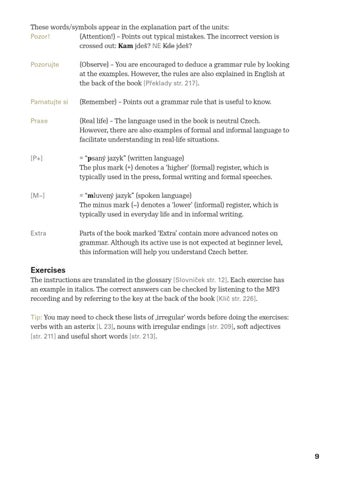
These words/symbols appear in the explanation part of the units: Pozor! (Attention!) – Points out typical mistakes. The incorrect version is crossed out: Kam jdeš? NE Kde jdeš? Pozorujte
(Observe) – You are encouraged to deduce a grammar rule by looking at the examples. However, the rules are also explained in English at the back of the book [Překlady str. 217].
Pamatujte si
(Remember) – Points out a grammar rule that is useful to know.
Praxe
(Real life) – The language used in the book is neutral Czech. However, there are also examples of formal and informal language to facilitate understanding in real-life situations.
[P+]
= “psaný jazyk” (written language) The plus mark (+) denotes a ‘higher’ (formal) register, which is typically used in the press, formal writing and formal speeches.
[M−]
= “mluvený jazyk” (spoken language) The minus mark (−) denotes a ‘lower’ (informal) register, which is typically used in everyday life and in informal writing.
Extra
Parts of the book marked ‘Extra’ contain more advanced notes on grammar. Although its active use is not expected at beginner level, this information will help you understand Czech better.
Exercises The instructions are translated in the glossary [Slovníček str. 12]. Each exercise has an example in italics. The correct answers can be checked by listening to the MP3 recording and by referring to the key at the back of the book [Klíč str. 226]. Tip: You may need to check these lists of ‚irregular‘ words before doing the exercises: verbs with an asterix [L 23], nouns with irregular endings [str. 209], soft adjectives [str. 211] and useful short words [str. 213].
9
Akropolis-Cestina-extra-167x235-sazba.indd 9
12.6.2012 18:27:43