PWC PT6E adds digital controls by David Donald Pratt & Whitney Canada (P&WC, Booth K67) has unveiled the latest member of its perennial PT6 turboshaft family. Known as the PT6E-66XT, the engine’s first application is the Daher TBM 960 single-engine turboprop. Indeed, the 66XT was developed specifically with the TBM 960 in mind on the back of more than 30 years of PT6 integration. Both engine and aircraft debuted during the Sun n’ Fun Expo held at Lakeland, Florida, in April. The PT6E-66XT is a very different powerplant from the original PT6A that first ran in 1960. The family—which now numbers more than 50,000 engines with over 400 million flying hours—has expanded to cover a wide power range and has benefitted from repeated improvements. The latest major innovation is the integration of advanced digital control, resulting in the PT6E series. This is the first engine family in the general aviation sector to offer a dual-channel integrated electronic propeller and engine control system (EPECS). Drawing on more than 100 digital data inputs, the EPECS delivers optimized performance, fuel efficiency, and precision, while greatly simplifying pilot control. The system monitors and refines engine performance throughout the whole flight, as well as aircraft data, making continuous alterations to fuel flow and propeller pitch to extract maximum efficiency and optimal power. All of the gathered data is available for postflight downloading by wireless connection to a variety of devices for analysis. Improved design has allowed PWC to extend the engine’s scheduled maintenance intervals from 3,500 to 5,000 hours compared with earlier, similarly-rated models. The adoption of the EPECS also permits a number of redundant components to be removed, combining with the time-between-overhaul
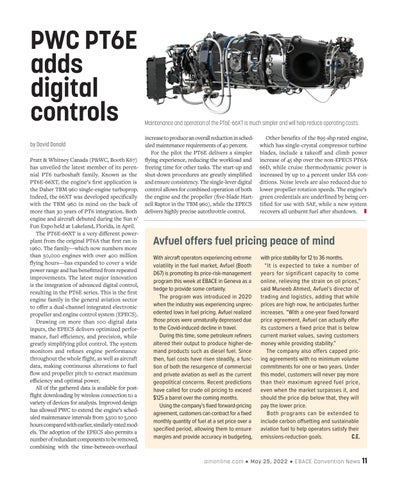
Maintenance and operation of the PT6E-66XT is much simpler and will help reduce operating costs. increase to produce an overall reduction in scheduled maintenance requirements of 40 percent. For the pilot the PT6E delivers a simpler flying experience, reducing the workload and freeing time for other tasks. The start-up and shut-down procedures are greatly simplified and ensure consistency. The single-lever digital control allows for combined operation of both the engine and the propeller (five-blade Hartzell Raptor in the TBM 960), while the EPECS delivers highly precise autothrottle control.
Other benefits of the 895-shp rated engine, which has single-crystal compressor turbine blades, include a takeoff and climb power increase of 45 shp over the non-EPECS PT6A66D, while cruise thermodynamic power is increased by up to 4 percent under ISA conditions. Noise levels are also reduced due to lower propeller rotation speeds. The engine’s green credentials are underlined by being certified for use with SAF, while a new system recovers all unburnt fuel after shutdown.
Avfuel offers fuel pricing peace of mind With aircraft operators experiencing extreme volatility in the fuel market, Avfuel (Booth D67) is promoting its price-risk-management program this week at EBACE in Geneva as a hedge to provide some certainty. The program was introduced in 2020 when the industry was experiencing unprecedented lows in fuel pricing. Avfuel realized those prices were unnaturally depressed due to the Covid-induced decline in travel. During this time, some petroleum refiners altered their output to produce higher-demand products such as diesel fuel. Since then, fuel costs have risen steadily, a function of both the resurgence of commercial and private aviation as well as the current geopolitical concerns. Recent predictions have called for crude oil pricing to exceed $125 a barrel over the coming months. Using the company’s fixed forward-pricing agreement, customers can contract for a fixed monthly quantity of fuel at a set price over a specified period, allowing them to ensure margins and provide accuracy in budgeting,
with price stability for 12 to 36 months. “It is expected to take a number of years for significant capacity to come online, relieving the strain on oil prices,” said Muneeb Ahmed, Avfuel’s director of trading and logistics, adding that while prices are high now, he anticipates further increases. “With a one-year fixed forward price agreement, Avfuel can actually offer its customers a fixed price that is below current market values, saving customers money while providing stability.” The company also offers capped pricing agreements with no minimum volume commitments for one or two years. Under this model, customers will never pay more than their maximum agreed fuel price, even when the market surpasses it, and should the price dip below that, they will pay the lower price. Both programs can be extended to include carbon offsetting and sustainable aviation fuel to help operators satisfy their emissions-reduction goals. C.E.
a i n o n l i n e . c o m • May 25, 202 2 • E BACE Convention News
11