CAN ARTIFICIAL INTELLIGENCE help us tackle the pressing issues in Africa?
“The rise of powerful AI will be either the best or the worst thing ever to happen to humanity. We do not yet know which.” Scientist Stephen Hawking spoke these noteworthy words in 2016. We haven’t made much progress in resolving the issue he raised. We still don’t know if AI will deliver the greatest or the most horrible outcomes of humanity. by Silent Dzikiti Junior Data Scientist, Global Stalls
3RD QUARTER 2019
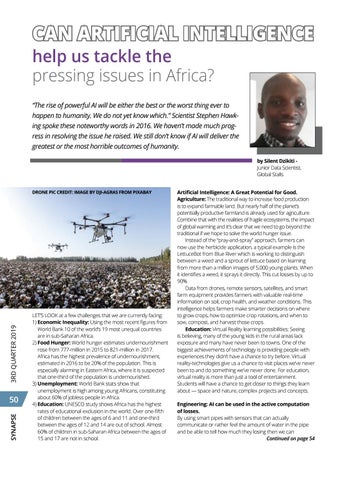
DRONE PIC CREDIT: IMAGE BY DJI-AGRAS FROM PIXABAY
SYNAPSE
50
LET’S LOOK at a few challenges that we are currently facing: 1) Economic Inequality: Using the most recent figures from World Bank 10 of the world’s 19 most unequal countries are in sub-Saharan Africa. 2) Food Hunger: World hunger estimates undernourishment rose from 777-million in 2015 to 821-million in 2017. Africa has the highest prevalence of undernourishment, estimated in 2016 to be 20% of the population. This is especially alarming in Eastern Africa, where it is suspected that one-third of the population is undernourished. 3) Unemployment: World Bank stats show that unemployment is high among young Africans, constituting about 60% of jobless people in Africa. 4) Education: UNESCO study shows Africa has the highest rates of educational exclusion in the world. Over one-fifth of children between the ages of 6 and 11 and one-third between the ages of 12 and 14 are out of school. Almost 60% of children in sub-Saharan Africa between the ages of 15 and 17 are not in school.
Artificial Intelligence: A Great Potential for Good. Agriculture: The traditional way to increase food production is to expand farmable land. But nearly half of the planet’s potentially productive farmland is already used for agriculture. Combine that with the realities of fragile ecosystems, the impact of global warming and it’s clear that we need to go beyond the traditional if we hope to solve the world hunger issue. Instead of the “pray-and-spray” approach, farmers can now use the herbicide application, a typical example is the LettuceBot from Blue River which is working to distinguish between a weed and a sprout of lettuce based on learning from more than a million images of 5,000 young plants. When it identifies a weed, it sprays it directly. This cut losses by up to 90%. Data from drones, remote sensors, satellites, and smart farm equipment provides farmers with valuable real-time information on soil, crop health, and weather conditions. This intelligence helps farmers make smarter decisions on where to grow crops, how to optimize crop rotations, and when to sow, compost, and harvest those crops. Education: Virtual Reality learning possibilities: Seeing is believing, many of the young kids in the rural areas lack exposure and many have never been to towns. One of the biggest achievements of technology is providing people with experiences they didn’t have a chance to try before. Virtual reality-technologies give us a chance to visit places we’ve never been to and do something we’ve never done. For education, virtual reality is more than just a tool of entertainment. Students will have a chance to get closer to things they learn about — space and nature, complex projects and concepts. Engineering: AI can be used in the active computation of losses. By using smart pipes with sensors that can actually communicate or rather feel the amount of water in the pipe and be able to tell how much they losing then we can Continued on page 54