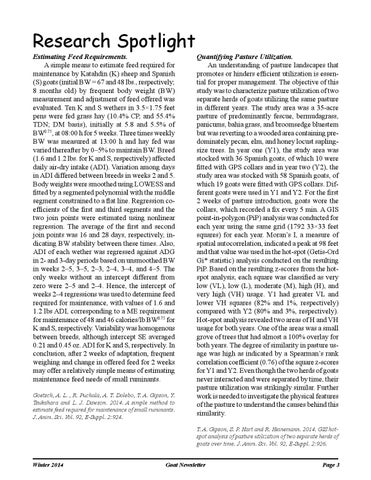
Research Spotlight Estimating Feed Requirements. A simple means to estimate feed required for maintenance by Katahdin (K) sheep and Spanish (S) goats (initial BW = 67 and 48 lbs., respectively; 8 months old) by frequent body weight (BW) measurement and adjustment of feed offered was evaluated. Ten K and S wethers in 3.5×1.75 feet pens were fed grass hay (10.4% CP, and 55.4% TDN; DM basis), initially at 5.8 and 5.5% of BW0.75, at 08:00 h for 5 weeks. Three times weekly BW was measured at 13:00 h and hay fed was varied thereafter by 0–5% to maintain BW. Breed (1.6 and 1.2 lbs. for K and S, respectively) affected daily air-dry intake (ADI). Variation among days in ADI differed between breeds in weeks 2 and 5. Body weights were smoothed using LOWESS and fitted by a segmented polynomial with the middle segment constrained to a flat line. Regression coefficients of the first and third segments and the two join points were estimated using nonlinear regression. The average of the first and second join points was 16 and 28 days, respectively, indicating BW stability between these times. Also, ADI of each wether was regressed against ADG in 2- and 3-day periods based on unsmoothed BW in weeks 2–5, 3–5, 2–3, 2–4, 3–4, and 4–5. The only weeks without an intercept different from zero were 2–5 and 2–4. Hence, the intercept of weeks 2–4 regressions was used to determine feed required for maintenance, with values of 1.6 and 1.2 lbs ADI, corresponding to a ME requirement for maintenance of 48 and 46 calories/lb BW0.75 for K and S, respectively. Variability was homogenous between breeds, although intercept SE averaged 0.21 and 0.45 oz. ADI for K and S, respectively. In conclusion, after 2 weeks of adaptation, frequent weighing and change in offered feed for 2 weeks may offer a relatively simple means of estimating maintenance feed needs of small ruminants. Goetsch, A. L. , R. Puchala, A. T. Dolebo, T. A. Gipson, Y. Tsukahara and L. J. Dawson. 2014. A simple method to estimate feed required for maintenance of small ruminants. J. Anim. Sci. Vol. 92, E-Suppl. 2:924.
Quantifying Pasture Utilization. An understanding of pasture landscapes that promotes or hinders efficient utilization is essential for proper management. The objective of this study was to characterize pasture utilization of two separate herds of goats utilizing the same pasture in different years. The study area was a 35-acre pasture of predominantly fescue, bermudagrass, panicums, bahia grass, and broomsedge bluestem but was reverting to a wooded area containing predominately pecan, elm, and honey locust saplingsize trees. In year one (Y1), the study area was stocked with 36 Spanish goats, of which 10 were fitted with GPS collars and in year two (Y2), the study area was stocked with 58 Spanish goats, of which 19 goats were fitted with GPS collars. Different goats were used in Y1 and Y2. For the first 2 weeks of pasture introduction, goats wore the collars, which recorded a fix every 5 min. A GIS point-in-polygon (PiP) analysis was conducted for each year using the same grid (1792 33×33 feet squares) for each year. Moran’s I, a measure of spatial autocorrelation, indicated a peak at 98 feet and that value was used in the hot-spot (Getis-Ord Gi* statistic) analysis conducted on the resulting PiP. Based on the resulting z-scores from the hotspot analysis, each square was classified as very low (VL), low (L), moderate (M), high (H), and very high (VH) usage. Y1 had greater VL and lower VH squares (82% and 1%, respectively) compared with Y2 (80% and 3%, respectively). Hot-spot analysis revealed two areas of H and VH usage for both years. One of the areas was a small grove of trees that had almost a 100% overlay for both years. The degree of similarity in pasture usage was high as indicated by a Spearman’s rank correlation coefficient (0.76) of the square z-scores for Y1 and Y2. Even though the two herds of goats never interacted and were separated by time, their pasture utilization was strikingly similar. Further work is needed to investigate the physical features of the pasture to understand the causes behind this similarity. T. A. Gipson, S. P. Hart and R. Heinemann. 2014. GIS hotspot analysis of pasture utilization of two separate herds of goats over time. J. Anim. Sci. Vol. 92, E-Suppl. 2:926.
Winter 2014
Goat Newsletter
Page 3