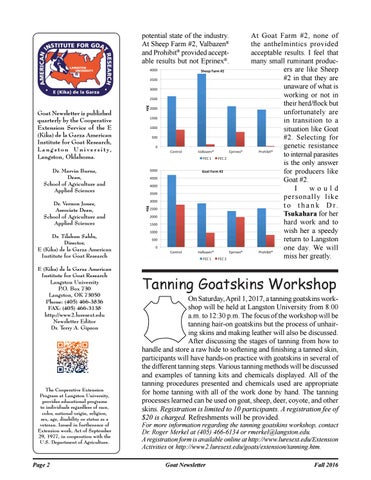
potential state of the industry. At Sheep Farm #2, Valbazen® and Prohibit® provided acceptable results but not Eprinex®.
Goat Newsletter is published quarterly by the Cooperative Extension Service of the E (Kika) de la Garza American Institute for Goat Research, L a n g s t o n U n i v e r s i t y, Langston, Oklahoma. Dr. Marvin Burns, Dean, School of Agriculture and Applied Sciences Dr. Vernon Jones, Associate Dean, School of Agriculture and Applied Sciences Dr. Tilahun Sahlu, Director, E (Kika) de la Garza American Institute for Goat Research E (Kika) de la Garza American Institute for Goat Research Langston University P.O. Box 730 Langston, OK 73050 Phone: (405) 466-3836 FAX: (405) 466-3138 http://www2.luresext.edu Newsletter Editor Dr. Terry A. Gipson
The Cooperative Extension Program at Langston University, provides educational programs to individuals regardless of race, color, national origin, religion, sex, age, disability or status as a veteran. Issued in furtherance of Extension work, Act of September 29, 1977, in cooperation with the U.S. Department of Agriculture.
Page 2
At Goat Farm #2, none of the anthelmintics provided acceptable results. I feel that many small ruminant producers are like Sheep #2 in that they are unaware of what is working or not in their herd/flock but unfortunately are in transition to a situation like Goat #2. Selecting for genetic resistance to internal parasites is the only answer for producers like Goat #2. I would personally like t o t h a n k D r. Tsukahara for her hard work and to wish her a speedy return to Langston one day. We will miss her greatly.
Tanning Goatskins Workshop On Saturday, April 1, 2017, a tanning goatskins workshop will be held at Langston University from 8:00 a.m. to 12:30 p.m. The focus of the workshop will be tanning hair-on goatskins but the process of unhairing skins and making leather will also be discussed. After discussing the stages of tanning from how to handle and store a raw hide to softening and finishing a tanned skin, participants will have hands-on practice with goatskins in several of the different tanning steps. Various tanning methods will be discussed and examples of tanning kits and chemicals displayed. All of the tanning procedures presented and chemicals used are appropriate for home tanning with all of the work done by hand. The tanning processes learned can be used on goat, sheep, deer, coyote, and other skins. Registration is limited to 10 participants. A registration fee of $20 is charged. Refreshments will be provided. For more information regarding the tanning goatskins workshop, contact Dr. Roger Merkel at (405) 466-6134 or rmerkel@langston.edu. A registration form is available online at http://www.luresext.edu/Extension Activities or http://www2.luresext.edu/goats/extension/tanning.htm. Goat Newsletter
Fall 2016