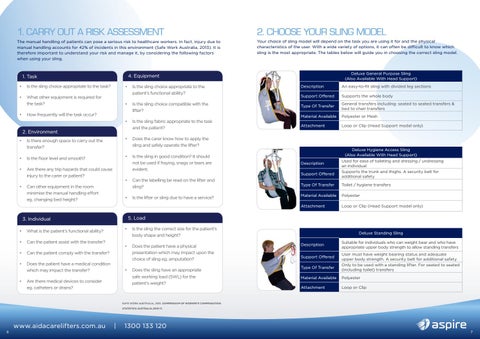
1. CARRY OUT A RISK ASSESSMENT
2. CHOOSE YOUR SLING MODEL
The manual handling of patients can pose a serious risk to healthcare workers. In fact, injury due to manual handling accounts for 42% of incidents in this environment (Safe Work Australia, 2013). It is therefore important to understand your risk and manage it, by considering the following factors when using your sling.
Your choice of sling model will depend on the task you are using it for and the physical characteristics of the user. With a wide variety of options, it can often be difficult to know which sling is the most appropriate. The tables below will guide you in choosing the correct sling model.
Deluxe General Purpose Sling (Also Available With Head Support)
4. Equipment
1. Task • Is the sling choice appropriate to the task?
• Is the sling choice appropriate to the patient’s functional ability?
• What other equipment is required for the task?
• Is the sling choice compatible with the lifter?
• How frequently will the task occur?
• Is the sling fabric appropriate to the task and the patient?
2. Environment
Description
An easy-to-fit sling with divided leg sections
Support Offered
Supports the whole body
Type Of Transfer
General transfers including: seated to seated transfers & bed to chair transfers
Material Available
Polyester or Mesh
Attachment
Loop or Clip (Head Support model only)
Deluxe Hygiene Access Sling (Also Available With Head Support) Used for ease of toileting and dressing / undressing an individual Supports the trunk and thighs. A security belt for additional safety
• Is there enough space to carry out the transfer?
• Does the carer know how to apply the sling and safely operate the lifter?
• Is the floor level and smooth?
• Is the sling in good condition? It should not be used if fraying, snags or tears are evident.
Description
• Can the labelling be read on the lifter and sling?
Type Of Transfer
Toilet / hygiene transfers
Material Available
Polyester
Attachment
Loop or Clip (Head Support model only)
• Are there any trip hazards that could cause injury to the carer or patient? • Can other equipment in the room minimise the manual handling effort eg. changing bed height?
• Is the lifter or sling due to have a service?
Support Offered
5. Load
3. Individual
• Is the sling the correct size for the patient’s body shape and height?
• What is the patient’s functional ability? • Can the patient assist with the transfer?
• Does the patient have a physical presentation which may impact upon the choice of sling eg. amputation?
• Can the patient comply with the transfer? • Does the patient have a medical condition which may impact the transfer?
• Does the sling have an appropriate safe working load (SWL) for the patient’s weight?
• Are there medical devices to consider eg. catheters or drains?
Deluxe Standing Sling Description Support Offered Type Of Transfer
Suitable for individuals who can weight bear and who have appropriate upper body strength to allow standing transfers User must have weight bearing status and adequate upper body strength. A security belt for additional safety Only to be used with a standing lifter. For seated to seated (including toilet) transfers
Material Available
Polyester
Attachment
Loop or Clip
SAFE WORK AUSTRALIA, 2013. COMPENDIUM OF WORKER’S COMPENSATION STATISTICS AUSTRALIA 2010-11.
www.aidacarelifters.com.au 6
|
1300 133 120 7