The Show Must Go On
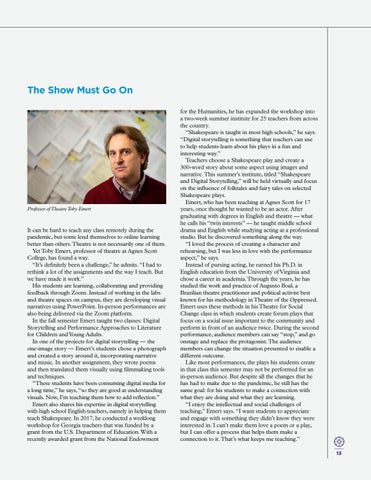
Professor of Theatre Toby Emert
It can be hard to teach any class remotely during the pandemic, but some lend themselves to online learning better than others. Theatre is not necessarily one of them. Yet Toby Emert, professor of theatre at Agnes Scott College, has found a way. “It’s definitely been a challenge,” he admits. “I had to rethink a lot of the assignments and the way I teach. But we have made it work.” His students are learning, collaborating and providing feedback through Zoom. Instead of working in the labs and theatre spaces on campus, they are developing visual narratives using PowerPoint. In-person performances are also being delivered via the Zoom platform. In the fall semester Emert taught two classes: Digital Storytelling and Performance Approaches to Literature for Children and Young Adults. In one of the projects for digital storytelling — the one-image story — Emert’s students chose a photograph and created a story around it, incorporating narrative and music. In another assignment, they wrote poems and then translated them visually using filmmaking tools and techniques. “These students have been consuming digital media for a long time,” he says, “so they are good at understanding visuals. Now, I’m teaching them how to add reflection.” Emert also shares his expertise in digital storytelling with high school English teachers, namely in helping them teach Shakespeare. In 2017, he conducted a weeklong workshop for Georgia teachers that was funded by a grant from the U.S. Department of Education. With a recently awarded grant from the National Endowment
for the Humanities, he has expanded the workshop into a two-week summer institute for 25 teachers from across the country. “Shakespeare is taught in most high schools,” he says. “Digital storytelling is something that teachers can use to help students learn about his plays in a fun and interesting way.” Teachers choose a Shakespeare play and create a 300-word story about some aspect using images and narrative. This summer’s institute, titled “Shakespeare and Digital Storytelling,” will be held virtually and focus on the influence of folktales and fairy tales on selected Shakespeare plays. Emert, who has been teaching at Agnes Scott for 17 years, once thought he wanted to be an actor. After graduating with degrees in English and theatre — what he calls his “twin interests” — he taught middle school drama and English while studying acting at a professional studio. But he discovered something along the way. “I loved the process of creating a character and rehearsing, but I was less in love with the performance aspect,” he says. Instead of pursing acting, he earned his Ph.D. in English education from the University of Virginia and chose a career in academia. Through the years, he has studied the work and practice of Augusto Boal, a Brazilian theatre practitioner and political activist best known for his methodology in Theatre of the Oppressed. Emert uses these methods in his Theatre for Social Change class in which students create forum plays that focus on a social issue important to the community and perform in front of an audience twice. During the second performance, audience members can say “stop,” and go onstage and replace the protagonist. The audience members can change the situation presented to enable a different outcome. Like most performances, the plays his students create in that class this semester may not be performed for an in-person audience. But despite all the changes that he has had to make due to the pandemic, he still has the same goal: for his students to make a connection with what they are doing and what they are learning. “I enjoy the intellectual and social challenges of teaching,” Emert says. “I want students to appreciate and engage with something they didn’t know they were interested in. I can’t make them love a poem or a play, but I can offer a process that helps them make a connection to it. That’s what keeps me teaching.” 13