JOHN NEYL AN
Assessing organic
amendments
ATM expert columnist John Neylan outlines some recent work to assess the characteristics and performance of
I
organic amendments used in sports turf profiles.
noted in my article in ATM Volume 25.2 (March-April 2023, ‘Testing times’, p44-48) that there was a lack of availability of coir fibre and peat moss that was creating issues where amendments were required to increase the water holding capacity of sands for sports turf construction projects. Many sands used to construct golf greens and sports fields have a low capillary porosity (moisture retention) and need the addition of an amendment to ensure the capillary porosity is within the optimum range (i.e. 15-25 per cent by volume at 30cm tension). The two main organic amendments typically used are coir fibre and peat moss which have an organic matter content of at least 85 per cent by weight (USGA 2018). With several construction projects over the past 18-24 months there has been a reported shortage of coir fibre and peat moss and what is available has become very expensive. Consequently, there has been a search for a viable alternative. 44
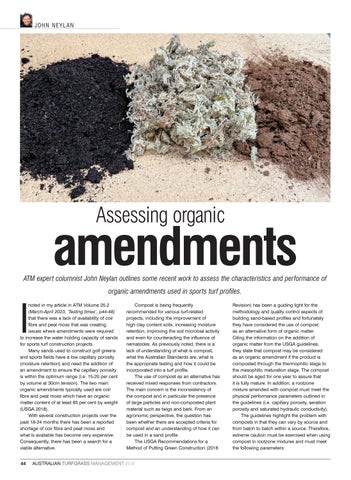
Compost is being frequently recommended for various turf-related projects, including the improvement of high clay content soils, increasing moisture retention, improving the soil microbial activity and even for counteracting the influence of nematodes. As previously noted, there is a lack of understanding of what is compost, what the Australian Standards are, what is the appropriate testing and how it could be incorporated into a turf profile. The use of compost as an alternative has received mixed responses from contractors. The main concern is the inconsistency of the compost and in particular the presence of large particles and non-composted plant material such as twigs and bark. From an agronomic perspective, the question has been whether there are accepted criteria for compost and an understanding of how it can be used in a sand profile. The USGA Recommendations for a Method of Putting Green Construction (2018
AUSTRALIAN TURFGRASS MANAGEMENT 25.6
Revision) has been a guiding light for the methodology and quality control aspects of building sand-based profiles and fortunately they have considered the use of compost as an alternative form of organic matter. Citing the information on the addition of organic matter from the USGA guidelines, they state that compost may be considered as an organic amendment if the product is composted through the thermophilic stage to the mesophilic maturation stage. The compost should be aged for one year to assure that it is fully mature. In addition, a rootzone mixture amended with compost must meet the physical performance parameters outlined in the guidelines (i.e. capillary porosity, aeration porosity and saturated hydraulic conductivity). The guidelines highlight the problem with composts in that they can vary by source and from batch to batch within a source. Therefore, extreme caution must be exercised when using compost in rootzone mixtures and must meet the following parameters: