JOHN NEYL AN
WINTER MANAGEMENT OF SPORTS FIELDS: PLANNING AHEAD
C
OVID-19 provided significant respite for many sportsfields during last winter and possibly we have forgotten the effects of what a wet and cold winter can have on poorly prepared sportsfields. While we are struggling to get through another summer, we need to be thinking about how we are going to prepare our sportsfields for the winter months. The effects of a hot and dry summer can weaken the turf sward, even where warm-season grasses are used, resulting in a turf that is less able to survive the ravages of a wet and cold winter. The winter months coincide with the major football codes of rugby, rugby league, soccer and Australian Rules and each of these sports impose a high level of wear and turf damage at a time when grass growth is slow. The popularity of the football codes are such that most municipal sportsfields are used most days of the week for a combination of training and matches. The work load on winter fields is usually far greater than for summer sports and consequently there is greater turf damage. Traffic and wet soils can cause a dramatic deterioration in the quality of the turf surface. As soils become wet there is a redistribution of the silt and clay particles which clog the larger pore spaces which in turn reduces the infiltration rate and aeration porosity. When the soils become saturated and muddy the turfgrasses become coated with soil and partially buried and irreparable damage to the turf can be caused in a very short time period. How can wear and the damage it causes be managed at a time when growth is slow and soils are wet? Based on recent sportsfield audits some of the key factors identified that minimised turf damage involved a combination of relatively simple factors including;
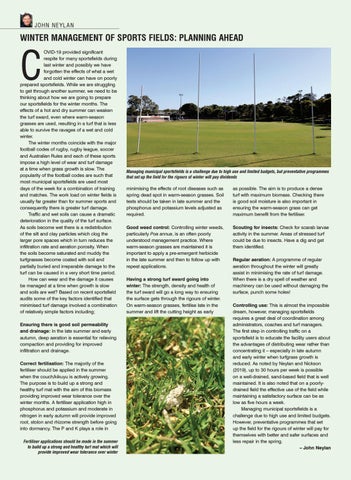
Managing municipal sportsfields is a challenge due to high use and limited budgets, but preventative programmes that set up the field for the rigours of winter will pay dividends
minimising the effects of root diseases such as spring dead spot in warm-season grasses. Soil tests should be taken in late summer and the phosphorus and potassium levels adjusted as required.
as possible. The aim is to produce a dense turf with maximum biomass. Checking there is good soil moisture is also important in ensuring the warm-season grass can get maximum benefit from the fertiliser.
Good weed control: Controlling winter weeds, particularly Poa annua, is an often poorly understood management practice. Where warm-season grasses are maintained it is important to apply a pre-emergent herbicide in the late summer and then to follow up with repeat applications.
Scouting for insects: Check for scarab larvae activity in the summer. Areas of stressed turf could be due to insects. Have a dig and get them identified.
Having a strong turf sward going into winter: The strength, density and health of the turf sward will go a long way to ensuring the surface gets through the rigours of winter. On warm-season grasses, fertilise late in the summer and lift the cutting height as early
Ensuring there is good soil permeability and drainage: In the late summer and early autumn, deep aeration is essential for relieving compaction and providing for improved infiltration and drainage. Correct fertilisation: The majority of the fertiliser should be applied in the summer when the couch/kikuyu is actively growing. The purpose is to build up a strong and healthy turf mat with the aim of this biomass providing improved wear tolerance over the winter months. A fertiliser application high in phosphorus and potassium and moderate in nitrogen in early autumn will provide improved root, stolon and rhizome strength before going into dormancy. The P and K plays a role in Fertiliser applications should be made in the summer to build up a strong and healthy turf mat which will provide improved wear tolerance over winter
44
AUSTRALIAN TURFGRASS MANAGEMENT 23.1
Regular aeration: A programme of regular aeration throughout the winter will greatly assist in minimising the rate of turf damage. When there is a dry spell of weather and machinery can be used without damaging the surface, punch some holes! Controlling use: This is almost the impossible dream, however, managing sportsfields requires a great deal of coordination among administrators, coaches and turf managers. The first step in controlling traffic on a sportsfield is to educate the facility users about the advantages of distributing wear rather than concentrating it – especially in late autumn and early winter when turfgrass growth is reduced. As noted by Neylan and Nickson (2019), up to 30 hours per week is possible on a well-drained, sand-based field that is well maintained. It is also noted that on a poorlydrained field the effective use of the field while maintaining a satisfactory surface can be as low as five hours a week. Managing municipal sportsfields is a challenge due to high use and limited budgets. However, preventative programmes that set up the field for the rigours of winter will pay for themselves with better and safer surfaces and less repair in the spring. – John Neylan