research research
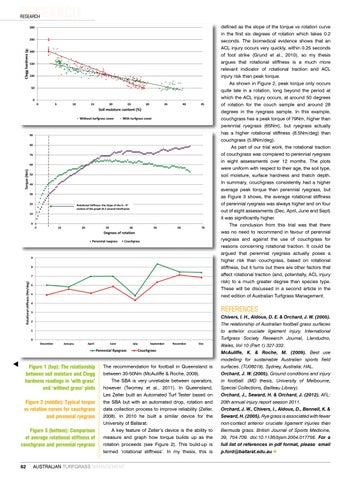
defined as the slope of the torque vs rotation curve in the first six degrees of rotation which takes 0.2 seconds. The biomedical evidence shows that an ACL injury occurs very quickly, within 0.25 seconds of foot strike (Grund et al., 2010), so my thesis argues that rotational stiffness is a much more relevant indicator of rotational traction and ACL injury risk than peak torque. As shown in Figure 2, peak torque only occurs quite late in a rotation, long beyond the period at which the ACL injury occurs, at around 50 degrees of rotation for the couch sample and around 28 degrees in the ryegrass sample. In this example, couchgrass has a peak torque of 79Nm, higher than perennial ryegrass (65Nm), but ryegrass actually has a higher rotational stiffness (8.5Nm/deg) than couchgrass (5.8Nm/deg). As part of our trial work, the rotational traction of couchgrass was compared to perennial ryegrass in eight assessments over 12 months. The plots were uniform with respect to their age, the soil type, soil moisture, surface hardness and thatch depth.
s
Rotational stiffness (Nm/deg)
In summary, couchgrass consistently had a higher average peak torque than perennial ryegrass, but as Figure 3 shows, the average rotational stiffness of perennial ryegrass was always higher and on four out of eight assessments (Dec, April, June and Sept) it was significantly higher. The conclusion from this trial was that there was no need to recommend in favour of perennial ryegrass and against the use of couchgrass for reasons concerning rotational traction. It could be argued that perennial ryegrass actually poses a higher risk than couchgrass, based on rotational stiffness, but it turns out there are other factors that affect rotational traction (and, potentially, ACL injury risk) to a much greater degree than species type. These will be discussed in a second article in the next edition of Australian Turfgrass Management.
References
Figure 1 (top): The relationship between soil moisture and Clegg hardness readings in ‘with grass’ and ‘without grass’ plots Figure 2 (middle): Typical torque vs rotation curves for couchgrass and perennial ryegrass Figure 3 (bottom): Comparison of average rotational stiffness of couchgrass and perennial ryegrass
62
The recommendation for football in Queensland is between 30-50Nm (McAuliffe & Roche, 2009). The SBA is very unreliable between operators, however (Twomey et al., 2011). In Queensland, Les Zeller built an Automated Turf Tester based on the SBA but with an automated drop, rotation and data collection process to improve reliability (Zeller, 2008). In 2010 he built a similar device for the University of Ballarat. A key feature of Zeller’s device is the ability to measure and graph how torque builds up as the rotation proceeds (see Figure 2). This build-up is termed ‘rotational stiffness’. In my thesis, this is
Australian Turfgrass Management
Chivers, I. H., Aldous, D. E. & Orchard, J. W. (2005). The relationship of Australian football grass surfaces to anterior cruciate ligament injury. International Turfgrass Society Research Journal, Llandudno, Wales, Vol 10 (Part 1) 327-332. McAuliffe, K. & Roche, M. (2009). Best use modelling for sustainable Australian sports field surfaces. (TU06019). Sydney, Australia: HAL. Orchard, J. W. (2005). Ground conditions and injury in football. (MD thesis, University of Melbourne, Special Collections, Bailleau Library). Orchard, J., Seward, H. & Orchard, J. (2012). AFL: 20th annual injury report season 2011. Orchard, J. W., Chivers, I., Aldous, D., Bennell, K. & Seward, H. (2005). Rye grass is associated with fewer non-contact anterior cruciate ligament injuries than Bermuda grass. British Journal of Sports Medicine, 39, 704-709. doi:10.1136/bjsm.2004.017756. For a full list of references in pdf format, please email p.ford@ballarat.edu.au