My Promise
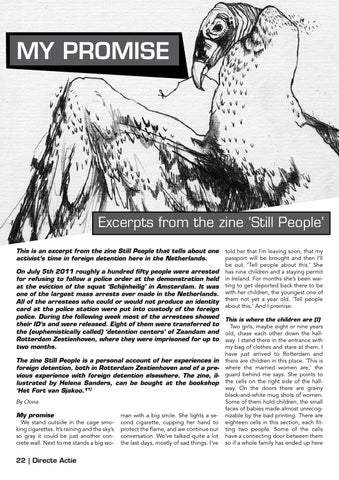
Excerpts from the zine ‘Still People’ This is an excerpt from the zine Still People that tells about one activist’s time in foreign detention here in the Netherlands. On July 5th 2011 roughly a hundred fifty people were arrested for refusing to follow a police order at the demonstration held at the eviction of the squat ‘Schijnheilig’ in Amsterdam. It was one of the largest mass arrests ever made in the Netherlands. All of the arrestees who could or would not produce an identity card at the police station were put into custody of the foreign police. During the following week most of the arrestees showed their ID’s and were released. Eight of them were transferred to the (euphemistically called) ‘detention centers’ of Zaandam and Rotterdam Zestienhoven, where they were imprisoned for up to two months. The zine Still People is a personal account of her experiences in foreign detention, both in Rotterdam Zestienhoven and of a previous experience with foreign detention elsewhere. The zine, illustrated by Helena Sanders, can be bought at the bookshop ‘Het Fort van Sjakoo.’[1] By Oona
My promise We stand outside in the cage smoking cigarettes. It’s raining and the sky’s so gray it could be just another concrete wall. Next to me stands a big wo-
22 | Directe Actie
man with a big smile. She lights a second cigarette, cupping her hand to protect the flame, and we continue our conversation. We’ve talked quite a lot the last days, mostly of sad things. I’ve
told her that I’m leaving soon, that my passport will be brought and then I’ll be out. ‘Tell people about this.’ She has nine children and a staying permit in Ireland. For months she’s been waiting to get deported back there to be with her children, the youngest one of them not yet a year old. ‘Tell people about this.’ And I promise. This is where the children are (I) Two girls, maybe eight or nine years old, chase each other down the hallway. I stand there in the entrance with my bag of clothes and stare at them. I have just arrived to Rotterdam and there are children in this place. ‘This is where the married women are,’ the guard behind me says. She points to the cells on the right side of the hallway. On the doors there are grainy black-and-white mug shots of women. Some of them hold children, the small faces of babies made almost unrecognizable by the bad printing. There are eighteen cells in this section, each fitting two people. Some of the cells have a connecting door between them so if a whole family has ended up here