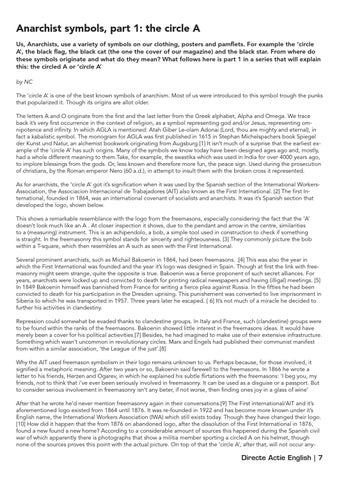
Anarchist symbols, part 1: the circle A Us, Anarchists, use a variety of symbols on our clothing, posters and pamflets. For example the ‘circle A’, the black flag, the black cat (the one the cover of our magazine) and the black star. From where do these symbols originate and what do they mean? What follows here is part 1 in a series that will explain this: the circled A or ‘circle A’ by NC The ‘circle A’ is one of the best known symbols of anarchism. Most of us were introduced to this symbol trough the punks that popularized it. Though its origins are allot older. The letters A and O originate from the first and the last letter from the Greek alphabet, Alpha and Omega. We trace back it’s very first occurrence in the context of religion, as a symbol representing god and/or Jesus, representing omnipotence and infinity. In which AGLA is mentioned: Atah Giber Le-olam Adonai (Lord, thou are mighty and eternal), in fact a kabalistic symbol. The monogram for AGLA was first published in 1615 in Stephan Michelspachers book Spiegel der Kunst und Natur, an alchemist bookwork originating from Augsburg.[1] It isn’t much of a surprise that the earliest example of the ‘circle A’ has such origins. Many of the symbols we know today have been designed ages ago and, mostly, had a whole different meaning to them.Take, for example, the swastika which was used in India for over 4000 years ago, to implore blessings from the gods. Or, less known and therefore more fun, the peace sign. Used during the prosecution of christians, by the Roman emperor Nero (60 a.d.), in attempt to insult them with the broken cross it represented. As for anarchists, the ‘circle A’ got it’s signification when it was used by the Spanish section of the International WorkersAssociation, the Associacion Internacional de Trabajadores (AIT) also known as the First International. [2] The first International, founded in 1864, was an international covenant of socialists and anarchists. It was it’s Spanish section that developed the logo, shown below. This shows a remarkable resemblance with the logo from the freemasons, especially considering the fact that the ‘A’ doesn’t look much like an A . At closer inspection it shows, due to the pendant and arrow in the centre, similarities to a (measuring) instrument. This is an achipendolo, a bob, a simple tool used in construction to check if something is straight. In the freemasonry this symbol stands for sincerity and righteousness. [3] They commonly picture the bob within a T-square, which then resembles an A such as seen with the First International. Several prominent anarchists, such as Michail Bakoenin in 1864, had been freemasons. .[4] This was also the year in which the First International was founded and the year it’s logo was designed in Spain. Though at first the link with freemasonry might seem strange, quite the opposite is true. Bakoenin was a fierce proponent of such secret alliances. For years, anarchists were locked up and convicted to death for printing radical newspapers and having (illigal) meetings. [5] In 1849 Bakoenin himself was bannished from France for writing a fierce plea against Russia. In the fifties he had been convicted to death for his participation in the Dresden uprising. This punishement was converted to live imprisonment in Siberia to which he was transported in 1957. Three years later he escaped. [ 6] It’s not much of a miracle he decided to further his activities in clandestiny. Repression could somewhat be evaded thanks to clandestine groups. In Italy and France, such (clandestine) groups were to be found within the ranks of the freemasons. Bakoenin showed little interest in the freemasons ideas. It would have merely been a cover for his political actievities.[7] Besides, he had imagined to make use of their extensive infrastructure. Something which wasn’t uncommon in revolutionary circles. Marx and Engels had published their communist manifest from within a similar association, ‘the League of the just’.[8] Why the AIT used freemason symbolism in their logo remains unknown to us. Perhaps because, for those involved, it signified a metaphoric meaning. After two years or so, Bakoenin said farewell to the freemasons. In 1866 he wrote a letter to his friends, Herzen and Ogarev, in which he explained his subtle flirtations with the freemasons: ‘I beg you, my friends, not to think that i’ve ever been seriously involved in freemasonry. It can be used as a disguise or a passport. But to consider serious involvement in freemasonry isn’t any beter, if not worse, then finding ones joy in a glass of wine’ After that he wrote he’d never mention freemasonry again in their conversations.[9] The First international/AIT and it’s aforementioned logo existed from 1864 until 1876. It was re-founded in 1922 and has become more known under it’s English name, the International Workers Association (IWA) which still exists today. Though they have changed their logo. [10] How did it happen that the from 1876 on abandoned logo, after the dissolution of the First International in 1876, found a new found a new home? According to a considerable amount of sources this happened during the Spanish civil war of which apparently there is photographs that show a militia member sporting a circled A on his helmet, though none of the sources proves this point with the actual picture. On top of that the ‘circle A’, after that, will not occur any-
Directe Actie English | 7