A2 A4
The Afro-American, February 11, 2012 - February 17, 11, 2012
‘Equality’ Lawsuit Continued from A1
institutions, not counting the University of Maryland-College Park.” Lichtman chose to exclude University of Maryland-College Park in his analysis apparently due to his concern that its inclusion would create a skewed statistical picture. Lichtman’s testimony last week was part of a larger effort to prove that the state of Maryland has done more than enough to remedy past racial discrimination. The testimony was given as part of $2.1 billion suited filed in 2006 to compel the state to make its four HBCUs –Morgan State University, Bowie State University, Coppin State University and the University of Maryland-Eastern Shore – “comparable and competitive.” While neglecting to adequately fund the four Black universities, the suit contends, White state institutions of higher education the University of Maryland- College Park, the University of Maryland-Baltimore County, Towson University and Salisbury University (TWIs)– were provided resources that gave them significant advantages over HBCUs. The suit was filed against the Maryland Higher Education
HBCU Fight
Continued from A1
In 2005, Morgan State University (MSU) and Towson University were negotiating a special 3+2 Master’s of Business Administration (MBA) program. With Towson unwilling to allow MSU to be the sole grantor of the degree, a deal was inked with the University of Baltimore (UB) and approved by the MHEC. Towson’s agreement with UB consequently decimated the number of White students in MSU’s MBA program, even though the MSU MBA was the more mature program. “Program duplication is very detrimental. It provides an opportunity for a student to make a choice based on race as opposed to what program is being offered at one institution or another,” said former president of
Morgan State University, Dr. Earl S. Richardson. Aside from program duplications, enrollment trends at Black and White institutions were also discussed. Dr. Donald Hossler, professor of Educational Leadership and Policy Studies at Indiana University, gave extensive information on how and when students make their decision to attend an institution of higher learning. Author of 24 publications, Dr. Hossler has studied everything from improved admission and marketing tactics to financial aid, retention and much more. Dr. Hossler now serves as executive director of the National Student Clearinghouse Research Center. Dr. Hossler testified to
Commission (MHEC) by the Coalition for Equity and Excellence in Maryland Higher Education, Inc., a consortium of students and alumna of the various Maryland HBCUs who share a frustration with the state’s continuous neglect of HBCUs and the education of African American students. The selection of a historian to serve as an expert on statistics was a curious one, according to many court observers. Typically, mathematicians or statisticians are used to analyze and comment on numbers. Moreover, Lichtman admitted that he reached his conclusions without ever visiting any campuses or interviewing the head of any of the universities in question. Lichtman’s narrow testimony did go to the heart of the suit that includes allegations that the state weakened HBCUs by limiting their missions, permitting unnecessary duplication of HBCU academic programs by White universities and allowing buildings on Black campuses to fall into disrepair. After breaking down state funding on a per pupil basis (FTE), Lichtman asserted, “Even with College Park included, historically Black institutions are about equal to the nonhistorically Black institutions.” But Lichtman seemed ambivalent when Jon Greenbaum of the Lawyers’ Committee for Civil Rights Under Law, one of the attorneys for the Coalition, commented on cross-examination a trend seen in other states where non-Black students seem to attend more at night, on weekends, and at off-site locations rather than during the day in regularly scheduled classes with Black students. Though his words seemed to help the plaintiff’s case in many regards, more than a few eyebrows were raised when Dr. Hossler said funding into the billions for Black schools would mean that institutions “would be forced to choose between being a traditionally Black institution and a historically Black institution.” Meaning that adequate funding would bring an influx of non-black students, making its HBI status a reference more to its past roots, not necessarily the actual student body. “Dr.Hossler was intimating that for us to be successful at one level we would have to accept the possibility of HBIs becoming historical only in name and
weddings by
that per pupil spending on Black universities also exceeded that of their White counterparts during de jure segregation. In response, Lichtman simply stated “I did not review the de jure era”. “How could anyone possibly say either Coppin or Morgan has fared as well as College Park or any other White campus?” asked Claude Parker, an alumnus of Morgan. “College Park is like a city within a city, with massive buildings.” Lichtman’s decision to use FTEs – full-time equivalent students –as a yardstick is a questionable methodology. Judges handling higher education desegregation cases have refused to rely on such measurements. In Knight & Sims v. Alabama, for example, the judge ruled that proportional FTE funding, even if it favors HBCUs, does not demonstrate adequate funding necessary to remedy past racial discrimination. The impact of the picture painted by Lichtman of Maryland’s four HBCUs being institutions whose edifices, facilities and resources far out-gleam the TWIs, awaits the outcome of the trial. The current phase of the trial is expected to come to an end this week. Experts have indicated that a decision should not be anticipated until some time this summer.
Photo by Alexis Taylor
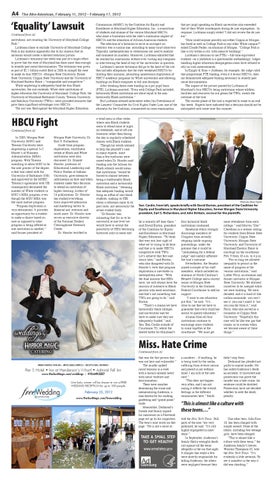
Sen. Cardin, from left, speaks briefly with David Burton, president of the Coalition for Equity and Excellence in Maryland Higher Education, former Morgan State University president, Earl S. Richardson, and John Brittain, counsel for the plaintiffs. he is entirely off base there,” said David Burton, president of the Coalition for Equity and Excellence in Maryland Higher Education. “To think that way you lose sight of what we’re trying to do hereand that is to make HBCUs competitive with TWIs. Let’s achieve that first and worry later,” said Burton, who also disagreed with Dr. Hossler’s view that program duplication is inevitable in metropolitan areas. “With the dual mission that HBIs have, we will always have the mission of outreach to Black persons who need assistance, and that’s not something that TWIs are going to do,” said Burton. “There’s a reason we have historically black colleges and universities and we have to make sure they are adequately funded,” said Sen. Ben Cardin outside of Courtroom 7D, where the heated battle for Maryland’s
four historical black institutions continued. Senatorial ethics strongly discourage members of Congress from actually stepping inside ongoing proceedings, under the premise that it could be “intimidating for a federal judge” and unduly influence the trial’s outcome. Nevertheless, the Senator joined a couple of his staff members, which included an alumnus of North Carolina’s Bennett College and a current senior at Morgan State University in the Garmatz Federal Courthouse to add his support. “I want to see education put first,” he said. “It’s clear to me that we have to guarantee that every child has access to quality education.” Alumni from all four institutions continue to encourage more students to come together at the courthouse. “We must get
more attendance from each college,” said Marvin “Doc” Cheatham in a release calling for students from Bowie State University, Coppin State University, Morgan State University, and University of Maryland Eastern Shore to converge on the courthouse Feb. 9 from 10 a.m. to 4 p.m. “For so long we allowed inequality to persist in the name of progress at the various institutions,” said Luther Perry, an alumnus and former instructor at Morgan State University. We allowed ourselves to be unequal while we were building. We were deluded, and it is kind of like carbon monoxide: you can’t see it, you can’t smell it- but you can die from it,” said Perry, who also served as a counselor at Coppin State University. “Hopefully this case will be like tear gas that causes us to scream when we become aware of these things.”
Miss. Hate Crime
Continued from A1
BREATHTAKING VENUES • IMPECCABLE SERVICE • EXCEPTIONAL CATERING
Pier 5 Hotel • Inn at Henderson’s Wharf • Admiral Fell Inn www.HarborMagic.com/weddings - 410.649.5327
One lucky winner will be chosen to win a FREE WEDDING RECEPTION for up to 100 people.
February 25, 2012 www.HarborMagic.com/freewedding
that was the first person that was out here and vulnerable.” The murder spiked racial tensions in a state with a history already laced with racial violence and discrimination. There were marches denouncing the crime and memorializing Anderson, a man known for his cooking, gardening and “grand-piano” smile. Meanwhile, Dedmond’s friends and family argued his innocence on a Facebook page set up by his supporters. The teen’s aunt wrote on that page: “He is not a racist or
a murderer…If anything, he is being tried by the media, suffering from reverse racism and placed in jail without bond. I am sick of the race card.” “This does not happen very often, and I am not saying it reflects the overall feelings in the different communities here,” Smith
didn’t stop them. Dedmond has pleaded not guilty to capital murder. He has called Anderson’s death an accident. If convicted and prosecutors can prove the murder was a hate crime, his sentence could be doubled. Prosecutors have not decided whether to seek the death penalty.
“This is almost like a culture with these teens…” told the New York Times. Still, parts of the area “are very polarized, he said. “It’s still highly segregated in most ways.” In September, Anderson’s family filed a wrongful death suit against all the teens allegedly in the car that night. It charges that while a few were directly responsible for killing Anderson, the others were negligent because they
One other teen, John Rice, 18, has been charged with simple assault. None of the others, including two teenage girls, have been charged. “This is almost like a culture with these teens,” the Anderson family’s lawyer, Winston Thompson III, told the New York Times. “It’s evidently a little network. To see it manifest in the way it did was shocking.”