T E C H N I C A L G R A M M Y AWA R D
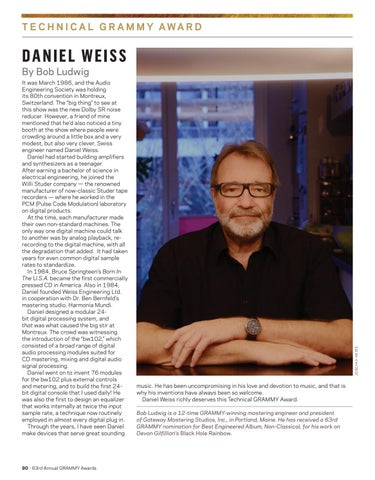
DA N I E L W E I S S It was March 1986, and the Audio Engineering Society was holding its 80th convention in Montreux, Switzerland. The “big thing” to see at this show was the new Dolby SR noise reducer. However, a friend of mine mentioned that he’d also noticed a tiny booth at the show where people were crowding around a little box and a very modest, but also very clever, Swiss engineer named Daniel Weiss. Daniel had started building amplifiers and synthesizers as a teenager. After earning a bachelor of science in electrical engineering, he joined the Willi Studer company — the renowned manufacturer of now-classic Studer tape recorders — where he worked in the PCM (Pulse Code Modulation) laboratory on digital products. At the time, each manufacturer made their own non-standard machines. The only way one digital machine could talk to another was by analog playback, rerecording to the digital machine, with all the degradation that added. It had taken years for even common digital sample rates to standardize. In 1984, Bruce Springteen’s Born In The U.S.A. became the first commercially pressed CD in America. Also in 1984, Daniel founded Weiss Engineering Ltd. in cooperation with Dr. Ben Bernfeld’s mastering studio, Harmonia Mundi. Daniel designed a modular 24bit digital processing system, and that was what caused the big stir at Montreux. The crowd was witnessing the introduction of the “bw102,” which consisted of a broad range of digital audio processing modules suited for CD mastering, mixing and digital audio signal processing. Daniel went on to invent 76 modules for the bw102 plus external controls and metering, and to build the first 24bit digital console that I used daily! He was also the first to design an equalizer that works internally at twice the input sample rate, a technique now routinely employed in almost every digital plug in. Through the years, I have seen Daniel make devices that serve great sounding
90 - 63rd Annual GRAMMY Awards
JOSCHKA WEISS
By Bob Ludwig
music. He has been uncompromising in his love and devotion to music, and that is why his inventions have always been so welcome. Daniel Weiss richly deserves this Technical GRAMMY Award. Bob Ludwig is a 12-time GRAMMY-winning mastering engineer and president of Gateway Mastering Studios, Inc., in Portland, Maine. He has received a 63rd GRAMMY nomination for Best Engineered Album, Non-Classical, for his work on Devon Gilfillian’s Black Hole Rainbow.