Cover Story: Independent Public Schools
Independent Public Schools – how much do you know? Department of Educ ation, Training and
With the recent incursion of Independent Public Schools into WA and QLD, we take a look at what they are and whether we need them.
The Coalition’s Policy for Schools, August 2013.
We’ve been hearing claims in Australia like the one above for a number of years, but despite our ongoing coverage of the issue in the Journal and consistent reports on the topic in the press, most educators still don’t know a great deal about the phenomenon that threatens to change the nature of public education.
So what is an Independent Public School? As the name implies, Independent Public Schools (IPS) are publicly funded schools operating with varying degrees of independence from a central education bureaucracy. IPS are governed in ways that resemble a private (or “independent”) school – they are administered by an elected School Board with the Principal operating like the CEO of a typical company. IPS boards usually consist of parents, community members and business representatives. In Queensland, where they were implemented last year, the Department of Education Training and Employment describes IPS as “providing opportunities for: • enhanced local governance • advancing innovation • locally-tailored workforce • financial flexibility • building for the future • public accountability, transparency and performance.” The principles that drive this model are very much derived from free market
Independent Publi
c Schools
Driving local decisio n-making and inno vation
“…there is little evidence of changes to student outcomes as a result of initiatives of this kind. At best they produce a feel good effect.” Ken Boston economics – the idea that deregulation and devolution from a government bureaucracy will produce better results, lead to more innovation, give “consumers” greater choice and, with specific regard to schools, provide principals and school councils/boards with more “autonomy”.
130318
“A programme to implement independent public schools will lead to higher productivity, better quality education outcomes for students.”
Education Queenslan d United in our pursu it of excellence
While based on the same free market principals as similar international models – charter schools in the US, academy and free schools in the UK and Europe – in their current form IPS are not as independent as the name suggests. In both Queensland and Western Australia, the two states that have rolled IPS out in recent years, flexibilities around curriculum, industrial agreements, enrolments and a number of other government regulated areas are limited. For the time being, IPS schools still have to adhere to legislation, directives, whole-of-government policy and national agreements.
Why does the government want schools to convert to IPS? After the 2013 federal election, Federal Education Minister Christopher Pyne quickly announced a $70m fund to entice public schools to become IPS; his hope is that a quarter of all public schools will become an IPS by 2017. You might ask how $70m could possi-
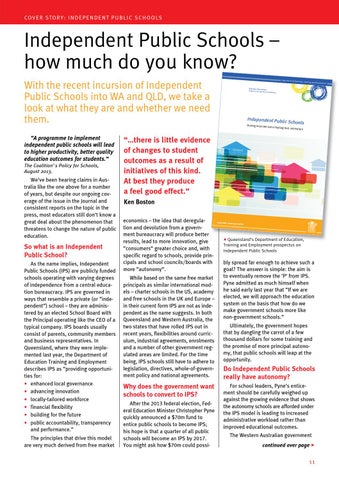
1 Queensland’s Department of Education, Training and Employment prospectus on Independent Public Schools
bly spread far enough to achieve such a goal? The answer is simple: the aim is to eventually remove the ‘P’ from IPS. Pyne admitted as much himself when he said early last year that “If we are elected, we will approach the education system on the basis that how do we make government schools more like non-government schools.” Ultimately, the government hopes that by dangling the carrot of a few thousand dollars for some training and the promise of more principal autonomy, that public schools will leap at the opportunity.
Do Independent Public Schools really have autonomy? For school leaders, Pyne’s enticement should be carefully weighed up against the growing evidence that shows the autonomy schools are afforded under the IPS model is leading to increased administrative workload rather than improved educational outcomes. The Western Australian government continued over page 3 11
Employment