I S S U E #18
AGENTIC AI
SERVANTS NOT MASTERS
The bots delivering value for ING ARTIFICIAL INTELLIGENCE
AI: WHERE NOW?
What Finastra’s State Of The Nation report tells us about bank strategy
REAL-TIME RAILS
WE’RE GOING TO BARBADOS! Instant payments are about to land CUSTOMER JOURNEYS
CALL A FRIEND
CSG on why banks are right to buddy up with telcos
FREE SPIRIT ECOSYSTEMS
HOW TIMUR TURLOV’S FREEDOM SUPERAPP COULD PUT KAZAKHSTAN ON THE GLOBAL FINTECH MAP
INSIGHTS PAYMENTOLOGY ● ENTERPRISE IRELAND ● TEMENOS ● GOOGLE CLOUD ● SAGICOR BANK
Don’t just add another AI tool.
Deploy Agent Fleet. Financial institutions don’t need isolated AI tools or generic copilots. They need orchestrated AI agents that can run end-to-end workflows across regulated environments, while maintaining control, accountability and auditability. Agent Fleet is an institutional-grade orchestration of multiple AI agents, designed, governed and continuously supervised by financial services domain specialists. Working together across research, analytics, operations and decision workflows, Agent Fleet embeds directly into existing environments to deliver consistent, auditable and actionable outcomes at scale.
About Acuity Analytics Acuity Analytics is the trading name of Acuity Knowledge Partners, a global leader in delivering bespoke research, data management, analytics and AI-enabled solutions to financial institutions and corporates. With more than 7,200 analysts, data specialists and technologists across 28 locations, the firm combines deep financial-services expertise with strong engineering, digital and AI capability. Acuity supports over 800 organisations in enhancing efficiency, improving insight and unlocking human potential. Acuity was established as a separate business from Moody’s Corporation in 2019 following its acquisition by Equistone Partners Europe. In January 2023, funds advised by global private equity firm Permira acquired a majority stake, with Equistone remaining invested as a minority shareholder.
© 2026 Acuity Analytics. All Rights Reserved.
Experience the impact of Agent Fleet. Scan the QR code or visit acuityanalytics.com
ISSUE #18
THE PAYTECH MAGAZINE 6 16 AGENTIC AI
SAUDI ARABIA
HARVESTING TRUST
ING’s blueprint for customer-centric AI-driven banking imagines a future where agents toil to serve human overseers and, ultimately, customers. But the bank is ploughing its furrow carefully
8
ECOSYSTEMS
Smart moves
2026 looks to be a key year for Freedom Holding Corp, a global fintech conglomerate with a major presence in Kazakhstan that’s betting big on banking ecosystems
10
FOUNDER INTERVIEW
Freedom calling
Timur Turlov is building a financial ecosystem in Kazakhstan, which could serve as a blueprint to expand across the world. In this special Q&A with the Founder of Freedom Holding Corp, Turlov explains his superapp strategy and why his door is open to hyperscalers
14
ECOSYSTEMS
Beyond the Cloud
Google Cloud’s Karen Zhang maps out the many ways in which the infrastructure provider is helping to build a modern financial services community
8
FFNEWS.COM
Line of vision
Crown Prince Mohammed bin Salman’s ambition to transform his kingdom’s economy has created a welcoming environment for providers like Paymentology to build a brave new financial world
10
THEEDITOR’SVIEW Editing this edition of The Paytech Magazine, I was struck by how many similar thoughts were being echoed across the industry. We didn’t orchestrate the content – they’re unprompted observations made by unrelated companies, which makes it even more striking. Freedom Holding Corp (pages 8 and 10), for example, figured out early on that having a telecoms company within the same ecosystem as its financial services made a lot of sense, especially when building a superapp. And CSG's Richard Ullenius (page 20) points to examples of banks hiring telecoms experts to inject some of their ‘boundaryless portfolio’ thinking into their own organisations, while predicting wider and closer alignment between the two in future. Finastra’s always-fascinating annual State Of The Nation report (page 32) this year observed how execution, resilience and trust were no longer siloed objectives, but held equal sway with boards – both as a result of, and leading to, AI being leveraged across all of them. ING (pages 6 and 29) is a casebook study of that trend, having surged ahead of the industry’s implementation charts when it comes to the use of co-pilots. Meanwhile, the big daddy of core banking technology, Temenos (page 34), tells us clients are increasingly judging AI on its impact, which is focussing minds and budgets, and (as all the above indicate) encouraging closer alliances up, down and between supply chains. More than any other technology leap, AI perhaps makes us realise we really are all in this together. Sue Scott, Editor This issue’s spinetingler quote comes from Timur Turlov, Founder of Freedom Holding Corp ISSUE 18 THEPAYTECHMAGAZINE 3
22 29
34
19
24
DATA
Exchange of information
CUSTOMER JOURNEYS
Banking without boundaries
Richard Ullenius from CSG tells us how he believes organisations can reinvent their structures, balance the human and the machine, and layer on new capabilities without destabilising the business... just as telcos did!
22
REAL-TIME RAILS
Islands in the real-time sun
How Sagicor Bank is racing to lead the instant payments era in the Caribbean
INSTANT PAYMENTS
Staying real
Payment Spayce has been quietly building resilient real-time payments integrations for years. Now it’s ready to help businesses in Barbados ride the new rail there
The most valuable commodity right now for the London Stock Exchange Group is data. But it's also courting founders in imaginative new ways
20
37
29
ARTIFICIAL INTELLIGENCE
From philosophy to production
ING’s Marco Li Mandri describes how the bank is putting its AI vision into practice
32
STATE OF THE NATION
Leaning in and stepping up
Finastra’s annual State Of The Nation report on the challenges facing financial institutions and their technology responses to them, highlights just how much the instant payment revolution is driving adoption of AI
34
LEGACY DEBT
Travelling Light
Fragmented and legacy systems are weighing down banks, undermining the innovation agility that modern payments now demand, according to Temenos
37
ENTERPRISE IRELAND
Irish eyes on London
The UK is a key destination for fintechs from Ireland, many of which are supported overseas by their government’s trade and innovation agency. The London Stock Exchange is welcoming them with open arms
THEPAYTECHMAGAZINE2026 EXECUTIVE EDITOR Ali Paterson
ART DIRECTOR Chris Swales
GENERAL MANAGER Tom Dickinson
PRODUCT & CONTENT MARKETING Matt Sarkar
EDITOR Sue Scott SUB EDITOR Frank Tennyson
CHIEF REVENUE OFFICER Shaun Routledge PHOTOGRAPHER Jordan Drew
PRODUCTION TEAM Chloe Butler Tom Dickinson Matthew Burls Dylan Young PRODUCTION Taylor Griffin Laura Raimondi Kimberley Barrios
ISSUE#18 ONLINE EDITOR Lauren Towner Dominic Sow VIDEO TEAM Louis Jean La Grange David Hill Ethan Peck
FEATURE WRITERS David Firth Martin Heminway Tracy Mitchell Sue Scott James Tall Frank Tennyson
The Fintech Magazine is published by FF NEWS LTD. Pantiles Chambers 85 High Street Tunbridge Wells, TN1 1XP
CONTACT US ffnews.com DESIGN & PRODUCTION www.yorkshire creativemedia.co.uk
IMAGES BY www.istock.com PRINTED BY Everything Creative "PROUDLY NOT ABC AUDITED"
All Rights reserved. No part of this publication may be reproduced, stored in a retrieval system or transmitted in any form or by any means, electronic, photocopying or otherwise, without prior permission of the publisher and copyright owner. While every effort has been made to ensure the accuracy of the information in this publication, the publisher accepts no responsibility for errors or omissions. The products and services advertised are those of individual authors and are not necessarily endorsed by or connected with the publisher. The opinions expressed in the articles within this publication are those of individual authors and not necessarily those of the publisher.
4 THEPAYTECHMAGAZINE ISSUE 18
FFNEWS.COM
The Boutique Banking Conference
#TBSCONF26AMS March 24, 2026 - Eye Filmmuseum, Amsterdam
"Rethinking Relevance" Gain insights from industry leaders and join the discussions as we challenge conventional thinking and explore what it means to be a truly "relevant" bank in the 21st century.
Use FFN15TBS26 for 15% discount https://thebankingscene.com/events/tbsconfams/tickets/
Harvesting trust AGENTIC AI
ING’s blueprint for customer-centric AI-driven banking imagines a future where agents toil in digital farms, serving human overseers and, ultimately, customers. But it’s ploughing its furrow carefully There is a version of the future where the world is run by systems that are autonomous from human beings, yet capable of knowing and characterising almost everything about their lives, including their finances. Every transaction parsed. Every behavioural signal scored. Every life milestone predicted before it is spoken aloud. Credit pre-approved before it is requested; risk priced before it materialises. Invisible systems watch, learn and decide, quietly shaping the financial pathways available to each institution and the individuals it serves. Omnipresent intelligence. Algorithmic authority. A financial panopticon, humming beneath daily life. For more cynical observers, the adoption of the technology driving this in banking edges uncomfortably close to the Orwellian. But as far as the man driving change at Dutch banking giant 6 THEPAYTECHMAGAZINE ISSUE 18
Marnix van Stiphout, COO and Member of the Management Board at ING
ING is concerned, that framing is wrong: ING’s technological architecture is being designed methodically, deliberately to empower customers, not have dominion over them. Founded in 1991 through the merger of insurer Nationale-Nederlanden and NMB Postbank, ING has grown into one of Europe’s most prominent digital-first banking groups, serving tens of millions of retail, corporate and institutional clients across more than 100 countries. In recent years, the bank has paired balance-sheet strength with strategic transformation, reporting multi-billion-euro annual profits, returning capital to shareholders through buybacks, and investing heavily in digital infrastructure to support long-term growth. Having built a reputation as something of a boundary-pusher, its financial resilience has given leadership the latitude to pursue large-scale
technology modernisation, with AI positioned not as an experimental layer but as a core operating capability.
Operational infrastructure Across operational workflows and decisioning environments, intelligent systems are set to permeate the bank’s core. But the strategic intent behind that roll-out matters, says COO Marnix van Stiphout. As he puts it: “I’m here to grow our businesses safely and securely, and I can only grow it when people want to bank with us. “Anything to do with fulfilment is subject to AI-ification, if that’s a verb!” he adds. “Operating the bank means everything from business operations to finance, risk operations and HR, but also data, transformation and analytics.” And in that context, AI is not a siloed innovation programme – it is operational infrastructure and, crucially, a growth lever. FFNEWS.COM
“The strategy of the bank is to grow across our markets,” says van Stiphout. “The task is to deepen those franchises safely, securely and at scale, making sure that we are so productive, that we can keep on adding customers, without necessarily having to add [resources] at the same rate.” In this scenario, AI becomes the multiplier. “It’s a fantastic opportunity and a big toolbox to build things at scale and do so safely and securely, giving us extra speed, extra content and also extra bandwidth,” he adds. That doesn’t come without huge change. ING has been upfront about the number of human roles that could be affected by technology transformation at the bank. It has forecast that its total staff requirement could be 960 fewer by the end of this year. At the same time, new technologies will also bring better careers for people who re-skill and play a part in the transformation, says van Stiphout. To be clear, customers are not crops to be cultivated, segmented and monetised, in a hyper-efficient, asymmetrical ecosystem that primarily benefits the bank. Rather, this AI production system is aimed at empowering and expanding the reach and capabilities of human employees across ING’s global business, by giving them virtual ‘staff’. “If I am working today in wholesale lending operations, then tomorrow I could be overseeing business banking and other loans with the help of agentic solutions,” he says. In this way, he is envisioning something closer to precision farming for maximum individual and communal benefit. It is financial wellbeing: helping customers avoid missed payments. Financial inclusion: access to appropriate credit. Financial protection: detecting fraud earlier and providing guidance tailored to customers’ circumstances. In this framing, the intelligence generated becomes protective and enabling. AI-driven self-service allows individuals to act instantly – refinancing loans, adjusting savings strategies, resolving disputes – without waiting in call queues. The system anticipates needs, but does not remove choice. Human advice remains available, layered on top of automation rather than replaced by it. “The toolbox gets us a lot closer to our clients,” van Stiphout says. “When you are able to decide yourself to do something with a bank, but still have the opportunity to speak with people, what you produce as a banker is far closer to what the customer wants.” It’s an inversion of the darker narrative: here, automation expanding autonomy rather than constraining it. Hyper-personalisation, FFNEWS.COM
after all, could edge towards manipulation. evolution rather than an exception, albeit Behavioural modelling, so powerful in one requiring careful understanding before anti-money-laundering detection, could use is industrialised. theoretically be repurposed toward aggressive product steering. Predictive analytics could Don’t underplay the upsides entrench bias if poorly governed. As fulfilment becomes automated, and Which is why van Stiphout is precise in employees shift toward oversight and describing the degree of autonomy his reconciliation roles, van Stiphout concedes envisaged AI agents have to operate. ‘that needs quite a rigorous retraining and “Autonomous sounds very negative,” he repositioning of people and jobs’. agrees. “But a lot of IT is already working kind Yet he sees mainly upsides here. Banking, of autonomously – applications that do things long viewed by some technologists as legacy themselves because we programmed them to.” infrastructure with little to inspire a younger The important limiter with artificial workforce, could become extremely intelligence lies in the governance around it. attractive, he believes. “When ING deploys it, we take a work “We can actually get young, talented people instruction and give that to a digital agent, in the bank to do that work. I think that gives who becomes, in effect, a colleague, bound by us a real comparative advantage.” the same rules. We tell it: ‘If you reach your Automation, in this sense, also reshapes defined boundary, you need to ask a human employability. And always, the customer and for an intervention’. Agents do not roam freely their welfare, remains the defining principle. across the data landscape. They operate “Yes, of course, we have conversations within fenced fields.” about social consequences,” van Stiphout says. Scaling such systems, however, can be “But those two [positive] things, in terms of a roadblock – one ING is addressing. employability and customer centricity, are true “The main challenge is not lack of ideas,” next to the debate about social consequence.” van Stiphout says. “The challenge is ‘can the The dystopian version of the future remains organisation adopt it at scale?’.” technically possible. A bank that can see Skills, risk frameworks, operating models, all everything must continually prove it will must evolve, and the question for the bank not use everything. Data minimisation, becomes ‘can we convert our teams to be able purpose limitation and ethical design to work with all these things across the world?’. become trust infrastructure as much as Hence ING’s incremental deployment compliance obligation. philosophy, which van Stiphout Van Stiphout is pragmatic about summarises as: “Let’s learn the unknowns, and the fact that before we really start running new risks will undoubtedly AI agents do with this thing.” Small surface. But ING is betting not roam freely proofs precede scale. that governance, a strong Agentic mortgage guiding culture and across the data processes in the regulatory oversight landscape. They operate Netherlands and can bend the trajectory within fenced fields Germany, for instance, towards a more Marnix van are being rolled out step constructive outcome, Stiphout, COO by step with salary retrieval where artificial intelligence, agents and document agents, rather than command each generating operational authority, operates as a value and governance learning. financial co-pilot. Chatbots follow a similar discipline. In that world, agents work the soil of data Hallucination risk – where AI generates continuously, and their outputs are measured responses containing false or misleading in customer resilience: fewer fraud losses, information – is mitigated through continuous faster credit access, smarter savings pathways. testing. “We are very, very prudent in how we It is still a system of immense informational go about these things,” adds van Stiphout. power. It still watches, learns and decides at This measured approach extends to scale. But rather than an all-seeing command regulation. But van Stiphout resists the authority, ING would prefer that its customers notion that AI introduces wholly new experience AI as being something closer to operational risk categories. an intelligent partner – one that’s present, “Why would it be different from any other analytical and, ultimately, in the service of IT that we apply?” he asks, framing AI as an their financial agency. ISSUE 18 THEPAYTECHMAGAZINE 7
When ecosystems work well, there’s balance, harmony and mutual growth. When they don’t, there’s tension, disunity and stagnation. No one understands that better than Renat Tukanov, Group Chief Technology Officer for Freedom Holding Corp (FRHC), who says his job is to build bridges between people as much as between machines; to promote not just digital integration, but also cultural coalescence. “Why do projects fail? It’s all about the culture,” says Tukanov. “Eventually, the challenge is not to build the technical part, but to build the human part to make people communicate with each other, work with each other.” Freedom Holding Corp is the financial services group built by Timur Turlov. Born in Russia, his business career and the growth of FHRC have been defined by its expansion across Central Asia, and later in Europe and the US. He transformed a small brokerage operation into a diversified international ecosystem listed in the US on Nasdaq. By the time FRHC began attracting global attention, Turlov was already leading a sizeable fintech empire spanning more than 20 countries, anchored by the largest business in Kazakhstan – the country that would
become the group’s strategic market and has become Turlov’s home. He hadn’t been born into privilege, and Turlov’s path to becoming a multi-billionaire, now leading the most valuable, non-state-owned company in the largest of the so-called Central Asian ‘Stans’, wasn’t linear. But in amassing brokerage, banking, insurance, telecoms and ecommerce companies under FHRC, operating more than 20 businesses in 22 countries, he became expert at building ecosystems, both inside and out. Perhaps the best example of that is the Freedom SuperApp launched by the Corp’s Freedom Bank in Kazakhstan in April 2024. As of October 2025, it had 1.6 million active monthly users and was the most downloaded app that year. “The Freedom SuperApp is one of the key activators of the ecosystem,” says Tukanov. “It collects a customer’s fragmented digital experiences into one. So you don’t have to keep in your memory ‘what was the account, what was the password?’. In that way, there is less decision fatigue.” It demonstrates what Freedom’s founder believes is the inevitable convergence between banking and telecoms. In this symbiotic relationship, the former has the advantage of long customer retention cycles while the latter enjoys low acquisition costs.
Each benefits from keeping customers in the same ecosystem, which is ultimately defined, says Turlov, as ‘a true set of rails for communication between people’. The Freedom SuperApp brings together the services its banking customers use multiple times a day, such as payments, with others that are less frequently accessed (brokerage, investments, insurance). It also plugs users into the largest online grocery platform in Kazakhstan, Arbuz.kz, which is owned by Freedom; Freedom Ticketon, its ticketing platform; and its flight aggregator, Aviata. And all these can be accessed via one login, with payment credentials automatically and securely retrieved, while permissioned integrations with government departments allow for one-click ID checks. Turlov told an audience in Dubai in December 2025 that a financial ecosystem is more powerful than individual products. But it relies, of course, on a technology infrastructure that can handle the data calls. And it’s an advantage if you also have control over that architecture. In Kazakhstan, at least, Freedom does. Through Freedom Telecom, the Group is expanding Freedom Cloud Kazakhstan to improve the nation’s digital sovereignty to support
Renat Tukanov, Group Chief Technology Officer for Freedom Holding Corp & CEO Freedom Finance Global
Smart moves ECOSYSTEMS
2026 looks to be a key year for Freedom Holding Corp, a global fintech conglomerate with major presence in Kazakhstan that’s betting big on banking ecosystems 8 THEPAYTECHMAGAZINE ISSUE 18
FFNEWS.COM
not just financial services, which were running out of processing space, but also government services. At the same time, Freedom Holding Corp is reducing its reliance on external technology providers, instead developing in-house solutions. “The logic is pretty simple,” says Tukanov. “Everything that is connected with the core of our business should be developed in-house, because it’s our technology foundation. That’s why we cannot rely on somebody else, because eventually, from this foundation, we are rising up, developing products that bring value to our clients. The core systems we’re replacing; for non-core, we’re relying on other vendors. “We’re not at the same scale, but AWS and Google replaced all the core systems with their own. I think it’s always the same path for technology companies, so as not to have vendor lock-in.” Turlov has said that, in his opinion, it is ‘impossible to be a true digital bank if you don’t control your own core… now our goal is full control over card processing and the core banking system’. It’s a big strategic play. But then Turlov is a supreme strategist, an accomplished chess player who is so passionate about the game that he took over the Kazakhstan Chess Federation in 2023.
A global player While his opening gambit, back in 2011, was to become the first Kazakhstan brokerage to give local investors access to US stock markets, today it’s a significant player in many of the countries of Central Asia, and active in the EU and the US. Turlov tends now to describe Kazakhstan as a laboratory for experimenting with products and business models that could be applied elsewhere. Freedom Holding Corp listed on NASDAQ in 2019, becoming the first financial
Strategy play: Freedom Holding Corp is moving pieces into place
FFNEWS.COM
investment company from Kazakhstan and the SuperApp, a [AI] voice assistant Central Asia to join a US bourse. It is will help perform routine operations that incorporated in the States, where it conducts you don’t want to do – press, find, etc. brokerage operations as an agency broker on But in other cases, we should always look the floor of the New York Stock Exchange. hard at what value AI will bring.” Under the Freedom Capital Markets brand, The arrival of the SuperApp unsettled the company also offers investment banking Freedom’s internal ecosystem equilibrium. services, including participation in the That was to be expected, says Tukanov. syndication of both primary and secondary “When any standalone application is going offerings, while actively expanding its into the SuperApp, there are multiple things capabilities in market research. Now, it hopes it needs to be compliant with. That, of course, to build a successful fintech in the US, too. changes our process, and we have to adapt Freedom might find the competition harder to that. That’s the challenge. You have to in the States on many levels. The superapp adapt each and every time to a changing challenge was thrown down in April 2025 environment, to the changing processes. when US payments company Bolt launched And, of course, when people disagree, even its own, combining one-click payments with within the same group, you try to solve that. crypto and an AI-powered shopping agent As I said, my role is building bridges.” that users can send on a The respected Graduate Business buying spree across its School of Stanford University in integrated ecommerce site, the US recently published a the app then tracks users’ study, Freedom Holding The Freedom purchases. Corp, Building An SuperApp is one of On the subject of AI, Ecosystem As A Path To the key activators Tukanov says: “What Scale, in which it looked of the ecosystem. It we see now [with AI] is at what it believed were collects a customer’s somewhere close to the company’s strategic fragmented digital what has happened options: doubling down experiences into one with other technologies. on what it has built in Renat Tukanov Yes, the internet changed Kazakhstan to dominate the world, but the internet the market there; scaling didn’t replace the world. So, horizontally in its existing there shouldn’t be AI in each and every territories; or pulling out the part of our lives and work. stops and expanding into new markets. “There is a question around the trillion In January 2026, Freedom Telecom dollars of investments in AI. Will they ever get International signed a MoU with e&, an Abu their ROI or not? In each and every business Dhabi-based global technology and investment case we look at, we are trying to find the conglomerate. A few weeks earlier, it inked value – something that the agreements with multiple partners in Japan, customer will buy, or can use including one to establish a joint venture for to simplify their life. With fintech-based services, another to develop financial technology and ecosystem services, and a third to expand its ecommerce offer with Japanese goods. In November 2025, Freedom Holding Corp, in collaboration with NVIDIA and Kazakhstan’s Ministry of Artificial Intelligence and Digital Development, announced a $2billion Sovereign AI Hub project powered by advanced NVIDIA AI infrastructure and designed to position Kazakhstan as a regional leader in AI. Always one move ahead, it looks like Turlov had already read the board and is working towards the endgame.
ISSUE 18 THEPAYTECHMAGAZINE 9
FREEDOM CALLING FOUNDER INTERVIEW
Timur Turlov is building a financial ecosystem in Kazakhstan, which could serve as a blueprint to expand not just across Central Asia, but the world. In this special Q&A with the Founder of Freedom Holding Corp, Turlov explains his superapp strategy and why his door is open to hyperscalers THE PAYTECH MAGAZINE: Can you give us a snapshot of the company’s growth path and where it is now? TIMUR TURLOV: I launched Freedom in late 2008 to allow people in Eastern Europe and Central Asia to access the US stock market. We saw we were good at building technology so we began expanding into other services, including insurance, which remains much less digitalised than brokerage. At the same time, digital banks were starting to compete directly with brokers, so if we wanted to remain independent and continue growing, we had to evolve into a digital bank ourselves. That led us to launch Freedom Bank in Kazakhstan, which became the foundation of our ecosystem. We continued expanding into telecommunications, e-commerce and other digital services — all designed to work together within one integrated platform. So, what began as a brokerage-only company, evolved into Freedom Holding Corp, a US-based public company listed on NASDAQ. In 2024, we launched our Freedom Super App, where customers can manage their finances, invest, make payments, buy tickets for a football
10 THEPAYTECHMAGAZINE ISSUE 18
match or concert, arrange travel, or even watch a movie. It’s not just a financial app – it’s a true super-app, a full digital ecosystem designed to simplify everyday life. TPM: The Freedom Superapp has rapidly evolved into one of the most advanced multi-vertical ecosystems in the region. What was the thought process behind it? TT: Some services can acquire customers very cheaply, but it’s very difficult for them to retain them. For others, like insurance and investments, acquisition is harder, and the cost of it is significantly higher. Banks, however, are among the most trusted institutions, so it’s much easier to upsell customers to more complex services. Different services [in our ecosystem] complement each other, too. You can make the payments experience much smoother, for example, if a customer holds an account with Freedom Bank. If we already have customers’ information, it becomes much easier for them to buy, for instance, an airline ticket through the platform. Instead of going to a separate service, they can
simply open the banking app they use every day, click a button, and buy the ticket. It’s easier, faster, and often cheaper than via an external provider. And customers are starting to see day-to-day savings, too, because our loyalty programme gives cash back, creating unique experiences. Some of the services are contributing frequency. Some are contributing retention. Others are contributing confidence and trust. All of them benefit from being part of the ecosystem.
Timur Turlov, Chief Executive Officer and Founder of Freedom Holding Corp
TPM: Kazakhstan isn’t seen as a global fintech centre. What makes it a good environment for building a platform of this scale? TT: We have a lot of well-educated people, for a start. The majority of our 10,000 employees speak English. Kazakhstan also has a very young population, and our GDP per capita is higher than in neighbouring markets, or the rest of Central Asia combined. Both the population and the government are very tech-optimistic. We adopt technology very fast, and that rapid adoption has created a unique
FFNEWS.COM
sandbox in a relatively small market of about 20 million people. The general cost of doing business and R&D is much lower here, too. It’s difficult to invest if you don’t know whether something will work. Lower costs mean we’re not afraid to experiment and make mistakes. Currently, we’re working hard on training and deploying AI across our ecosystem to create a true personal assistant who will help customers manage their finances, maybe help with their taxes, order food or recommend a movie, or just answer everyday questions. I believe that, based on some OpenAI and open-source technology, we will create this unique enabler to give ordinary people the same quality of personal service that only high-net-worths were able to enjoy before. Yes, it is a blueprint. I want to build not just one of the most advanced and competitive ecosystems in my country; I want to build that in the region first, and then globally.
I definitely want to build not just one of the most advanced and competitive ecosystems in my country; I want to build that in the region and then globally Timur Turlov
Superapp-etite: Freedom Founder Timur Turlov
FFNEWS.COM
ISSUE 18 THEPAYTECHMAGAZINE 11
That’s why we’re expanding in Europe with our brokerage services, that’s why we’re going to Kyrgyzstan, to Georgia, to Tajikistan. We’re also going to Turkey and look to further develop our presence in the United States. Our success will depend on how many countries we’ll finally be able to serve because the competition is already becoming regional and global. TPM: Freedom Holding Corp has recently announced some significant events around artificial intelligence: a partnership with OpenAI, and a $2billion sovereign AI wealth hub with Nvidia. This touches on AI infrastructure in the region. How important could Kazakhstan be to the world? TT: If you take a look at the map to see where, for example, the hyperscalers’ data centres are in Eurasia, you will find almost nothing between Poland and South Korea. That’s why we needed to build our own corporate Clouds because we can’t rely on anyone. There’s nobody there. I believe that we will not just build our national Clouds. We will be happy to work with hyperscalers and let them serve the macro region through Kazakhstan. In terms of the AI partnerships, AI training is a very global market. If you have some compute anywhere in the world, you can exchange it for training. Usually the market is in deficit: more people need compute than there is available in
usually gain. And the longer you exist, the easier it is to move forward. But while legacy is helping with that, it is killing you at the same time. We definitely have some room to compete with them now; to even rethink the sector itself. The key advantage of digital banks is that we can do everything much cheaper, much faster. It may take some time [to build as big as a legacy bank]. But this may happen very, very fast, as we’ve seen in Kazakhstan. Before 2020, 80 per cent of payments in the country were
I believe I still can do something good for my customers, for my country, for other countries. I can create something meaningful Timur Turlov the training room. So we can serve customers anywhere in the world. We just need to provide some attractive terms for that. Kazakhstan has a lot of things in its favour. We have a stable political situation and growing FDI inflows. We have investment-grade credit rating. No capital movement restrictions. It’s a favourable tax regime, and we still have quite cheap energy in our country, which means we have the potential to create a unique AI hub that will serve all of Central Asia. TPM: Traditional financial institutions still operate largely within very narrow verticals. What competitive advantage does a unified digital ecosystem give you? TT: Large banks are very powerful. But at the end of the day, they may be inefficient. The bigger you become, the more trust you 12 THEPAYTECHMAGAZINE ISSUE 18
cash payments. Now it’s around 12 per cent. If you have the right product, sooner or later, customers will appreciate that. And we will consume much less resource redistributing money and facilitating transactions. That should unlock a lot of opportunities because the cost to the customer for financial services will be much smaller. That’s good because people will be able to do something more useful with their money. At the end of the day, the financial sector will become much smaller in terms of GDP. TPM: What role do you see Freedom playing in the future of global financial services? And, in particular, is there strong growth potential for Freedom in the US? TT: We already operate a licensed broker-dealer in the US, providing market research and
institutional investment services. This gives us a strong foundation to expand our financial offerings in America. And, if you study Freedom, you will see that we actually have many dozens of potential unicorns as different subsidiaries, different products – development of core banking, card processing systems, payments, buy-now-pay-later, etc. Potentially, we can go to other markets to provide those solutions. The cost of origination of a mortgage loan in the US, for example, is now more than $10,500.
In Kazakhstan, we spend $200. And that shows how much efficiency technology can bring to financial services I may outsource accounting. I may outsource parts of credit decision-making. But technology is something I will keep in-house because a digital bank, let alone a digital ecosystem of services, is fundamentally a technology company. The real assets of this company are its technology and the talent that builds it. TPM: You’ve built this company from the ground up to be very successful. You have a lot of happy customers. So why not sit on a beach drinking Mai Tais? Why keep doing this? TT: I really believe that a person can be happy only if he is contributing something; if he can finally create more than he will take from society. I believe I still can do something good for my customers, for my country, for other countries. I can create something meaningful. I want to be able to compete as long as I can to survive in this fast-transforming global industry. It’s very hard to imagine just finishing my career. It would be very boring. FFNEWS.COM
Loving your Fintech Meetup experience? Register your interest for 2027 to unlock exclusive benefits, discounts, and more throughout the year.
Google Cloud’s Karen Zhang maps out the many ways in which the infrastructure provider is helping to build a modern financial services community
Beyond ECOSYSTEMS
the Cloud It’s the world’s third largest Cloud technology provider, but Google Cloud has emerged as much more than a convenient host. The company works closely with fintechs and financial institutions, not only supporting them from a Cloud infrastructure perspective – so they don’t have to worry about ‘keeping the lights on’ and can instead focus on
Karen Zhang, Start-ups Lead & VC Partnerships for UK & Ireland at Google Cloud
developing the products and services for customers; it’s also helping guide them through an age of rapid regulatory change and accelerated innovation. We spoke with Google Cloud’s Start-ups Lead for UK & Ireland, Karen Zhang, to understand how and why the technology giant is investing time and money in the sector.
Her job, she says, is about more than technology development and deployment: “We also develop cultural ties [though hackathons and workshops]. It’s exciting to work with early-stage fintechs from the ground up and see them grow.” Here are four distinct ways in which she believes Google Cloud is a game changer for its partners.
Creating an optimal operating environment New regulations create new considerations. The European Union’s Digital Operational Resilience Act (DORA), for example, requires fintechs to have high-level redundancy and resilience measures in place for critical functions to ensure business continuity. Google Cloud is working with its partners to help them demonstrate multi-Cloud strategies and robust security practices to meet the requirements of the Act. “We support companies’ core platform services to ensure they’re compliant and resilient from a security standpoint,” says Zhang. “That’s super-critical and one way in which we can really help them at the foundational level.” She draws an analogy with an environment in which risk is also a critical issue. “If you think about Formula One racing, you can’t 14 THEPAYTECHMAGAZINE ISSUE 18
have the confidence to really accelerate if you don’t have your brakes in place. “We see security as the brakes when it comes to Cloud infrastructure.” Moving beyond the structural foundations, Google Cloud also helps fintechs develop their product propositions, particularly around personalisation and explainability, which is subject to the EU AI Act’s responsible use rules. Zhang likens Google Cloud’s approach to joining Lego bricks. It starts with the infrastructure, then builds in data and AI tools, which unlock deeper insights that drive value-added products and services.
You can’t have the confidence to really accelerate if you don’t have your brakes in place
“One good example is the work we’re doing with the UK’s Starling,” says Zhang. “We’ve helped it create a spend intelligence service, so users can use written or voice prompts to check their spending behaviours. They can ask, for example, ‘how much have I spent on transport over the last week and how has that changed, week-on-week?’ It enables them to better engage with, and understand, their financial behaviour, and that’s powerful.” Google Cloud also supports back-end services. It helped embedded finance specialist Liberis build its AI underwriting agent Ada, for example. Underwriting involves large volumes of data and repeatable steps, creating a heavy load for smaller fintechs in particular. Ada does the lifting for them. “By working in conjunction with their underwriting team, Ada’s reduced overheads by 50 per cent, allowing them to focus on more critical, knowledge-based work,” says Zhang. FFNEWS.COM
Conquering compliance with explainable AI Google Cloud is working with leading financial institutions to redefine fraud prevention using AI. Its Anti Money Laundering AI, based on advanced large language models (LLMs), launched in 2023 an has already helped banks and fintechs to identify more risk, more defensibly, with fewer false positives and reduced time per review. This includes partnering with HSBC to co-develop Dynamic Risk Assessment, the AI system that the bank uses to check for financial crime. “In the past, they relied on a legacy AML solution that was quite rudimentary and restricted to a rigid rules-based system to detect anomalies. It was coming back with 95-98 per cent false positives,” says Zhang. “So we worked with them to leverage
[previous iterations of] Gemini and some of our explainable AML solutions to increase their fraud detection rate by two to four times, while reducing false positives by 60 per cent.” The bank no longer needs to call so many customers unnecessarily to ask them about what turns out to be completely legitimate activity. “This has resulted in a massive reduction in terms of the overheads and human costs involved,” adds Zhang. “There is still very much a human in the loop; it’s just made their job more efficient.” The UK’s Starling, meanwhile, has adopted a new purchase scam intelligence tool, modelled on the latest Gemini multimodal large language models (MLLMs). Applying MLLMs to compliance processes can help firms
better understand both text and visual data, such as images and documents, to automate, monitor, and enforce regulatory requirements. Unlike standard LLMs, which are limited to text, MLLMs can also verify visual evidence. In the case of Starling, it provides customers with a way to upload images of items, marketplace ads, and even messages from sellers for the tool to analyse in a matter of seconds for potentially fraudulent activity. It is the first of its type in the UK.
There is still very much a human in the loop; it’s just made their job more efficient
Making the most of MLLMs
Scaling ambition
Released in November 2025, Google Cloud’s Gemini 3 is a multimodal large language model (MLLM) that has opened up new use cases that derive value from unstructured data.
Whether it’s streamlining back-office processes or curating customer personalisation, Google Cloud is helping fintechs and financial institutions scale efficiently.
These advanced AI systems that integrate text-based LLMs with sensory encoders to perceive reason, and generate content across multiple formats, including images and video, draw on wider sources to fuse perception with reasoning. To illustrate Gemini 3’s potential, Zhang provides an example from a customer that manages around 20 per cent of the UK’s fleet management services, working closely with Amazon Logistics. Traditionally, producing its driver safety training videos was a costly affair. “You’d have entire film crews and would need to block off a street for an entire day,” she explains. “Imagine the overheads needed to generate this content.” But using Google Cloud’s video generation model (Veo 3) alongside Gemini 3, the team now generates safety training content through prompting, which has resulted in more than 50 production-grade videos. FFNEWS.COM
What was once labour-intensive and expensive has become faster, more flexible, and more scalable. “A year ago, this would have been hard to imagine because we were still in a space that was so focussed on structured data,” adds Zhang. “Whereas now we have all this unstructured data from videos and images that we can actually use to create meaningful, impactful content.”
A year ago, this would have been hard to imagine because we were still in a space that was so focussed on structured data Thinking from a financial services perspective, Gemini 3 can instantly comprehend complex text, images, video, and audio files to provide fintechs with far more usable information from unstructured data. And this informs better decision-making and more personalised customer experiences.
In Zhang’s experience, AI liberates founders who previously may have been constrained by the challenge of securing investment in an impossibly long development runway. “It’s opened doors and enabled many different founders, bringing them to a place where they don’t need all this venture capital backing, which has typically stopped many people with great ideas from getting a head start,” says Zhang. It’s also underpinning the transition from B2C to B2B revenue streams, which is an increasingly prominent strategic shift, driven by the need for profitability, lower customer acquisition costs, and more predictable revenue models. With B2C fintechs facing high churn, tight margins, and intense competition, many are pivoting to offer ‘enabling’ services, leveraging their existing technology to serve other businesses. “They’re essentially white-labelling services and building out certain components of their tech stack for larger enterprises,” explains Zhang. “We’re seeing a huge shift from B2C to B2B ‘banking-as-a-service’ propositions, and that’s where I’m spending a lot of my time – supporting those fintechs that have shifted their business models. “It moves the conversation from technology to supporting new go-to-market strategies and a whole new level of scale where founders can deploy their proposition across millions of users by expanding into the Tier One ecosystem.” ISSUE 18 THEPAYTECHMAGAZINE 15
Line of Vision SAUDI ARABIA
Crown Prince Mohammed bin Salman’s ambition to transform his kingdom’s economy has created a welcoming environment for providers like Paymentology to build a brave new financial world When Paymentology announced that it was seeking to register the company in Saudi Arabia in 2025 and expand its team on the ground in Riyadh, it underlined the kingdom’s status as a fintech land of opportunity. The number of fintechs has exploded, with the Saudi British Joint Business Council counting fewer than 20 in 2018 and more than 200 six years later. The growth was triggered by Crown Prince Mohammed bin Salman’s modernising programme Vision 2030, which aims to reduce his kingdom’s reliance on oil. It’s seen the liberalisation of investment rules, guaranteeing equal treatment for foreign and local investors, and regulatory reforms that have both driven and responded to consumer demand for digital financial services, such as e-wallets and buy-now-pay-later (BNPL). Despite physical transactions being overtaken by apps and e-commerce, Paymentology Chief Executive Jeff Parker says payments remains a ‘people business’, which demands a physical presence – especially in a country where culture and finance are so deeply intertwined, with Islamic principles providing the legal and operational framework. “To really grasp the huge opportunity in Saudi Arabia, it makes sense for us to be on the ground,” he says. “You need a team here that understands the market and can build relationships.” The government’s ultimate aim is a cashless economy. And that provides opportunities for providers such as Paymentology, the issuer/processor with a Cloud-based plug-and-play platform that allows banks, fintechs and telcos to issue and manage a wide range of debit, prepaid, and credit cards. It predicts a four per cent growth in card use between 2024 and 2028. Debit cards already dominate, with around 31 million cards in circulation, followed by pre-payment cards
16 THEPAYTECHMAGAZINE ISSUE 18
(around 22 million) and credit cards (around “The energy here feels like Silicon Valley four million). Meanwhile, the Saudi Central Bank 10 years ago, where it was never about reported that electronic payments accounted finding the problem in ideas, but working for 79 per cent of total retail transactions in together to find solutions. That’s a great 2024, up from 70 per cent a year earlier. mindset,” says Parker. Parker says: “We have the ability to integrate “We’re always looking at how we can into local domestic switches such as Mada, and continue to improve our proposition, whether the ability to process transactions ‘on soil’, that’s the speed at which we can create new which is a requirement here. We think what products or enhancing tokenisation capabilities we’ve done so far proves that we can help our for the needs of the Saudi market. clients achieve their growth ambitions. “It pushes us as a business because we “Barriers to entry have come down a lot know our clients and the cardholders have this because players such as ourselves can provide demand for things to be better and better.” Cloud-first infrastructure with access not just The paytech was already working with Saudi for the big clients, but for small ones, too. clients, including digital bank D360 and BNPL “The ecosystem is key; that and building lender Tabby, before deciding to commit to the partnerships. I don’t think you can be successful region with registration on Saudi soil. today trying to be all things to all people. So, That’s already delivering opportunities. we’re very much focussed on Paymentology signed a memorandum what we do really well, and of understanding with Saudi then we find partners that remittance/digital payments can support us. firm Enjaz on the same day To really grasp “How do you build that it committed to the huge opportunity a good ecosystem? expanding its presence in Saudi Arabia, it makes You operate locally on in Riyadh. The deal to sense for us to be on the the ground, you build provide card products ground. You need a team relationships and to Enjaz should be here that understands the trust, and, hopefully, lucrative – Enjaz market and can build that’s what we’re operates money relationships going to do at transfers to more than Jeff Parker Paymentology.” 200 countries and will use It’s a humble approach Paymentology’s Cloud-based that should play well in card issuing and processing a country where business platform to offer its customers relationships are defined by respect, patience pre-paid, credit and virtual cards. and strong personal connections. That’s not to say the pace of change in Working ‘on soil’ Saudi Arabia is slow – it’s anything but, Beyond enhancing opportunities to network and the aspiration is huge. Large-scale and win business, having a base in Saudi Arabia infrastructure projects are transforming is a necessity if Paymentology wants to people’s lives at an unprecedented pace become a strategically important player. and the Crown Prince’s drive and optimism A cornerstone of the Vision 2030 initiative appear to have infected all levels of society is a Saudi Central Bank requirement that who show the same hunger for change. payment service providers process, store and
FFNEWS.COM
manage transaction data within the country’s physical borders. Transactions must be processed using locally-hosted infrastructure, not offshore. The policy ultimately pushes foreign firms to invest in Saudi data centres and infrastructure, and it has driven the number of fintechs licensing their operations in the country. The Law of Payments and Payment Services, which came into force in 2023, gives the central bank authority over payment systems and services, including digital wallets and instant payment platforms. Mada, the national debit card and payments network, connects all banks to ATMs, POS terminals and e-commerce channels. Debit cards are mandated to run on the system’s rails, though credit cards do not have to. The country has a national bill-payment system, SADAD, for the payment of utility bills and government fees and fines. And there’s SARIE – a real-time gross settlement and instant payments facility that allows payments between accounts using IBANs, emails, mobile phone numbers and national IDs. To build resilience and scalability, Parker says Paymentology will integrate with Google Cloud Platform (GCP), having previously relied on Saudi Arabia’s dominant provider, Oracle Cloud Infrastructure. “We recognise that integrating into GCP gives us extra resilience,” he says. “Though the Cloud is resilient, I think in the region last year they processed over 12 billion transactions, so you must continue to scale and never stop. The great thing about the Cloud, though, is that it can be scaled up and down. So,
FFNEWS.COM
we can grow it with our clients, but we can also retract in off-peak times, which manages cost.” Paymentology is owned by the vertically integrated Teya Group (formerly SaltPay), which supports SMEs globally with multiple payment services delivered through multiple companies. Just prior to its acquisition in 2021, Paymentology’s global reach outside Europe was boosted by a merger of Paymentology UK with South African payments company Tutuka. Operating in 65 countries, the combined Paymentology team offers the tokenisation of credit, debit and pre-payment cards for use via e-wallets, with a focus on user experience that provides cardholders with dynamic controls, such as the ability to set spend limits against category codes to help with budgeting. Paymentology’s expanded international reach gives the business a deep well of experience to draw from when facilitating a customer’s card payments plan. Also central to its offer is the business’s modular platform, which gives clients access to more than 450 production-ready APIs.
Leaving legacy behind Banks’ legacy systems are clearly a potential drag on Saudi Arabia’s ambitions for financial services, so Paymentology offers varying levels of programme control and ownership, geared to particular client types. For large banks and fintechs that require unique functionality, it has an ‘in-house’ model where Paymentology only provides particular operational
components, and the technical processing platform is run by the client. Meanwhile, the model used by most issuers is the ‘technical processing’ model, whereby the client manages the card product, uses its own licence, or is sponsored by a partner, but Paymentology delivers the most complex operation – running the card’s core technical processing requirements. For smaller fintechs, or clients where payments is not their core focus, the ‘programme management’ model gives clients control of the product, sales and marketing, but Paymentology runs the back end and acts as a licence sponsor. And for clients with no development capability or experience of payments (typically those that want a credit card for loyalty purposes), it has a ‘co-branded’ model whereby it does everything except branding and marketing. Paymentology describes Saudi Arabia’s regulatory requirements as ‘strict but manageable’ for clients, since licence sponsors and programme managers have evolved there to share the burden. For Parker, the country’s ‘almost insatiable appetite and ambition for growth’ pushes his team to ‘never rest on our laurels’. “It’s what’s exciting about working in this region,” he says.
Jeff Parker, Chief Executive, Paymentology
Forward looking: Saudi Arabia's ambitious plans have opened up the region to foreign fintech
ISSUE 18 THEPAYTECHMAGAZINE 17
My Payments
MY WAY Whether you build, buy, or both – manage your payments transformation journey your way with the Icon Payments Framework (IPF) Banks need control to transform their payments ecosystem safely, quickly and cost-effectively by consolidating fragmented systems and progressively moving towards a unified infrastructure.
A transformation journey starts with a clear strategy that sets out WHY it is needed and WHAT ‘good looks like’ in terms of the target state. The key question is: HOW do I get there?
IPF is the only solution available on the market that offers an alternative to buy or build and is proven from a functional and non-functional level at Tier 1 banks across the globe. BUILDING IN-HOUSE? IPF provides a comprehensive SDK and cloud-native deployment options to safely and sustainably build your own payments solution that meets your unique needs. It integrates with other systems, and can be easily extended to add new functionality with or without the help of Icon. WANT A MORE TRADITIONAL TURNKEY PAYMENT ENGINE? IPF provides the out-of-the-box functionality you need and can be delivered by Icon or an accredited System Integrator. This offers far more flexibility and transparency, without vendor dependency for implementation or change, and a future foundation for innovation.
W iconsolutions.com
Icon Solutions
Exchange of information DATA
The most valuable commodity right now for the London Stock Exchange Group is data. But the market is also courting founders in imaginative new ways
This month (March) sees the first shares bought and sold through the new Private Securities Market (PSM) operated by the London Stock Exchange – although not directly traded by a private company. Instead, a special purpose investment vehicle, a TPEIC (or Tradable Private Equity Investment Company, pronounced T-pick) will offer secondary shares in Oxford Science Enterprises, which itself finds, funds and helps scale Oxford University technology spin-offs. The TPEIC was created by Tradable Private Equity (TPE), a firm set up to work within a framework called the Private Intermittent Securities and Capital Exchange System (PISCES) that was launched by the FCA last year. PISCES provides opportunities for investors, including founders and employees (but not general investors) to buy and sell holdings in companies that are not publicly listed, over platforms like the PSM. The auctions are regulated, transparent and take place during limited trading windows. It seems counter intuitive for a primary exchange to be involved in an initiative that, on the face of it, could give founders the opportunity to run for a profitable exit without having to IPO. But Ayuna Nechaeva, Head of Europe, Primary Markets for the London Stock Exchange Group (LSEG), sees it differently. In the highly competitive world of capital market listings, any chance the LSE has to get alongside FFNEWS.COM
founders and work with a board in advance of to AI systems, but integrated directly into an IPO makes it more likely that it’ll be the LSE, client workflows, through, for example, not another exchange, that showers them in Snowflake and Databricks. confetti on listing day. Distributing financial market data and “We go proactively to founders and CEOs analytics through new AI distribution channels because we have read about them in the press, is the real growth story for LSEG. Partnerships or investment banks have mentioned them to with Anthropic and OpenAI, among others, us. The reason they come to us is because they appear to be driving a significant uptick in want to understand in simple terms what’s subscribers to LSEG’s data services division, involved [in an IPO],” says Nechaeva. which, at £4billion revenue, generates by far “It’s not just about the technicalities. It’s the biggest share of the Group’s income. about paying attention to the governance and “We are seeing very strong demand for our changing the mindset from private to a public data through new AI distribution channels… setting, and what the CEO’s role is. channels for which you have to have a direct “There is a misconception that private licence with LSEG,” said Schwimmer. “We see equity is easier than an IPO. But it’s worth the AI capabilities and partnerships as an remembering that private equity can take expansion of our addressable market.” months to pay down, whereas, with an IPO, Customers have had direct access to LSEG liquidity is much faster – within three days market data and analytics through Snowflake from deposit to paying.” since October last year. Around the same time, Having only secondary shares traded across it announced a partnership with Microsoft, the PSM ensures the LSE doesn’t cannibalise enabling, among other things, agents to its own flow of companies listing in London, be built in Microsoft Copilot Studio and which have been trending downwards for a deployed in Microsoft 365 with LSEG data. number of years. That said, the Oli Bage, Head of Architecture, There is a last quarter of 2025 witnessed a Data and Analytics at LSEG, said positive updraft in London IPOs, so misconception he expected there to be more much so that the LSE actually ran that private partnerships in 2026 as it finds out of celebration confetti. The equity is easier new use cases for proprietary FTSE 100 continues to outperform market intelligence. than an IPO the SNP 500 in 2026 and, if you The Group’s internal AI research Ayuna Nechaeva, strip out the US big-techs, the team works closely with startups LSEG metrics look even better. to identify technology that Speaking in February, following a bullish set better serves customers and their end users, he of 2025 results for the LSEG, CEO David said. “[And] we enjoy onboarding those new Schwimmer said it had been the best year of products and innovations to the market.” activity for the London market since 2021, and Natural language processing capability insisted the LSE would remain is a key technology. a core part of the Group’s future, not least “We are investing in a natural language because of its crucial role in delivering the experience, using voice-only intentionally ‘LSEG Everywhere’ data strategy. – for example, in customer services for That’s focussed on making the company’s 45,000 customers, which is very nearly proprietary, historical data not just accessible everyone in UK financial services.” ISSUE 18 THEPAYTECHMAGAZINE 19
Banking CUSTOMER JOURNEYS
boundaries
Richard Ullenius, VP – Global Banking & Financial Services at CSG, tells us how he believes organisations can reinvent their structures, balance human and machine, and layer on new capabilities without destabilising the business... just as telcos did! Today’s customers expect brands to know them – and act upon it. That extends to banks and other financial institutions. Recent research from SBS found that unlocking personalisation at scale could create $1.7trillion to $3trillion in global value for the banking sector. Financial institutions are therefore understandably focussing on optimising the customer experience; they’re seeking new ways to redefine their portfolio to better serve both enterprise and retail clients. The holy grail is a boundaryless portfolio that releases both new efficiencies and new revenue opportunities. Against this backdrop, CSG helps financial institutions modernise how they manage revenue, engage customers, and move money in a digital-first world. 20 THEPAYTECHMAGAZINE ISSUE 18
It empowers companies from a variety of verticals – including media, telecoms, and financial services – to monetise their services more intelligently. Solutions such as CSG Data Manager and CSG Deal Manager help banks unify data, design new propositions, and manage complex, multi-party deals across a single, simplified portfolio. It typically starts by helping banks map their existing customer journeys and data estate, identifying where silos, legacy systems, and hand-offs are blocking value. It then provides the platforms and services to operationalise those recommendations, from revenue management and payments to real-time journey orchestration. A growing footprint across multiple sectors gives CSG an advantage; the team has a depth of experience with
Richard Ullenius, Vice President – Global Banking & Financial Services at CSG
similar organisational challenges in adjacent industries to banks, particularly telecoms. “We’ve been working with various industries for a long time as they’ve transformed the way they service their customers and think through what they’re doing, for whom, and why,” explains Richard Ullenius, VP – Global Banking & Financial Services at CSG. “What we’ve seen is that success is derived from a truly customer-centric approach, and this is where the banks are certainly headed.” The parallels between telco reinvention as the market liberalised and banks facing up to new neobank challengers have been drawn before. Now, it’s going beyond banks learning from telcos to active collaboration with them, as illustrated by recent partnerships such as the one between FFNEWS.COM
Verizon and Santander, which revolves around a co-branded savings account that rewards Verizon customers. Brazil’s Nubank, meanwhile, has teamed up with telco Claro to offer wireless service through its digital banking app. In a fascinating interview, Ullenius explored how banks can bypass data and organisational silos – across products, channels, and business units – while harnessing AI to deliver the best possible customer journey and move closer to banking without boundaries. Here are the highlights of an absorbing discussion. THE PAYTECH MAGAZINE: How can banks begin to break down silos to deliver those holistic, personalised experiences that retail and enterprise customers are seeking? RICHARD ULLENIUS: Many banks say they’re ‘customer-focussed,’ but that’s fundamentally different to being customer-centric. [As a consumer] I don’t think about banking products; I think about experiences. If you’re going to deliver an extraordinary service to anyone – whether company or consumer – you must start there. The second thing in terms of the transformation journey is bringing the data together. Unified, actionable, real-time data helps banks with revenue management and cost-to-serve, but also with managing risk and compliance. If banks can bring this clean data to the front lines – to the fingertips of those who really need it – they can service customers in a speedier, more proactive manner. They can design new capabilities with regulation in mind and an emphasis on customer-centricity that will help those customers grow their finances. Simply throwing all the data into one place and hoping that it will transform operations is rarely successful. The third thing you’ve got to do is start to unify the different groups within the bank, which often compete with each other. Whether it’s the lending side or the cash management side, you have to start with harmonising these portfolios. You can then free the data required to properly service customers. Banks that can combine these three things successfully have a huge opportunity to outcompete the rest. TPM: What examples of restructuring are you seeing in the market? How are banks reimagining their culture to provide better customer outcomes? RU: We’re starting to see banks (and one or two have gone public with it) organising across customer journeys rather FFNEWS.COM
than traditional business units or product lines. is evolving, do you see the most striking I like this approach because it encourages all similarities with the telecoms industry? the different groups – be they sales, marketing, RU: Yes. If you look at what’s happened product, finance or IT – to converge around the to telcos in the last 10 years or so, customer. And it encourages them to rethink they’ve really started to think through that how they operationalise and best serve their kind of boundaryless portfolio. Most, not all customers in real time. of course, now have just two or three lines of For me, this is when you really start to change business. They have a retail business and a the culture. You want people who want to be corporate business, and maybe something part of this journey, rather than the bank's on the side for smaller companies. They have C-suite mandating the change. If you different product line experts that support, do it because you’re forced to, it doesn’t really but they basically have just one portfolio for spur curiosity, innovation, or the collaborative corporate customers and one for consumers. drive to create a new way of working. It’s a huge step compared to where they If you can really tease out were. For example, BT used to have that creativity in how you around 150,000 employees; service customers, then today it’s much nimbler you’ll be able to entirely and probably a better Many leading banks reimagine and revamp servant of customers. are moving beyond the bank. There’s a ton of simply looking at how crossover going on telcos have transformed TPM: CSG is starting right now between to lean more into banking and telecoms. their business models and agentic AI and Many leading banks portfolios; they’re actively automation tools to are moving beyond partnering with telcos help inform more simply looking at how Richard Ullenius intelligent customer telcos have transformed experiences. How can their business models and incumbent banks combine portfolios; they’re actively trust with the new tools out partnering with telcos and there as they restructure hiring telco experts to help them rethink their propositions? who they should be. RU: I know this sounds a little like The Matrix, but, in my mind, the human TPM: What advice would you give to banks workforce, to a large degree, needs to focus looking to shift to a boundaryless portfolio? on the relationship-building aspects; creating RU: Figure out a much simpler and maintaining that trust that shapes engagement layer between yourself successful customer relationships. And then and your customers. While that’s perhaps you have the AI workforce basically running easy to say, it involves changing a bank’s operations in real time. DNA and moving away from how they’ve I believe that if you get that combination worked for a long time. right in an incumbent bank, you can create We’re working with a few banks right now something exciting, irrespective of what that are totally revamping their engagement customers you serve. layer, rethinking processes and the technology If you’re able to combine the best of the needed to support the end-to-end customer human workforce with advanced AI capabilities journey. One bank, one portfolio, and one way and layer it on top of those core banking of managing the customer. systems, you’ll be able to create the bank of If you look at those who’ve succeeded, tomorrow that is much more pre-emptive one thing that becomes clear is that you and high-speed. You’ll be able to constantly shouldn’t rip and replace. launch and serve customers, even when they To take a surgical analogy, don’t do didn’t think they needed these new capabilities open-heart surgery, which is difficult to until they saw them. manage and difficult to create value from. Ultimately, it’s a fantastic opportunity for Think more in terms of a keyhole surgery: the incumbent banks to not just play defence, for most banks, their core system should but also to play a significant offence. be kept in place. It’s lasted for a long time. Focus on building the right capabilities TPM: CSG operates across a number of around it and figure out what has the most verticals. In terms of the way financial services impact for customers. ISSUE 18 THEPAYTECHMAGAZINE 21
Islands in the reall-tiime sun REAL-TIME RAILS
How Sagicor Bank is racing to lead the instant payments era in the Caribbean In a country of fewer than 300,000 people, scale is intimate, market share is personal and reputation travels at the speed of conversation. Innovation cannot feel like disruption for its own sake; it must feel like progress that people recognise and trust. That is the environment in which Sagicor Bank (Barbados) Limited has launched, scaled and positioned itself at the centre of the island’s instant payments transformation. At the helm is CEO George Thomas, who joined the Caribbean country’s first neobank in January 2022 as employee number one. Nine months later, the bank went live. In less than two-and-a-half years, it had onboarded more than 30,000 customers – a significant achievement in a market with just six banks in total and a tightly knit population. Inside the bank, there was clear intent. “We didn’t go digital-first,” Thomas says. “We went digital-only.” That distinction shapes everything that followed.
A clean-sheet bank, built at pace Sagicor’s heritage dates back to 1840, when it began as a Barbadian mutual company. Over 185 years, it expanded across the Caribbean and into North America, building a broad financial services footprint. By 2020, it identified a domestic gap, not for another branch-heavy institution, but for a digitally native bank, designed from scratch. A new licence was secured, Sagicor Bank (Barbados) Limited was incorporated, and Thomas was hired to build it. “In six months, we put the team together,” he says. “Just nine months later, we went live.” 22 THEPAYTECHMAGAZINE ISSUE 18
In fintech, nine months from concept to launch is brisk. In regulated banking, it is exceptional. Speed was possible because of a deliberate choice: no legacy core, no inherited data centres and no incremental digitisation strategy. “One hundred per cent Cloud. Zero data centres. The app is our branch,” Thomas says. The result is a bank whose primary interface is a mobile application, supported by a modest ATM footprint and a single client experience centre in Bridgetown. Designed more like a technology showroom than a traditional branch, it operates without queues and encourages appointments, though walk-ins are welcome. The emphasis is on advisory interaction and brand experience.
Cloud-only, and proud of it Across the Caribbean and beyond, many incumbents still operate hybrid estates, balancing on-premise systems with selective Cloud migration. Thomas has led transformation in such legacy environments before and understands the complexity and organisational pain that’s involved. “Transforming in a legacy organisation is difficult,” he says. “You have a train moving quickly, and you’re not just changing the tracks – you’re redesigning the train.” Sagicor Bank began without that constraint. Infrastructure, operating model and customer journey were designed together. But Thomas resists the notion that Cloud always means lower costs or effortless scalability. “There’s a lot of hype around the Cloud,” he says. “People say costs will drop overnight. That’s not true. You have to be intentional.”
For a greenfield institution, the economics are more predictable because there is no migration phase or duplication of infrastructure. The Cloud is not a bolt-on; it is foundational. That’s not to say that, as the bank grows, workload placement won’t evolve. Even global technology firms have reassessed the economics of universal Cloud residency. For now, though, full Cloud alignment suits Sagicor’s scale, agility and growth ambitions.
Machine learning behind the scenes Where Cloud provides infrastructure, machine learning provides intelligence at Sagicor. More than 95 per cent of the bank’s retail customers have never visited the client experience centre. They download the app, photograph a government-issued ID and complete onboarding digitally. Behind that seamless flow sits a stack of models conducting identity verification, anti-money laundering (AML) and know-your-customer (KYC) checks, fraud analysis and behavioural monitoring. “We’ve invested significantly in machine learning,” Thomas says. “But you have to be very careful with large language models in financial services.” Rather than chase headlines with genAI chatbots, the bank focusses its AI efforts on risk, compliance and operational optimisation. Fraud detection models analyse patterns in real time. Systems monitoring tools use AI-driven insights to optimise performance and manage resource utilisation. In a digital-only bank, these capabilities are not enhancements; they are operational essentials. Such technology explains the efficiency, but not the impressive rate of adoption. In Barbados, relationships
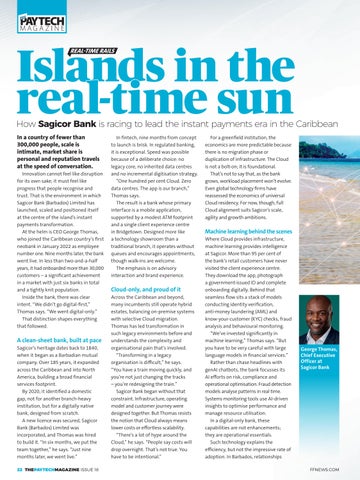
George Thomas, Chief Executive Officer at Sagicor Bank
FFNEWS.COM
matter deeply, says Thomas: “Digital has to meet physical. You can’t just put an app in the app store and expect people to come.” So Sagicor’s team engaged directly with corporate employers, community groups and public audiences. Education became strategic, explaining cybersecurity, demystifying fraud and promoting what Thomas describes as ‘cyber hygiene’. That outreach proved particularly important for older customers who are less accustomed to digital banking, but everyone required reassurance as much as functionality.
efforts. Internally, staff are tested through simulated phishing campaigns. This year, Thomas notes, the bank achieved a 100 per cent pass rate. Security can create friction, though, especially in a real-time environment. Transactions may be flagged; cards may be declined if behaviour appears unusual. Thomas views that friction as evidence of vigilance, demonstrating that convenience must be balanced with control. This coincides with a structural shift in Barbados’ financial infrastructure. Historically,
The Bridgetown client experience centre reinforces that human layer. Its design signals modernity, but its purpose is confidence-building. Customers can speak with staff, seek guidance or simply experience the brand in person. Thomas describes the outcome as ‘a digital bank with a human heartbeat’, and, in a market where word of mouth carries weight, that balance has underpinned rapid growth.
Faster payments aren’t the destination. They’re the plumbing that enables what comes next George Thomas, Sagicor Bank
Security as a strategic pillar Instant payments and digital onboarding increase the stakes on security, which Sagicor treats as a core strategic function. The bank maintains ISO 27001 certification, recently upgrading from the 2013 to the 2022 standard, and also holds SOC 2 Type II certification. Ethical hacking exercises, involving red-team and blue-team simulations, penetration testing and continuous vulnerability monitoring are routine. There is also regulatory accountability. Monthly reporting to the Barbados Central Bank covers vulnerabilities and remediation FFNEWS.COM
the island relied on a batch-based automated clearing house (ACH) system, with transactions clearing at intervals throughout the day. Earlier domestic switching arrangements had faded, while card interoperability shifted toward global schemes. As of March this year, Barbados entered an instant payments era with the rollout of a new domestic real-time payments system. Developed through collaboration between the Central Bank, commercial banks and credit unions, the platform enables real-time interbank transfers nationwide. For consumers, that means funds move immediately. For merchants, it unlocks new use cases and reduces settlement friction. For banks, it raises expectations around availability, integration and risk management.
Sagicor, having already introduced real-time capabilities in 2023, is structurally aligned with these changes. Its Cloud-native architecture integrates naturally with instant rails. “We’re standing on the backs of giants,” Thomas says, referencing global precedents. “But this isn't imitation without adaptation. You can’t just copy,” he says. “You must ask how it’s relevant to your circumstances.”
Small market, agile ecosystem Barbados’ size is often framed as a constraint, but increasingly, it functions as an advantage. In smaller markets, regulators, policymakers and industry leaders operate in close proximity. Alignment around modernisation can translate into swift execution. The instant payments rollout reflects that coordination. Broader discussions around cybersecurity oversight, digital identity and open banking signal an ecosystem willing to evolve. As payment rails modernise, foundations emerge for embedded finance, tokenisation and expanded e-commerce. Local platforms such as Hopscotch, Barbados’s homegrown delivery service, stand to benefit from faster, interoperable payments. Hospitality, ride-share and event-driven commerce can layer new experiences on top of real-time infrastructure. Thomas sees wearables and invisible payments as logical next steps in a festival-driven economy – embedded payments in wristbands, seamless checkout experiences at large events. “Faster payments aren’t the destination,”
he says. “They’re the plumbing that enables what comes next.” And, for Sagicor, what comes next isn't limited to Barbados. As Caribbean jurisdictions modernise domestic rails, regional interoperability becomes conceivable across island economies that share tourism flows and diaspora ties. For Sagicor – part of a multinational group spanning Canada and the Caribbean – that presents strategic opportunity. What is tested in Barbados can inform deployments elsewhere, adapted to local regulatory and cultural contexts. “Barbados was a great start,” Thomas says. “You can expect continued improvements in client experience, new products and innovation that’s relevant to our society.” ISSUE 18 THEPAYTECHMAGAZINE 23
Staying real INSTANT PAYMENTS
Payment Spayce has been quietly building resilient real-time payments integrations for years. Now it’s ready to help businesses in Barbados ride the new RTP rail there Canadian banks have deep and historic roots in Barbados. RBC Royal Bank and Scotiabank have operated on the island for decades. Compliance culture, supervisory philosophy and operational frameworks connect the two markets more closely than many realise. And 2026 will be a significant year for both of them. That’s when the two jurisdictions enter a new era of real-time payments (RTP) almost in parallel, and with it comes a new era of risk management for financial services. Speed has always been the most seductive promise in payments, from the introduction of telegraphic transfers to transitioning from paper-based transactions to electronic Automated Clearing House (ACH) networks. But the arrival of RTP rails has been a seismic shift: governments are modernising their infrastructure and their rules, banks are rethinking oversight, and fintechs are positioning themselves at the centre of compliance. This year, Canada’s long-awaited Real-Time Rail (RTR), overseen by Payments Canada, will deliver 24/7 instant, data-rich account-to-account transfers, while Barbados’ BiMPay initiative, led by
24 THEPAYTECHMAGAZINE ISSUE 18
the Central Bank of Barbados, will transform domestic payments with instant clearing and settlement. For payment facilitators, this change of mindset and technology provides tangible opportunities. And that’s something Barbados-based Payment Spayce has had experience of before. It’s been building real-time capability in North America behind the scenes for years. And its approach has been consistently straightforward: when settlement shrinks to seconds, compliance cannot be an afterthought. The company’s origins were in traditional rails. “We were doing ACH with banks in the US, providing payment services, withdrawing and depositing funds into people’s accounts – commercial accounts as well,” says co-founder Ramon Caracas. But while ACH is reliable, predictable and well understood, it is not instant, and, working directly with sponsoring banks, Caracas says the company gained insight into product development conversations to take transactions to the next level. “We had multiple sponsoring banks
Ramon Caracas and Deborah LePage, Co-founders at Payment Spayce
where we had a peek behind the curtain in regards to certain products or services that they weren’t able to develop,” he explains. “As a technology company, we were able to take a look at what they were not pushing out. They gave us the opportunity to pilot different programmes.”
Evolving the infrastructure The United States is a useful reference point for real-time payments infrastructure. The Clearing House launched its RTP network in 2017, introducing instant, irrevocable settlement among participating banks. In 2023, the Federal Reserve followed with FedNow, expanding coverage further. Adoption has required deep changes in the financial industry – from liquidity management to fraud monitoring to treasury operations and redefined partnerships. “When we built out the RTP system for
Direction of travel: Barbados and Canada are both about to launch RTP rails
FFNEWS.COM
a bank, we became their tech partner in that department,” says Caracas. “What we were able to offer was seven days a week, 24 hours a day, 365 days out of the year.” That distinction matters. Real-time capability is not simply about faster clearing. It’s about operational continuity. Liquidity must be available at any time of the day or night. Fraud monitoring must operate at the weekends. Customer service cannot switch off. For certain merchants, particularly those in sectors where speed is competitive, this alters the landscape entirely. “For a lot of our clients where speed is important, it changed their offer towards their clients,” Caracas adds. “They were able to start changing how they market themselves to gain more clients and separate themselves from their competition.” If Caracas frames the company’s growth through product capability, Co-founder Debra LePage frames it through risk discipline. “I come from a background of compliance and banking,” she says. “But my passion is really sales and product innovation. There’s no sale that’s too great to ever compromise compliance.” Instant payments compresses the window for intervention. Once funds are sent, they are gone. There is no batch file to halt. No opportunity to correct errors. Fraud must be detected before or during the transaction – not after the proverbial horse has bolted. LePage understands that only too well. To illustrate, she describes mentoring an intern who wanted to learn the business. “I threw her into compliance to
FFNEWS.COM
understand what the backend takes from an underwriting perspective when an application comes in, all the way up to walking that client through, to integration,” recalls LePage. “That way, she got to understand the system – it became her sales tool – really understanding that whole full-flow process. “Speaking from my own perspective, I understand what compliance is looking for. When a customer comes in, I prep them on what they need to supply ahead of time. It takes away a lot of back and forth and speeds up the process.”
regime, overseen by the Bank of Canada, PSPs must safeguard funds appropriately, maintain operational risk frameworks and comply with reporting obligations. There is the all-too sobering realisation that anti-fraud precautions need to match the pace of this transformation. Fraud prevention in a real-time ecosystem cannot rely on manual review. Instead, velocity checks, sanctions screening, behavioural modelling and transaction monitoring must operate in milliseconds. That puts Payment Spayce and its technology in prime position in Barbados. At last year’s Money20/20 USA, Payment Instant improvements Spayce announced a partnership with Israeli Barbados’ BiMPay will be launched in two regtech firm ThetaRay to further reinforce phases, with the main financial institutions its infrastructure for the real-time era. and the island’s stock exchange being the The integration embeds AI-driven first participants. The big banks include First transaction monitoring into the company’s Citizens Bank, RBC Royal Bank, Republic Bank, gateway at a time when financial crime Sagicor Bank and Scotiabank. Fintechs will networks are becoming more sophisticated follow in the second phase. and agile, operating with the complexity of BiMPay first aims to fix the current multinational corporations. fragmented infrastructure, whereby current “Our customers – from SMEs to enterprise systems suffer from interoperability issues, clients – are seeing reduced compliance leading to delays and high costs for transactions friction, faster transaction approval times, between different financial institutions. and a higher degree of confidence in their Secondly, BiMPay will allow users to send and cross-border activity. It’s helping them move receive money in real-time (within seconds) money smarter and safer,” says LePage. 24/7/365, with immediate “It’s all done in under a access to funds – a major second. It doesn’t slow upgrade over the current down any transaction. It ACH, which can take days. speeds up the ability to The system also promotes intake a lot more.” financial inclusion, being Payment Spayce says it can accessible to everyone, even push payments safely into those without traditional bank more than 170 countries, the accounts, by allowing for majority in real time. Debra LePage, digital wallets that connect “I think what customers Payment Spayce to the system. It will increase love the most is the speed of efficiency and lower costs for consumers and the transaction,” continues LePage. “For gig businesses by facilitating direct, instant economy workers who are reliant on a vendor transfers, and improving cash flow. payment, they don’t want to be waiting three And finally, the instantaneous system, which or four weeks to receive their money. will use aliases (such as phone numbers or “With our system, those payments are now email addresses) or QR codes to make virtually instantaneous.” payments faster and easier, will keep pace Canada’s implementation of the Retail with Barbados’ wider shift towards digital Payment Activities Act (RPAA) has forced channels. Direct electronic transfers in the a structural reckoning across the payments country have expanded by more than 700 per landscape. For some providers, that has cent in the last decade. meant revisiting internal controls. For others, Meanwhile, Canada’s Real-Time Rail initiative it has meant rethinking governance. For is also more than a technical upgrade. It sits Spayce, it meant altering the architecture alongside the implementation of the Retail of the business itself. Payment Activities Act (RPAA), which introduces “We looked at where the market was a supervisory framework for payment service heading and decided we didn’t want to providers that hold end-user funds. Under the sit on the sidelines,” says LePage.
There’s no sale that’s too great to ever compromise compliance
ISSUE 18 THEPAYTECHMAGAZINE 25
“So we acquired a regulated trust company in Canada and integrated it into our product suite, so now we’re a financial entity in that jurisdiction. It’s not something you can easily acquire anymore – especially in Canada.” In an environment where banks themselves face heightened scrutiny around third-party risk, alignment with a provider that can demonstrate regulatory maturity like that reduces exposure. It was important that the company’s move was proactive rather than reactive, says LePage. “We wanted to be ahead of the curve. “Banks are under pressure," she adds. “They need partners who understand governance, who understand reporting, who understand accountability. It’s not optional anymore. And it’s no longer defensive. It’s competitive.” The logic is straightforward. Payments sit at the centre of everything. As one industry maxim puts it: ‘if you don’t take a payment, you don’t get to revenue; if you don’t get to revenue, you don’t get to profit; if you don’t get to profit, you don’t get to cash’. “Payments are foundational,” LePage says. “If that layer isn’t solid, everything above it is exposed. Compliance ultimately becomes commercial capital. It opens doors.”
only take you so far. A consumer has to feel the interaction, rather than just experience it. “Everybody’s important,” he says. “Big or small, everybody gets treated the same. We really heavily rely on feedback from the clients and our partners. It’s never finished, and you’re always refining. This is how we improve ourselves. “We know that customer experience is more than interface design. It’s onboarding clarity. It’s responsiveness. It’s system reliability. It’s what happens after settlement.” LePage agrees that Spayce’s development model is collaborative. “We ask clients all the
marketing. LePage reaches for a familiar analogy when describing the paytech’s position in the market: the scenario of David and Goliath springs to mind. “I think we’re David,” she says. “But infrastructure changes create competitive openings. When systems modernise, relationships get reconsidered. Qualification criteria evolve.” Real-time rails adoption in both Canada and Barbados may represent just such an inflexion point. “It’s a reset moment,” LePage agrees. “People are reassessing who they want to work with.”
A transformational change Barbados’ transition to instant payment rails touches consumers and small businesses directly. mMoney, currently the leading
You can’t fake it: Real-time requires baked-in resilience
We heavily rely on feedback from clients and our partners. It’s never finished, you’re always refining Ramon Caracas, Payment Spayce digital wallet application on the island, has approximately 20,000 consumers and 2,000 merchants registered, out of a total population of around 280,000 people. This and future wallets will be able to operate over BiMPay, which will reduce the cost of banking for thousands of businesses and consumers. But such transformation, LePage cautions, is rarely immediate. “Everything comes with baby steps,” she says. “There’s going to be that learning curve. [But] faster access to funds matters. For small businesses, especially, that timing can make a real difference. The counterweight to that is that speed increases exposure. So, education has to move alongside infrastructure.” Caracas frames Payment Spayce’s client philosophy in deliberately human terms, emphasising that cold, hard technology will 26 THEPAYTECHMAGAZINE ISSUE 18
time: what would you change, what would you add?” she says. “Not every request is actioned, but when you see the same themes coming up again and again, you pay attention.” Banks, she says, are recalibrating their approach and, as a potential partner, Payment Spayce is stepping up to the plate. “They’re not interested in building out full tech teams anymore. It’s cheaper to partner with somebody like us. For that to work, vendor due diligence is intense. You have to demonstrate operational resilience. You have to demonstrate transparency. It’s strategic alignment. You’re becoming part of someone’s ecosystem.”
Evolving partnerships Spayce’s consistent annual growth has been driven largely by referrals, not by aggressive
For all the discussion of regulation, rails and risk, LePage returns repeatedly to the end user. The ideal payment experience, she argues, is invisible. “They don’t care about infrastructure,” she says. “They care about completion: secure, seamless, frictionless. That’s the goal. “You’re ultimately balancing immediacy with identity verification, fraud prevention and compliance checks. You’re simplifying without compromising. When they work perfectly, they’re invisible. When they fail, they’re headline news.” In the parallel modernisation of Canadian and Barbadian central payment systems, speed is no longer the differentiator; it’s the baseline. What separates providers in this real-time environment, LePage argues, is resilience. “It’s safeguarding of funds, robustness of monitoring, clarity of onboarding, regulatory alignment. Money now moves in seconds. Accountability moves just as quickly. “You can’t fake readiness. In real time, everything shows.” FFNEWS.COM
Connect with Irish innovation Enterprise Ireland supports and funds the most ambitious Irish companies, helping them bring groundbreaking Irish innovation to a global audience. With 42 offices across the globe, our industry advisors are here to connect you with the power of Irish innovation. Discover how we can help your business at enterprise-ireland.com
Helping Irish business go global
Tooling up: ING’s rate of implementation outstrips the industy average
From philosophy to production ARTIFICIAL INTELLIGENCE
ING’s Marco
Li Mandri describes how the bank is putting its AI vision into practice
Over the past 18 months, Dutch banking giant ING has accelerated its digital transformation, pairing strong financial performance with large-scale investment in data platforms, automation – and AI. The group has reported multi-billion-euro annual profits while returning capital to shareholders – financial resilience that has created room to modernise infrastructure and scale digital innovation. The latest AI capabilities now sit firmly at the centre of that transformation, not as a lab experiment, but as embedded capability across retail, operations and wholesale banking. Recent developments underline the shift from proof of concept to scaled deployment. More than 90 per cent of ING’s generative AI pilots have progressed into production
FFNEWS.COM
environments, a high conversion rate in a sector where roughly two-thirds of AI proofs of concept fail to industrialise. The bank has rolled out AI solutions across multiple markets, automated large elements of customer service and begun piloting with agentic AI in selected domains like voice agents and mortgages. At the same time, AI is being embedded in financial crime monitoring, know-your-customer (KYC) processes and internal engineering workflows, signalling enterprise-wide integration rather than isolated innovation. It is this prioritised approach that separates ING from many of its peers. “Last year, we measured how many of the pilots we started in generative AI made it into production, and that number is above 90 per cent,” says the bank’s Global Head of Advanced
Marco Li Mandri, Global Head of Advanced Analytics Strategy at ING Bank
Analytics Strategy, Marco Li Mandri. And he attributes that to prioritising projects that are ‘based on value’. In other words, ING has concentrated on domains where AI can deliver immediate customer or operational impact. Across the banking sector, AI investment has surged, but implementation maturity remains uneven. A recent EY-Parthenon generative AI survey found that 77 per cent of banks have launched or soft-launched generative AI/genAI use cases, yet far fewer have scaled them meaningfully into production. Governance complexity, fragmented data and organisational readiness continue to slow progress. ING, however, appears to be moving faster than the industry’s average implementation pace.
ISSUE 18 THEPAYTECHMAGAZINE 29
That acceleration could stem from ING’s entrepreneurial spirit, a larger technology war chest, or structural advantages in data architecture – or a combination of all three. But culture and operating philosophy undoubtedly play defining roles. Elsewhere in this issue (page 6), ING’s COO Marnix van Stiphout talks of the bank raising AI agents, each tasked with running critical operational functions under human supervision. It is a metaphor intended to capture ING’s production-led mindset: build agents, govern them and deploy them at scale. Add to that a sustained focus on digital transformation – reskilling employees, centralising analytics platforms and embedding responsible AI frameworks, Its internal experience is also shaping external sentiment. ING’s own 2026 investment outlook identifies AI as a structural growth engine, capable of boosting productivity, attracting capital and offsetting labour shortages across the economy. That institutional conviction, rooted in hands-on deployment rather than abstract forecasting, has contributed to a notably bullish investor perspective on AI-enabled banking transformation.
Getting personal Retail banking has been ING’s first proving ground, and hyper-personalisation sits at the forefront of it. ING has developed a global tooling layer that allows marketers to deliver highly tailored communications at scale. “More than seven million customers globally received a personal message,” Li Mandri says, describing campaigns calibrated to behavioural data, product relevance and life-stage signals. The result? Measurable uplifts in satisfaction and engagement. Credit decisioning provides another high-impact deployment, says Li Mandri. Machine learning models now support instant lending approvals in multiple markets, compressing wait times that stretched over days, into decisions delivered in seconds. “We have machine learning models that now instantly provide loans,” he says. “Customers do not have to wait.” Contact centres have been equally fertile territory. ING was among the early European banks to deploy generative AI chatbots directly into retail service environments. Today, those systems operate across most of ING’s retail markets, handling between 65 and 75 per cent of routine customer queries. 30 THEPAYTECHMAGAZINE ISSUE 18
“They help reduce friction,” Li Mandri explains, freeing human agents to focus on complex or emotionally nuanced interactions. “And we are working to make these chatbots smarter… with the ability to execute actions, but also moving into voice,” he adds. Voice agents represent the next interface layer – conversational systems capable not only of answering questions but also of resolving requests in real time. “Voice bots will be able to understand what customers are asking, provide an answer, and also execute some of the actions already in that moment,” says Li Mandri. Beyond retail, ING is embedding AI into operations and wholesale banking. Know-your-customer processes in wholesale
learning and genAI. Machine learning flags suspicious transactions with greater precision; generative systems then assist analysts by extracting, summarising and contextualising case data. “It’s about improving the efficiency… without compromising risk,” says Li Mandri. Digital transformation is also reshaping ING’s engineering backbone. More than 5,000 software engineers now use AI as a peer-programming tool, augmenting coding productivity, accelerating testing cycles and shortening time-to-market for new digital services. “It’s very well received,” Li Mandri notes. Yet perhaps the most structurally transformative layer sits within agentic AI
It’s about improving the efficiency… without compromising risk banking – traditionally labour-intensive and document-heavy – are being augmented with AI, but also data extraction and summarisation tools are being used to improve front office productivity. The same capabilities support sustainable finance structuring, where large datasets must be analysed to benchmark companies against their ESG (environmental, social and governance) peers.
Implementing AI, front to back Front-office productivity is another emerging domain. Li Mandri says ING is testing AI tools that prepare client meeting briefs automatically, aggregating financial data, prior interactions and market context so that relationship managers can focus on advisory depth rather than administrative preparation. KYC, however, remains one of the most strategically critical battlegrounds. Anti-money-laundering systems are being re-engineered through a blend of machine
(agents set up to perform specific tasks to a set of instructions), which are now in pilot phase. Mortgage processing has been selected as the initial focus for this. Agents augmenting human underwriters by extracting data, validating policy compliance and generating documentation will shorten approval timelines, ‘potentially to within a day’, says Li Mandri. But human advisory roles remain intact, he insists. “Advice is still human and very important,” he stresses. Looking ahead, ING’s roadmap centres on scaling AI across more domains and pilots with agentic AI, supported by a centralised analytics platform and workforce AI-fluency programmes. Li Mandri’s mandate is to build, deploy and govern those agents, ensuring their outputs remain aligned to customer value with augmentation over replacement, governance not opacity. In an industry still learning how to maximise the potential of AI, ING’s progress suggests the idea is not just conceptual. The AI fields are already in cultivation. FFNEWS.COM
Find out more
Ahead of the game: AI innovation must go hand-in-hand with trust and security
Leanıng ın and steppıng up! STATE OF THE NATION
Finastra’s annual State Of The Nation report on the challenges facing financial institutions and their technology responses to them, highlights just how much the instant payment revolution is driving adoption of AI When one of the world’s leading fintechs concludes that decisions made by financial institutions in the next 11 to 18 months will shape their competitiveness for the rest of the decade, it pays to take notice. Finastra’s State Of The Nation 2026 report based its observation on a survey of more than 1,500 banking and FI executives across 11 countries, including the US and the UK. It revealed that AI, modernisation, security, and customer experience are no longer being viewed as separate initiatives. Instead, they are converging into a single operating 32 THEPAYTECHMAGAZINE ISSUE 18
Radha Suvarna, Chief Product Officer for Payments at Finastra
reality where execution, resilience and trust matter just as much as innovation. Nowhere is this more apparent than in payments. That's no surprise, says Radha Suvarna, Finastra’s Chief Product Officer for Payments. “Payments is in the front line of customer experience and trust, more than any other area of financial services, because we’re all interacting with payments every day,” he says. What is new, however, and what the report identified, is that confluence of priorities – execution, resilience and trust – and how AI is being leveraged across all of them.
Suvarna’s advice? “Lean in and figure out your strategy. Craft a story that is very customised to your specific organisation. That’s the key. “Think about what’s going to deliver most value to your customers in the near term. That could be delivering a particular use case, modernising a set of capabilities, or improving the user experience.” Whatever their specific roadmap, Suvarna cautions against banks and FIs going on the journey alone. “Whether it’s a bank or whether it’s Finastra, if everyone tries to do everything by themselves, no one’s going to be successful,” he says. “And FFNEWS.COM
it’ll take you away from the core mission of your organisation. If the core mission of my organisation, as an example, is to deliver payment hubs and financial messaging solutions that work all the time, I may not have any business building fraud detection models. Just because I can doesn’t mean I should. The same applies to every organisation. “So, figure out what your core mission is, focus on that, and partner with ecosystem players, because that will help you be nimble, experiment and fail fast. Banks and financial institutions need to keep that in mind, especially in times like this, where the change is happening fast and furious.”
Finastra’s Top 5 Ways To Lean On Partners To Future-proof
1
Accelerate Modernisation “Ninety-six per cent of the people we surveyed said they are actively pursuing AI and modernisation within their organisations, either implementing something or working on implementing something,” says Suvarna. “Experimentation is the key theme that we have seen this year,” he continues, “but banks can do that only when they have modern technology platforms that make it easier to experiment and fail fast.”
Progress is not about being the biggest or the fastest, but about being the most dependable
Finastra State of the Nation report 2026
Here, though, many feel they face a dilemma: partnerships speed up innovation, but in-house builds ensure data sovereignty, even if that comes at a much higher cost in expertise and infrastructure. The report proffers a pragmatic solution: “For leaders who are cautious about over‑reliance on external providers, the most resilient path forward is not choosing one model over the other but blending both,” it says. “Leveraging partnerships to accelerate innovation while retaining in‑house builds for areas where control, compliance, and data integrity are paramount.” This is the first survey where AI and modernisation are equally top of mind for business leaders, points out Suvarna. While AI can deliver powerful customer experience in some cases, it is also driving internal change. “And that’s mutually reinforcing, multiplying the ability to deliver FFNEWS.COM
the end customer experience, because now banks can experiment with new solutions faster, thanks to AI coding and testing agents,” says Suvarna. “It’s going to take longer initially to test some of these AI use cases. That’s always going to be the case with anything new. But stay with it because the exponential growth of efficiencies that you will see subsequently is likely to deliver real value.”
2
Close the skills gap Forty-three per cent of financial institutions surveyed by Finastra for the report said that a talent and skills gap is stopping them from modernising. So, its second recommendation relates to accessing specialised talent in AI, Cloud and security, where shortages are most acute. Suvarna highlights how the dramatic growth in demand for immediate payments has highlighted the necessity for FIs to have the right staff working on the right technology. “Instant payments are growing, and, as a result, regulators are expecting banks to make their systems resilient and always on. In order for them to deliver that, the payment models, be it fraud detection or sanctions screening, have to become much faster,” he says. “You don’t have the luxury of a wire transfer that can sit for two hours while someone is going through a repair. The transaction has to happen within seconds, and it’s humanly impossible for somebody to go and fix it in that timeframe.” That’s forcing adoption of AI as a co-pilot and redefining the role of operations staff. Across the sector, the recruitment challenge is particularly acute in Singapore (54 per cent), the UAE (51 per cent), and Japan and the US (50 per cent). And within the sector, hedge funds face the largest shortages, says the report. So what’s the solution? Here again, partnerships with providers are seen as key. Fifty-four per cent of organisations surveyed believed this was the fastest way to add new technology capabilities and mitigate internal gaps, allowing them to ‘access innovation without bearing the full burden of talent’. . Streamline integration The best way for institutions to go about streamlining integration, according to the report, is by adopting modular APIs and interoperable platforms. That allows them to modernise discrete areas of the business where value can be felt fast. “Modernise a set of capabilities, whether it’s user experience or the intermediate
3
interface layer, if that’s what is going to deliver most value to the customers in the near term, versus going all the way to the back end and modernising the underlying systems,” says Suvarna.“Put some points on the board in terms of the value of modernisation and then progressively go on the journey.”
4
Strengthen compliance Almost half of the institutions surveyed cited constantly evolving risks and AI deployment itself as their two biggest security concerns. As a result, four in 10 were prioritising investment in security. Finastra suggests they reframe it as an investment not only in risk but also in competitiveness. “Leaders need to think about security not just as an insurance policy but also as a growth strategy,” the report says. Suvarna cites the use of AI for fraud detection and sanction screening as examples of where
Experimentation is the key theme that we have seen this year. But banks can do that only when they have modern technology platforms that make it easier to experiment and fail fast Radha Suvarna, Finastra
technology dollars in auditable workflows and embedded reporting not only minimise regulatory risk, but also improve customer experience, driving better results for banks.
5
Balance sovereignty concerns Finastra is aware that this is an acute issue for banks. But it can be achieved by establishing governance frameworks that maintain control while benefitting from external innovation, it says. “We have to absolutely retain, if not enhance, security and trust within payments,” stresses Suvarna. “No matter what the better customer experience might be, new technology and capabilities can’t be at the expense of that. That is absolute table stakes.” The key takeaway from the State Of The Nation report? “Progress is not about being the biggest or the fastest, but about being the most dependable. Firms that build responsibility into every decision will not only earn trust, but they will also define what competitiveness looks like in the age of AI.” ISSUE 18 THEPAYTECHMAGAZINE 33
Weight of responsibility: But AI could relieve banks of a burden
Travelling light LEGACY DEBT
Fragmented and legacy systems are weighing down banks, undermining the innovation agility that modern payments now demand, according to Temenos
For all the noise around digital transformation, payments remain the most unforgiving test of whether banks are truly modernising, or merely updating the language they use to describe themselves.
Customers expect money to move instantly, securely and transparently. Consequently, regulators expect compliance in real time. And, in the already frantic race to modernise, financial institutions, still carrying decades of accumulated technology debt, are expected to deliver both of these often conflicting priorities at scale. It is against this backdrop that banking software provider Temenos chose SIBOS 2025 in Frankfurt to unveil Money Movement & Management, its intelligent, unified platform that brings together payments processing, account management, risk and treasury into a single operating layer. On the surface, it is simply another product launch. In context, it is a response to a deeper structural challenge facing the industry: innovation is accelerating faster than most banks’ infrastructures and governance models can comfortably keep up with. For Heman Daswani, Payments Specialist at Temenos, that tension defines the current moment. “Before we even talk about challenges,” he says, “we must all acknowledge that we are in this golden era for payments innovation.” He is acknowledging the fact that AI, open banking, blockchain and stablecoins are no longer theoretical. They are shaping 34 THEPAYTECHMAGAZINE ISSUE 18
customer expectations and competitive dynamics in real time. “The problem,” Daswani adds, “is that a lot of the critical mass of the banks is not able to move as fast and catch up with this innovation because of the legacy technology they have within their institutions.” That technology, he argues, is neither nimble nor designed for real-time finance, and it is increasingly acting as a brake on growth.
Innovation outpacing infrastructure This mismatch is most visible in payments, given their inherent challenges around customer expectations of speed and ease and sheer transactional volumes, fuelled by today’s always-on digital landscape. Instant payments have been live for years, yet many banks still lack 24/7 cores. Real-time fraud and sanctions checks are not universal, despite the rapidly accelerating volume and complexity of threats. “Even if they have these two things,” Daswani notes, “oftentimes they are lacking the capability to make use of the rich data that comes in the new ISO 20022 payment formats.” The result is a patchwork of systems, each performing a narrow function, none offering end-to-end visibility or control. “That legacy technology is like baggage that a lot of these institutions are carrying,” he says bluntly. “It’s stopping them from moving as fast as they should right now.” Those concerns resonate strongly with what Temenos hears at board and executive
level. According to Sairam Rangachari, Chief Product Officer at Temenos, the company’s conversations with banks echo that. “We hear three things from banks all the time,” he says. “Number one is how do they reduce risk and complexity. The second is that they’re worried about the spiralling cost of operations. The third is how can they enable growth and innovation from the point of view of core banking.” In other words, transformation is no longer about experimentation. It is about survival, efficiency and relevance all at once.
Cutting through the AI hype AI sits at the centre of this conversation, but not always comfortably. “There’s a lot of hype,” Rangachari acknowledges. “Banks get pitched AI quite a bit these days.” Yet when the conversation turns practical, priorities sharpen quickly. “What we consistently hear is: can we look at AI for security? Can we look at AI for fraud monitoring? Compliance efficiencies? And of course, how do we create hyper-personalised experiences for customers?” he says. These are not moonshot ambitions. They are grounded, operational demands, and they reflect a maturing attitude to AI across financial services. As the industry moves from pilots to production, AI is increasingly judged not on novelty, but on measurable impact. That shift is visible in payments and compliance, as volume rise, settlement windows shrink, and regulatory scrutiny FFNEWS.COM
intensifies. Manual review processes simply do not scale. Nor do fragmented architectures designed for batch processing in a real-time world.
One platform, four pillars Temenos Money Movement & Management is built around this reality and layers on top of the company’s existing Temenos Payments Hub, which is already used by banks globally. The integrated money movement and management platform encompasses payments processing, account management, risk and treasury capabilities. The logic is straightforward: every payments operation, whether in a bank, fintech or EMI (electronic money institution), ultimately revolves around these four pillars. Providers need payments to process efficiently, at scale and without exceptions. They must manage customer accounts as well as internal nostro and settlement accounts. They need real-time visibility into liquidity across those accounts to ensure smooth settlement. And overarching all of this is risk management: real-time screening and fraud monitoring from a payments perspective.
Legacy technology is like baggage that a lot of these institutions are carrying. It’s stopping them from moving as fast as they should right now Heman Daswani By unifying these capabilities, Temenos aims to modernise not just payments technology, but the operating model that sits beneath it. AI is embedded across the workflow, automating payment repair, improving straight-through processing and reducing manual intervention. This approach extends to compliance. Temenos’ Financial Crime Mitigation AI Agent, launched earlier in 2025 and now integrated into the platform, evaluates screening alerts in real time, achieving false-positive rates below two per cent in live deployments, compared with an industry average of five to eight per cent. In a sector where more than 40 per cent FFNEWS.COM
of compliance costs are tied to personnel, the implications are profound. Fewer false positives mean fewer interrupted payments, faster settlement and better customer experiences, without compromising regulatory obligations. Compliance shifts from being a bottleneck to becoming an enabler of scale.
Agility without recklessness Beyond efficiency, banks are also looking for room to experiment safely. Stablecoins, real-time payments and new AI-driven services are all on the agenda, but so, too, is risk containment. “If you peel back the onion and look at what banks really, really want,” Rangachari says, “they’re looking for innovation agility. How can they experiment? How can they take new ideas to customers without having to spend too much money or worry about risk and complexity?” he asks. “And, of course, they’re looking at a lot of efficiency plays around compliance. And AI has very, very promising ideas there.” That balance, between speed and safety, is becoming the defining challenge of modern banking. It is also where regulation looms largest. Historically, periods of rapid innovation are followed by regulatory consolidation. “When there is rapid disruption,” Daswani observes, “we see that the regulatory regime catches up. They start putting more and more controls, more safety nets around the responsible use of these innovations.” In the UK, regulators have resisted AI-specific rulebooks, favouring principles-based, outcomes-focussed oversight that’s embedded in existing frameworks. In the EU, the AI Act introduces additional safeguards for high-risk use cases while explicitly seeking to avoid unnecessary duplication with financial regulation. “We are still in a situation where the regulatory regime is not yet firm on all these innovative topics,” Daswani says. “We will see that shaping up, which will determine how frequently or how safely we can use these innovations in future.”
Y2K to AI: another inflection point There is certainly an uncomfortable sense of déjà vu here. It was Y2K that
last forced banks to confront the systemic risks of retaining legacy technology at scale. Artificial Intelligence is creating a similar inflection point, but with far less time to respond. Payments are already real-time. Customer expectations are already reset. Regulatory scrutiny is already intense. Temenos’ approach centres on a unified platform model. Fewer platforms, more deeply integrated. Intelligence embedded by design, not bolted on. Compliance treated as core infrastructure, not an afterthought. For incumbents, the platform offers a way to drop the baggage without sacrificing trust. For new entrants, it accelerates time to market, too. FINCI, an EMI regulated by the Bank of Lithuania, went live on the Money Movement & Management platform in just four months, processing thousands of payment requests per second and onboarding new payment providers in a matter of a few weeks.
If you peel back the onion and look at what banks really, really want, they’re looking for innovation agility Sairam Rangachari
The new platform is part of a new framework for the next phase of transformation, one characterised by reduced risk and complexity through unified architectures, lower operating costs via AI-driven automation, straight-through processing, innovation agility without reckless experimentation, and compliance-at-scale, embedded and explainable. As banks navigate this ‘golden era’ of payments innovation, the question is no longer whether AI will reshape money movement, but whether existing infrastructures and governance models can keep up. Temenos’ answer is clear: modernisation cannot be piecemeal, and AI cannot live at the edges, because in a world of instant money and adaptive regulation, where the AI is powering good and bad actors alike, standing still is no longer a neutral option: it is a strategic risk.
Sairam Rangachari, Chief Product Officer at Temenos
Heman Daswani, Payments Specialist at Temenos
ISSUE 18 THEPAYTECHMAGAZINE 35
Irish eyes on London ENTERPRISE IRELAND
The UK is a key destination for fintechs from Ireland, many of which are supported overseas by their government’s trade and innovation agency. The London Stock Exchange is welcoming them with open arms When Ireland’s Minister of State at the Department of Finance, Robert Troy, rang the bell to open trading at the London Stock Exchange in November 2025 – the first Irish minister to do so – the tickers lit up a beautiful deep shade of shamrock green. It wasn’t a stunt. But it was a very fortuitous coincidence. The luck of the Irish, perhaps. Troy was heading a delegation of fintech founders and representatives from Enterprise FFNEWS.COM
Ireland (Europe’s third most active VC investor in fintech) to London, just as chipmaker and AI bellwether Nvidia’s knockout results lifted prices across the board. The LSE isn’t Nvidia’s primary listing – that’s the US NASDAQ – but it is the market that 42 Irish companies with a combined market cap of €210billion have chosen to go public on. Around half are dual listed with the London and Dublin exchanges, giving them ‘a unique strategic positioning’, according to LSE CEO Julia Hoggett, who admits she has a soft spot for the Emerald Isle. “It’s very much the place where I feel at home,” she says. “It matters personally to me that we do everything we can to support Enterprise Ireland through the LSE.”
A proactive investor Operating as a ‘fund of funds’, the Irish government’s trade and innovation agency has been responsible for driving more than €1billion of VC investment into Ireland-backed fintechs over the past five years; companies like ID-Pal, which recently upgraded its award-winning SaaS identification verification
and screening engine that doesn’t require access to customer data for KYC. Its most recent enhancements raise the ante on injection attacks – a fast-growing type of AI-driven fraud that involves hijacking and manipulating images during the ID verification flow, bypassing selfie and document checks. Founder and CEO Colum Lyons was keen to stress just how important Enterprise Ireland had been to his company’s global expansion. “The DNA of the Irish is to be helpful,” he says. “That definitely goes for the people at Enterprise Ireland, who were our first backers – they wrote the first cheque – and, in the last three to four years, as we have scaled into new markets, they’ve been at our side the whole time.” With just over €8million in investment from multiple rounds now under its belt, 30 per cent of ID-Pal’s revenue is generated from UK clients, while a strategic partnership with Salesforce is driving growth in the States. The company’s solutions currently support more than 7,000 identity documents and 200 verified address data sources in 200 countries. “To be successful, you need to get beyond Ireland,” says Lyons. ISSUE 18 THEPAYTECHMAGAZINE 37
While 17 of the world’s top 20 banks have a base there, alongside 400 financial services firms, Enterprise Ireland’s Executive Director, Kevin Sherry, agrees that most fintechs who dream big will need to look offshore. “Our jewel in the crown is our overseas offices to help Irish companies gain a foothold in foreign markets,” says Sherry. “Global offices are the eyes and ears for us while providing an introductory mechanism for businesses.” There are Enterprise Ireland representatives in 42 bases across 26 countries. The UK team of 30 includes specialists with a particular focus on financial services and others with deep expertise in related technologies, of which cybersecurity is a major segment, all supported by an advisory panel made up of CTOs and CIOs.
“We do that to be relevant to industry on both sides: the one that’s seeking innovation and the Irish industry looking to enter the market,” says Anna-Marie Turley, Head of Fintech, Financial Services & Cybersecurity at Enterprise Ireland. The crucial role the agency plays as a super-networker is reflected in its strategy: Start, Compete, Scale and Connect. “That last one for us, as an organisation, is key,” says Sherry. “We have lots of feedback from CEOs and entrepreneurs who tell us we play a hugely important role as a connector for them in Ireland and globally.” He doesn’t see the agency’s job as pitting Ireland against other states for investment and jobs. Rather, it’s ‘growing the cake’ for everyone. “It’s not about the Irish coming to the UK and redirecting investment to Ireland; we come with a view to partnership, investment and job creation in both countries,” he says: “A great example of that is Version 1.” A mature tech company, headquartered in Dublin with offices around the world, Version 38 THEPAYTECHMAGAZINE ISSUE 18
1 specialises in large-scale AI-driven transformation projects and is investing £40million into AI-related hubs across six UK cities during the course of 2026/27, creating hundreds of local jobs in London, Birmingham, Newcastle, Manchester, Edinburgh, and Belfast. Like ID-Pal, Version 1 realised early on that international expansion was a no-brainer. And, like ID-Pal, the US is an important market. “Expansion in the US is a critical aim for Version 1,” says CEO Roop Singh.
Entries and exits While the size of the prize across the Pond is eyewatering for Irish founders, they’re meeting many leaders rowing the other way these days. America’s unpredictable environment is likely
But it’s often in that tricky transition between startup, scaleup, acquisition and exit that founders need most help, says Turley. “There’s an increasing dialogue around how you scale in financial services and help them through the riskiest stages,” she says. Colum Lyons has recently navigated one of them: ID-Pal’s first acquisition in December 2025 of London-based regtech Northrow for an undisclosed sum. Northrow’s portfolio of financial services clients includes Equifax and Hargreaves Lansdown, while ID-Pal works with multiple government departments and FS firms. The deal means ID-Pal can now offer clients ‘native, end-to-end KYB checks, enabling firms to verify businesses at onboarding and to
We have lots of feedback from CEOs and entrepreneurs who tell us we play a hugely important role as a connector for them in Ireland and globally Kevin Sherry, CEO, Enterprise Ireland behind a big leap in dollar investment into Ireland in 2025 – up 37 per cent year-on-year in the first half. Most recently, US-based Payoneer acquired Dublin fintech start-up Boundless in January 2026. Many LSE-listed Irish companies have significant US backing. And, if a founder is looking to move on, being merged with or acquired is a good route out, whoever’s doing it. “The vast majority of exits we see are trade sales and acquisitions by major internationals with a propensity for the US,” says Sherry. With its own seed fund, Enterprise Ireland helps crank-start companies and supports applied research in technology hubs grouped around universities involved in commercial projects that require a long runway.
continuously monitor changes in company structure, directors or status’. Others in the Enterprise Ireland fintech cohort, including Fenergo and Clear Strategy, will be adding to their UK headcount this year, too, deepening the relationship between two of the highest-ranked fintech hubs in Europe. Much like Sherry, the LSE’s Hoggett doesn’t see it as a competition. In all cases, the role of the market operator is the same, she says. “Stock exchanges are conveners. Our role is to bring [investors and companies] together; to get companies to grow, stay here and scale here. “Irish companies listing on our market represent substantial value. Everything we can do to support capital to support [them], we will do.” FFNEWS.COM