vim&
SUMMER 2010 $2.95
FIND CLASSES AND EVENTS IN THE BACK OF THIS ISSUE
Healthy Living for Your Family
Avoid another heart attack THE LATEST IN COMMON CANCER TREATMENTS
Decisions that help you enjoy pregnancy
Brought to you by:
FdVVSU1094_00_Cover.indd 1
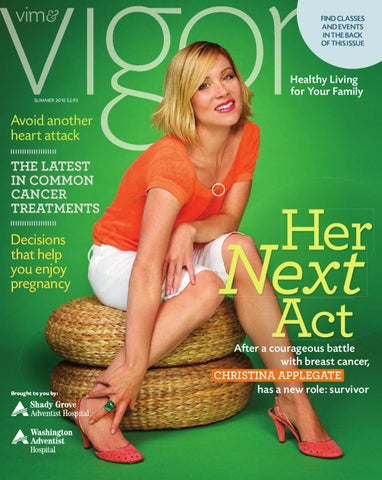
Her Next Act
After a courageous battle with breast cancer, CHRISTINA APPLEGATE has a new role: survivor
3/2/10 5:20:56 PM
CONTENTS
SPECIAL Get with the Program Exercise training, nutrition and education help heart patients avoid cardiac episodes down the road.
4 DEPARTMENTS 2
Opening Thoughts Discover two new ways we’re improving access to care for our communities.
COVER PHOTOGRAPH © MICHAEL GRECCO/CONTOUR BY GETTY IMAGES
HA1 Health Advisor Health and wellness classes, programs and support groups for a healthy mind, body and spirit.
3 6 8 10 16 18
FEATURES
Summer First Aid Learn about five common ailments of the season—and how to treat them at home. Choices in Childbirth You have enough to worry about during your pregnancy. But figuring out three areas can help you make the most of this special time. Understanding the Options Find out what’s involved in today’s cancer treatments. Ready ... Set ... Get Motivated! Give your health an overhaul with this plan for long-term success. Having Reservations? Restaurants are a minefield of nutrition no-nos. But they are navigable— with a helping of common sense. Stressing Stress Anxiety isn’t just a mental problem. Find out how it physically affects your body from head to toe.
30 35 38 42 46
Adults at Play Want a surefire way to induce relaxation? Tap your inner child and go out and play. In Good Hands Carpal tunnel syndrome can make almost any task painful. Get a grasp on the condition and find relief. Think Again Six thoughts that may sound innocent could actually mean heart attack. Learn when to listen to your body. No Kidding Humor columnist Dave Barry had a colonoscopy—and lived to tell about it! Read his story. Giving Is Great Medicine It’s better to give than receive. But did you know that donating time or money can benefit your health, too?
SECOND ACT
24
As Christina Applegate knows, a diagnosis of breast cancer is devastating and daunting. But it also can lead to a sense of renewal when it’s all over. Read about her experience and how you can persevere. Vim & Vigor · SUMM ER 2010
FdVVSU1094_01_TOC2.indd 1
1
3/29/10 9:50:21 AM
Opening Thoughts
Expanded Access to Healthcare
A family health magazine brought to you by Shady Grove Adventist Hospital and Washington Adventist Hospital, members of Adventist HealthCare President & CEO, Adventist HealthCare Inc. William G. “Bill” Robertson
Delivering our mission to the community
President, Shady Grove Adventist Hospital Dennis Hansen
I
President, Washington Adventist Hospital Jere Stocks
mproving access to care for our communities has been part of Adventist HealthCare’s mission for more than 100 years. Our commitment to the health of our community has been demonstrated through our collaborative, handson work as well as our partnerships with other organizations in the community. We Dennis Hansen are pleased to update you on two important initiatives that are also part of this continuous commitment.
PRODUCTION Editorial V.P./Strategic Content: Beth Tomkiw Editor-in-Chief: Shelley Flannery Editors: Sam Mittelsteadt, Matt Morgan, Amanda Myers, Jill Schildhouse, Tom Weede, Julie Wlodychak Copy Editor: Cindy Hutchinson
Design Managing Art Director: Adele Mulford Art Directors: Lisa Altomare, Monya Mollohan, Kay Morrow,
Jere Stocks
Tami Rodgers, Keith Whitney
Production Senior Production Manager: Laura Marlowe Ancillary Production Manager: Angela Liedtke Imaging Specialist: Dane Nordine Production Technology Specialists: Julie Chan, Sonia Washington
Washington Adventist Hospital’s Relocation An application has been submitted to the state of Maryland requesting approval to relocate Washington Adventist Hospital to the White Oak/Calverton area, along the border of Montgomery and Prince George’s counties. The new location will offer better access to health services, a state-of-the-art healthcare facility and a variety of other health services on our campus. On the current Takoma Park campus we plan to create a Village of Health and Well-Being that will offer extensive healthcare services including urgent care, a primary care clinic, and educational and social services for the community. For information, visit www.expandedhealthaccess.com or join Washington Adventist Hospital on Facebook.
Circulation V.P./Business Intelligence Group: Patrick Kehoe Postal Affairs & Logistics Director: Joseph Abeyta
client services V.P./Sales & Product Development: Chad Rose, 888-626-8779 V.P./Client Services & Strategy: Heather Burgett Account Managers: Barbara Mohr, Andrea Parsons, Paul Peterson, Todd Speranzo
Advertising Sales Advertising Sales Representatives New York: Phil Titolo, Publisher, 212-626-6835 Phoenix: Soliteir Jaeger, Associate Publisher, 888-626-8779 Mail Order: RB Advertising Reps Inc., 914-769-0051
Clarksburg Community Hospital and Germantown Emergency Center Nearly 10 years ago, Adventist HealthCare purchased land in Clarksburg and began planning for the future healthcare needs of the rapidly growing upcounty area. Adventist HealthCare has submitted an application seeking state approval to build a new hospital and comprehensive medical campus in Clarksburg. Plans for the campus also include a nursing and rehabilitation center, a primary care clinic for the uninsured and a day-care center. The hospital and medical campus would blend well with existing healthcare services, including the Shady Grove Adventist Germantown Emergency Center. To learn more, visit www.clarksburghospital.com or join Clarksburg Community Hospital on Facebook. These projects are just two examples of our continuous work to improve access to care. In good health,
Dennis Hansen President Shady Grove Adventist Hospital
2
Jere Stocks President Washington Adventist Hospital
ADMINISTRATION Vim & Vigor Founder: J. Barry Johnson Chairman: Preston V. McMurry Jr. President/Chief Executive Officer: Christopher McMurry Chief Operating Officer/Financial Officer: Audra L. Taylor President/Content Marketing: Fred Petrovsky
9901 Medical Center Drive, Rockville, MD 20850 www.shadygroveadventisthospital.com
7600 Carroll Ave., Takoma Park, MD 20912 www.washingtonadventisthospital.com If you receive more than one copy of Vim & Vigor, or if you do not wish to receive this publication, please call 301-315-3044. Vim & Vigor,TM Summer 2010, Volume 26, Number 2 is published quarterly by McMurry, McMurry Campus Center, 1010 E. Missouri Ave., Phoenix, Arizona 85014, 602-395-5850. Vim & VigorTM is published for the purpose of disseminating health-related information for the well-being of the general public and its subscribers. The information contained in Vim & VigorTM is not intended for the purpose of diagnosing or prescribing. Please consult your physician before undertaking any form of medical treatment and/or adopting any exercise program or dietary guidelines. Vim & VigorTM does not accept advertising promoting the consumption of alcohol or tobacco. Copyright © 2010 by McMurry. All rights reserved. Subscriptions in U.S.: $4 for one year (4 issues). Single copies: $2.95. For subscriptions and address changes, write: Circulation Manager, Vim & Vigor,TM McMurry Campus Center, 1010 E. Missouri Ave., Phoenix, Arizona 85014.
Vim & Vigor • SUM M E R 2 0 1 0
FdVVSU1094_02_Thoughts.indd 2
3/2/10 5:32:02 PM
Summer First Aid
The scoop on five common ailments of the season—and how to treat them at home
1
2 3
hydrocortisone cream or calamine lotion to relieve itching— the rash will dry and flake off in a week or two. Sprains and strains. When ligaments around a joint are stretched beyond their normal range, you get a sprain. The joint may swell and appear bruised. Strains are caused when the muscle is stretched or torn. In each case, ice the area to reduce swelling and take an over-thecounter painkiller. Swimmer’s ear. This infection is caused by water that gets trapped in the ear canal and unbalances the natural acidity. You may feel severe pain, and your ear and lymph nodes may swell. Take anti-inflammatory painkillers and use warm heating pads. Avoid swimming until the infection clears. See a doctor if there is pus draining from the ear.
4
5 ONLINE
Warm weather seems to bring out the adventurer in every member of the family. Minor injuries and ailments crop up throughout the season but, thankfully, most only require at-home remedies, using supplies you should always keep on hand. Sunburn. Even the strongest sunscreen is compromised by sweat and water. If you get sunburned, your skin turns red and hurts. Squeeze the clear liquid from a fresh-cut aloe vera branch onto the sunburned area to ease discomfort—or use aloe vera gel available at health-food stores. An ice pack and a nonprescription painkiller may help, too. Stings. Unless you are allergic to stings from bees, wasps or yellow jackets, the worst you will experience is swelling and pain or itching around the bite. Cold compresses and hydrocortisone cream might help, as may an antihistamine or over-the-counter painkiller. If you have a tick bite, carefully remove the tick so that the entire body is intact. Save it in rubbing alcohol so that it can be tested if you develop a red bull’s-eye around the bite—the telltale sign of Lyme disease. Poison ivy, oak, sumac. These plants contain the same oily resin that causes an itchy rash and blisters in up to 80 percent of people. Wash the resin off your skin right away in a shower, not a bath. Treat the rash with
Protect Your Family. Plan Ahead
Do you know where the closest emergency room is to you? Go to www.adventisthealthcare.com/911 and get directions today.
Go Directly to the ER Although most summer ailments are minor and can be easily treated at home, some problems call for a trip to the emergency room. Heatstroke. This happens when the body’s usual methods of cooling down stop working. If a person runs a fever above 102 F, faints, has seizures, or suddenly stops sweating, call 911. Concussion. The signs and symptoms of a concussion can be subtle and may not be immediately apparent. If someone
suffers a head injury and then vomits, has seizures or shows signs of dizziness, seek immediate medical care. Bee-sting allergy. A sting that causes hives, faintness, wheezing or shortness of breath is a cause for serious concern. Seek medical attention immediately. Broken bone. Immobilize the area as best you can. En route to the ER, stop any bleeding by applying pressure with a clean cloth, and apply ice packs to help ease pain and decrease swelling. Vim & Vigor • SUMM ER 2010
FdVVSU1094_03_FirstAid.indd 3
3
3/15/10 3:11:02 PM
Cardiac rehab puts patients on the path to a healthier way of life
Get with the
m a r g Pro
4
Vim & Vigor • SUM M E R 2 0 1 0
FdVVSU1094_04-5_Heart.indd 4
3/2/10 5:35:35 PM
Understanding Cardiac Rehab “Cardiac rehab is for patients with heart disease and is designed to reduce the risk of future heart problems by introducing lifestyle modification techniques,” says Michael Payne, M.S., CDE, Clinical Coordinator at Shady
Cardiac Rehab Timeline Phase 1 takes place in the hospital, where the main goal is to get patients on the correct medications, out of bed and walking. At this stage, doctors usually meet with the patients to discuss cardiac rehab, its benefits and what to expect.
Grove Adventist Hospital’s Cardiac Rehabilitation and Enhanced External Counterpulsation Center. These heart-healthy changes include getting an individualized exercise evaluation and recommendation; reducing risk factors by lowering cholesterol, blood pressure and weight; going through a smoking-cessation program; being educated about proper nutrition and medication; and seeing a counselor. The benefits of exercise after a heart attack include decreased stress on the heart and improved blood pressure control, Davis says. And the support patients get from fellow cardiac rehab program members can greatly improve their outlook. “After a heart attack, many patients struggle with depression and anxiety,” Payne adds. “Speaking about these issues with the staff and other participants who may be experiencing the same feelings is extremely important in the recovery process.”
ONLINE
I
f you were a heart patient with a chance to avoid another cardiac episode, would you take it? A whopping 80 percent of heart patients don’t. That chance, better known as cardiac rehabilitation, is a program of exercise training, nutrition and education that greatly reduces your risk of experiencing another heart problem and improves your quality of life. “People who engage in cardiac rehab live longer, and they feel enormously better, too,” says Linda Davis, R.N., B.C., Supervisor of Cardiac Rehabilitation at Washington Adventist Hospital. “They’re more energetic, they feel better and they work better.” The number of people who might benefit from cardiac rehab is high: An estimated 1.2 million people in the U.S. will have a new or recurrent coronary attack this year, while an additional 800,000 will have coronary artery intervention procedures such as bypass surgeries. Those who undergo cardiac rehabilitation have a 26 percent lower risk of dying of their heart disease than people who do not participate in a rehab program, according to the American Heart Association.
2 Minutes to a Better Heart
Check out our videos, tips and “ask the experts” tool for simple but powerful ways to take care of your heart. Visit www.adventisthealthcare.com/heart.
Phase 2 involves patients going to wellness centers or exercise facilities. Patients are given physical assessments to help exercise and cardiac specialists create personalized exercise routines based on their needs. Most patients are advised to attend rehab sessions three times a week. “While exercising, patients are supervised and monitored by exercise physiologists and registered nurses, all under the care of your physician,” says Michael Payne, M.S., CDE, Clinical Coordinator at Shady Grove Adventist Hospital. “Dietitians and psychologists may also be available.” These sessions typically last 12 weeks, up to 36 sessions or until patients become comfortable with the level and amount of exercise they should be getting. They also attend sessions covering proper nutrition and other topics, such as how to handle stress and depression. “You’ll learn all about the medications you need to be taking, and you’ll see other people around you doing the same thing,” adds Linda Davis, R.N., B.C., Supervisor of Cardiac Rehabilitation at Washington Adventist Hospital.
Phase 3 is very similar to Phase 2, except that patients are not monitored—rather supervised—by a specialist. “Phase 3 is a maintenance phase that remains medically supervised,” Payne says. If you show signs of complication, a specialist is available to help.
Vim & Vigor • SUMM ER 2010
FdVVSU1094_04-5_Heart.indd 5
5
3/15/10 3:11:54 PM
Think ahead about three important areas of your pregnancy— and make the most of your special day
Choices in Childbirth Why is it that discovering you’re pregnant makes every decision you make over the next nine months seem as if your life depends on it? Your doctor tells you to avoid stress, but why is everything around you stressful?
In the past, pregnant women were instructed to create a birth plan outlining every detail and request. With the changing face of labor and delivery services—and healthcare in general—expectant mothers can trust their
6
healthcare providers and their hospitals of choice to be part of their team, helping to create the desired experience.
1. Your Hospital First, you’ll want to choose the hospital where you will deliver your baby. This decision will shape your birth experience and recovery immensely. Choose an obstetrician who delivers at the hospital of your choice. Or, if you already have an obstetrician, find out what hospital he or she is affiliated with.
Vim & Vigor • SUM M E R 2 0 1 0
FdVVSU1094_06-7_Delivery.indd 6
3/2/10 5:36:38 PM
Remember that each hospital’s services and approach to birth are unique. For example, a woman with a highrisk pregnancy may require a hospital with a neonatal intensive care unit in case the baby needs specialized care. Another woman might want a comfortable postpartum room that offers a place for her husband to sleep. Remember that the hospital you choose will be more than just the place you go when it’s time to give birth. You’ll likely attend childbirth-preparation, newborn-care and breastfeeding classes there as well. To be sure you’re making the right choice, take a hospital tour to learn about the hospital’s policies, view the birthing rooms and get a sense for how things will go when you walk through the door on that important day.
2. Your Team In addition to the father, your support team usually includes an obstetrician or midwife, but might also include a doula, friend or relative. A doula provides emotional and physical support throughout labor and delivery, but has no clinical duties. A certified nurse-midwife is a registered nurse with a degree from a university-affiliated nurse-midwife program—most have master’s degrees—and has the credentials to perform most duties of an obstetrician except certain procedures such as cesarean sections. Your clinicians are there to support you and coach you through the entire experience. Especially if you have never given birth before, “we don’t expect that you will know what to do,” says Susan Hine, Birth Advisor at Shady Grove Adventist Hospital. “Your labor and delivery team will help you and advise you every step of the way.”
10 Tips for a Healthy, Safe Pregnancy 1. Take 400 micrograms of folic acid daily. This B vitamin helps prevent spinal and brain birth defects. 2. Get 1,000 milligrams of calcium daily. Take a supplement or eat dairy and leafy greens, because it isn’t included in most prenatal vitamins. 3. Eat only pasteurized cheeses and fully cooked meats. Bacteria can lead to premature delivery or miscarriage. 4. Use a seat belt correctly. Place the lap strap under your belly and the chest strap off to the side of your belly (never directly over it) and between your breasts. 5. Follow a low-fat, high-fiber daily diet, broken into several small meals to help prevent nausea. 6. Don’t smoke or drink. Each can cause birth defects, and smoking can lead to premature birth or infant death. 7. Avoid raw fish and shellfish. They may contain a parasite that can cause infant blindness or brain damage. 8. Don’t change cat litter. Parasites are found there, too. 9. Exercise to improve circulation, mood and energy. 10. Sleep on your side to reduce pressure on your back from your belly weight.
3. Your Experience
ONLINE
Using epidurals or other pain-suppressing drugs remains the norm in the U.S. You don’t have to make those decisions in advance. In addition to pain medications, there are relaxation techniques and other tools available. Your physician or childbirth educator can assist you in learning about these methods.
Questions About Your Pregnancy?
Ask our expert, Susan Hine, Birth Advisor at Shady Grove Adventist Hospital. Post your question confidentially at www.adventist healthcare.com/experts.
Expert Care, Right Here Shady Grove Adventist Hospital and Washington Adventist Hospital, part of the Adventist HealthCare system, provide a multitude of prenatal and postnatal classes and support groups, but also provide exceptional clinical care. Moms who deliver at either hospital have access to Shady Grove Adventist Hospital’s specialists, who treat high-risk expectant mothers, as well as its Level III B neonatal intensive care unit—one of the highest designations a unit can receive based on the complexity of care provided for newborns who are premature or have special needs. Vim & Vigor • SUMM ER 2010
FdVVSU1094_06-7_Delivery.indd 7
7
3/2/10 5:37:01 PM
Understanding
the Options
Someone to Lean On Shady Grove Adventist Hospital and Washington Adventist Hospital offer you cancer care navigators, able to answer your questions, help find resources and assist you through your cancer care journey. Here are two of the many other resources: Look Good ... Feel Better, a program for women undergoing cancer treatments. General cancer support groups, open to all cancer patients, their families and friends.
8
Remember when you were young and noises in the dark made you hide under your covers at night? It wasn’t until your mom turned on the light to show you there was nothing to be scared of that you could finally fall asleep. Well, when it comes to cancer treatment, surgery, radiation and chemotherapy may sound scary—until a little light is shed on them. “Different cancers require different treatments,” says Kashif Firozvi, M.D., Medical Oncologist at Washington Adventist Hospital. “There’s no simple rule, as every patient requires unique treatment and cancer management; however, surgery, radiation and chemotherapy have been the mainstays for many years.”
Surgery What it is: A procedure to remove cancerous tumors and usually some surrounding tissue. When it’s used: To some extent in almost all cancer cases, according to the American Cancer Society. Surgery often is performed when cancer is confined to a specific area, and in conjunction with radiation or chemotherapy. Side effects: Pain, risk of infection at the surgical site, temporary physical restrictions. How it’s evolving: Minimally invasive techniques are making cancer surgery more effective, with fewer risks and less recovery time.
Radiation What it is: The use of high-energy X-rays to shrink or kill cancer cells. When it’s used: To treat localized cancers, or those that have not spread. In some cancers, radiation may be the only treatment necessary. In others, radiation is used to shrink the tumor before surgery or to prevent it from coming back after surgery.
Side effects: Fatigue; irritated, itchy skin at the site of the radiation delivery. Other side effects depend on the body part receiving the radiation. For example, radiation to the head or neck may cause loss of taste. How it’s evolving: “In the past, damage to surrounding tissue was significant,” Firozvi says. “Today, newer techniques deliver higher doses of radiation with less collateral damage.”
Chemotherapy What it is: The use of one or more medicines to treat cancer, administered most often through injection. When it’s used: Because chemotherapy travels throughout the body, it is used when cancer has spread beyond the original tumor. Side effects: Vary greatly among patients but can include nausea and vomiting, hair loss, fatigue, low white blood cell counts, sore mouth and dry skin. How it’s evolving: “We’ve seen tremendous evolution in chemotherapy,” Firozvi says. “Today we can target our therapy more precisely on cancer cells, effectively sparing more normal cells. This can result in improved outcomes and sometimes less severe side effects.”
ONLINE
What you need to know about three common cancer treatments
Fighting Cancer? We Can Help
For a complete list of programs and information about cancer treatments, go to www.adventist healthcare.com/cancer.
Vim & Vigor • SUM M E R 2 0 1 0
FdVVSU1094_08_Cancer.indd 8
3/2/10 6:02:32 PM
W
By Amy Lynn Smith
orking out. Eating in. Slimming down. Getting regular checkups. If you stop to think about everything that’s involved in staying well, it seems as if there aren’t enough hours in the day. But a slight shift in mind-set— and a little bit of planning—can turn lifestyle improvements into healthy habits in no time. “Bad habits imprison us, but good ones bring us closer to our heart’s desire,” says M.J. Ryan, author of This Year I Will …: How to Finally Change a Habit, Keep a Resolution, or Make a Dream Come True. “The more you make what you want part of your everyday life, soon you won’t even have to think about it.”
Ready...
SetGet...Mo Whatever your health goals, try a systematic approach to taking charge of your life
10
Vim & Vigor • SUM M E R 2 0 1 0
FdVVSU1000_10-15_take charge.indd 10
1/15/10 4:18:01 PM
.
Motivated! 11
FdVVSU1000_10-15_take charge.indd 11
1/15/10 1:48:37 PM
find a reason You know that eating well, exercising regularly and taking care of your health just make sense. But you are equally aware that change isn’t easy. Which is why it’s smart to find a really good reason for self-improvement. “Don’t focus just on yourself, but on other things in your life that are important to you,” suggests Jason Dees, D.O., a family physician and a member of the American Academy of Family Physicians’ board of directors. “Do healthy things so you’ll be there to see your grandchild graduate, get married and have children. Take care of yourself for the people you love.” When even that isn’t quite enough to prompt you to get up at 5 a.m. to exercise, try setting shorter-term goals. Many of us function best when we have a deadline to meet, especially when it isn’t self-imposed, Ryan says. “I worked with one man who wanted to get fit, so he tried out for a local production of The Full Monty and got the part,” she says. “He knew he was going to have to appear on stage naked in front of everybody in his town—and now he looks fabulous.”
Track Your Progress
Setting goals is essential, such as deciding you’ll get seven to eight hours of sleep every night, the importance of which Dees says can’t be overstated. But then you need a plan for making your goal a reality. “Build your schedule around getting that amount of sleep, and have a consistent time for going to bed and waking up every morning,” Dees says. Ryan is a big believer in the merits of making a promise to yourself that’s actionable. For example, after she turned 50, she made a commitment to exercise 30 minutes per day—a resolution she has kept about 80 percent of the time since January 2004. “Make an appointment with yourself,” Ryan explains. “That’s how I did it. I put it in my day planner and treated it like an appointment with a client.” And be specific about your objective, whatever it is. Instead of thinking, “I want to exercise more,” make a firm decision that you will exercise for 30 minutes a day.
Breaking bad habits takes daily effort. Logging positive actions can help keep you accountable. Case in point: Ryan had one client who set all the right goals for herself but found that she stalled out week after week. Finally, she came up with a solution that worked for her: She created a chart she posted on the refrigerator, listing the days of the week and all the things she wanted to do each day, including drinking more water, exercising and choosing healthy foods. Every day, as she completed each activity she would check it off on the chart. “Creating the chart only took three minutes, but my client lost 30 pounds,” Ryan says. “It helped her view her progress and stay on track.” Asking your doctor or dentist to send you reminder cards when it’s time for your next appointment is another good way to keep up with healthy habits. You may also benefit from keeping food and exercise journals in which you write down everything you eat or the physical activities you do.
Photograph by Photolibrary
12
Strategize for Success
Vim & Vigor • SUM M E R 2 0 1 0
FdVVSU1000_10-15_take charge.indd 12
1/21/10 1:40:04 PM
LOOK FOR PAYOFFS
Sun Smarts Summertime is that season in the year when you look forward to spending as much time as possible outdoors with friends and family. You are often unaware of the potential harm caused by prolonged exposure to the sun. Many skin cancers can be prevented by people protecting themselves from the sun’s rays and avoiding indoor tanning, according to the American Cancer Society. Leon Brown, M.D., Dermatologist at Washington Adventist Hospital, says that by taking the following simple steps, you can significantly reduce your risk of developing skin cancer.
1 2 3
Use sunscreen that has an SPF of 30 or higher and reapply as directed. Avoid direct sunlight and seek shade when you can. Increase your antioxidant intake through the types of food you eat. Also, consider vitamin supplements.
CRUNCH THE NUMBERS @kËj kil\ k_Xk \Xk`e^ X _\Xck_p [`\k ZXe Zfjk X Y`k dfi\ k_Xe jn`e^`e^ k_ifl^_ k_\ [i`m\$ k_ifl^_% 9lk [feËk aljk X[[ lg k_\ n\\bcp ^ifZ\ip Y`ccÇcffb Xk k_\ Y`^ g`Zkli\% ÈK_`eb f] n_Xk `k Zflc[ Zfjk pfl `e k\idj f] _\Xck_ `jjl\j [fne k_\ ifX[ `] pfl [feËk kXb\ ZXi\ f] pflij\c]#É ;\\j jXpj% K_\ jXd\ ZfeZ\gk Xggc`\j kf \jkXY$ c`j_`e^ Xe fe^f`e^ i\cXk`fej_`g n`k_ X gi`dXip ZXi\ g_pj`Z`Xe% Pfli [fZkfi ZXe ^l`[\ pfl k_ifl^_ jkX^\j f] pfli c`]\# `[\ek`]p`e^ k_\ gi\m\ek`m\ d\Xjli\j Xe[ jZi\\e`e^j pfl e\\[% È@] pfl Xi\ j\\`e^ X [fZkfi i\^lcXicp# _\ fi j_\ ZXe Ôe[ gifYc\dj \Xicp Xe[ _Xe$ [c\ k_\d Xggifgi`Xk\cp# n_`Z_ lck`dXk\cp i\[lZ\j _\Xck_ZXi\ Zfjkj#É ;\\j \ogcX`ej% È8e[ X g_pj`Z`Xe n_f befnj pfl n\cc ZXe dXb\ jli\ pfl i\Xccp ^\k k_\ _\Xck_$ ZXi\ pfl e\\[# Xe[ k_Xk pflËi\ efk ^\kk`e^ _\Xck_ZXi\ j\im`Z\j pfl [feËk e\\[%É 9\jk f] Xcc# efk \m\ip _\Xck_p \e[\Xmfi Zfjkj dfe\p% KXb`e^ X nXcb n`k_ pfli jn\\k_\Xik `j ]i\\% Jf `j X ^ff[ cXl^_% È@ ^l\jj k_XkËj dp ]Xmfi`k\ _\Xck_ i\Z$ fdd\e[Xk`fe f] Xcc#É ;\\j jXpj% ÈN_\e n\ cXl^_# n\ i\c\Xj\ X cfk f] eXkliXc ]\\c$ ^ff[ _fidfe\j k_Xk Xi\ i\cXo`e^ Xe[ dXb\ lj ]\\c Y\kk\i XYflk flij\cm\j% CXl^_k\i i\Xccp `j ^i\Xk d\[`Z`e\%É
online
@k ZXe Y\ [Xlek`e^ kf Ôk _\Xck_p _XY`kj `ekf pfli jZ_\[lc\% 9lk kXb`e^ X dfd\ek kf k_`eb XYflk k_\ Y\e\Ôkj dXp dXb\ `k Xcc j\\d dfi\ nfik_n_`c\ÇXe[ dfk`mXk\ pfl kf jk`Zb n`k_ pfli gif^iXd% =fi \oXdgc\# [f\j ^\kk`e^ j\m\e fi \`^_k _flij f] jc\\g X e`^_k jfle[ `dgfjj`Yc\6 8ZZfi[`e^ kf ;\\j# ^ff[ jc\\g ZXe _\cg dXeX^\ Zfe[`k`fej c`b\ _`^_ Ycff[ gi\jjli\ Xe[ [`XY\k\j% Efn k_fj\ j\m\e fi \`^_k _flij gifYXYcp jfle[ c`b\ k`d\ n\cc jg\ek% Fi n_Xk XYflk k_\ \]]fik `k kXb\j kf ^f ^ifZ\ip j_fgg`e^ Xe[ Zffb X d\Xc Xk _fd\6 ÈN_\e pfl jkXik \Xk`e^ _\Xck_`\i# pflËi\ ^f`e^ kf ]\\c dfi\ c`b\ \o\iZ`j`e^#É ;\\j jXpj% È8e[ k_\e pfl d`^_k ]\\c c`b\ nfib`e^ k_Xk 0' d`elk\j f] fm\ik`d\ fi jg\e[`e^ \okiX k`d\ n`k_ pfli ]Xd`cp%É Jk`cc e\\[ kf j\\ dfi\ d\XjliXYc\ i\jlckj6 IpXe jl^^\jkj kXb`e^ X Zl\ ]ifd _`^_$g\i]fidXeZ\ Xk_c\k\j% ÈCffb Xk _fn ]Xi pflËm\ Zfd\ `ejk\X[ f] _fn dlZ_ pfl _Xm\ c\]k kf [f#É j_\ jXpj% È8e[ [feËk ]fi^\k kf Xjb pflij\c] _fn pflËm\ XZZfdgc`j_\[ k_\ kXjb jf ]Xi% K_Xk nXp# pfl ZXe d`e\ pfli jlZZ\jj ]fi `[\Xj fe _fn kf b\\g ^f`e^%É
Check Out Your Skin
Register for a FREE skin cancer screening or community lecture at www.washington adventisthospital. com/wellness.
Vim Vigor · SUMM ER 2010
FdVVSU1000_10-15_take charge.indd FdVVSU1094_Commons.indd 1 15
(,
1/22/10 3/29/10 11:58:12 9:22:26 AM
Don’t let restaurant land mines keep you from having a healthy meal out
HAV NG RESERVAT IO F
rom the bottomless breadbasket to mile-high burgers and decadent desserts, most restaurants are a minefield for people trying to eat healthfully. But with a little knowledge and willpower, you can learn to navigate a menu and make smart choices no matter where you go.
FIRST
COURSE OF ACTION Once that plate of perfectly prepared food is in front of you, you know you’re going to eat it. And it can be dangerous, because the average—yes, the average—restaurant meal contains about 1,000 to 2,000 calories. That’s why making healthy decisions should start before you even leave home. “The Internet has a wealth of information on nutrition facts for restaurant meals,” says Toby Smithson, R.D., a spokeswoman for the American Dietetic Association. Sites like healthydiningfinder.com and calorieking.com allow you to search for a restaurant, view menus and get nutrition information. Many restaurant chains also offer this information on their own sites. If you’re forced to be a bit more spontaneous, subtly check out other diners’ plates to get an idea of portion size and then order accordingly, recommends American Heart Association spokeswoman Alice H. Lichtenstein, D.Sc.
BY JENNIFER DAACK WOOLSON 16
Vim & Vigor · SUM M E R 2 0 1 0
FdVVSU1000_16-17_reservations.indd 16
1/15/10 2:00:32 PM
online
T IONS THE
MAIN IDEA
FeZ\ pfl Xi\ i\X[p kf fi[\i# b\\g pfli i\jfcm\% ÈI\d\dY\i kf jg\e[ pfli ZXcfi`\j n`j\cp#É Jd`k_jfe jXpj% È<Xk pfli ]Xmfi`k\j Xe[ jb`g k_\ ]ff[j k_Xk Xi\ aljk k_\i\% =fi \oXdgc\# `] pfl [feËk ZXi\ ]fi n_XkËj `e k_\ Yi\X[YXjb\k# [feËk \Xk k_\ Yi\X[# fi `] Xe Xgg\k`q\i `j fi[\i\[ ]fi k_\ n_fc\ kXYc\ kf j_Xi\ Xe[ pfl [feËk ZXi\ ]fi k_\ `k\d ¿ jb`g `k%É N_\e g\ilj`e^ k_\ d\el# Xmf`[ `k\dj k_Xk Xi\ ]i`\[# Ylkk\ip# Zi`jgp# Zi\Xdp# `e X Z_\\j\ jXlZ\# `e `kj fne ^iXmp fi Xl ^iXk`e% @ejk\X[# cffb ]fi fgk`fej k_Xk Xi\ Yif`c\[# ifXjk\[# ^i`cc\[# gfXZ_\[# jk`i$]i`\[# Yf`c\[ fi jk\Xd\[% 8e[ [feËk ]\\c ^l`ckp ]fi Zljkfd`q`e^ pfli fi[\i% 8jb ]fi Xcc [i\jj`e^j Xe[ jXlZ\j fe k_\ j`[\# j`eZ\ Yfk_ k\e[ kf Y\ _`^_ `e ZXcfi`\j Xe[ jf[`ld% =\\c ]i\\ kf Yi\Xb k_\ ilc\j n_\e `k Zfd\j kf b\\g`e^ gfik`fe j`q\j [fne# kff% Fi[\i X cleZ_ gfik`fe ]fi [`ee\i# jgc`k X d\Xc n`k_ X ]i`\e[ fi fi[\i Xe Xgg\k`q\i `e gcXZ\ f] Xe \eki \% C`Z_k\ejk\`e Xcjf X[m`j\j Zljkfd`q`e^ pfli d\Xc# jlZ_ Xj Xjb`e^ ]fi [flYc\ m\^\kXYc\j `ejk\X[ f] k_\ gfkXkf fi gXjkX j`[\% ÈPflËi\ `e Zfekifc f] n_Xk pflËi\ \Xk`e^#É j_\ jXpj% È@kËj k_\ iXi\ \oZ\gk`fe k_Xk X j\im\i nfeËk XZZfddf[Xk\ pfli i\hl\jk%É
SWEET
Eat Out Healthy
Schedule a session with our nutrition counselor to learn how to eat healthy at home or on the road. Visit www.washington adventisthospital.com/ weightmanagement.
SUCCESS
N_\k_\i pflËm\ dX[\ X _\Xck_p Z_f`Z\ fi [\Z`[\[ k_`j `j k_\ [Xp kf jgcli^\# gXp Xkk\ek`fe kf pfli ]\\c`e^ f] ]lcce\jj% ÈB\\g `e d`e[ k_Xk `k kXb\j )' d`elk\j ]fi k_\ jkfdXZ_ kf k\cc k_\ YiX`e k_Xk `k `j ]lcc#É Jd`k_jfe jXpj% ÈF]k\e g\fgc\ [feËk XZZflek ]fi k_\ )' d`elk\j cX^ k`d\ Xe[ b\\g \Xk`e^ lek`c k_\p Xi\ ]\\c`e^ jkl]]\[%É J_\ i\Zfdd\e[j kXb`e^ X hl`Zb nXcb kf k_\ ]ifek f] k_\ i\jkXliXek fi k_\ i\jkiffd XYflk _Xc]nXp k_ifl^_ k_\ d\Xc jf pfl ZXe ]fZlj fe _fn ]lcc pfl ]\\c n`k_flk le\Xk\e ]ff[ jkXi`e^ pfl `e k_\ ]XZ\% FeZ\ pfl ]\\c Zfd]fikXYcp ]lcc# Xjb ]fi k_\ i\jk f] pfli d\Xc kf Y\ gcXZ\[ `e X [f^^`\ YX^% Fi Y\k$ k\i p\k# Xjb pfli j\im\i kf Yfo lg _Xc] pfli d\Xc Y\]fi\ _\ fi j_\ Yi`e^j `k kf k_\ kXYc\ jf pflËi\ efk \m\e k\dgk\[ kf \Xk Xcc f] `k% ÈK_\ ^fXc `j kf Y\ jXk`jÔ\[# efk [\gi`m\[ fi jkl]]\[#É C`Z_k\ejk\`e jXpj%
Navigating Ethnic Cuisines Jamie Futterman, an Outpatient Dietitian at the Center for Medical Weight Management at Washington Adventist Hospital, offers these tips: Asian: Steamed chicken or shrimp with vegetables is a nutritious, low-calorie option. Avoid tempura and rolls made with cream cheese, and choose sashimi to further cut calories. Indian: To limit butter and cream-based sauces, choose tandoori chicken or vegetables. Avoid fried appetizers such as samosas, and remember that breads like naan may also be fried. Mexican: Choose grilled chicken or seafood dishes, and try ceviche for an appetizer. Avoid beans cooked in lard, and limit cheese and sour cream. Leaving butter off fajitas cuts more than 100 calories. Vim Vigor · SUMM ER 2010
FdVVSU1000_16-17_reservations.indd FdVVSU1094_Commons.indd 2 17
(.
1/22/10 3/29/10 12:04:42 9:22:59 AM PM
BY JILL SCHILDHOUSE
S
tress schmess. So what if you’re being asked to do more at work, dealing with family drama and taking care of elderly parents. Who isn’t? Stress is just a mental thing, and you’ll deal with it later. After all, you have more pressing matters. Sound familiar? If so, it’s time you take stress seriously—it could be harmful to your health.
THE GOOD AND THE BAD Some stress is natural and even good for you, such as when it helps you conquer a fear or motivates you to accomplish a task, according to the American Psychological Association (APA). Bad stress, though, including long-lasting worrying about your job, family, relationships or money, can cause your system to overload. And that may result in head-to-toe problems. “Stress can come across through signs and symptoms of the entire body,” says Ken Bertka, M.D., who serves on the board of directors of the American Academy of Family Physicians (AAFP). “Stress will come out because your body has to deal with it. It’s just a question of how and where.” One-third of Americans are living with extreme stress, and nearly half say they believe their stress has increased over the past five years, reports the APA. That means it’s likely that
JOINT
Stress STRESSING
How tension may be affecting your health from head to toe
18
Vim & Vigor · SUM M E R 2 0 1 0
FdVVSU1000_18-23_stress2.indd 18
1/15/10 2:11:05 PM
HEAD
Listen to Your Body
SKIN
HEART
Stress is a risk factor of heart disease and heart attack, so make sure you know the symptoms of a heart attack. Chest discomfort. Pressure, squeezing, fullness or pain that lasts for more than a few minutes, or that goes away and returns. Pain. In one or both arms, the back, neck, jaw or stomach. Shortness of breath. With or without chest discomfort. Other signs. Cold sweats, nausea or light颅 headedness. Minutes matter! If you experience any of these signs, call 911 immediately. Calling 911 is the fastest way to get lifesaving treatment.
PHOTOGRAPH BY VEER
LUNG
STOMACH
Vim Vigor 路 SUMM ER 2010
FdVVSU1000_18-23_stress2.indd FdVVSU1094_Commons.indd 3 19
(0
1/22/10 3/29/10 12:13:41 9:23:26 AM PM
pfl fi jfd\fe\ pfl cfm\ Zflc[ Y\ \og\i`\eZ`e^ k_\ g_pj`ZXc j`[\ \]]\Zkj f] jki\jj% C\kËj \ogcfi\ k_\ gcXZ\j pfli jki\jj d`^_k Y\ _`[`e^ Xe[ X]]\Zk`e^ pfli _\Xck_%
HEAD 8j pfl dXp \og\Zk# jki\jj X]]\Zkj pfli YiX`e `e dXep nXpj% ÈKff dlZ_ fi Z_ife`Z jki\jj ZXe [\Zi\Xj\ pfli XY`c`kp kf ZfeZ\ekiXk\ Xe[ ZXlj\ gffi al[^d\ek# `ii`kXY`c`kp# e\^Xk`m\ k_`eb`e^ Xe[ k_\ `eXY`c`kp kf i\cXo \m\e n_\e Xe fggfikle`kp gi\j\ekj `kj\c]#É 9\ikbX jXpj% È@k dXp Xcjf ZXlj\ pfl kf jc\\g fi \Xk kff dlZ_ fi kff c`kkc\Ç\XZ_ g\ijfe i\XZkj [`]]\i\ekcpÇXe[ kf ZiXm\ Zfd]fik ]ff[j# jlZ_ Xj ZXiYj%É
Even when faced with stressful times, you can take a few actions to better manage the effects. Judy Lichty, Regional Director of Health and Wellness for Adventist HealthCare, suggests the following: Relax. It’s important to unwind. Try yoga, meditation, reading a book or listening to soothing music. Spend time solo. Set aside at least 15 minutes daily to do something for yourself, like taking a walk or writing in a journal. Set limits. There are only so many hours in a day, so don’t be afraid to say no to requests for your time. Eat right. Fuel your body with whole grains, fruit, vegetables and protein, such as peanut butter and lean meat. Get moving. Physical activity helps boost your mood, thanks to chemicals called endorphins your body releases after a workout. Phone a friend. A companion who can lend an ear will help remind you that you’re not alone and may even provide useful advice. Call in a professional. A therapist can help you work through stress and find better ways to deal with it.
)'
online
Stop the Stress
Heart Attack ... or Jalapeño?
The difference can mean life or death. We’re helping you find out faster. Visit www.adventist healthcare.com/chestpain to see how.
Vim Vigor · SUM M E R 2 0 1 0
FdVVSU1000_18-23_stress2.indd FdVVSU1094_Commons.indd 4 20
3/25/10 9:23:51 3/29/10 2:21:41 AM PM
“Too much or chronic stress can decrease your ability to concentrate and cause poor judgment, irritability, negative thinking and the inability to relax even when an opportunity presents itself. ”
HEART You are no doubt familiar with that heartpounding feeling you get when a work deadline is fast approaching or you open an unexpected bill. In fact, you may have even uttered, “I think I’m gonna have a heart attack.” But can stress really cause heart disease? Perhaps, indirectly. Acute and chronic stress may affect risk factors of heart disease, such as high blood pressure, smoking, physical inactivity and overeating, according to the American Heart Association. Additionally, Bertka says that stress can induce angina—chest pain resulting from reduced blood flow (usually caused by coronary artery disease) to an area of the heart muscle.
LUNGS There’s a reason the age-old advice “just take a deep breath” is dispensed to overstressed individuals: It calms the “fight or flight” chemicals released during stressful moments. Those who suffer from asthma know just how important this advice is. “While stress can make anyone feel short of breath, it can also induce wheezing in asthmatic individuals,” Bertka explains. “It’s a common asthma trigger.”
JOINTS Oh, my aching back/neck/knees/fingers/wrists. “People who have had any sort of injury may find it common for the pain to return when under stress,” Bertka explains. So when that old high school injury flares up, it’s a sure sign that relaxation is needed. “For those who suffer from arthritis, your pain may increase during times of stress,” Bertka adds.
SKIN Stress can even show up in your skin. Some people express their stress through flushed skin or rashes. “These red patches are most common on the face and extremities,” Bertka says. And eczema, an itchy skin condition, can flare up when you’re under stress, according to the AAFP. But rashes may seem like nothing compared with the longer-term side effects your skin may suffer. “Constant stress can cause you to age faster,” Bertka warns. As a matter of fact, extended reactions to stress can alter the body’s immune system in ways that are associated with other “aging” conditions, such as frailty, cardiovascular disease, osteoporosis, inflammatory arthritis, type 2 diabetes and cancer, reports the APA.
STOMACH While you may think you just had a bad meal, upset stomach, cramping, a feeling of fullness, heartburn, constipation and diarrhea actually may be signs of stress. That’s because stress has been found to cause or aggravate diseases of the digestive tract, including gastritis (inflammation of the stomach lining), stomach ulcers, ulcerative colitis (inflammatory bowel disease that affects the large intestine and rectum) and irritable colon, according to the American Institute of Stress.
Vim & Vigor · SUMM ER 2010
FdVVSU1000_18-23_stress2.indd 23
23
1/21/10 3:50:39 PM
BY ALLISON THOMAS
Second A
A candid look at CHRISTINA APPLEGATE’S battle with breast cancer helps others understand what to expect after treatment
OSCAR WILDE WAS RIGHT:
Sometimes life does imitate art. In the TV comedy Samantha Who? Christina Applegate played a woman who had been in an accident that caused her to forget her past. As bits and pieces of her memory returned in each episode, she dealt with the fallout, learned more about herself and tried to create a “new normal.” Applegate’s real-life battle with breast cancer reflects this journey in some ways. Like other breast cancer survivors, she was forced to face the unknown, and—in many ways— start anew. Although a diagnosis can be devastating and the treatment grueling, the worry of what comes next may be just as upsetting. Applegate knows firsthand.
24
Vim & Vigor · SUM M E R 2 0 1 0
FdVVSU1000_24-28_Applegate_CH.indd 24
3/18/10 2:04:23 PM
PHOTOGRAPH BY MARIO ANZUONI, CORBIS
d Act 25
FdVVSU1000_24-28_Applegate_CH.indd 25
3/18/10 2:04:35 PM
You’ve got to kind of go for JOY AND HAPPINESS as if your life depended on it. STAYING POWER For more than 20 years, Applegate has dazzled us on both stage and screen with her comedic sense, classic beauty and girl-next-door charm. Her career took off in 1987, with a memorable role as the wild teenager Kelly Bundy in the raunchy sitcom Married With Children. Since then, Applegate has found success on the big screen, looking for love with Cameron Diaz in The Sweetest Thing and holding her own opposite Will Ferrell in Anchorman: The Legend of Ron Burgundy. She has picked up a few accolades along the way, including three Golden Globe nominations and four Emmy nominations, winning in 2003 for a guest appearance on Friends. In 2005, Applegate took a turn on Broadway in the musical Sweet Charity, earning a Tony Award nomination. But none of her work and training could prepare her for the shock of a breast cancer diagnosis at age 36 in 2008. “Even though it ran in my family, I never in a million years thought it would happen to me,” she said in an interview in Women’s Health magazine.
FdVVSU1000_24-28_Applegate_CH.indd 26
3/18/10 2:05:17 PM
9\ZXlj\ 8ggc\^Xk\Ëj dfk_\i _X[ YXkkc\[ ZXeZ\i kn`Z\ Yi\Xjk Xe[ fmXi`Xe # j_\ be\n j_\ e\\[\[ kf XZk hl`Zbcp% J_\ `dd\[`Xk\cp le[\in\ek X cldg\Z$ kfdp kf i\dfm\ k_\ kldfi Xe[ X Y`fgjp f] cpdg_ ef[\j kf j\\ `] k_\ ZXeZ\i _X[ jgi\X[ `k _X[eËk % 9Xj\[ fe _\i ]Xd`cp _`jkfip Xe[ [`X^efj`j# 8ggc\^Xk\ Xcjf Z_fj\ kf Y\ k\jk\[ ]fi 9I:8( ^\e\ dlkXk`fe# n_`Z_ `e[`ZXk\j _`^_ i`jb ]fi Yi\Xjk Xe[ fmXi`Xe ZXeZ\ij% N_\e k_\ k\jk ZXd\ YXZb gfj`k`m\# j_\ nXj Xk X ZifjjifX[j1 jkXik n\\bj f] iX[`Xk`fe Xe[ X c`]\k`d\ f] k\jk`e^ fi fgk ]fi X [flYc\ dXjk\Zkfdp% 8ggc\^Xk\ kXcb\[ XYflk k_`j [`]Ô Zlck [\Z`j`fe fe K_\ FgiX_ N`e]i\p J_fn% ÈK_Xk jfik f] Z_Xe^\[ \m\ipk_`e^ ]fi d\#É j_\ jX`[% ÈIX[`Xk`fe nXj jfd\k_`e^ k\dgfiXip# Xe[ `k nXjeËk X[[i\jj`e^ k_\ `jjl\ f] k_`j Zfd`e^ YXZb fi k_\ Z_XeZ\ f] `k Zfd`e^ YXZb `e dp c\]k Yi\Xjk% @ jfik f] _X[ kf b`e[ f] n\`^_ Xcc dp fgk`fej Xk k_Xk gf`ek%É J_\ [\Z`[\[ fe X [flYc\ dXjk\Zkfdp% È@k nXj fe\ f] k_fj\ k_`e^j k_Xk @ nfb\ lg Xe[ `k ]\ck jf i`^_k#É j_\ jX`[% È@k aljk j\\d\[ c`b\# Ê@ [feËk nXek kf _Xm\ kf [\Xc n`k_ k_`j X^X`e% @ [feËk nXek kf b\\g glkk`e^ k_Xk jkl]] `e dp Yf[p% @ aljk nXek kf Y\ [fe\ n`k_ k_`j%Ë 8e[ @ nXj aljk ^f`e^ kf c\k k_\d ^f%É
REMINDERS—AND RENEWAL
Call
8ggc\^Xk\ hl`Zbcp c\Xie\[# Xj dXep nfd\e [f# k_Xk c\kk`e^ ^f `jeËk \Xjp% 9\]fi\ jli^\ip# j_\ nXj ZfeZ\ie\[ XYflk k_\ Zfj$ d\k`Z flkZfd\ f] k_\ gifZ\[li\ Xe[ \m\e _X[ b\\gjXb\ g_fkfj kXb\e% È@ dX[\ jli\ k_Xk @ _Xm\ Zcfj\$lg g_fkf^iXg_j f] k_\d ]ifd \m\ip Xe^c\ jf @ ZXe b`e[ f] i\d\dY\i k_\d#É j_\ kfc[ N`e]i\p% =\\c`e^ le\Xjp XYflk i\ZfejkilZk`fe `j Zfd$ dfe# jXpj ;\YY`\ JXjcfn# G_%;%# [`i\Zkfi f] Yi\Xjk Xe[ ^pe\Zfcf^`Z ZXeZ\ij ]fi k_\ 8d\i`ZXe :XeZ\i JfZ`\kp 8:J %
Cancer Concerns? Call On Us Connect with our cancer navigators: Sharon Franz, Shady Grove Adventist Hospital, at 240-826-6297; or Traudi Rose, Washington Adventist Hospital, at 301-891-5559.
È8 cfk f] k_\ Yf[p `dX^\ `jjl\ `j X ]\Xi f] k_\ lebefne Y\]fi\ jli^\ip% GXk`\ekj j_flc[ [`jZljj k_\ Zfjd\k`Z `dgXZk n`k_ k_\`i [fZkfi Xj ]Xi Xj Z_ffj$ `e^ Y\kn\\e Yi\Xjk Zfej\imXk`fe jli^\ip# `] `kËj Xe fgk`feÇn_`Z_ `k `j ]fi dfjk nfd\eÇXe[ i\ZfejkilZ$ k`fe#É JXjcfn jXpj% ÈK_\i\ Xi\ X cfk f] i\ZfejkilZk`fe Z_f`Z\j# Xe[ k_\pËm\ Y\\e `dgifm`e^ fm\i k_\ p\Xij%É @e _\i FgiX_ `ek\im`\n# 8ggc\^Xk\ efk\[ k_Xk Xck_fl^_ _\i i\ZfejkilZk`fe n\ek n\cc# k_\ X]k\idXk_ _Xj Y\\e kfl^_% È@ Zip Xk c\Xjk feZ\ X [Xp XYflk `k# Y\ZXlj\ `kËj _Xi[ kf fm\icffb `k n_\e pflËi\ jkXe[`e^ k_\i\ `e k_\ d`i$ ifi#É j_\ jX`[% ÈN_\e pfl cffb [fne# `kËj k_\ Ô ijk k_`e^ pfl j\\% Jf pflËi\ i\d`e[\[ ZfejkXekcp f] k_`j k_`e^Çk_`j ZXeZ\i k_`e^ k_Xk pfl _X[%É
THINKING OF A GENE SCREEN? Testing for mutations of BRCA genes can be invaluable when it comes to making decisions about your care. But BRCA testing, which may reveal a high risk for breast and ovarian cancers, isn’t for everyone. “We don’t recommend for or against genetic testing, but we do recommend genetic counseling, when appropriate,” says American Cancer Society spokeswoman Debbie Saslow, Ph.D. A genetic counselor should take a full family history to find out: Your personal history of breast cancer. How many blood relatives have had breast cancer. Age at diagnosis for blood relatives with breast cancer. If any blood relatives have had bilateral breast cancer. If there is a family history of ovarian cancer. If there are male family members who have had breast cancer. If another family member has been found to have the BRCA mutation.
•• •• •• •
Vim Vigor · SUMM ER 2010
FdVVSU1000_24-28_Applegate_CH.indd FdVVSU1094_Commons.indd 5 27
).
3/22/10 9:25:27 3/29/10 2:58:59 AM PM
DEALING WITH AFTERSHOCKS
“For the most part, quality-of-life measures show that after treatment most women have a very high quality of life similar to women who’ve never had cancer,” she says. “Most of these effects are shortlived and tolerable.”
REACHING PAST THE FEAR Although physical, mental and emotional side effects decrease over time, Saslow warns that women may experience a surge in fear, about a year after treatment initially began, that the cancer will come back. “For the first year or so, the patient has been in the doctor’s office constantly. This can be reassuring in a way and offer a sense of security,” she says. “Once radiation and chemotherapy are over and they don’t have to come back so frequently, that’s when there can be a real sense of discomfort for many.” The ACS recommends seeking support—whether friends, family or church or formally joining a support group—to deal with fear and emotional turmoil. For Applegate, the healing process has meant helping others. She founded Right Action for Women, a foundation dedicated to funding MRI testing for women at high risk for breast cancer whose insurance won’t cover the exam. Her involvement has allowed her to bond with other survivors. “There’s a real kinship when we meet,” she told Women’s Health. “We hold each other tight because we know where the other has been.” Despite this journey, Applegate proved in an interview with People magazine that her positive outlook on life hasn’t been tarnished by her experience. “You’ve got to kind of go for joy and happiness as if your life depended on it and flush away anything that doesn’t fit within that,” she said. “That’s not just for people who are cancer survivors. That should be for everybody.”
PHOTOGRAPH BY MARIO ANZUONI, CORBIS
As any breast cancer survivor knows, the aftereffects of treatment go well beyond appearance. Physical symptoms also can be hurdles to recovery. “Fatigue is one of the most common side effects, particularly from radiation,” Saslow says. “But the most important thing a patient can do is let their doctor know that they’re experiencing fatigue or other side effects, because often there’s something that can be done.” In the case of fatigue, Saslow advises that your healthcare provider look for anemia or consider behavioral modifications, such as a change in diet, and exercise may help. “After treatment, a lot of women feel that they are too tired to exercise, but physical activity actually increases energy and decreases fatigue,” Saslow says. There may not be a treatment for every symptom. This is often the case for women who are prescribed hormone therapy such as tamoxifen, which is recommended for five years after treatment. “It can bring on premature menopause and with it hot flashes and other symptoms that there aren’t new treatments for,” Saslow says. Numbness or tingling, especially in the extremities, is another possible side effect, and one that Applegate experienced. “There’s a numbness—my back is still numb,” she told Women’s Health. “Even exercising feels strange. It’ll take two years [for the sensation] to come back.” And then there are the mental effects, like “chemo brain,” the mental fog that may linger after chemotherapy for some patients. But take heart, Saslow says: The majority of these symptoms won’t last.
There’s a real kinship when we meet. WE HOLD EACH OTHER TIGHT because we know where the other has been. 28
Vim & Vigor · SUM M E R 2 0 1 0
FdVVSU1000_24-28_Applegate_CH.indd 28
3/18/10 2:06:00 PM
As a child,
30
Photograph by Photolibrary
my afternoons were spent kicking the soccer ball, dressing up Barbies and, if I was feeling particularly entrepreneurial, working my lemonade stand. Times were simpler then. I didn’t have to worry about work deadlines, traffic or utility bills. It was easier to let my mind wander when there were no obligations clouding it. But growing up doesn’t have to mean growing out of playtime. In fact, finding ways to let loose as adults allows us to enjoy the same feel-good, carefree attitudes we once did as children—while keeping our minds sharp. “Research indicates that play can help you relax, enhance creativity and can stimulate curiosity,” says Share DeCroix Bane, Ph.D., chair of the Mental Health and Aging Network. “You allow for a different part of the mind to function in a different way other than what it would do on a daily basis.” Playful activities even can help with problem solving, improve brain function, alleviate stress and improve social skills, according to the American College of Sports Medicine. It’s time for you to embrace your inner child and experience the mental and physical health benefits of play.
Vim & Vigor • SUM M E R 2 0 1 0
FdVVSU1000_30-32_adults at play_2.indd 30
3/18/10 2:10:17 PM
Adults at
l p ay Act like a kid a gain—and reap the mental hea lth benefits B
y Julie Wlo dychak
Walk Down Memory Lane As adults, we give up playful, stimulating activities in lieu of family, work and social responsibilities. But being an adult doesn’t mean you can’t mentally venture back to the days of bologna sandwiches and paper dolls. If you’re unsure about how to incorporate playtime into your adult life, try a relaxation exercise, Bane suggests. Reflect on times when you were younger and ask yourself: What made you laugh? What part of that playful activity made you joyful? What about that situation can you use now? Was it being outside and playing ball or was it the interaction with friends? Then, put those realizations to use.
Use Your Body Any type of play is beneficial. “But sports and physical activities also have added physical benefits of increasing
lung capacity and flexibility,” Bane says. “They help get blood flow to the brain, which is very good for your mental well-being.” Take up a sport, like tennis or golf, that also allows you to mentally escape. Or simply try adding youthful activities, such as skipping or hula hooping, to your regular workout routine.
Roll the Dice “The health benefits of play happen often when you have interaction with other people,” Bane says. Gather friends to play a classic game like Monopoly or Clue. “Board games are great in allowing people to connect,” Bane says. And the laughter that is bound to erupt when adults gather round a game will lead to the release of endorphins—pain-relieving, feel-good hormones—and help improve mood and well-being. Vim & Vigor • SUMM ER 2010
FdVVSU1000_30-32_adults at play_2.indd 31
31
3/18/10 2:10:45 PM
T:2.375” S:2”
Take a Break
2 One month of BONIVA free.* 2 Helpful monthly reminders to take your BONIVA delivered by phone, e-mail, or mail. 2 Updates from Sally Field. 2 Quarterly newsletters filled with valuable information like: – Bone-strengthening exercises. – Simple, delicious recipes. – Healthy lifestyle tips.
FdVVSU1000_30-32_adults at play_2.indd FdVVSU1094_Commons.indd 6 32
DXep Z_`c[i\e Yi\Xb flk [XeZ`e^ n_\e k_\p _\Xi dlj`ZÇef dXkk\i n_fËj nXkZ_`e^% D`d`Z k_Xk jgfekXe\flj Xkk`kl[\ Yp \ogcfi$ `e^ [XeZ`e^ jkpc\j% Ef# pfl [feËk _Xm\ kf [f k_\ Dfeb\p n_\e X jfe^ Zfd\j fe Xk k_\ jlg\idXib\k% >iXY X gXike\i# b`Zb lg pfli _\\cj Xe[ kip X ZcXjj c`b\ YXcciffd [XeZ`e^ fi jhlXi\ [XeZ`e^# 9Xe\ jl^^\jkj%
KID AROUND N_Xk Y\kk\i nXp kf \dYiXZ\ pfli `ee\i Z_`c[ k_Xe Yp jg\e[`e^ k`d\ n`k_ c`kkc\ fe\j6 È@ek\i^\e\iXk`feXc gcXp Xccfnj Z_`c[i\e Xe[ X[lckj kf c\Xie ]ifd \XZ_ fk_\i# [`jZfm\i e\n k_`e^j Xe[ [\m\cfg i\jg\Zk ]fi \XZ_ fk_\iËj jki\e^k_j Xe[ mXcl\j#É 9Xe\ jXpj% Mfclek\\i n`k_ X ^iflg c`b\ 9`^ 9ifk_\ij 9`^ J`jk\ij# fi jg\e[ k`d\ n`k_ pfli fne Z_`c[i\e fi ^iXe[Z_`c[i\e% PflËcc \og\i`\eZ\ X gfj`k`m\ Z_Xe^\ `e dff[ Xe[ X _`^_\i c\m\c f] \e^X^\d\ek# 9Xe\ jXpj%
ADOPT A FURRY FRIEND @kËj \Xjp kf ]\\c pflk_]lc Xe[ i\cXo\[ n_\e jg\e[`e^ k`d\ n`k_ X cfm`e^ Xe`dXc% È?Xm`e^ X g\k _Xj X gfj`k`m\ \]]\Zk fe d\ekXc X^`e^#É 9Xe\ jXpj% ÈJkl[`\j j_fn k_Xk n_\e g\fgc\ Xi\ m`j`k`e^ n`k_ X g\k# `k _\cgj cfn\i k_\`i Ycff[ gi\jjli\%É 8e[ g\kj ZXe \Xj`cp j_`]k pfli Xkk\ek`fe XnXp ]ifd fk_\i k_`e^j fZZl$ gp`e^ pfli d`e[%
Exercise Your Brain and Body
Adventist HealthCare offers numerous classes to help you stay healthy. To find a class, visit www.adventisthealth care.com/wellness.
PHOTOGRAPH BY PHOTOLIBRARY
*Y * You mustt be b 18 years off age or older ld to t join j i MyBONIVA. M BONIVA The free trial offer is limited to one per patient. MyBONIVA is a registered trademark of Roche Therapeutics Inc.
MOVE TO THE MUSIC
B:11.125”
MyBONIVA is a free program that delivers ideas and support that can help women manage their osteoporosis. You’ll get:
T:10.5”
S:9.125”
Daily stressors at work make it difficult to access your inner child. But even by switching your train of thought to something slightly more enjoyable for just a few minutes each day, you can experience the health benefits of play. “Adults should incorporate play into their daily routine to enhance mental health,” says Judy Lichty, Regional Director of Health and Wellness for Adventist HealthCare. The good news is that you don’t have to round up coworkers for a game of kickball to benefit (although that would be fun). Lichty suggests trying one of these mini-recess tactics to give your brain a break midday: Listen. Put on peaceful music or the sound of rain. Look. If your office has an aquarium, watch the fish swim for a bit. Touch. Mold modeling clay or Play-Doh. If that’s too messy, squeeze a stress ball. Create. Learn to knit or crochet, and devote a few minutes of your lunch hour to your latest project.
interactive
Join the MyBONIVA® Program and get one month of BONIVA free!
3/22/10 9:40:46 3/29/10 2:59:29 AM PM
GOOD HANDS IN
PHOTOGRAPH BY PHOTOLIBRARY
Carpal tunnel syndrome can turn ordinary activities into painful obstacles. Here’s how to keep it from getting the upper hand in your everyday life CAROLYN NOEL WAS FRIGHTENED when she began waking up in the middle of the night with throbbing, aching hands. “I would wake up and my hands would just hurt,” she says. Within a few weeks, the achy feeling progressed to excruciating pain. “I was worried because I was young and working as a secretary at the time, and
my job depended on me being able to type,” she says. “I was really scared about the situation.” Noel visited her doctor and learned she had carpal tunnel syndrome. “My doctor told me he believed it was a result of overuse,” she says. “If I wasn’t working, I was playing the piano or crocheting—I was constantly using my hands.”
B Y K AT E G R I P D E N O N Vim & Vigor · SUMM ER 2010
FdVVSU1000_38-41_carpal tunnel_2.indd 35
35
3/18/10 2:20:13 PM
A Grasp on the Condition
36
Too Much Typing?
Although it seems carpal tunnel syndrome exploded on the medical scene as computer use increased, the condition is nothing new, says Rachel S. Rohde, M.D., an orthopedic hand surgeon and a spokeswoman for the American Academy of Orthopaedic Surgeons. “It has become more prevalent as we’ve started living longer and we’re also becoming more sedentary—being active is good for any orthopedic condition,” she says. The biggest myth is that carpal tunnel syndrome stems from keyboard use. “There’s no evidence saying this is true,” Rohde says. “It’s an unknown cause.” What Rohde does know is that it is more prevalent in postmenopausal women and in men who work in labor jobs. Heim adds that women are three times more likely than men to develop the condition, and it’s common in pregnant women, “but we don’t know why,” she says.
keyboard Photograph by Webphotographeer, iStock; Knitting photograph by photoshot
The biggest myth is that carpal tunnel syndrome stems from keyboard use.
The carpal tunnel is a structure in the hand that houses ligaments, bone and the median nerve, which controls sensations in the thumb and index, middle and ring fingers, according to the National Institute of Neurological Disorders and Stroke. Carpal tunnel syndrome is when the median nerve becomes compressed in the tunnel because of swelling or irritation. The compression decreases blood supply to the nerve, causing numbness and tingling in the fingers. The sensations are similar to the pins-andneedles feeling of when your arm or leg falls asleep, says Lori Heim, M.D., president of the American Academy of Family Physicians. “It starts as night pain where it will hurt and you want to shake it to relieve the tingling sensation,” she says. Sometimes the feeling will stretch up to the elbow or shoulder. It can affect both hands, “but there’s usually one hand that’s worse.” Mild nighttime symptoms often progress and begin to extend into the daytime. “The fat pad in the palm of your hand is a muscle; if this flattens and becomes weak, you can have trouble holding things or opening doors, and that’s what we call serious,” Heim says.
Vim & Vigor • SUM M E R 2 0 1 0
FdVVSU1000_38-41_carpal tunnel_2.indd 36
3/18/10 2:20:38 PM
HANDLE ON THINGS
K_\ Zflij\ f] ki\Xkd\ek [\g\e[j fe k_\ j\m\i`kp f] gX`e% 8e[ k_\ Ôijk fgk`fe `j jgc`ek`e^ k_\ ni`jk% È<Xicp fej\k f] jpdgkfdj# \jg\Z`Xccp k_fj\ Xk e`^_k# jfd\k`d\j i\jgfe[j kf jgc`ek`e^ f] k_\ ni`jk kf gi\m\ek Õ\o`e^ [li`e^ jc\\g#É If_[\ jXpj% @] jpdgkfdj g\ij`jk fi Y\Zfd\ dfi\ j\m\i\# X jk\if`[ `ea\Zk`fe `j i\Zfd$ d\e[\[% ÈK_`j `j ljlXccp `ea\Zk\[ Xifle[ k_\ e\im\#É ?\`d jXpj% Ki\Xkd\ek ]fi dfi\ j\m\i\ ZXj\j dXp `eZcl[\ jkife^ gX`e d\[`Z`e\j ZXcc\[ Zf$XeXc^\j`Zj% Jfd\k`d\j \c\Zki`ZXc jk`dlcXk`fe f] k_\ jg`eXc Zfi[ `j lj\[% @] k_\j\ ki\Xkd\ekj [feËk gifm`[\ i\c`\]# jli^\ip `j XmX`cXYc\% N_\e If_[\ Y\^Xe \og\i`\eZ`e^ ZXigXc klee\c jpe[ifd\# jli^\ip nXj k_\ cf^`ZXc jk\g feZ\ jk\if`[ `ea\Zk`fej ]X`c\[ kf _\cg% È9\`e^ X _Xe[ jli$ ^\fe# @Ëd ]Xd`c`Xi n`k_ k_\ jpdgkfdj Xe[ n_Xk ZXe _Xgg\e# jf @ gcXee\[ dp jli^\ip#É j_\ jXpj% I\Zfm\ip ]fi dfjk `j XYflk fe\ n\\b% GXk`\ekj n`cc efk`Z\ k_Xk e`^_kk`d\ jpdgkfdj [`jXgg\Xi `dd\[`Xk\cp# If_[\ jXpj% 8]k\i j`o kf \`^_k n\\bj# ]lcc ^i`g jki\e^k_ i\kliej% È<og\Zk jfd\ c`kkc\ k_`e^j kf Y\ dfi\ [`]ÔZlck `e k_\ Ôijk n\\bj f] i\Zfm$ \ip# c`b\ klie`e^ b\pj# [ffibefYj Xe[ ^\kk`e^ [i\jj\[#É j_\ jXpj% ÈK_XkËj n_p n\ [feËk i\Zfdd\e[ ^\kk`e^ Yfk_ _Xe[j [fe\ Xk k_\ jXd\ k`d\%É
PHOTOGRAPH BY PHOTOLIBRARY
Keep Your Grip While much is unknown about how or why some people suffer from carpal tunnel syndrome, Steven Tuck, M.D., an Orthopedic Surgeon at Shady Grove Adventist Hospital, offers tips on how to reduce your risk: • Go easy on your hands. “Banging something hard with the palm of your hand repeatedly is something to avoid,” Tuck says. “It can aggravate the hand muscles.” • Think before you grip. Be mindful of how much time you devote to activities that require constant gripping. For instance, “gardening tasks like pulling weeds can strain hand muscles,” he says. • Reduce bad vibrations. “Motorcyclists often develop carpal tunnel as a result of the heavy vibrations experienced when gripping the handlebars of a motorcycle,” he says. “Also something to consider when using a push lawnmower.”
FINDING RELIEF
8ck_fl^_ k_\i\ `j ef jZ`\ek`ÔZ \m`[\eZ\ k_Xk \o\iZ`j\j fi Xck\ieXk`m\ k_\iXg`\j Zli\ ZXigXc klee\c jpe[ifd\# Ef\c# n_f `j efn X gifa\Zk jg\Z`Xc`jk ]fi k_\ 8d\i`ZXe GX`e =fle[Xk`fe# jXpj kf b\\g Xe fg\e d`e[ fe n_Xk dXp nfib ]fi pfl% J_\ _Xj dXeX^\[ kf \Xj\ _\i jpdg$ kfdj n`k_ k_\ lj\ f] m`kXd`e 9 Zfdgc\o# jgc`ek`e^ Xe[ dXjjX^\% È@Ëm\ c`m\[ n`k_ k_`j ]fi )' p\Xij# Ylk pfl _Xm\ kf _Xm\ Xe fg\e d`e[ Xe[ glijl\ k_\ ki\Xkd\ekj k_Xk nfib Y\jk ]fi pfl#É j_\ jXpj% K_\ dfjk `dgfikXek d\jjX^\ If_[\ jXpj k_\i\ `j XYflk ZXigXc klee\c jpe[ifd\ `j k_Xk k_\ gX`e `j efk jfd\k_`e^ pfl _Xm\ kf c`m\ n`k_% È@k ZXe Y\ ki\Xk\[#É j_\ jXpj%
online
GETTING A
Surgeons for All Body Parts
Find a surgeon to treat your carpal tunnel, sports injuries, or hand, forearm or wrist problems. Visit www.adventist healthcare.com/doctors. Vim Vigor · SUMM ER 2010
FdVVSU1000_38-41_carpal tunnel_2.indd FdVVSU1094_Commons.indd 7 37
*.
3/22/10 9:41:19 3/29/10 3:02:17 AM PM
Think
Again Six common thoughts that could actually mean heart attack
38
Vim & Vigor • SUM M E R 2 0 1 0
FdVVSU1000_38-41_women heart.indd 38
3/18/10 2:23:39 PM
I
’m having a heart attack! Why can’t anyone see
Photograph by Veer
that but me?” 38-year-old Theresa Volpa wondered in desperation. The stay-at-home mother of two girls, ages 6 and 9, had suffered from mysterious symptoms for months. A hectic holiday season combined with a move to a new home left her feeling exhausted—not unusual, except for the degree. “I wouldn’t carry the laundry up and down the steps, because I knew that it would wear me out. I would even get tired washing my hair,” recalls Volpa, who struggled to stay awake while reading her daughters a bedtime story at 8 p.m. She visited her primary care physician, who ordered blood work and a stress test, which came back normal. Two months later, a massive heart attack hit at a family birthday party. “A funny sensation came over me, like the blood was drained from me,” she recalls. “Both my arms felt heavy and numb, and I had an odd sensation of pressure in my jaw.” Then, pain in her chest grew so severe “it felt like an elephant was standing on my chest. It was difficult for me to talk.” Somehow she managed to sputter, “Dial 911,” to her husband. Volpa had no doubt she was having a heart attack, but the paramedics weren’t convinced. They even thought she could walk to the ambulance, creating a dangerous delay that’s all too common for female heart attack victims. A recent study found that paramedics generally take longer transporting women to the hospital than men. Why the difference? Women often suffer from six sneaky heart disease symptoms that even professionals can miss:
By Lori K. Baker Vim & Vigor • SUMM ER 2010
FdVVSU1000_38-41_women heart.indd 39
39
3/18/10 2:23:54 PM
1
YOU THINK:
“I’m really out of shape.”
THINK AGAIN: Suddenly, you must take a breather in the middle of your usual morning walk. Or you can’t go up a flight of stairs at home without feeling winded. “A huge red flag is when a woman tells me she can’t exercise like she used to,” says Mary Ann Bauman, M.D., an American Heart Association (AHA) spokeswoman.
2
YOU THINK:
“It must have been something I ate.”
THINK AGAIN: Eating a slice of pepperoni pizza brings on a sharp burning sensation in your chest, near your breastbone or ribs. Is the pain heartburn, or a sneaky symptom of a heart attack? “This is really difficult,” Bauman says, “because heartburn or dyspepsia can be an indicator of heart disease. If you take a Tums and it completely goes away, it’s probably not your heart.” But be alarmed if your heartburn comes with other telltale symptoms, such as shortness of breath, sweating or arm pain. Other red flags are heartburn that doesn’t get better with antacid remedies and a burning sensation in your chest during exercise.
3
YOU THINK:
“It’s just another hot flash.”
THINK AGAIN: There you are, at a business meeting or dinner party, with a red, flushed face and beads of sweat gathering on your brow and pooling under your arms. If you’re perimenopausal, you could chalk up the embarrassing symptoms to “the change,” but suddenly feeling clammy and sweaty is also a red flag you might be having a heart attack. “During menopause, when you’re losing your estrogen, you can be at high risk for a heart attack if you have a strong family disposition for coronary disease,” says Suzanne Sorof, M.D., an interventional cardiologist and AHA spokeswoman. Dial 911 if sweatiness is accompanied by other symptoms, such as nausea, jaw pain, shortness of breath or heartburn, Bauman advises.
4
YOU THINK:
“I’m having an anxiety attack.”
THINK AGAIN: Hearing about your company’s next round of layoffs, you feel so anxious it’s difficult to breathe as your heart pounds madly and indigestion grips your gut. Panic attack or heart attack? Shortness of breath, anxiety, palpitations and indigestion are symptoms of both. “Women with heart disease often feel very anxious and nervous; there’s a sense of impending doom,” Sorof says. “Women are so in tune with their bodies, when something is not right, they feel unsettled.” The AHA advises not to wait longer than five minutes before calling 911 for help if you have these warning signs.
5
YOU THINK:
“It must be the flu.”
40
PHOTOGRAPH BY VEER
THINK AGAIN: A heart attack can masquerade as the flu, leaving you feeling queasy and lightheaded and breaking out in a cold sweat. “Many people have nausea and vomiting when they’re actually having a heart attack,” Sorof says. “I’ve heard a lot of women say, ‘I’ve been taking Tums or Rolaids for two weeks, and I’m not getting better.’ If it’s a new symptom, that’s a big red flag that maybe this isn’t nausea, this isn’t reflux, this is their heart.” Vim & Vigor · SUM M E R 2 0 1 0
FdVVSU1000_38-41_women heart.indd 40
3/18/10 2:24:15 PM
6
YOU THINK:
“My heart just skips a beat.”
THINK AGAIN: @] pfli _\XikËj Xcc XÕlkk\i# [feËk aljk Z_Xcb `k lg kf jki\jj# k_Xk [flYc\ \jgi\jjf pfl [iXeb fi \m\e ]Xcc`e^ `e cfm\% Pfl dXp Y\ \og\i`\eZ`e^ Xki`Xc ÔYi`ccXk`fe# fe\ f] k_\ dfjk Zfddfe _\Xik i_pk_d [`jfi[\ij `e k_\ Le`k\[ JkXk\j# X]]\Zk`e^ Xj dXep Xj )%) d`cc`fe 8d\i`ZXej% K_\ dfjk Zfddfe jpdgkfd `j k_\ Õlkk\i`e^ j\ejX$ k`fe f] X iXZ`e^ _\XikÇXcjf ZXcc\[ gXcg`kXk`fej% N`k_ fi n`k_flk k_Xk j\ejXk`fe# X g\ijfe d`^_k Y\Zfd\ j_fik f] Yi\Xk_# fi jl[[\ecp ]\\c ]Xk`^l\[ fi c`^_k_\X[\[% Jfd\ g\fgc\ dXp ]X`ek [li`e^ Xe \g`jf[\% ;`jfi[\ij f] k_\ i\^lcXi i_pk_d`Z Y\Xk`e^ f] k_\ _\XikÇfi Xii_pk_d`XjÇZXe fZZli `e _\Xck_p _\Xikj Xe[ Y\ f] d`e`dXc Zfej\hl\eZ\% 9lk `e fk_\i ZXj\j# k_\ Zfe[`k`fe ZXe c\X[ kf jl[[\e ZXi[`XZ [\Xk_ fi jkifb\% È@] pfli _\Xik Õlkk\ij# k\cc pfli [fZkfi#É Jfif] X[m`j\j%
TAKE IT TO HEART
online
F] Zflij\# nfd\e Xcjf ZXe \og\i`\eZ\ k_\ ZcXjj`Z _\Xik [`j\Xj\ jpdgkfdj ]i\hl\ekcp jl]]\i\[ Yp d\e1 h :_\jk [`jZfd]fik k_Xk cXjkj ]fi dfi\ k_Xe X ]\n d`elk\j# ^f\j XnXp Xe[ k_\e Zfd\j YXZb% @k ZXe ]\\c c`b\ leZfd]fikXYc\ gi\jjli\# jhl\\q`e^# ]lcc$ e\jj fi gX`e% w ;`jZfd]fik `e fk_\i Xi\Xj f] k_\ lgg\i Yf[p1 Yfk_ Xidj# k_\ YXZb# e\Zb# aXn fi jkfdXZ_% w J_fike\jj f] Yi\Xk_ n`k_ fi n`k_flk Z_\jk [`jZfd]fik % N_\k_\i pfl _Xm\ je\Xbp fi ZcXjj`Z _\Xik [`j\Xj\ jpdgkfdj# gXp Zcfj\ Xkk\ek`fe Xe[ j\\b `dd\[`Xk\ d\[`ZXc ZXi\% È8Zk c`b\ X gi`mXk\ \p\ Xe[ gXp Xkk\ek`fe kf n_\e k_\ jpdgkfdj _Xgg\e# _fn cfe^ k_\p cXjk# n_Xk dXb\j k_\d Y\kk\i# n_Xk pfl n\i\ [f`e^ Xk k_\ k`d\ Xe[ n_Xk dXb\j k_\d nfij\#É 9XldXe jXpj% ÈK_XkËj Xe `dgfikXek nXp kf ^\k pfli [fZkfiËj Xkk\ek`fe# Y\ZXlj\ k_XkËj _fn n\ k_`eb XYflk `k%É
Heart-Health Tips for Women Many people don’t know that diagnosis of heart disease presents a greater challenge in women than in men. In fact, heart attack, stroke and cardiovascular disease are responsible for almost twice as many deaths among women than all cancers combined, according to the American Heart Association. Joann Urquhart, M.D., a Cardiologist at Washington Adventist Hospital, suggests that women can significantly reduce their risk of dying from cardiovascular disease. Here are three action steps she recommends for protecting your heart:
1 2 3
If you suffer from chest pain, shortness of breath or profound fatigue, you should undergo a full cardiac evaluation. If you experience chest pain lasting more than 30 minutes, you should go straight to your nearest emergency department. If family history, smoking, diabetes and elevated cholesterol put you at high risk of suffering from cardiovascular disease, you should consider setting up a risk management plan.
Study Up for Your Heart
Protect yourself from heart attack. Visit Adventist HealthCare’s online heart library at www.adventist healthcare.com/heart.
Vim Vigor · SUMM ER 2010
FdVVSU1000_38-41_women heart.indd FdVVSU1094_Commons.indd 8 41
+(
3/22/10 9:47:40 3/29/10 3:02:50 AM PM
ILLUSTRATION BY BILL MAYER
FdVVSU1000_42-45_colon.indd 42
1/15/10 3:24:15 PM
NO BY ALLISON THOMAS
KIDDING D
ave Barry is a fraud, a hypocrite and a liar. At least that’s how the Pulitzer Prizewinning humor writer referred to himself in one of his columns. Did he mislead the public about a political scandal or plagiarize someone’s work? Nope. He promised to get a colonoscopy … and he didn’t do it. Barry isn’t the only person who has dodged this test. When colorectal cancer is detected early, the five-year relative survival rate is 90 percent, yet less than 40 percent of patients are diagnosed at this stage because so many don’t get screened, according to the Centers for Disease Control and Prevention. People avoid colorectal cancer screening for a variety of reasons, especially if the disease doesn’t run in the family. But a family history isn’t necessarily a predictor of colon cancer, says Durado Brooks, M.D., director of prostate and colorectal cancers for the American Cancer Society. “What we know is 25 to 30 percent of cases at most have a hereditary component. Seven out of 10 cases occur with no identifiable risk besides being over age 50,” Brooks says. “But if you do have a family history, you need to be even more vigilant with screening.”
Are you avoiding a colonoscopy? Humor columnist Dave Barry had his—and lived to tell the story
WHAT TOOK SO LONG?
I
n Barry’s case, it took a family scare to finally persuade him to have the test. Still, he managed to postpone screening for more than 10 years after turning 50 (the age at which initial screening is recommended for average-risk adults). During this time, Barry toured the “Colossal Colon,” a 40-foot-long replica of the human colon designed to increase colorectal cancer awareness—and signed a pledge to get screened. But again, he didn’t. Vim & Vigor · SUMM ER 2010
FdVVSU1000_42-45_colon.indd 43
43
1/15/10 3:25:00 PM
Then in 2008, he received an e-mail from his younger brother, Sam, telling him he’d had a routine colonoscopy and they’d found cancer. Barry made an appointment that same day. Fortunately, this story has a happy ending for both Barry brothers: Sam made a full recovery and Dave’s colonoscopy yielded no growths or cancer— just plenty of fodder for his work. Once Sam received a clean bill of health, Barry decided to write about the wake-up call and his own odyssey to colonoscopy in a 2009 column titled, “Dave Barry: a Journey into My Colon—and Yours.” “My brother gave us quite a scare and he also made me feel pretty
stupid for not having been screened,” Barry says. “And so I thought, ya know, if it’s funny and it does some good, why not?” Barry succeeded on both fronts. His hilarious account went viral and continues to be forwarded around in cyberspace whenever a good laugh (or a kick in the backside) is needed. “I still get letters
ur of yo t r a er p e d low , it can b n a d m D n u E u rect is fo OLV your normal INV f S o ’ AT side g ab WH h e i n m et h i n t s e CY min . If so UEN r ex a e d t u b e o Q t E c cer. trong id FR do r can take s a gu our o d f Y g n n a d i en. efore este n us HAT PS be giv day b co l o e d a n d t t e TS T POLY h h or g t S i t E T ECT so m ov r doct l die R l u a a y i E m o c r a y e e C e , T m r e sp Ev rs DE CAN our n ene d tub eat a a und, y lon. A lighte ed to o o f a e c 5 ye n e g AND e l r l n h i i a t tion. s s You w amina polyp leanse tive. U x c a r e d o o r E e t s e Y s L s h h IB ve OP rowt r furt a mild laxati FLEX IDOSC n. If g ceive em fo o l e h O r o t l c l f ’ M e o r You SIG arts r e nt i m or p s you e e h n i t e m Every s v ex a n r remo your colo r can 10 yea o t c o d cleanse n Y d (a a t P ie d O ri l a C h b um pecia NOS e test, bot u’ll eat a s h t o y g , COLO n n, g ri lo in u t o D s c ur ma. Before te be into yo or an ene u e t iv a t a m x o la fr ng n X-ray. nema flow with a stro colon on a nd an air e r a u ) t o s y f ra t o y n r e Eve liquid co the outlin octor see rs NTRAST d a e r O y u -C 5 o E y L g B DOU lettin ENEMA BARIUM taken. ur colon and a CT scan is This test pumps air into yo cau on is needed. Be se the m is quick, and no sedati exa e Th Every CT (VIRTUAL) t as well, a restricted diet must be clean for this tes on col rs HY yea AP 5 GR NO COLO a are necessary. and laxatives or an enem
TESTS THAT DETECT CANCER FECAL OCCULT BLOOD TEST O R FECAL IMMUNOCHEM ICAL TEST STOOL D NA
44
Vim & Vigor · SUM M E R 2 0 1 0
FdVVSU1000_42-45_colon.indd 44
TEST
FREQUENCY
Every year
Interval uncertain
WHAT’S INVOLVED Using an at-hom e kit from your doctor, you’ll sm a small amount ear of stool on a ca rd and return it your doctor fo to r testing. These tests detect so cancers but can me miss some.
After coll ecting on e entire b return it to owel mov a lab for te ement, yo sting. The u’ll some colo te s n cancers t can dete , but som c t e may be missed.
1/15/10 3:41:48 PM
THE WAIT IS THE HARDEST PART
A
j 9Xiip Xe[ jf dXep fk_\ij _Xm\ [`j$ Zfm\i\[ÇX]k\i dlZ_ _Xe[ni`e^`e^ Xe[ i\jZ_\[lc`e^Çk_\i\Ëj c`kkc\ kf ]\Xi n_\e `k Zfd\j kf X ZfcfefjZfgp% È@e jkl[`\j f] gXk`\ekj _Xm`e^ X ZfcfefjZfgp# k_\ mXjk dXafi`kp \og\i`\eZ\ ef gX`e% PflËi\ le[\i Zfe$ jZ`flj j\[Xk`fe# `e X kn`c`^_k jc\\g fi Xi\ i\cXo\[#É 9iffbj jXpj% @] pfl aljk ZXeËk ^\k gXjk k_\ `[\X# k_\i\ Xi\ fk_\i fgk`fej# `eZcl[`e^ X jkffc jg\Z`d\e fi Xe O$iXp# 9iffbj efk\j% K_\ 8d\i`ZXe :XeZ\i JfZ`\kp _Xj ^fkk\e dfi\ jg\Z`Ô Z XYflk `kj i\Zfdd\e[Xk`fej Xe[ efn ZXccj ]fi [fZkfij kf \eZfliX^\ gXk`\ekj kf _Xm\ k\jkj k_Xk cffb efk fecp ]fi ZXeZ\i Ylk Xcjf gfc$ pgj# ^ifnk_j fe k_\ jli]XZ\ f] k_\ Zfcfe k_Xk ZXe Y\Zfd\ ZXeZ\iflj% ÈK_\ Y\kk\i k\jkj Xi\ k_\ dfjk `emXj`m\ fe\j# c`b\ ZfcfefjZfgp Xe[ j`^df`[fjZfgp#É 9iffbj jXpj% @] pfl Xe[ pfli [fZkfi Z_ffj\ X d\k_f[ fk_\i k_Xe ZfcfefjZfgp# b\\g `e d`e[ k_Xk pfl jk`cc dXp e\\[ kf _Xm\ fe\ `] k\jk i\jlckj Zfd\ YXZb XYefidXc%
SPREAD THE WORD
N
fn k_Xk k_\ i\Xjfej Xi\ Zc\Xi Xe[ k_\ \oZlj\j _Xm\ Y\\e i\]lk\[# _fn [f n\ g\i$ jlX[\ g\fgc\ kf ^\k jZi\\e\[ ]fi Zfcfi\ZkXc ZXeZ\i6 B\\g jgi\X[`e^ k_\ jkfip%
call
a n,
Xe[ \$dX`cj ]ifd g\fgc\ n_f aljk i\X[ `k#É _\ jXpj% È@Ëm\ _\Xi[ ]ifd jf dXep# Xe[ k_\pËi\ jk`cc Zfd`e^ `e%É 9\pfe[ ni`kk\e i\jgfej\j k_\i\ Xi\ Xcjf glYc`Z gifZcXdXk`fej% ÈN_\e @ ^\k fe X gcXe\# jfd\Yf[p n`cc p\cc XZifjj k_\ ZXY`e# Ê?\p# @ ^fk X ZfcfefjZfgp Ë N_`Z_ ZXe Y\ \dYXiiXjj`e^# Y\ZXlj\ @ [feËk befn k_\j\ g\fgc\ Xe[ k_\ g\fgc\ Xifle[ lj [feËk e\Z\jjXi$ `cp befn n_p fe\ g\ijfe nflc[ Y\ j_flk`e^ k_Xk Xk jfd\fe\ \cj\#É _\ dlj\j% È9lk i\Xccp# efk_`e^ k_Xk @Ëm\ ni`kk\e `e X cfe^ k`d\ _Xj kflZ_\[ X e\im\ c`b\ k_`j jkfip [`[%É
Need an Expert to Talk To?
Call Adventist HealthCare’s cancer care navigators at 240-826-6297 or 301-891-5559, or visit www.adventist healthcare.com/cancer.
9Xiip _Xj j_Xi\[ k_`j jZi\\e`e^ d\j$ jX^\ n`k_ Xe \dg_Xj`j fe _ldfi# Xe[ _`j jkfip jkilZb X Z_fi[ n`k_ k_fljXe[j f] i\X[\ij% È@ k_`eb n_Xk dXb\j g\fgc\ ]\\c X c`kkc\ Y\kk\i XYflk k_\ k\jk `j j\\`e^ `k ]ifd Xe XZbefnc\[^\[ ZfnXi[ fi gi\j\ek\[ _ldfi$ fljcp#É _\ jXpj% ÈK_Xk dXb\j k_\d ]\\c X c`kkc\ dfi\ Zfd]fikXYc\ n`k_ k_\ n_fc\ `[\X%É 9iffbj glkj k_\ \dg_Xj`j fe jZi\\e`e^ ]fi gi\$ m\ek`fe% ÈK_\i\Ëj X ^ff[ Z_XeZ\ f] Xmf`[`e^ fi R[`X^$ efj`e^T Zfcfi\ZkXc ZXeZ\i Xk Xe \Xicp jkX^\ k_ifl^_ jZi\\e`e^#É 9iffbj jXpj% ÈFli _fg\ `j kf Ô e[ `k \Xicp fi gi\m\ek `k ]ifd jkXik`e^%É
Next Steps What happens if your colorectal screening detects polyps or cancer? If there are polyps, they will be removed and sent to a lab to be analyzed, explains Joshua Katz, M.D., Director of Shady Grove Adventist Hospital’s Biophysiology Center. “Polyps are fairly common: 15 to 25 percent of patients have one or more.” Hyperplastic polyps mean there’s no cancer; larger or multiple adenomatous polyps are potentially precancerous. “Based on the number and size, you’ll likely need to have another colonoscopy sooner, within one to three years in most instances,” he says. If it’s cancer, you’ll be referred to a surgeon, and tests will be run to make sure it hasn’t spread. The primary treatment is surgery to remove a portion of your colon. A temporary ostomy, in which an opening is surgically made in the body to allow for waste discharge, may be required, along with a second surgery to reattach the colon section. It depends on the stage of the cancer. Unlike what you may have heard, “for the vast majority of surgeries, there’s no permanent ostomy,” Katz says. “This is a myth.” If the cancer has spread, you may be a candidate for chemotherapy or radiation, or both. “You won’t know until after surgery,” he says.
Vim Vigor · SUMM ER 2010
FdVVSU1000_42-45_colon.indd9 45 FdVVSU1094_Commons.indd
+,
1/22/10 9:47:56 3/29/10 1:44:51 AM PM
You know sharing your time and money makes you feel good. But why? Here’s the science behind philanthropy
E
llen Budish knows that it’s better to give than receive. For 30 years she has volunteered at local hospitals, homeless shelters and other hands-on organizations. She says she prefers projects that directly brighten the lives of those in need, like spearheading holiday gift donations for impoverished families through her school or gathering everyday items for residents of a local homeless shelter. One project that particularly inspired Budish was making activity bags for the emergency department staff at a local hospital to distribute to waiting children as a distraction. “I’m a parent myself and know what it’s like to rush to the hospital with nothing but my keys and my child,” she says. “It makes my heart ache
46
By Darcy Lewis
Giving Is Great Medicine
to think of children suffering. When I do something to help, that ache goes away and I hope that others can have even a moment of joy like I’ve had in helping them.” But just what is it about doing good deeds that eases heartache and makes us feel warm and fuzzy inside?
‘Helper’s High’ Scientists have dubbed the positive physical and emotional sensations that Budish and other philanthropists experience as “the helper’s high,” says Stephen Post, Ph.D., coauthor of Why Good Things Happen to Good People. “The helper’s high is real,” he says. “Researchers in many diverse fields have identified a physical biology of giving and positive emotions.”
Vim & Vigor • SUM M E R 2 0 1 0
FdVVSU1000_46-48_giving.indd 46
1/15/10 3:59:20 PM
Donations in Action
online
PHOTOGRAPH BY GETTY IMAGES
“I had no hope. Another institution had recommended hospice, but I came to Washington Adventist Hospital, and they saved my life.” These are the words of Helene, describing her experience as a cancer patient. Helene was told her cancer could be treated with chemotherapy and radiation therapy, daily over several weeks. However, she was worried about how she would get to the treatments. Helene qualified for assistance from the Cancer Patient Assistance Fund, which paid for six weeks of daily cab fare to and from her treatment. “This fund was established by the hospital’s foundation to assist patients with everyday bills such as cab fare and groceries to ensure they are able to continue their treatment,” says Bridget Hart Shea, J.D., Executive Director of the Washington Adventist Hospital Foundation.
Many Ways to Give Find out about the three ways you can make a gift to those who need it most. Visit www.adventist healthcare.com/giving.
Vim Vigor · SUMM ER 2010
FdVVSU1000_46-48_giving.indd10 47 FdVVSU1094_Commons.indd
+.
1/22/10 9:49:24 3/29/10 2:09:10 AM PM
LET’S GET PHYSICAL
People who were assigned to spend money on others experienced greater happiness than those assigned to spend money on themselves.
FOLLOW YOUR PASSION Much is still being learned about how you can improve your happiness and health by giving, but one thing seems clear: Choosing a cause that excites you is always good advice. “I always encourage people to only give and become involved with charities they have a passion for,” says Mary Anne Chern, president of a hospital foundation in Los Angeles. “That’s how you can make the most difference and reap the most benefits.” That has been John Kopkowski’s experience. “Six years ago, I had a hip and knee replaced the same year, and was able to ride my bike 20 miles again within a year. I wanted to give back to the hospital that had helped me, so I decided to volunteer there,” the retired government employee says, adding that his volunteer role quickly expanded to eight hours a day, several days per week. “I literally feel fantastic when I leave the hospital at the end of the day, knowing I’ve done something good for people and am part of a great organization.”
PHOTOGRAPH BY VEER
48
Post says that some describe it as feeling renewed. “We hear lots about a sense of warmth and joy in life,” he says. “People even report feeling increased energy.” Those who donate money also reap emotional benefits. A study in the journal Science analyzed the spending habits of 600 adults and how they related to the participants’ happiness. “We hypothesized that spending money on other people may have a more positive impact on happiness than spending money on oneself,” researcher Elizabeth Dunn, Ph.D., wrote. “Participants who were randomly assigned to spend money on others experienced greater happiness than those assigned to spend money on themselves.” Penelope Burk, president of Cygnus Applied Research Inc., a company that researches donor behavior for nonprofits, confirmed these findings. In 2009, Cygnus engaged 22,000 donors in an online survey about their long-term and recent giving history. “When we asked people what it feels like to give, they recounted physical issues like sweating hands and a racing heart as they write the check,” she says. “It’s a feeling of excitement and joy. And it’s so important to them that half of the respondents were willing to make compromises in other areas of their lives to sustain their philanthropy if necessary.” Post, director of a nonprofit that awards grants to researchers studying the emotional and physical effects of caring, has seen it firsthand. “When people even think about making charitable donations, the reward centers of their brains dole out higher levels of dopamine, the pleasure neurotransmitter,” he says. “It seems we’re hardwired to be generous, and as a side effect, we do tend to feel happier.”
Just because givers feel good about doing good, can that really translate into improved physical health? Cheryl Phillips, M.D., president of the American Geriatrics Society, says she believes it can. “In my work with older patients, I have seen many times that people who stay engaged in volunteer activities remain more vital and independent than those who withdraw from the world,” she says. “What’s more, some studies clearly link positive clinical outcomes—improved health—to being active as opposed to those who isolate themselves. One easy way to track that is through studying volunteerism. We know people who volunteer tend to feel better and even have longer lives.” Scientists are using techniques like measuring hormone levels in saliva to draw further connections between giving and health. “A team at Harvard showed movies to people, then gauged their physical reactions,” Post says. “When they saw people performing generous actions on screen, their immune systems went up significantly, enough to potentially make a difference in their health. That didn’t happen when they saw people doing neutral or negative actions.”
Vim & Vigor · SUM M E R 2 0 1 0
FdVVSU1000_46-48_giving.indd 48
1/15/10 4:04:30 PM
HEALTH ADVISOR
6/10-8/10 Health and wellness classes, programs and support groups for a healthy mind, body and spirit
SPECIAL EVENTS
LOCATION LEGEND Consult this key to find the location for your class, program or support group s = Shady Grove Adventist Hospital, 9901 Medical Center Drive, Rockville Note: Paid parking w = Washington Adventist Hospital, 7600 Carroll Ave., Takoma Park a = Adventist HealthCare Support Center, 1801 Research Blvd., Rockville r = Adventist Rehabilitation Hospital of Maryland, 9909 Medical Center Drive, Rockville h = Holiday Park Multipurpose Senior Center, 3950 Ferrara Drive, Wheaton u = Gaithersburg Upcounty Senior Center, 80 A Bureau Drive, Gaithersburg
p = Takoma Park Community Center, 7500 Maple Ave., Takoma Park c = Shady Grove Cardiac Rehab Center, 9715 Medical Center Drive, Suite 130, Rockville m = Margaret Schweinhaut Senior Center, 1000 Forest Glen Road, Silver Spring t = Temple Beth Ami, 14330 Travilah Road, Rockville
L = Long Branch Community Center, 8700 Piney Branch Road, Silver Spring d = Damascus Senior Center, 9701 Main St., Damascus k = Rockville Senior Center, 1150 Carnation Drive, Rockville g = Great Beginnings, 18501 N. Frederick Ave., Gaithersburg
i = Institute for Genomic Research, 9712 Medical Center Drive, Rockville
f = Life Support Training Center, 16220 Frederick Road, Suite 410, Gaithersburg
j = Jewish Community Center, 6125 Montrose Road, Rockville
o = Bowie Senior Center, 14900 Health Center Drive, Bowie
b = Adventist Behavioral Health, 14901 Broschart Road, Rockville
Health Advisor · S U MME R 201 0
FdVVSU1094_49-56_HA.indd 1
JEWISH COMMUNITY CENTER MONTHLY HEALTH EDUCATION DAY j Annual JCC Health Fair. When: Sunday, 5/23, 10:30 a.m.–1:30 p.m. Cost: FREE k Osteoporosis screening. When: Sunday, 5/23, 11 a.m.–1:30 p.m. Cost: FREE
HEALTH AND FAITH w FAITH COMMUNITY NURSING: BASIC PREPARATION COURSE Educational course for registered nurses who wish to work within their faith communities. Preregistration is required. Where: Conference Center When: 7/17–7/22, 8:30 a.m.– 5 p.m. Cost: $850 Info: Katia Reinert at 301-891-6102 w FAITH COMMUNITY NURSING & HEALTH MINISTRY SUPPORT Support meetings and education for parish nursing and health
· To register, call 800-542-5096 · www.washingtonadventisthospital.com/calendar
HA1
3/2/10 5:38:40 PM
Health Advisor Contents Special Events Health and Faith Maternal/Child Health Education Classes Cardiac and Vascular Programs Cardiac Support Groups Cancer Programs Cancer Support Groups Community Lectures Youth Health and Education Nutrition Classes Fitness and Weight Management Self-Improvement First-Aid/CPR Classes Support Groups
ministry, integrating health and faith where you live and worship. When: Monday, 8/2, 6–8 p.m. Cost: FREE Info: Katia Reinert at 301-891-6102 w HEALTH MINISTRY TEAM BUILDING COURSE Training and preparation for building and sustaining a health ministry team. Preregistration is required by 8/31. When: Saturday, 9/25, and Sunday, 9/26, 2–6 p.m. Cost: FREE Info: 301-315-3141 or 301-891-6102 w FRIENDSHIP SUPPORT GROUPS COURSE A workshop for community congregations to establish support groups for the bereaved in the
HA1 HA1 HA2 HA3 HA4 HA5 HA5 HA5 HA6 HA6 HA6 HA6 HA6 HA7
congregation setting. Cost: FREE Info: Pastoral care at 301-891-5265
maternal/ child health education classes Please visit www. adventisthealthcare. com/calendar to find specific dates for the following maternal/ child health education classes.
Before your baby arrives Maternity Tours Information for expectant parents about maternity services. s Where: Third Floor/Mother Baby Unit When: Please call the registrar for specific dates and times Cost: FREE
w When: Please call the registrar for specific dates and times Cost: FREE Comprehensive Childbirth & Infant Care Series Available in six-week, three-day and two-day formats. a Six-Week Series Cost: $140 per couple Info: If you register for a breastfeeding class when you register for this course, the breastfeeding class will be FREE a Three-Day Series Cost: $150 per couple Info: If you register for a breastfeeding class when you register for this course, the breastfeeding class will be FREE a Two-Day, OneWeekend Course Cost: $150 per couple Info: If you register for a breastfeeding class when you register for this course, the breastfeeding class will be FREE w Birth, Baby Care & Breastfeeding Two-Day Course Cost: $150 per couple Info: Please sign up for a FREE breastfeeding class when you register for this course
a Express Childbirth Class This four-hour class provides just the basics for labor and birth. Cost: $65 per couple w CHILDBIRTH BASICS Learn the nitty-gritty about labor and delivery and pain medication in this three-hour class. Cost: $50 per couple w LABOR SUPPORT & COMFORT MEASURES In this two-hour class, expectant couples will focus on nonmedical options for managing the challenges and discomforts of labor and birth. Techniques include partnering skills, positioning, breathing, relaxation, imagery and use of the birth ball. Cost: $35 per couple Refresher Childbirth Class For those who have taken a childbirth class in the past four years and simply need a brief refresher. Cost: $50 per couple Cesarean Birth Class For those who are expecting to give birth by cesarean. a Cost: $40 per couple
w Cost: $40 per couple or $100 as a private class Info: 301-891-5305 Customized Private Childbirth Class This class meets your special needs— scheduling difficulty, bed-rest restrictions, VBAC preparation and more. a When: Arranged Cost: $60 per hour Info: 301-315-3130 w When: Arranged Cost: $50 per hour Info: 301-891-5305 Breastfeeding Class This program presents accurate, up-to-date information to get you off to the best start with breastfeeding. a Cost: $35 per couple, but FREE when registering at the same time for the Comprehensive Childbirth & Infant Care Series w Cost: $35 per couple, but FREE when registering at the same time for the Two-Day Childbirth & Infant Care Series Info: Already included in the Birth, Baby Care & Breastfeeding Series (this location only) Baby Care Basics Class Learn how to care for
HA2 To register, call 800-542-5096 • www.shadygroveadventisthospital.com/calendar • Health Advisor • S U MME R 201 0
FdVVSU1094_49-56_HA.indd 2
3/2/10 5:39:08 PM
Health Advisor to register because of limited space. Cost: FREE Info: 240-826-MOMS (6667) w The Latch Clinic: TLC for Breastfeeding Moms Cost: FREE when you deliver at Washington Adventist Hospital Info: 301-891-4TLC (4852) Infant Massage Classes can be arranged for parents and caregivers of newborns to 4-month-olds. w Info: 301-891-5305
your newborn. a w Cost: $35 per couple
EVENT
s Fatherhood 101 Classes Helps expectant or new dads meet the challenges of fatherhood. Cost: $25
Infant Safety and CPR This course covers childproofing, CPR, rescue breathing and airway management techniques. s Cost: $35 per person, $50 per couple w When: Saturdays Cost: $35 per person, $50 per couple
Registration
Detailed descriptions of our classes are available online at www. adventisthealthcare.com/ calendar. To register for any of our summer classes and events, call the registrar at 800-542-5096 or call the number listed in the program description.
s So, You’re Going to be a Grandparent? Information on how to be a helpful grandparent to the family with a new baby. Cost: $20 per person, $25 per couple
Sibling class The following class prepares big brothers and big sisters for the arrival of a new baby to their families. a Brother and Sister Class (ages 3 to 9) Cost: $15 for first child, $5 for each additional child
Health Advisor • S U MME R 201 0
FdVVSU1094_49-56_HA.indd 3
After baby arrives Lactation Services Lactation phone line for questions, breastpump sales and rentals, and breastfeeding support groups. a Info: 240-826MOMS (6667) w Info: 301-891-4852 a BEST Program: “Breastfeeding, Education, Support and Togetherness” An informal group for breastfeeding information, support and assistance with challenging situations. Call
Where: Main Street Massage, Gaithersburg Info: 301-792-2496 Where: Hands in Harmony, Germantown Info: 301-540-8805
cardiac and vascular programs Community Screenings Private consultation with a licensed medical professional to discuss your risks (one to four minutes each). w Where: Conference Center, third floor When: Wednesdays, 6/2 and 8/11, 8–10 a.m. s Where: Burch Room
• To register, call 800-542-5096 • www.washingtonadventisthospital.com/calendar HA3
3/2/10 5:39:31 PM
Health Advisor When: Wednesday, 7/7, 8–10 a.m. h When: Friday, 7/16, 10 a.m.–noon k When: Friday, 7/23, 10 a.m.–noon Screening Description and Fees • Lipid Profile: Basic cholesterol test—total cholesterol, HDL, LDL, VLDL, triglycerides, cholesterol/HDL ratio (12 hours of fasting recommended); $35, $31 for seniors (55-plus); only order this or the VAP test • VAP (Vertical Auto Profile): Expanded cholesterol test including all of the lipid profile plus information that can help identify inherited and hidden heart disease risks; $65, $61 for seniors (55-plus); only order this or the lipid profile test • Homocysteine: Vascular fitness test; $95 • HsCRP: Tests highsensitivity C-reactive protein for cardiovas cular risk; $45 • Blood Pressure Monitoring: FREE • Glucose: Basic screening for diabetes (12 hours of fasting recommended); $8 • A1c: Blood sugar test for known diabetics; $40 • Prostate-Specific Antigen (PSA):
Prostate cancer; $40 • Body-Fat Analysis: Tests percentage of body fat; $10 Heart Screening Packages • Sweetheart: Lipid profile and glucose; $38 • Heart Smart: VAP and glucose; $69 • Heart Risk Special: VAP, homocysteine and HsCRP; $199 • Diabetes Check: Glucose and A1c; $42 Monthly Blood Pressure Testing u When: Fourth Thursday of each month, 6/24, 7/22 and 8/26, 9:30–11 a.m. Cost: FREE Info: 301-258-6380 o When: Second Thursday of each month, 7/8, 8/12 and 9/9, 10–11 a.m. Info: 301-809-2300 p When: Fourth Thursday of each month, 11:30 a.m.– 12:30 p.m. s Where: Cafeteria When: Wednesdays, 6/16, 7/21 and 8/18, 11:30 a.m.–1:30 p.m. r Where: Lobby When: Tuesdays, 6/8, 7/13 and 8/10, 12:30– 2:30 p.m. w Where: Cafeteria When: Thursdays,
6/3, 7/1 and 8/5, 11:30 a.m.–1:30 p.m.
cardiac support groups
All support groups are FREE. s Congestive Heart Failure Discussion Group Where: Willow Room When: Mondays, 6/14 and 8/9, 7 p.m.
Info: Mike at 301-279-6662 c
w
Introduction to Cardiac Rehabilitation and EECP When: By appointment Info: Shady Grove Adventist Hospital Cardiac Rehab at 301-279-6662; Washington Adventist Hospital
Cardiac Rehab at 301-891-6016 s Internal Cardiac Defibrillator and Pacemaker Discussion Group Group discussion for patients, and the families of patients, with these devices. When: Monday, 7/12, 7 p.m. Info: 301-279-6662
HA4 To register, call 800-542-5096 • www.shadygroveadventisthospital.com/calendar • Health Advisor • S U MME R 201 0
FdVVSU1094_49-56_HA.indd 4
3/2/10 5:40:02 PM
Health Advisor
cancer programs
Many of the programs are FREE to the community, although some programs may have eligibility requirements. Info: Shady Grove Adventist Hospital programs at 301-315-3507; Washington Adventist Hospital programs at 301-315-3147; www.adventist healthcare.com Colorectal Cancer Screening Program Adventist HealthCare partners with Montgomery County Health Department to offer this FREE screening. Info: 301-315-3507 or 301-315-3147 to see if you are eligible Montgomery County Cancer Crusade Coalition Meeting Monthly meeting to discuss community needs for cancer screenings.
Info: 301-315-3507 or 301-315-3147 for meeting dates and times Look Good ... Feel Better A program for women undergoing cancer treatments. a When: Monday, 8/9, 10 a.m.–noon Cost: FREE w Where: Conference Room A When: Monday, 6/7, 10 a.m.–noon Cost: FREE r Focus on Healing through Movement and Dance Cost: $120 for six sessions Info: 240-864-6200 for dates and times
cancer support groups Info: For Shady Grove Adventist Hospital groups, Cancer Care Navigator at 240-826-6297 or sfrancz @ adventist healthcare.com; for Washington Adventist Hospital groups, Cancer Care Navigator at 301-891-5559 or trose @ adventist healthcare.com s Moving Forward Breast Cancer Support Group Open to all breast cancer patients.
s Sharing the Journey Cancer Support Group Open to all cancer patients, their families and friends. Focuses on coping, communication and current health information. When: Fourth Monday of each month, 6/28, 7/26 and 8/23, 6:30– 8:30 p.m.
s How to Be Your Personal Cancer Navigator Tips on how to advocate, organize, ask questions and find resources when you or your loved one has cancer. Info: Cancer care line at 240-826-6297
s Hematology Support Group For adults coping with leukemia, lymphoma, multiple myeloma and other blood cancers. When: Third Wednesday of each month, 6/16, 7/21 and 8/18, 6:30–8:30 p.m.
community
lectures
Long-Life Lecture Series L When: Tuesdays, 11 a.m.–noon 6/8: Dermascan Skin Analysis Screening 7/13: Colorectal Cancer and You 8/3: Diabetes Management Cost: FREE Info: 301-431-5708 (Spanish translation available)
s Cancer Caregiver Support Group For those caring for a loved one with cancer. When: Fourth Tuesday of each month, 6/22, 7/27 and 8/24, 6:30– 8:30 p.m. s Her2+ Breast Cancer Support Group Connecting women with other women who are HER2-positive. When: Second Tuesday of each month, 6/8, 7/13 and 8/10, 6:30–8 p.m.
Health Advisor • S U MME R 201 0
FdVVSU1094_49-56_HA.indd 5
s Women’s GYN Cancer Support Group For women coping with gynecological cancers. When: First Thursday of each month, 6/3, 7/1 and 8/5, 6:30–8 p.m.
When: Third Tuesday of each month, 6/15, 7/20 and 8/17, 6:30– 8:30 p.m.
EVENT
c Heart-toHeart Support group for individuals adjusting to life with heart disease. Spouses are welcome. When: Third Thursday of each month, 7–8 p.m. Cost: FREE Info: 240-826-6662
k When: Tuesday, 1–2 p.m. 6/22: Thinking of Quitting Smoking? Cost: FREE m Meet and Motivate Lecture Series When: Tuesdays, 10:30–11:30 a.m. 6/22: Saving Your Own Skin: Skin Cancer 7/27: Heatstroke: Information You Need to Know 8/24: Are You Vain About Your Veins? Cost: FREE Info: 240-777-8085 s WEIGHTLOSS SURGERY INFORMATION SEMINAR For individuals, and their family and friends, interested in learning more about surgical weight-loss options. Where: Birch Room When: First four Thursdays of each month, 6:30–8:30 p.m. Info: Amy at 240-826-5278 or ahernand @ ahm.com
Registration
Detailed descriptions of our classes are available online at www. adventisthealthcare.com/ calendar. To register for any of our summer classes and events, call the registrar at 800-542-5096 or call the number listed in the program description.
• To register, call 800-542-5096 • www.washingtonadventisthospital.com/calendar HA5
3/2/10 5:40:12 PM
Health Advisor youth health and education s Baby-sitting This two-session class for children ages 11 to 15 covers accident prevention and basic care for infants and children. Both sessions are required for certificate. Where: Suite 300 When: Sundays, 6/6 and 6/13, 8/8 and 8/15, 10 a.m.–noon; Saturdays, 7/10 and 7/17, 10 a.m.–noon Cost: $30 per person
EVENT
s Teen CPR Companion to Baby-sitting Rescue breathing, CPR skills, use of automated external defibrillator and management of choking for all ages. Where: Tower conference rooms When: Saturdays, 6/26, 7/31 and 8/28, 2–5 p.m. Cost: $60 per person ($10 discount when taken with babysitting class)
s Home Alone Prepares 8- to 11-yearolds and their parents for children spending brief periods alone at home. Children must attend with a guardian. Where: Tower conference rooms When: Saturdays, 6/26, 7/31 and 8/28, 10 a.m.–noon Cost: $10
nutrition classes w Weight Management An eight-week program built around nutrition and physical activity. When: Tuesdays, 7/6–8/24, 6–8 p.m. Cost: $140 s Food for Life: Nutrition and Cooking Classes For cancer survivors and individuals interested in healthy food choices to help prevent cancer. Presented by Cancer Project. When: Wednesdays,
Registration
Detailed descriptions of our classes are available online at www. adventisthealthcare.com/ calendar. To register for any of our summer classes and events, call the registrar at 800-542-5096 or call the number listed in the program description.
6:30–8 p.m. 6/9: Flavoring Fiber and Maintaining a Healthy Weight 7/7: Fueling Up on Low-Fat Foods and Planning Healthy Meals
fitness and weight management w Beginner T’ai Chi This Chinese coed exercise program helps improve balance and coordination. Where: Conference Center When: Thursdays, 7/29–9/30, 6:30– 7:30 p.m. Cost: $15 per class, $120 for entire series r SugarLoafers Walking Club A club for people who share an interest in keeping fit through walking. When: Second Tuesday of each month, 7:15– 9 p.m. (except July) Cost: FREE Info: Jackie at 301-9776870; Maribeth at 301946-5496 or gammie 0612 @ verizon.net
selfimprovement c Stop Smoking for Good! This class will provide techniques to keep you
smoke-free. Cost: FREE Info: 301-279-6662 for dates and times Are You Suffering from Arthritis or Joint Pain? Learn about the surgical procedure, hospital stay and rehabilitation program. s When: First Wednesday of each month, 1:30–3 p.m. Cost: FREE Info: 800-642-0101 r When: Thursdays, 7–8 p.m. Cost: $120 for six sessions Info: 240-864-6200 r The Community Aphasia Group Cost: $120 for six-week class Info: Sandi Lancaster at 240-864-6200 or slancas2 @ adventist healthcare.com s Diabetes Management Program Three programs to meet your needs: Nuts and Bolts of Diabetes, Carbohydrate Counting and Diabetes Meal Planning, and Getting the Most from Your Insulin Pump. Where: Oak Room Cost: FREE Info: 800-542-5096
firstaid/CPR classes Safety and Health Institute: Basic First Aid Learn how to treat first-aid emergencies. Preregistration is required. w Where: Lisner Building, Room 1 When: 6/8, 7/7 and 8/17, 6–9 p.m. Cost: $45 s When: 6/15, 6–9:30 p.m.; 7/10, 10 a.m.–1:30 p.m.; 8/11, 6–9:30 p.m. Cost: $45 Infant safety and CPR This course covers childproofing, CPR, rescue breathing and airway management. s Where: Tower conference rooms When: Sundays, 6/6, 6/13, 6/20, 6/27, 7/11, 7/18, 7/25, 8/1, 8/8, 8/15, 8/22 and 8/29, 8 a.m.–noon; Wednesdays, 6/30, 7/14, 7/28, 8/11 and 8/25, 6–8 p.m. Cost: $35 per person, $50 per couple Life & Support Classes ACLS, PALS, NRP, emergency pediatrics, and CPR for healthcare providers also offered, plus AED consultation services. Price includes cost of book.
HA6 To register, call 800-542-5096 • www.shadygroveadventisthospital.com/calendar • Health Advisor • S U MME R 201 0
FdVVSU1094_49-56_HA.indd 6
3/2/10 5:41:08 PM
Health Advisor When: Last Thursday of each month, 6–8 p.m. Info: Sandy at 240-864-6200 r Brain Injury Support Group For brain injury survivors, caregivers and their families. When: Second and fourth Thursday of each month, 7 p.m. Info: Tom at 301-294-9205; Brain Injury Association at www.biamd.org Diabetes Dining Club Info: Diane at 301-421-5767
Info: 301-315-3266 or www.adventistlife support.com
s When: 6/12, 11 a.m.–3 p.m.; 8/19, 6–10 p.m.
AHA Heartsaver CPR and AED Cost: $73 s When: 6/9, 6–10 p.m.
AHA Heartsaver First Aid Cost: $60 s When: 6/9, 6–10 p.m.
f When: 7/26; 8 a.m.–noon; 8/12, noon–4 p.m. w When: 6/18, 8 a.m.–noon; 7/14, 6–10 p.m.; 8/22, 8 a.m.–noon AHA Heartsaver for Childcare Providers Cost: $73 w When: 7/15, 6–10 p.m.
f When: 7/26, 1–4 p.m.
w When: 6/19, 2–5 p.m.; 8/12, 6–9 p.m. s When: 7/12, 6–9 p.m. AHA Family and Friends CPR for All Ages Cost: $40 w When: 7/17, 2–5 p.m.
s AHA HEARTSAVER PEDIATRIC FIRST AID When: 6/12, 3–7 p.m. Cost: $60
s When: 6/29, 6–9 p.m.; 8/21, 2–5 p.m.
All groups are FREE.
w Alzheimer’s Support Group Where: Cafeteria Conference Room A When: Third Thursday of each month, 7–8:30 p.m. Info: 301-326-4134
AHA Family and Friends Pediatric CPR Cost: $35 per person, $50 per couple
r Alcoholics Anonymous When: Sundays, 7:30– 10 p.m. Info: 202-966-9115
r Amputee Support Group “Ability with Mobility” for amputees and caregivers.
support groups
Health Advisor • S U MME R 201 0
FdVVSU1094_49-56_HA.indd 7
r Al-Anon/ Alateen A fellowship for family and friends whose lives have been affected by someone else’s drinking. When: Sundays, 6:30– 7:30 p.m. Info: 202-635-2023
Empty Arms, Aching Hearts For those experiencing pregnancy loss, miscarriage, stillbirth or infant death. s Where: Chapel When: Thursdays, 6/3, 7/1 and 8/5 Info: 301-279-6112 w Where: Conference Room A When: Second Sunday of each month, 2:30–4 p.m. Info: Melanie Bailey at 301-891-5266 w Empty Arms, Aching Hearts (in Spanish) When: Second Sunday of each month, 2:30–4 p.m.
• To register, call 800-542-5096 • www.washingtonadventisthospital.com/calendar HA7
3/2/10 5:41:25 PM
Health Advisor Info: Melanie Bailey at 301-891-5266 s WEIGHT-LOSS SURGERY SUPPORT GROUP Don’t walk the road alone. Support group open to individuals, and their support persons, who have had weight-loss surgery. Where: Sycamore Room When: First four Thursdays of each month, 6:30–8:30 p.m. Info: Amy at 240-8265278 or ahernand @ ahm.com
EVENT
Grief Care This mutual support group meets six consecutive weeks for those experiencing loss. Provides a safe place to grieve and helpful tools for coping. s Info: 240-8266112 for dates and to preregister w Where: Conference Room A When: Tuesdays, 7/6– 8/10 and 8/17–9/21, 7–8:30 p.m. Info: Carolyn Jones
at 301-891-5265 to preregister Maryland Metropolitan MS Support Group When: Second Tuesday of each
Registration
Detailed descriptions of our classes are available online at www. adventisthealthcare.com/ calendar. To register for any of our summer classes and events, call the registrar at 800-542-5096 or call the number listed in the program description.
month, 7 p.m. Info: Judi at 301-990-8797 r Montgomery County Stroke Association Support Group For stroke survivors, caregivers and their families. When: Second Wednesday of each month, 7–9 p.m. Info: 301-869-1580 or www.onehealthy life.org
s Narcotics Anonymous Support Group When: Saturdays, 7:30–8:30 p.m. Info: 800-543-4670 b Operation Runaway For runaway youths and their parents/ guardians. When: Wednesdays, 6:30–8:30 p.m. Info: 301-251-4545 or 800-204-8600
Info: Beatrice at 301-972-2442 r spinal cord injury/multiple sclerosis support group Where: Outpatient Gym When: Third Thursday of each month, 6–8 p.m. Info: Lisa Mathews at 240-864-6076 or sci-ms_support @ adventisthealthcare. com
s Sickle Cell Anemia When: First Saturday of each month, 12:30–2:30 p.m.
HA8 To register, call 800-542-5096 • www.shadygroveadventisthospital.com/calendar • Health Advisor • S U MME R 201 0
FdVVSU1094_49-56_HA.indd 8
3/2/10 5:41:47 PM
The Cancer Care Programs at Shady Grove Adventist and Washington Adventist Hospitals
GET THE BEST IN CANCER CARE. CLOSE TO HOME.
At Shady Grove Adventist and Washington Adventist Hospitals, our experts are dedicated to providing the best in cancer care. In fact, the American College of Surgeons Commission on Cancer has recognized the high quality care that we provide to our patients by granting accreditation to both our comprehensive cancer programs. Only 25 percent of U.S. hospitals hold this prestigious recognition of quality.
Commission on Cancer Accreditation: What does this mean for you? A full range of cancer care that includes state-of-the-art treatments and services A team approach to coordinated treatment and care, every step of the way Access to the latest information on clinical trials, treatments, education and support Cancer experts who collect data on cancer for lifelong patient follow up
Cancer Care Navigators: Helping You Navigate Your Cancer Experience. Whether you have cancer, a loved one has cancer or you are concerned about cancer, our Cancer Care Navigation teams are here to serve as a compassionate, knowledgeable resource for you and your family, every step of the way.
For more details about the comprehensive cancer care available at Shady Grove Adventist or Washington Adventist Hospitals visit
www.AdventistHealthCare.com/Cancer
A Member of Adventist HealthCare
V&V_BackCoverAd_February2010.indd 1 FdVVSU1094_C4_CancerCare.indd 1
A Member of Adventist HealthCare
2/11/2010 12:32:00 PM 3/2/10 5:45:13 PM