Cooling Water Systems Corrosion Monitoring Audits
Steve Powell I Victoria/South Australia Account Manager, Independent Monitoring Consultants (IMC)
M
aintaining a constant satisfactory balance between microbiological control (especially Legionella) and metal wastage by corrosion in cooling water systems is not an art – it is cold-blooded science, with possible dire consequences if control of the balance is lost even for relatively short periods. The two processes are interactive – for example, some biocides are aggressive to metals commonly found in cooling systems – and corrosion product is a Legionella food source. On the other hand, and apart from Legionella control, Microbiologically Induced Corrosion (MIC) is to be avoided.
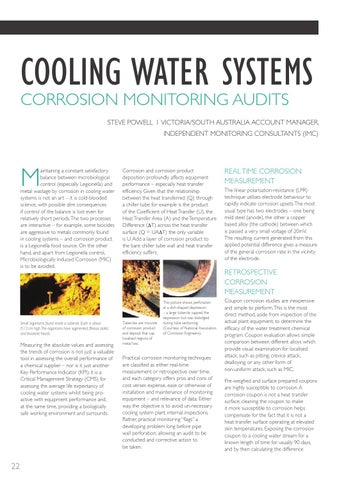
Small organisms found inside a tubercle. Each is about 0.13 cm high. The organisms have segmented, fibrous stalks and bivariate heads.
Measuring the absolute values and assessing the trends of corrosion is not just a valuable tool in assessing the overall performance of a chemical supplier – nor is it just another Key Performance Indicator (KPI); it is a Critical Management Strategy (CMS) for assessing the average life expectancy of cooling water systems whilst being proactive with equipment performance and, at the same time, providing a biologically safe working environment and surrounds.
22
Corrosion and corrosion product deposition profoundly affects equipment performance – especially heat transfer efficiency. Given that the relationship between the heat transferred (Q) through a chiller tube for example is the product of the Coefficient of Heat Transfer (U), the Heat Transfer Area (A) and the Temperature Difference (∆T) across the heat transfer surface (Q = UA∆T) the only variable is U. Add a layer of corrosion product to the bare chiller tube wall and heat transfer efficiency suffers.
Real Time Corrosion Measurement The linear polarisation-resistance (LPR) technique utilises electrode behaviour to rapidly indicate corrosion upsets. The most usual type has two electrodes – one being mild steel (anode), the other a copper based alloy (the cathode) between which is passed a very small voltage of 20mV. The resulting current generated from this applied potential difference gives a measure of the general corrosion rate in the vicinity of the electrode.
Retrospective Corrosion Measurement
Tubercles are mounds of corrosion product and deposit that cap localised regions of metal loss.
This picture shows perforation at a dish-shaped depression – a large tubercle capped the depression but was dislodged during tube sectioning. (Courtesy of National Association of Corrosion Engineers).
Practical corrosion monitoring techniques are classified as either real-time measurement or retrospective over time, and each category offers pros and cons of cost verses expense, ease or otherwise of installation and maintenance of monitoring equipment – and relevance of data. Either way, the objective is to avoid un-necessary cooling system plant internal inspections. Rather, practical monitoring “flags” a developing problem long before pipe wall perforation, allowing an audit to be conducted and corrective action to be taken.
Coupon corrosion studies are inexpensive and simple to perform. This is the most direct method, aside from inspection of the actual plant equipment, to determine the efficacy of the water treatment chemical program. Coupon evaluation allows simple comparison between different alloys which provide visual examination for localised attack, such as pitting, crevice attack, dealloying, or any other form of non-uniform attack, such as MIC. Pre-weighed and surface prepared coupons are highly susceptible to corrosion. A corrosion coupon is not a heat transfer surface; cleaning the coupon to make it more susceptible to corrosion helps compensate for the fact that it is not a heat transfer surface operating at elevated skin temperatures. Exposing the corrosion coupon to a cooling water stream for a known length of time for usually 90 days, and by then calculating the difference