Case Study:
The Coast Golf Club
W
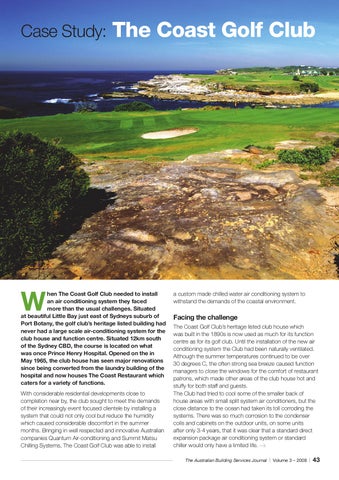
hen The Coast Golf Club needed to install an air conditioning system they faced more than the usual challenges. Situated at beautiful Little Bay just east of Sydneys suburb of Port Botany, the golf club’s heritage listed building had never had a large scale air-conditioning system for the club house and function centre. Situated 12km south of the Sydney CBD, the course is located on what was once Prince Henry Hospital. Opened on the in May 1965, the club house has seen major renovations since being converted from the laundry building of the hospital and now houses The Coast Restaurant which caters for a variety of functions. With considerable residential developments close to completion near by, the club sought to meet the demands of their increasingly event focused clientele by installing a system that could not only cool but reduce the humidity which caused considerable discomfort in the summer months. Bringing in well respected and innovative Australian companies Quantum Air-conditioning and Summit Matsu Chilling Systems, The Coast Golf Club was able to install
a custom made chilled water air conditioning system to withstand the demands of the coastal environment.
Facing the challenge The Coast Golf Club’s heritage listed club house which was built in the 1890s is now used as much for its function centre as for its golf club. Until the installation of the new air conditioning system the Club had been naturally ventilated. Although the summer temperatures continued to be over 30 degrees C, the often strong sea breeze caused function managers to close the windows for the comfort of restaurant patrons, which made other areas of the club house hot and stuffy for both staff and guests. The Club had tried to cool some of the smaller back of house areas with small split system air conditioners, but the close distance to the ocean had taken its toll corroding the systems. There was so much corrosion to the condenser coils and cabinets on the outdoor units, on some units after only 3-4 years, that it was clear that a standard direct expansion package air conditioning system or standard chiller would only have a limited life. > The Australian Building Services Journal | Volume 3 – 2008 |
43