Fab Tree Hab and Plug-In Ecology Terreform ONE Fab Tree Hab-Living Graft Prefab Structure: Our dwelling is composed of 100% living nutrients. Here traditional anthropocentric doctrines are overturned and human life is subsumed within terrestrial environs. Home, in this sense, becomes indistinct and fits itself symbiotically into the surrounding ecosystem. This domicile concept is intended to replace the outdated design solutions at Habitat for Humanity. We propose a method to grow homes from local native woody plants. A living structure is grafted into shape with prefabricated Computer Numeric Controlled (CNC) reusable scaffolds. The plan is to reuse the scaffolds and further enable more dwellings to be fully integrated into an ecological community. Plug-In Ecology-Urban Farm Pod with Agronomy is a “living� cabin for individuals and urban nuclear families that will grow and provide them with their daily vegetable needs. It is an interface with the city, potentially touching on urban farming, air quality levels, DIY agronomy techniques in test tubes, algal energy production, and bioluminescent light sources, to name a few possibilities. It can be outfitted with a number of optional systems to adapt to different locations, lighting conditions, and habitation requirements. While agricultural food sources are usually invisible in cities
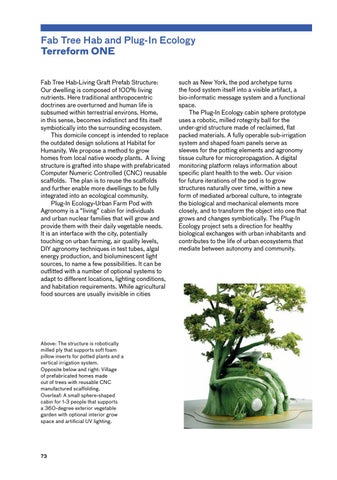
Above: The structure is robotically milled ply that supports soft foam pillow inserts for potted plants and a vertical irrigation system. Opposite below and right: Village of prefabricated homes made out of trees with reusable CNC manufactured scaffolding. Overleaf: A small sphere-shaped cabin for 1-3 people that supports a 360-degree exterior vegetable garden with optional interior grow space and artificial UV lighting.
73
such as New York, the pod archetype turns the food system itself into a visible artifact, a bio-informatic message system and a functional space. The Plug-In Ecology cabin sphere prototype uses a robotic, milled rotegrity ball for the under-grid structure made of reclaimed, flat packed materials. A fully operable sub-irrigation system and shaped foam panels serve as sleeves for the potting elements and agronomy tissue culture for micropropagation. A digital monitoring platform relays information about specific plant health to the web. Our vision for future iterations of the pod is to grow structures naturally over time, within a new form of mediated arboreal culture, to integrate the biological and mechanical elements more closely, and to transform the object into one that grows and changes symbiotically. The Plug-In Ecology project sets a direction for healthy biological exchanges with urban inhabitants and contributes to the life of urban ecosystems that mediate between autonomy and community.