FREIGHT CAR FERRY
FINISHED PRODUCT PARTS & ASSEMBLY WORKERS
penthouse projecting above the roofline. The resulting exaggerated ziggurat massing was structural and built according to New York City setback requirements. Steel casement ribbon windows wrapped the building, emphasizing the horizontality of the concrete floor slabs. These were supported by
massive concrete mushroom columns spaced six meters apart in the north-south direction and up to six meters in the east-west direction for the train track layout. The columns were set back from the perimeter wall which is picked up by the concrete slab cantilever, similar to the Van Nelle factory, allowing additional light to penetrate into the interior and the floor space to remain open. As critic Lewis Mumford noted, “Here a cantilevered front has been used, not as a cliché of modernism, but as a means of achieving a maximum amount of daylight and unbroken floor space for work requiring direct lighting. The aesthetic result is very happy indeed. The contrast between the long, continuous red-brick bands and the green-framed windows, with sapphire reflection or depths, is as sound a use of color as one can see about the city.”76 The building was the largest flat-slab reinforced concrete frame multistoried building in the United States when it was completed in 1931. Advertising 38,000 square meters on six floors housing 200 meters of linear production with four meter heights, the total building had 550,000 square meters of leasable space. After the demise of rail freight and the influx of truck-based transportation, trucks became the prime users of the lower-level circulation system and elevators, one of which still continues to operate today. In 1930, Colonel William A. Starrett promoted the building in the leasing brochure: “When water and rail and automotive transportation can be joined up in a great terminal, where under the same roof, executives, sales, storage, assembly and distribution all can be carried on in a single terminal unit we will have defeated the major affliction of modern metropolitan life — traffic congestion.”77 The extraordinary capacity of this vertical circulation inspired the building’s marketing slogan “Every floor a first floor.”78 Companies including printers, doll makers, clothing manufacturers, and die cutters leased space to have access to a floor with a vertical street that would connect “between the tenant and the services just as real and just as effective as in the horizontal street.”79 On the mezzanine floor, amenities such as a cafeteria, barbershop, and first aid clinic were included as services for the workers and industrialists in the building. This collaboration between investors, engineers, transit, and manufacturing specialists contributed to the development of a building type that uniquely provided hybrid services in the city.
VAN NELLE FACTORY BRINKMAN & VAN DER VLUGT, ROTTERDAM, 1926–1931
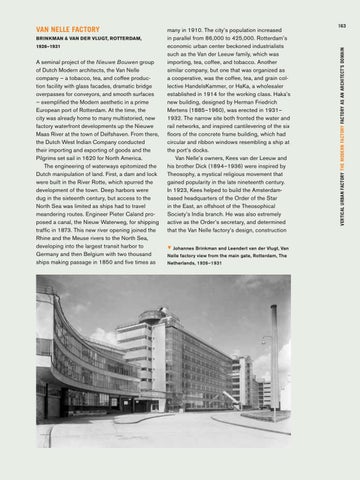
A seminal project of the Nieuwe Bouwen group of Dutch Modern architects, the Van Nelle company — a tobacco, tea, and coffee production facility with glass facades, dramatic bridge overpasses for conveyors, and smooth surfaces — exemplified the Modern aesthetic in a prime European port of Rotterdam. At the time, the city was already home to many multistoried, new factory waterfront developments up the Nieuwe Maas River at the town of Delfshaven. From there, the Dutch West Indian Company conducted their importing and exporting of goods and the Pilgrims set sail in 1620 for North America. The engineering of waterways epitomized the Dutch manipulation of land. First, a dam and lock were built in the River Rotte, which spurred the development of the town. Deep harbors were dug in the sixteenth century, but access to the North Sea was limited as ships had to travel meandering routes. Engineer Pieter Caland proposed a canal, the Nieuw Waterweg, for shipping traffic in 1873. This new river opening joined the Rhine and the Meuse rivers to the North Sea, developing into the largest transit harbor to Germany and then Belgium with two thousand ships making passage in 1850 and five times as
many in 1910. The city’s population increased in parallel from 86,000 to 425,000. Rotterdam’s economic urban center beckoned industrialists such as the Van der Leeuw family, which was importing, tea, coffee, and tobacco. Another similar company, but one that was organized as a cooperative, was the coffee, tea, and grain collective HandelsKammer, or HaKa, a wholesaler established in 1914 for the working class. Haka’s new building, designed by Herman Friedrich Mertens (1885–1960), was erected in 1931– 1932. The narrow site both fronted the water and rail networks, and inspired cantilevering of the six floors of the concrete frame building, which had circular and ribbon windows resembling a ship at the port’s docks. Van Nelle’s owners, Kees van der Leeuw and his brother Dick (1894–1936) were inspired by Theosophy, a mystical religious movement that gained popularity in the late nineteenth century. In 1923, Kees helped to build the Amsterdambased headquarters of the Order of the Star in the East, an offshoot of the Theosophical Society’s India branch. He was also extremely active as the Order’s secretary, and determined that the Van Nelle factory’s design, construction
Z Johannes Brinkman and Leendert van der Vlugt, Van Nelle factory view from the main gate, Rotterdam, The Netherlands, 1926–1931
163
VERTICAL URBAN FACTORY THE MODERN FACTORY FACTORY AS AN ARCHITECT’S DOMAIN
VERTICAL URBAN FACTORY THE MODERN FACTORY FACTORY AS AN ARCHITECT’S DOMAIN
162