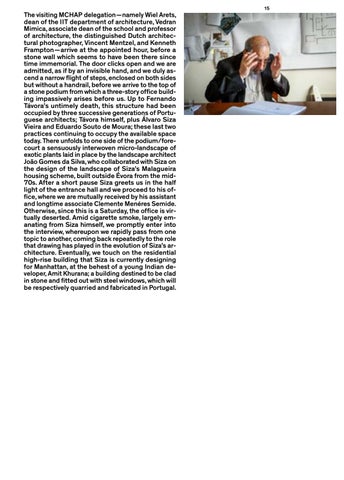
The visiting MCHAP delegation — namely Wiel Arets, dean of the IIT department of architecture, Vedran Mimica, associate dean of the school and professor of architecture, the distinguished Dutch architectural photographer, Vincent Mentzel, and Kenneth Frampton — arrive at the appointed hour, before a stone wall which seems to have been there since time immemorial. The door clicks open and we are admitted, as if by an invisible hand, and we duly ascend a narrow flight of steps, enclosed on both sides but without a handrail, before we arrive to the top of a stone podium from which a three-story office building impassively arises before us. Up to Fernando Távora’s untimely death, this structure had been occupied by three successive generations of Portuguese architects; Távora himself, plus Álvaro Siza Vieira and Eduardo Souto de Moura; these last two practices continuing to occupy the available space today. There unfolds to one side of the podium/forecourt a sensuously interwoven micro-landscape of exotic plants laid in place by the landscape architect João Gomes da Silva, who collaborated with Siza on the design of the landscape of Siza’s Malagueira housing scheme, built outside Évora from the mid70s. After a short pause Siza greets us in the half light of the entrance hall and we proceed to his office, where we are mutually received by his assistant and longtime associate Clemente Menéres Semide. Otherwise, since this is a Saturday, the office is virtually deserted. Amid cigarette smoke, largely emanating from Siza himself, we promptly enter into the interview, whereupon we rapidly pass from one topic to another, coming back repeatedly to the role that drawing has played in the evolution of Siza’s architecture. Eventually, we touch on the residential high-rise building that Siza is currently designing for Manhattan, at the behest of a young Indian developer, Amit Khurana; a building destined to be clad in stone and fitted out with steel windows, which will be respectively quarried and fabricated in Portugal.
15