Case Study B 48
MUSEUMSQUARTIER COURTYARD VIENNA, AUSTRIA STRATEGY: museumsquartier e+b STRATEGY/INTERVENTIONS: PPAG
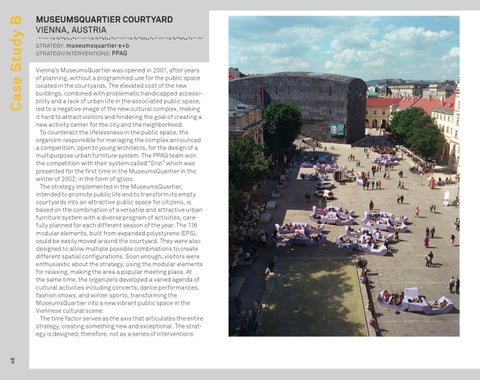
Vienna’s MuseumsQuartier was opened in 2001, after years of planning, without a programmed use for the public space located in the courtyards. The elevated cost of the new buildings, combined with problematic handicapped accessibility and a lack of urban life in the associated public space, led to a negative image of the new cultural complex, making it hard to attract visitors and hindering the goal of creating a new activity center for the city and the neighborhood. To counteract the lifelessness in the public space, the organism responsible for managing the complex announced a competition, open to young architects, for the design of a multipurpose urban furniture system. The PPAG team won the competition with their system called “Enzi” which was presented for the first time in the MuseumsQuartier in the winter of 2002, in the form of igloos. The strategy implemented in the MuseumsQuartier, intended to promote public life and to transform its empty courtyards into an attractive public space for citizens, is based on the combination of a versatile and attractive urban furniture system with a diverse program of activities, carefully planned for each different season of the year. The 116 modular elements, built from expanded polystyrene (EPS), could be easily moved around the courtyard. They were also designed to allow multiple possible combinations to create different spatial configurations. Soon enough, visitors were enthusiastic about the strategy, using the modular elements for relaxing, making the area a popular meeting place. At the same time, the organizers developed a varied agenda of cultural activities including concerts, dance performances, fashion shows, and winter sports, transforming the MuseumsQuartier into a new vibrant public space in the Viennese cultural scene. The time factor serves as the axis that articulates the entire strategy, creating something new and exceptional. The strategy is designed, therefore, not as a series of interventions