SOMMAIRE TABLE OF CONTENTS 8
ARTICLE A A1
PASSAGES, ESPACES DE TRANSITION
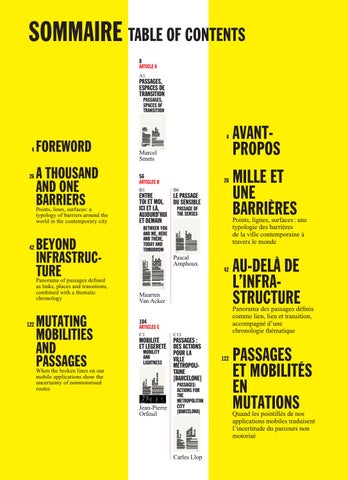
Panorama of passages defined as links, places and transitions, combined with a thematic chronology
122
MUTATING MOBILITIES AND PASSAGES
When the broken lines on our mobile applications show the uncertainty of nonmotorised routes
B1
B6
ENTRE LE PASSAGE TOI ET MOI, DU SENSIBLE PASSAGE OF ICI ET LÀ, AUJOURD’HUI THE SENSES ET DEMAIN
on thE tEchniquE and urban dEsign of PassagEs Every day we make our way through the city.
Some parts of our journey are more memorable than others: this bridge with the beautiful view over the city, the boulevard with its majestic row of trees, the alley where we declared our love, this long but convenient escalator to the subway, but also the unpleasant tunnel under the station. These special phrases in our journey are passages. They color our journey. Sometimes the passage is a shortcut, sometimes it is a detour we take with pleasure because it gives us a special experience. The passage is thus a choice. The passage is a moment of psychological transition: it leads us to another place, but sometimes also to another state of mind, a different mood. Passages enrich not only our own personal journey: many fellow citizens use them with gratitude. Passages are places where many roads and routes meet. The passage not only provides access, it also assembles. It is therefore a place of urbanity par excellence. The passage is not only a link, it is also a place, a space of transition.
roots of thE PassagE
The word ‘passage’ has its root in the Latin verb ‘passare’, which means ‘to traverse or cross’. ‘Passare’ is itself derived from the word ‘passus’, which can mean two things: the act of taking a step, and the trace of many such footsteps. The passage is thus something that
dE la tEchniquE Et dE l’aménagEmEnt urbain dEs PassagEs Nous parcourons la ville au quotidien. Certaines portions
“Passages” are divided into: a) Parisian, b) tricky, c) clandestine, d) North-West, e) rites of, f) Piranesi perspectives, g) of arms, h) included in the present classification, i) just closed, j) innumerable, k) backlit and aerial, l) et caetera, m) to the underworld, n) grassy, o) sloping upwards, p) surprising, q) full of events totally beyond our control, r) bathed in dawn’s early light, s) one-way, t) from whose bourne no traveler returns, u) nasal, v) of play, w) of scripture, x) of prose, y) underground, z) endlessly retreating...” In the introduction to his “The Order of Things”, Foucault quotes Borgès on the capacity of this kind of classification to express, beyond the “exotic charm of a different way of thinking”, the unthinkability of our own thinking, “the naked impossibility of thinking that.” Parody though it is, our own classification is a way to refer to the very impossibility of thinking the notion of passage or of fixing a rational definition. From heading to heading, the notion passes through the meshes of the typological net and the multiplicity of meanings that it can take on in different languages, in fact a sensory subject, a subject that could only be tackled “by the senses”. How? By employing the three senses that this expression encompasses in French: orientation, sensory modality, and meaning.
42
l’originE du PassagE
B1
Maarten Van Acker
ARTICLES C
MOBILITY AND LIGHTNESS
Walking, cycling, e-bikes, roller blades, scooters, segways, and... whatever invention comes next, constitute a family of forms of mobility that suit the modern yen for the light and agile, which we will refer to here as “light mobilities”. They reduce the cost to people (cheaper than the car) and to public authorities (lower funding requirements than public transit), make fewer demands on space (less than the car) and leave a smaller environmental footprint (no noise and pollution, low or zero CO2 emissions). Are these advantages sufficient for such modes to play a bigger role? And what role? An awareness of the change in the representations of the city and of mobility, an assessment of the potential of these modes, and an identification of the difficulties encountered by everyday city users, can go some way to answering these questions.
Les déplacements à pied, en vélo, vélo électrique, rollers, trottinette, mono roues, tricycles, et... les inventions à venir constituent une famille de moyens de déplacement en phase avec l’imaginaire actuel de légèreté et d’agilité qu’on appellera ici « mobilités légères ». Leur usage allège le coût pour les gens (moins cher que la voiture) et pour les collectivités (moins de besoins de financement que les transports publics), mais aussi l’occupation de l’espace (moindre que pour la voiture) et l’empreinte environnementale (absence de bruit et de pollution, émissions de CO2 faibles ou nulles). Ces vertus sont-elles suffisantes pour que ces modes trouvent toute leur place ? Et quelle place ? L’évolution des représentations de la ville et de la mobilité, des évaluations du potentiel de ces modes, le recensement des difficultés rencontrées par les passants dans leurs parcours aident à y répondre.
C1 © France Dubois/MuseoManiac
C13
PASSAGES : DES ACTIONS POUR LA VILLE MÉTROPOLI TAINE [BARCELONE]
PassagEs: actions for thE mEtroPolitan city by carlEs lloP
PASSAGES: ACTIONS FOR THE METROPOLITAN CITY [BARCELONA]
towards an intErconnEctEd mEtroPolitan arEa: barcElona Anyone who uses and lives in the city, anyone
who travels and moves around it, encounters a multiplicity of barriers and dead ends. The legacy of self-built neighborhoods, of suburbanization or a city built in fits and starts (and with a lack of inter-municipal coordination), has been widespread fragmentation, discontinuity and sectorization. If we observe and analyze the metropolis with the aim of enhancing continuities, we realize that we have a great opportunity for the introduction of a portfolio of metropolitan projects. And this is one of the challenges that, in my view, has been taken on by Barcelona Metropolitan Area as a strategy for developing more effective
AU-DELÀ DE L’INFRA STRUCTURE
Panorama des passages définis comme lien, lieu et transition, accompagné d’une chronologie thématique
104
MOBILITÉ ET LÉGÈRETÉ
MILLE ET UNE BARRIÈRES
B6
Pascal Amphoux
Le mot « passage » trouve son origine dans le verbe latin passare, qui signifie « traverser ». Celui-ci dérive quant à lui du mot passus, qui revêt deux significations : le geste du pas, et sa trace dans le paysage. Le passage est donc un élément qui en traverse un autre, un mouvement précis
Jean-Pierre Orfeuil
2
« Les passages se divisent en : a) parisiens, b) délicats, c) clandestins, d) du nord-ouest, e) pour initiés, f) perspectives piranésiennes, g) à l’acte ou à l’état gazeux, h) inclus dans la présente classification, i) qui viennent de fermer leurs portes, j) innombrables, k) photographiés à contre-jour et en contre-plongée, l) et caetera, m) corridors de la mort, n) sous couvert végétal, o) ascensionnels, p) sensationnels, q) parfaitement incontrôlables tant les événements qui s’y déroulent nous échappent, r) qui baignent dans la lumière du petit matin, s) à sens unique, t) dont on ne ressort pas indemne, u) dans lesquels on s’engouffre, v) à blanc ou à tabac, w) en mineur, x) à niveau, y) des nuages, z) qui n’en finissent pas de faire passage...» Foucault dans l’introduction des Mots et les choses pointe, en citant Borgès, la capacité de ce genre de classification à exprimer l’impensable de notre propre pensée, « l’impossibilité nue de penser cela ». Parodie, notre propre classification permettrait d’évoquer l’impossibilité même
de nos trajets se distinguent des autres : ce pont avec sa vue imprenable sur la ville, l’avenue et ses majestueuses rangées d’arbres, la ruelle dans laquelle on a déclaré sa flamme, cet escalator, bien long mais tout de même pratique, qui donne accès au métro, mais aussi ce tunnel désagréable qui passe en dessous de la gare. Ces séquences singulières de nos déplacements sont des passages qui viennent les colorer. Il s’agit ici d’un raccourci, là d’un détour que l’on emprunte volontiers car il nous fait vivre un moment à part. Le passage relève donc d’un choix. C’est une phase de transition psychologique : il nous mène à d’autres lieux mais aussi, parfois, à d’autres états d’esprit, d’autres dispositions psychiques. Les passages n’enrichissent pas seulement nos déplacements personnels : nombreux sont ceux qui les empruntent avec une forme de reconnaissance. Ce sont des lieux où convergent les trajets et les itinéraires. Le passage ne se contente pas de donner accès, il rassemble. C’est un lieu d’urbanité par excellence. Le passage est non seulement un lien, c’est aussi un lieu et un espace de transition.
C1
AVANTPROPOS
Points, lignes, surfaces : une typologie des barrières de la ville contemporaine à travers le monde
lE PassagE du sEnsiblE Par Pascal amPhoux
BETWEEN YOU AND ME, HERE AND THERE, TODAY AND TOMORROW
PassagE of thE sEnsEs by Pascal amPhoux
BEYOND INFRASTRUC TURE
26
ARTICLES B
PassagEs : dEs actions Pour la villE métroPolitainE Par carlEs lloP
42
56
EntrE toi Et moi, ici Et là, aujourd’hui Et dEmain Par maartEn van ackEr
Points, lines, surfaces: a typology of barriers around the world in the contemporary city
Marcel Smets
mobilité Et légèrEté Par jEan-PiErrE orfEuil
A THOUSAND AND ONE BARRIERS
4
lEs PassagEs Primitifs
Depuis toujours, les passages aident l’homme à franchir les obstacles. Sous la forme de vallées et de gorges creusées par les cours d’eau, ils créent des ouvertures au travers des massifs rocheux, rendant accessibles des zones de montagnes. Ils apparaissent naturellement là où l’érosion des berges ou un changement dans la composition du sol réduisent la profondeur de l’eau et permettent aux hommes et aux bêtes de franchir les rivières. Ailleurs, il faut conforter les franchissements naturels ou prolonger les chemins tracés, en construisant un pont de fortune à l’endroit où le ravin se rétrécit, pour réussir à enjamber la coupure.
A1
bEtwEEn you and mE, hErE and thErE, today and tomorrow by maartEn van ackEr
26
FOREWORD
franchir dEs obstaclEs. La passerelle d’Holzarte, Larrau, France. crossing barriErs. Holzarte Passage, Larrau, France.
mobility and lightnEss by jEan-PiErrE orfEuil
4
© Office de tourisme de Soule
Early PassagEs
From the earliest days, passages have helped human beings to cross barriers. They took the form of valleys and gorges, carved out by watercourses that created openings through and into the heart of mountain ranges. They formed naturally in places where retreating riverbanks or changing land conditions created fords that human beings and animals could cross. Elsewhere, natural crossings or tracks could be improved by building makeshift bridges to span chasms at their narrowest points. The common feature of this kind of early passage was to create a shortcut. By following the passage, people could avoid long detours imposed by land formations, rivers or soil characteristics. They could shorten their journeys by incorporating a route that could only be used with an understanding of their specific characteristics and customs. Using a passage therefore required familiarity with its position
PassagEs, EsPacEs dE transition Par marcEl smEts
PassagEs, sPacEs of transition by marcEl smEts
PASSAGES, SPACES OF TRANSITION
vErs unE airE métroPolitainE réticuléE : barcElonE Lorsque l’on profite de la ville dans laquelle on vit, que l’on y voyage et que l’on s’y déplace, on découvre un grand nombre de barrières et de culs-de-sac. L’héritage des quartiers construits par les habitants eux-mêmes, de la périurbanisation et des villes construites par à-coups (avec un manque de coordination intercommunale) a mené à une fragmentation, une discontinuité et une sectorisation importantes. Si l’on observe et analyse la métropole du point de vue de l’amélioration des continuités, on réalise qu’elles constituent une excellente opportunité pour mettre en place un portefeuille de projets métropolitains. Il s’agit de l’un des défis qui, à mon sens, ont été lancés par l’Aire Métropolitaine de Barcelone dans une stratégie visant à améliorer l’efficacité des projets mis en œuvre pour accroître la qua-
C13
Carles Llop
122
PASSAGES ET MOBILITÉS EN MUTATIONS
Quand les pointillés de nos applications mobiles traduisent l’incertitude du parcours non motorisé