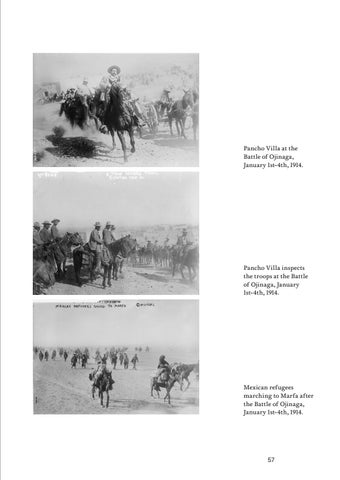
After about fifty meters, there is a door with a plaque commemorating the day Fort D.A. Russell was founded. The first mention of the fort in Marfa dates back to the year 1911 when soldiers camped to the southwest of the railroad tracks. Although the plain was not apt for the cavalry, the railroad station turned out to be an important distribution point, turning Marfa into a prime center for the trading of wool, mohair, and livestock. In 1914, Camp Marfa was the main military headquarters for the Big Bend region. The camp supplied soldiers, horses, and provisions to fourteen other advanced outposts of the American army along the Mexican border. Because of the Mexican Revolution, there was an increased military presence. Different groups of outlaws took advantage of the disturbances in Mexico to loot haciendas on the frontier. As a result, the cavalry and air force pilots began to patrol the areas of a border that had not yet been defined nor accepted by the corresponding governments. In 1914, Pancho Villa entered Ojinaga, Chihuahua, and two thousand Mexicans, both civilians and federal troops, crossed the border and turned themselves over to the American authorities as a way to avoid being executed by the revolutionaries in their country. The fugitives were held in Marfa before being taken to El Paso, where their situation was dealt with. In 1918, at the end of World War I, and in an attempt to normalize the limits of both countries, the Rio Grande was decreed an impassable line, and countries on either side agreed not to cross that border. Shortly after that they began to build the fort. It had previously consisted of tents. First a house was built near the west gate and on a high ground (Officer’s Hill-Cerro de los Oficiales) for the commanding officer. A hospital with 96 beds, a veterinary surgery room, a radio station, and a theater were also built. In 1920 U-shaped barracks were built for the soldiers along a line known as Cavalry Row. Three barracks created an habitational unit, equipped with a kitchen, din-
56
Artillery Sheds
Pancho Villa at the Battle of Ojinaga, January 1st-4th, 1914.
Pancho Villa inspects the troops at the Battle of Ojinaga, January 1st-4th, 1914.
Mexican refugees marching to Marfa after the Battle of Ojinaga, January 1st-4th, 1914.
57