Structure and Design
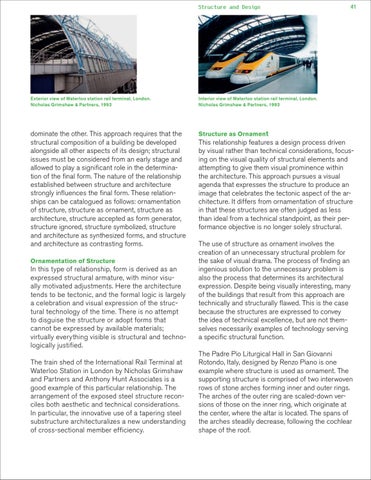
Exterior view of Waterloo station rail terminal, London. Nicholas Grimshaw & Partners, 1993
Interior view of Waterloo station rail terminal, London. Nicholas Grimshaw & Partners, 1993
dominate the other. This approach requires that the structural composition of a building be developed alongside all other aspects of its design; structural issues must be considered from an early stage and allowed to play a significant role in the determination of the final form. The nature of the relationship established between structure and architecture strongly influences the final form. These relationships can be catalogued as follows: ornamentation of structure, structure as ornament, structure as architecture, structure accepted as form generator, structure ignored, structure symbolized, structure and architecture as synthesized forms, and structure and architecture as contrasting forms.
Structure as Ornament
Ornamentation of Structure
In this type of relationship, form is derived as an expressed structural armature, with minor visually motivated adjustments. Here the architecture tends to be tectonic, and the formal logic is largely a celebration and visual expression of the structural technology of the time. There is no attempt to disguise the structure or adopt forms that cannot be expressed by available materials; virtually everything visible is structural and technologically justified. The train shed of the International Rail Terminal at Waterloo Station in London by Nicholas Grimshaw and Partners and Anthony Hunt Associates is a good example of this particular relationship. The arrangement of the exposed steel structure reconciles both aesthetic and technical considerations. In particular, the innovative use of a tapering steel substructure architecturalizes a new understanding of cross-sectional member efficiency.
41
This relationship features a design process driven by visual rather than technical considerations, focusing on the visual quality of structural elements and attempting to give them visual prominence within the architecture. This approach pursues a visual agenda that expresses the structure to produce an image that celebrates the tectonic aspect of the architecture. It differs from ornamentation of structure in that these structures are often judged as less than ideal from a technical standpoint, as their performance objective is no longer solely structural. The use of structure as ornament involves the creation of an unnecessary structural problem for the sake of visual drama. The process of finding an ingenious solution to the unnecessary problem is also the process that determines its architectural expression. Despite being visually interesting, many of the buildings that result from this approach are technically and structurally flawed. This is the case because the structures are expressed to convey the idea of technical excellence, but are not themselves necessarily examples of technology serving a specific structural function. The Padre Pio Liturgical Hall in San Giovanni Rotondo, Italy, designed by Renzo Piano is one example where structure is used as ornament. The supporting structure is comprised of two interwoven rows of stone arches forming inner and outer rings. The arches of the outer ring are scaled-down versions of those on the inner ring, which originate at the center, where the altar is located. The spans of the arches steadily decrease, following the cochlear shape of the roof.