Wes Jones Architecture Option Studio, Fall 2011
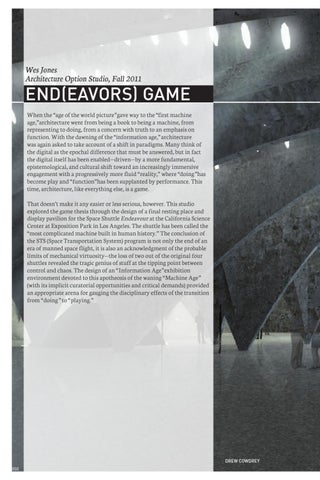
END(EAVORS) GAME When the “ age of the world picture” gave way to the “ first machine age,” architecture went from being a book to being a machine, from representing to doing, from a concern with truth to an emphasis on function. With the dawning of the “ information age,” architecture was again asked to take account of a shift in paradigms. Many think of the digital as the epochal difference that must be answered, but in fact the digital itself has been enabled—driven—by a more fundamental, epistemological, and cultural shift toward an increasingly immersive engagement with a progressively more fluid “ reality,” where “ doing” has become play and “ function” has been supplanted by performance. This time, architecture, like everything else, is a game. That doesn’t make it any easier or less serious, however. This studio explored the game thesis through the design of a final resting place and display pavilion for the Space Shuttle Endeavour at the California Science Center at Exposition Park in Los Angeles. The shuttle has been called the “ most complicated machine built in human history.” The conclusion of the STS (Space Transportation System) program is not only the end of an era of manned space flight, it is also an acknowledgment of the probable limits of mechanical virtuosity—the loss of two out of the original four shuttles revealed the tragic genius of stuff at the tipping point between control and chaos. The design of an “ Information Age” exhibition environment devoted to this apotheosis of the waning “ Machine Age” (with its implicit curatorial opportunities and critical demands) provided an appropriate arena for gauging the disciplinary effects of the transition from “ doing ” to “ playing.”
drew cowdrey 050