TESSELLATION / SYSTEM
Vertical / Two-Way Frame 111 FIRST STREET
OFFICE FOR METROPOLITAN ARCHITECTURE; WSP CANTOR SEINUK
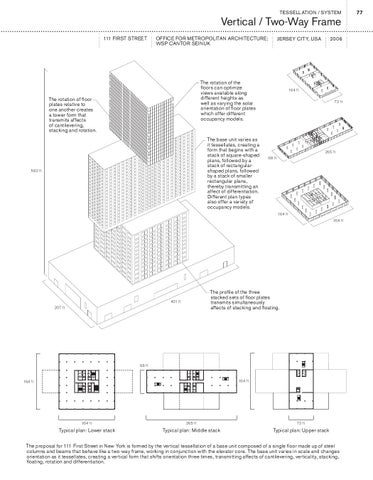
The rotation of the floors can optimize views available along different heights as well as varying the solar orientation of floor plates which offer different occupancy models.
The rotation of floor plates relative to one another creates a tower form that transmits affects of cantilevering, stacking and rotation.
The base unit varies as it tessellates, creating a form that begins with a stack of square-shaped plans, followed by a stack of rectangularshaped plans, followed by a stack of smaller rectangular plans, thereby transmitting an affect of differentiation. Different plan types also offer a variety of occupancy models.
592 ft
2006
JERSEY CITY, USA
164 ft 72 ft
265 ft 68 ft
164 ft 164 ft
The profile of the three stacked sets of floor plates transmits simultaneously affects of stacking and floating.
401 ft 207 ft
68 ft
164 ft
164 ft
164 ft
265 ft
72 ft
Typical plan: Lower stack
Typical plan: Middle stack
Typical plan: Upper stack
The proposal for 111 First Street in New York is formed by the vertical tessellation of a base unit composed of a single floor made up of steel columns and beams that behave like a two-way frame, working in conjunction with the elevator core. The base unit varies in scale and changes orientation as it tessellates, creating a vertical form that shifts orientation three times, transmitting affects of cantilevering, verticality, stacking, floating, rotation and differentiation.
77