TESSELLATION / SYSTEM
Vertical / Two-Way Frame SEAGRAM BUILDING
L. MIES VAN DER ROHE AND P. JOHNSON; KAHN AND JACOBS
NEW YORK CITY, USA
1954–58
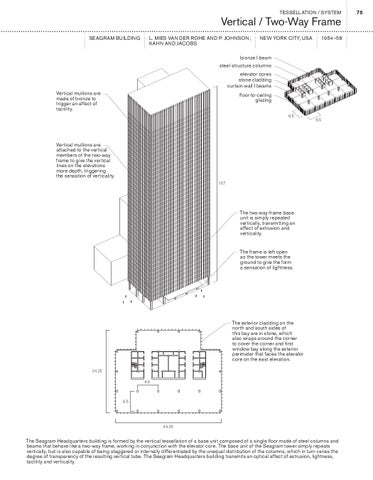
bronze I beam steel structure columns elevator cores stone cladding curtain wall I beams Vertical mullions are made of bronze to trigger an affect of tactility.
floor-to-ceiling glazing 8.5
8.5
Vertical mullions are attached to the vertical members of the two-way frame to give the vertical lines on the elevations more depth, triggering the sensation of verticality. 157
The two-way-frame base unit is simply repeated vertically, transmitting an affect of extrusion and verticality. The frame is left open as the tower meets the ground to give the form a sensation of lightness.
The exterior cladding on the north and south sides of this bay are in stone, which also wraps around the corner to cover the corner and first window bay along the exterior perimeter that faces the elevator core on the east elevation. 34.25 8.5
8.5
44.25
The Seagram Headquarters building is formed by the vertical tessellation of a base unit composed of a single floor made of steel columns and beams that behave like a two-way frame, working in conjunction with the elevator core. The base unit of the Seagram tower simply repeats vertically, but is also capable of being staggered or internally differentiated by the unequal distribution of the columns, which in turn varies the degree of transparency of the resulting vertical tube. The Seagram Headquarters building transmits an optical affect of extrusion, lightness, tactility and verticality.
75