FAST COMPANY: ARCHITECTURE AND THE SPEED OF TECHNOLOGY
73
CHRIS PERRY
The future of the past is in the future. The future of the present is in the past. The future of the future is in the present. —John McHale, “The Future of the Future”
The instrumental and aesthetic implications of architecture’s engagement with science and technology has a long history, part of which includes the period following the Second World War when the rapid technological advances of the Industrial Revolution merged with a general cultural mindset characterized by themes of progress and futurism. The Industrial Revolution, and with it the emergence of machine technology, contributed to an even larger philosophical shift from a Newtonian physics of certainty to one of increasing contingency and probability.1 As a result, architecture was re-imagined not only in terms of its formal and aesthetic appearance, but more profoundly in terms of a transition from a logic of stasis to one of temporality, and by extension from a preoccupation with form and space to one concerning time. Given the equally revolutionary advances in computing technology in the last twenty years, our contemporary moment can be seen in similar terms. Not unlike the postwar generation of architects and thinkers, contemporary designers are inevitably faced with the challenge of engaging new technological advances and their implications for the discipline of architecture. While computing technology has been addressed quite extensively in recent architectural discourse, the predominant focus has been on modeling software and its potential as a design tool for producing new formal languages. The result has been to limit architecture to a static representation of dynamic processes and thus reinforce the perception that architecture remains first and foremost a formal discipline. What has been less apparent in recent years is an exploration of how computers introduce qualities of temporality, contingency, and feedback into the very performance of the architecture itself, shifting the discipline away from a preoccupation with form, space, and meaning, towards an exploration of temporality and instrumentality. This would suggest the incorporation of digital technologies into buildings from fields as diverse and pervasive as computing, interaction design, environmental science, and robotics, as a means of expanding their capacity to adjust and respond to changing programmatic and environmental forces. Furthermore, the explicit interdisciplinarity of this approach, in which
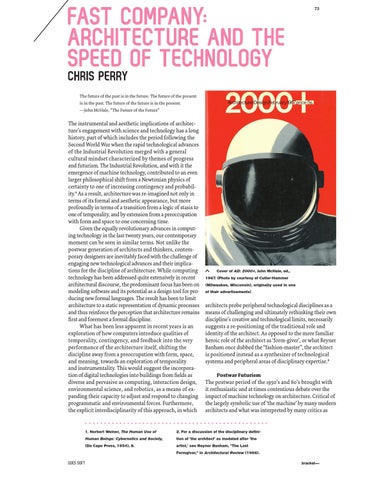
Cover of AD: 2000+, John McHale, ed., 1967. (Photo by courtesy of Cutler-Hammer (Milwaukee, Wisconsin), originally used in one of their advertisements)
architects probe peripheral technological disciplines as a means of challenging and ultimately rethinking their own discipline’s creative and technological limits, necessarily suggests a re-positioning of the traditional role and identity of the architect. As opposed to the more familiar heroic role of the architect as ‘form-giver’, or what Reyner Banham once dubbed the “fashion-master”, the architect is positioned instead as a synthesizer of technological systems and peripheral areas of disciplinary expertise.2 Postwar Futurism The postwar period of the 1950’s and 60’s brought with it enthusiastic and at times contentious debate over the impact of machine technology on architecture. Critical of the largely symbolic use of ‘the machine’ by many modern architects and what was interpreted by many critics as
1. Norbert Weiner, The Human Use of
2. For a discussion of the disciplinary defini-
Human Beings: Cybernetics and Society,
tion of ‘the architect’ as modeled after ‘the
(Da Capo Press, 1954), 8.
artist,’ see Reyner Banham, “The Last Formgiver,” in Architectural Review (1966).
GOES SOFT
bracket