VOLTAGE CONTROLLED SWITCH
45
00I SATELLITE
2
1
000 ANTENNA
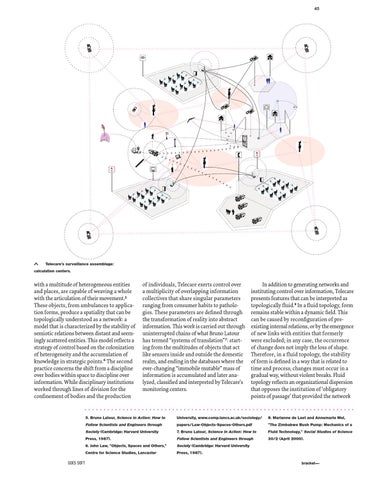
Telecare’s surveillance assemblage: calculation centers.
with a multitude of heterogeneous entities and places, are capable of weaving a whole with the articulation of their movement.5 These objects, from ambulances to application forms, produce a spatiality that can be topologically understood as a network: a model that is characterized by the stability of semiotic relations between distant and seemingly scattered entities. This model reflects a strategy of control based on the colonization of heterogeneity and the accumulation of knowledge in strategic points.6 The second practice concerns the shift from a discipline over bodies within space to discipline over information. While disciplinary institutions worked through lines of division for the confinement of bodies and the production
GOES SOFT
of individuals, Telecare exerts control over a multiplicity of overlapping information collectives that share singular parameters ranging from consumer habits to pathologies. These parameters are defined through the transformation of reality into abstract information. This work is carried out through uninterrupted chains of what Bruno Latour has termed “systems of translation” 7: starting from the multitudes of objects that act like sensors inside and outside the domestic realm, and ending in the databases where the ever-changing “immobile mutable” mass of information is accumulated and later analyzed, classified and interpreted by Telecare’s monitoring centers.
In addition to generating networks and instituting control over information, Telecare presents features that can be interpreted as topologically fluid.8 In a fluid topology, form remains stable within a dynamic field. This can be caused by reconfiguration of preexisting internal relations, or by the emergence of new links with entities that formerly were excluded; in any case, the occurrence of change does not imply the loss of shape. Therefore, in a fluid topology, the stability of form is defined in a way that is related to time and process; changes must occur in a gradual way, without violent breaks. Fluid topology reflects an organizational dispersion that opposes the institution of ‘obligatory points of passage’ that provided the network
5. Bruno Latour, Science in Action: How to
University, www.comp.lancs.ac.uk/sociology/
8. Marianne de Laet and Annemarie Mol,
Follow Scientists and Engineers through
papers/Law-Objects-Spaces-Others.pdf
“The Zimbabwe Bush Pump: Mechanics of a
Society (Cambridge: Harvard University
7. Bruno Latour, Science in Action: How to
Fluid Technology,” Social Studies of Science
Press, 1987).
Follow Scientists and Engineers through
30/2 (April 2000).
6. John Law, “Objects, Spaces and Others,”
Society (Cambridge: Harvard University
Centre for Science Studies, Lancaster
Press, 1987). bracket