25
Sculpting Human Expression: Donatello Renaissance (1386-1466)
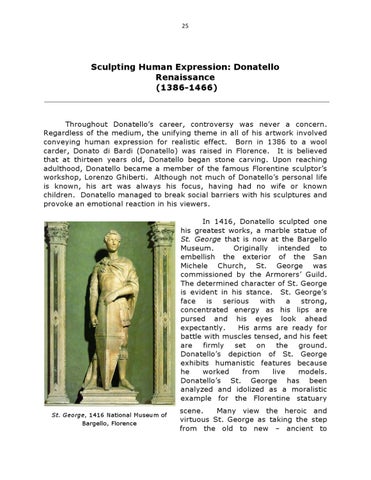
Throughout Donatello’s career, controversy was never a concern. Regardless of the medium, the unifying theme in all of his artwork involved conveying human expression for realistic effect. Born in 1386 to a wool carder, Donato di Bardi (Donatello) was raised in Florence. It is believed that at thirteen years old, Donatello began stone carving. Upon reaching adulthood, Donatello became a member of the famous Florentine sculptor’s workshop, Lorenzo Ghiberti. Although not much of Donatello’s personal life is known, his art was always his focus, having had no wife or known children. Donatello managed to break social barriers with his sculptures and provoke an emotional reaction in his viewers. In 1416, Donatello sculpted one his greatest works, a marble statue of St. George that is now at the Bargello Museum. Originally intended to embellish the exterior of the San Michele Church, St. George was commissioned by the Armorers’ Guild. The determined character of St. George is evident in his stance. St. George’s face is serious with a strong, concentrated energy as his lips are pursed and his eyes look ahead expectantly. His arms are ready for battle with muscles tensed, and his feet are firmly set on the ground. Donatello’s depiction of St. George exhibits humanistic features because he worked from live models. Donatello’s St. George has been analyzed and idolized as a moralistic example for the Florentine statuary St. George, 1416 National Museum of Bargello, Florence
scene. Many view the heroic and virtuous St. George as taking the step from the old to new – ancient to