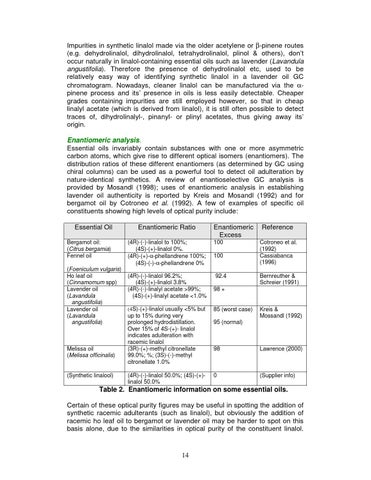
Impurities in synthetic linalol made via the older acetylene or β-pinene routes (e.g. dehydrolinalol, dihydrolinalol, tetrahydrolinalol, plinol & others), don’t occur naturally in linalol-containing essential oils such as lavender (Lavandula angustifolia). Therefore the presence of dehydrolinalol etc, used to be relatively easy way of identifying synthetic linalol in a lavender oil GC chromatogram. Nowadays, cleaner linalol can be manufactured via the αpinene process and its’ presence in oils is less easily detectable. Cheaper grades containing impurities are still employed however, so that in cheap linalyl acetate (which is derived from linalol), it is still often possible to detect traces of, dihydrolinalyl-, pinanyl- or plinyl acetates, thus giving away its’ origin. Enantiomeric analysis. Essential oils invariably contain substances with one or more asymmetric carbon atoms, which give rise to different optical isomers (enantiomers). The distribution ratios of these different enantiomers (as determined by GC using chiral columns) can be used as a powerful tool to detect oil adulteration by nature-identical synthetics. A review of enantioselective GC analysis is provided by Mosandl (1998); uses of enantiomeric analysis in establishing lavender oil authenticity is reported by Kreis and Mosandl (1992) and for bergamot oil by Cotroneo et al. (1992). A few of examples of specific oil constituents showing high levels of optical purity include: Essential Oil Bergamot oil: (Citrus bergamia) Fennel oil (Foeniculum vulgaris) Ho leaf oil (Cinnamomum spp) Lavender oil (Lavandula angustifolia) Lavender oil (Lavandula angustifolia)
Melissa oil (Melissa officinalis)
(Synthetic linalool)
Enantiomeric Ratio (4R)-(-)-linalol to 100%; (4S)-(+)-linalol 0%. (4R)-(+)-α-phellandrene 100%; (4S)-(-)-α-phellandrene 0% (4R)-(-)-linalol 96.2%; (4S)-(+)-linalol 3.8% (4R)-(-)-linalyl acetate >99%; (4S)-(+)-linalyl acetate <1.0%
Enantiomeric Excess 100 100
92.4
Reference Cotroneo et al. (1992) Cassiabanca (1996) Bernreuther & Schreier (1991)
98 +
(4S)-(+)-linalol usually <5% but up to 15% during very prolonged hydrodistillation. Over 15% of 4S-(+)- linalol indicates adulteration with racemic linalol (3R)-(+)-methyl citronellate 99.0%; %; (3S)-(-)-methyl citronellate 1.0%
85 (worst case)
98
Lawrence (2000)
(4R)-(-)-linalol 50.0%; (4S)-(+)linalol 50.0%
0
(Supplier info)
Kreis & Mossandl (1992)
95 (normal)
Table 2. Enantiomeric information on some essential oils. Certain of these optical purity figures may be useful in spotting the addition of synthetic racemic adulterants (such as linalol), but obviously the addition of racemic ho leaf oil to bergamot or lavender oil may be harder to spot on this basis alone, due to the similarities in optical purity of the constituent linalol.
14