ROBERT EDGAR STONE
many others were injured. Incredibly, the apse was undamaged, the candlesticks did not even move and the candles still burned despite the rest of the Chapel having crashed into a ruin. Together with the silver cross that was on the altar, these items are still used at the present Chapel, which was rebuilt in the early 1960s and rededicated in 1963. The Stones, blessed with the births of daughters in 1932 and 1936, would holiday at Dorothy’s parents at Finnart. Robert Stone combined this with business, calling off to see retailers in both the north of England and in Scotland’s principal cities.13 Following the outbreak of World War II, the London workshop was closed and the family first moved to the Lodge on the Finnart Estate and then to a house not far away in Portincaple.14 Indeed, this became the Stones’ Scottish home for many years. During the war, Stone worked at a torpedo factory at Arrochar at the northern end of Loch Long where the missiles were tested and repaired. Noticing that they were often being damaged when being loaded or
ROBERT EDGAR STONE
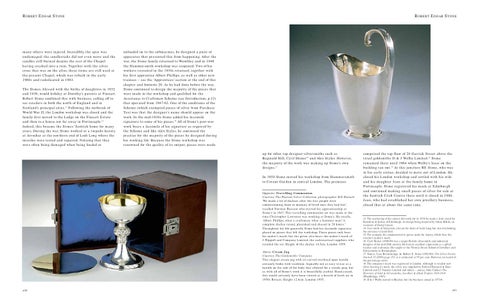
unloaded on to the submarines, he designed a piece of apparatus that prevented this from happening. After the war, the Stone family returned to Wembley and in 1946 the Hammersmith workshop was reopened. Two of his workers recruited in the 1930s returned, together with his first apprentice Albert Phillips, as well as other new trainees – see the ‘Apprentices’ section at the end of this chapter and footnote 20. As he had done before the war, Stone continued to design the majority of the pieces that were made in the workshop and qualified for the Assistance to Craftsmen Scheme (see Introduction, p.12) that operated from 1947-62. One of the conditions of the Scheme (which exempted pieces of silver from Purchase Tax) was that the designer’s name should appear on the work. In the mid-1930s Stone added his facsimile signature to some of his pieces.15 All of Stone’s post-war work bears a facsimile of his signature as required by the Scheme and like Alex Styles, he continued the practice for the majority of the pieces he designed during his working life. Because the Stone workshop was renowned for the quality of its output, pieces were made up for other top designer-silversmiths such as Reginald Hill, Cyril Shiner16 and Alex Styles. However, the majority of the work was making up Stone’s own designs.17 In 1950 Stone moved his workshop from Hammersmith to Covent Garden in central London. The premises Opposite: Travelling Communion Courtesy The Pearson Silver Collection, photographer Bill Burnett ‘We made a lot of chalices after the war; people were commissioning them in memory of loved ones they had lost’, recalled Norman Bassant who started his apprenticeship at Stone’s in 1947. This travelling communion set was made at the time Christopher Lawrence was working at Stone’s. He recalls, ‘Albert Phillips, what a craftsman, what a hammer man! A complete chalice raised, planished and chased in 28 hours.’ Throughout his life generally Stone had his facsimile signature placed on pieces that left the workshop. These pieces only bear his maker’s mark, but the paten also bears the maker’s mark of J Wippell and Company Limited, the ecclesiastical suppliers who retailed the set. Height of the chalice 14.5cm. London 1959. Above: Cream Jug Courtesy The Goldsmiths’ Company This elegant cream jug with its curved overhead open handle certainly broke with tradition. Arguably not as easy to use as a handle on the side of the body that allowed for a steady grip, but as with all of Stone’s work it is beautifully crafted. Hand-raised, this would certainly have been viewed as a breath of fresh air in 1950s Britain. Height 12.6cm. London 1955.
450
comprised the top floor of 20 Garrick Street above the retail goldsmiths D & J Welby Limited.18 Stone remained there until 1964 when Welby’s lease on the building ran out.19 At this juncture RE Stone, who was in his early sixties, decided to move out of London. He closed his London workshop and settled with his wife and his daughter Jean at the family home in Portincaple. Stone registered his mark at Edinburgh and continued making small pieces of silver for sale at the Scottish Craft Centre there until it closed in 1980. Jean, who had established her own jewellery business, closed that at about the same time.
13. The marketing of his talents did work, for in 1938 he made a fruit stand for Hamilton & Inches of Edinburgh, its design being inspired by Johan Rohde, an associate of Georg Jensen. 14. Just south of Ardarroch, also on the shore of Loch Long but also overlooking the entrance to Loch Goil. 15. For example, the commemorative pieces made for Asprey, which bear the retailer’s maker’s mark. 16. Cyril Shiner (1908-89) was a major British silversmith and industrial designer of the mid-20th century. He had an excellent reputation as a gifted teacher and craftsman. He taught at the Vittoria Street School of Jewellers and Silversmiths in Birmingham. 17. Source: Jean Breckenridge. In ‘Robert E. Stone (1903-90)’, The Silver Society Journal 15 (2003) page 153, it is estimated at 95 per cent. However, no record of the percentage exists. 18. The company’s mark was registered in London. Although it retailed new silver bearing its mark, the silver was supplied by Edward Barnard & Sons Limited and CJ Vanders Limited and others – source, John Culme’s The Directory of Gold & Silversmiths, Jewellers & Allied Traders 1838-1914 (Woodbridge, 1987). 19. D & J Welby moved to Mayfair, but the business closed in 1973/4.
451