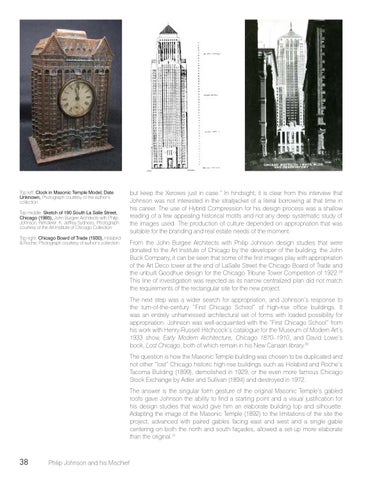
Top left: Clock in Masonic Temple Model, Date Unknown, Photograph courtesy of the author’s collection Top middle: Sketch of 190 South La Salle Street, Chicago (1985), John Burgee Architects with Philip Johnson, Renderer: K. Jeffrey Sydness, Photograph courtesy of the Art Institute of Chicago Collection Top right: Chicago Board of Trade (1930), Holabird & Roche, Photograph courtesy of author’s collection
but keep the Xeroxes just in case.” In hindsight, it is clear from this interview that Johnson was not interested in the straitjacket of a literal borrowing at that time in his career. The use of Hybrid Compression for his design process was a shallow reading of a few appealing historical motifs and not any deep systematic study of the images used. The production of culture depended on appropriation that was suitable for the branding and real estate needs of the moment. From the John Burgee Architects with Philip Johnson design studies that were donated to the Art Institute of Chicago by the developer of the building, the John Buck Company, it can be seen that some of the first images play with appropriation of the Art Deco tower at the end of LaSalle Street the Chicago Board of Trade and the unbuilt Goodhue design for the Chicago Tribune Tower Competition of 1922.29 This line of investigation was rejected as its narrow centralized plan did not match the requirements of the rectangular site for the new project. The next step was a wider search for appropriation, and Johnson’s response to the turn-of-the-century “First Chicago School” of high-rise office buildings. It was an entirely unharnessed architectural set of forms with loaded possibility for appropriation. Johnson was well-acquainted with the “First Chicago School” from his work with Henry-Russell Hitchcock’s catalogue for the Museum of Modern Art’s 1933 show, Early Modern Architecture, Chicago 1870–1910, and David Lowe’s book, Lost Chicago, both of which remain in his New Canaan library.30 The question is how the Masonic Temple building was chosen to be duplicated and not other “lost” Chicago historic high-rise buildings such as Holabird and Roche’s Tacoma Building (1899), demolished in 1929, or the even more famous Chicago Stock Exchange by Adler and Sullivan (1894) and destroyed in 1972. The answer is the singular form gesture of the original Masonic Temple’s gabled roofs gave Johnson the ability to find a starting point and a visual justification for his design studies that would give him an elaborate building top and silhouette. Adapting the image of the Masonic Temple (1892) to the limitations of the site the project, advanced with paired gables facing east and west and a single gable centering on both the north and south façades, allowed a set-up more elaborate than the original.31
38
Philip Johnson and his Mischief