Chapter 3 (pp22-37) _chapter 4 trial 1 14/02/2012 08:44 Page 33
Chapter III – A Lion of the District
mould which they removed after stoving, filling the cavity with pulp. Regrettably, we know neither how successful this method proved nor whether any examples have survived to the present day, but it appears not to have been used to any great extent. The joint between wood and papier mâché was often a source of weakness, and it is not uncommon to find that chairs have been repaired at this point. This problem was largely overcome by chair-backs made wholly from pasteboard which had been steam-moulded to curve both horizontally around, and vertically away from the sitter (plate 12). This was made possible by a patent (#11,670) granted to Theodore Hyla Jennens, of Jennens & Bettridge, in 1846, two years after the chair design was registered, which involved placing the panels in a chamber or vessel and admitting steam from a boiler. Its purpose was two-fold: once pliable, the panel could be compacted to make a stronger sheet, or it could be pressed into a pre-formed shape. Chairs made in this way stand out as being one of the few products which show any real understanding among manufacturers of the unique plasticity of the material with which they worked. No other contemporary material was capable of being used in this way, yet sadly such understanding was rare in the history of the industry. The author of an article in the Journal of Design and Manufactures in 1850, went even further by suggesting that although papier mâché is ‘the fittest substance for a tea tray ... [it is] most unsuitable for a sofa or a wardrobe, where its peculiar characteristics are not called for.’37
1786, and a similar one granted to the Birmingham buttonmaker, Obadiah Westwood, only five days later, this had certainly become common practice, and one which, according to Westwood, brought the variety of pulp goods into line with the range of those made by the best method. As with other stovings, great skill was required of the stover. John Haddan, in one of his patent specifications prepared almost sixty years later (see below) said that it was ‘well known’ that the length of time required to stove the oiled pulp ‘can only be ascertained by the opening and examination of a small portion of a sheet after being dried.’39 On the whole however, he found that one minute at a temperature of 55oF was sufficient for a sheet 3⁄8in. thick. In 1805, when Thomas Jones, a Bilston japanner, drew up his patent specification for new methods of making pulp articles by means of presses or stamps (#2830), he provided the earliest detailed pulp recipe to have survived to the present day.40 His preferred recipe required the pounding and pulping of 100lbs rope and about 20lbs rags for small articles, or about 110lbs of rope to about 10lbs rag for larger objects, to which he sometimes added vitriol (sulphuric acid) or something similar, to make a weak acid, though for what purpose he did not say. The invention which Jones sought to protect was adapted from standard paper-making methods. He placed a wire sieve, the shape and size of the intended object, in a deep, neatly fitting wooden frame, poured in the pulp and covered it with
By 1870 ready-made panels and ‘blanks’ had largely replaced the labour-intensive hand-made sheet-method of making papier mâché, and firms like McCallum & Hodson which continued to paste by hand became the exception rather than the rule. Papier mâché made from pulp – the ‘common’ method The methods for making pulp changed little during the course of the japanning industry, although by the 1780s, the ingredients had extended to include a mixture of linen, silk, cotton, sailcloth, rope (tarred or otherwise), flax, hemp, wool, and so on – in fact, any material which was commonly used in standard paper-making. The coarseness of some of these ingredients caused hard particles and ‘throw up blisters, and presents, generally, an unlevelled and “curdled” appearance’ in the finished articles;38 in consequence of this, and their brittleness, pulp goods were said to have been made by the ‘common method’. Their production was not confined to smaller and less prestigious makers as most larger firms, including Jennens & Bettridge, are known to have made ‘common’ goods. The fragility and limitations of early pulp-based papier mâché were partly overcome by oiling and stoving pulp in the same manner described by Clay in his pasteboard patent of 1772. To judge from the details of a later patent which Clay took out in
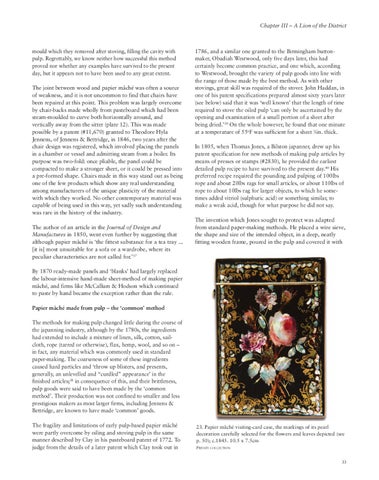
23. Papier mâché visiting-card case, the markings of its pearl decoration carefully selected for the flowers and leaves depicted (see p. 50); c.1845. 10.5 x 7.5cm PRIVATE COLLECTION
33