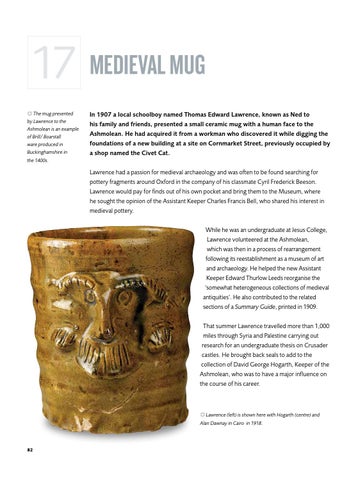
17 MEDIEVAL MUG K The mug presented by Lawrence to the Ashmolean is an example of Brill/ Boarstall ware produced in Buckinghamshire in
In 1907 a local schoolboy named Thomas Edward Lawrence, known as Ned to his family and friends, presented a small ceramic mug with a human face to the Ashmolean. He had acquired it from a workman who discovered it while digging the foundations of a new building at a site on Cornmarket Street, previously occupied by a shop named the Civet Cat.
the 1400s.
Lawrence had a passion for medieval archaeology and was often to be found searching for pottery fragments around Oxford in the company of his classmate Cyril Frederick Beeson. Lawrence would pay for finds out of his own pocket and bring them to the Museum, where he sought the opinion of the Assistant Keeper Charles Francis Bell, who shared his interest in medieval pottery. While he was an undergraduate at Jesus College, Lawrence volunteered at the Ashmolean, which was then in a process of rearrangement following its reestablishment as a museum of art and archaeology. He helped the new Assistant Keeper Edward Thurlow Leeds reorganise the ‘somewhat heterogeneous collections of medieval antiquities’. He also contributed to the related sections of a Summary Guide, printed in 1909. That summer Lawrence travelled more than 1,000 miles through Syria and Palestine carrying out research for an undergraduate thesis on Crusader castles. He brought back seals to add to the collection of David George Hogarth, Keeper of the Ashmolean, who was to have a major influence on the course of his career.
I Lawrence (left) is shown here with Hogarth (centre) and Alan Dawnay in Cairo in 1918.
82