Face2Face
Contract vs. freelance:
Employment options for a changing world The recent COVID-19 pandemic forced many people into leaving their jobs and pursuing new careers entirely, searching for something with flexible hours and remote options, and freelancing suddenly took on a whole new identity.
INTERVIEWS BY ESTELLA MYERS
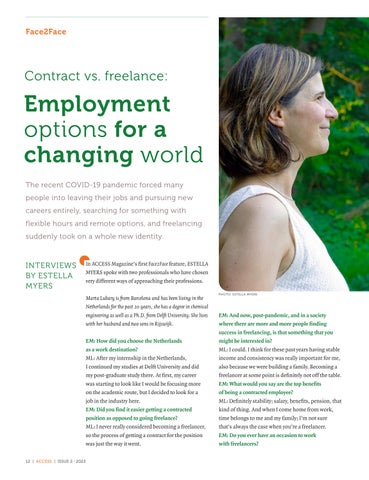
In ACCESS Magazine’s first Face2Face feature, ESTELLA MYERS spoke with two professionals who have chosen very different ways of approaching their professions. Marta Lubary is from Barcelona and has been living in the Netherlands for the past 20 years, she has a degree in chemical engineering as well as a Ph.D. from Delft University. She lives with her husband and two sons in Rijswijk. EM: How did you choose the Netherlands as a work destination? ML: After my internship in the Netherlands, I continued my studies at Delft University and did my post-graduate study there. At first, my career was starting to look like I would be focusing more on the academic route, but I decided to look for a job in the industry here. EM: Did you find it easier getting a contracted position as opposed to going freelance? ML: I never really considered becoming a freelancer, so the process of getting a contract for the position was just the way it went.
12 | ACCESS | ISSUE 2 - 2023
PHOTO: ESTELLA MYERS
EM: And now, post-pandemic, and in a society where there are more and more people finding success in freelancing, is that something that you might be interested in? ML: I could. I think for these past years having stable income and consistency was really important for me, also because we were building a family. Becoming a freelancer at some point is definitely not off the table. EM: What would you say are the top benefits of being a contracted employee? ML: Definitely stability; salary, benefits, pension, that kind of thing. And when I come home from work, time belongs to me and my family; I’m not sure that’s always the case when you’re a freelancer. EM: Do you ever have an occasion to work with freelancers?