African Nova Scotians The Times of
Times Series
A Celebration of Our History, Culture and Traditions
Volume One
ONE WONDERS IF…IT WAS A SURREPTITIOUS ENDEAVOR TO ENFORCE A JIM CROW RULE BY MISUSE OF A PUBLIC STATUTE.
– Justice William Hall, April 1947, after dismissing Viola’s appeal.
INSIDE
Did the Manager of the theatre who laid the complaint believe that there had been an attempt to defraud the province of Nova Scotia of one cent?
Teachers
Rosa Parks at the Black Cultural Centre in 1998.
BLACK CULTURAL CENTRE
Graduating Class of The Desmond Studio of Beauty Culture, 1947. Front row, left to right; Viola Desmond, Instructor; Bernadine Hampden; Evelyn Bryan; Vivian Jackson; Ruth Jackson. Back row, left to right; Rachel Goodridge; Joyce Dean; Rose Gannon; Verna Skinner; Geraldine States; Madeline Grosse; Helen Flint [née Davis, Viola’s sister]. Missing from photo; Elsie Stevens, Saint John, N.B.; Enid Parsons, Lucasville, N.S.; Dilma Joseph, Amherst, N.S. and Helen Gibson, Springhill, N.S.
defrauding the government of a one-cent amusement tax. Determined not to accept an unjust verdict, Viola rallied community support and appealed the decision to the Supreme Court of Nova Scotia. Though the case was lost on a technicality, it created a dramatic upsurge in race consciousness and pride in black communities throughout Nova Scotia. Viola Irene (née Davis) Desmond was a smart, ambitious and successful business woman. Born on July 6, 1914 into a middleclass Halifax family, Viola was one of 15 children of James Albert Davis and Gwendolyn Irene Davis. James was a barber who had learned his trade from his father, George Davis.
Sepia Beauty Products By
VIOLA DESMOND Special Attention To Veterans. 167 Gottingen St. Halifax, N.S. Sur Gro . . . . . . . . . . . . . . . . . 35c., 65c Gloss Wax . . . . . . . . . . . . . . . 35c., 65c Press Oil . . . . . . . . . . . . . . 35c and 65c Sepomade (for men) . . . . . . . . . . . 65c Face Powder (nut Brown) . . . .box 65c Perfume (No. 3) . . . . . . . . . . . . . . . 55c Lipsticks (Black-Red) . . . . . . . . . . 65c Nets (triangle) . . . . . . . . . . . . . . . . 35c Hair Dye . . . . . . . . . . . . . . . . . . . . 2.00 Page—Boys, Braids, Straightening Combs. Curlers.
MAIL ORDERS PROMPTLY FILLED!
THE CLARION VOL 2, NO 2
Viola Desmond is often referred to as Nova Scotia’s Rosa Parks. In 1946, nine years before Rosa Parks refused to give up her seat on a bus in Montgomery, Alabama, Viola Desmond refused to give up her seat in the whites-only lower section of the Roseland Theatre in New Glasgow. Viola was arrested, jailed for the night and the next day was fined $20.00 plus court costs, allegedly for
PRIVATE COLLECTION
PRIVATE COLLECTION
HAD THE MATTER REACHED THE COURT BY SOME OTHER METHOD THERE MIGHT HAVE BEEN THE OPPORTUNITY TO RIGHT THE WRONG DONE TO THIS UNFORTUNATE WOMAN.
This picture of Viola Desmond was used on promotional calendars and packaging for her own line of beauty products.
George had a store and barbershop on Artz Street in Halifax’s north end and James, along with his brothers, took over the barbershop when their father took a job with the post office. Gwendolyn was a loving mother who par-
ticipated actively in her children’s lives and both she and James were active members of various social, philanthropic, and Church groups. Gwendolyn’s father (Viola’s grandfather) was the Reverend H.H. Johnson, Minister of Cornwallis
Street Baptist Church from 1881-1884 and again from 1892-1895. The Cornwallis Street Baptist Church had been designated the ‘Mother church’ of the African Baptist Association of Nova Scotia since the inception of the Association in 1854 and was the ‘Mother church’ of the African United Baptist Association (AUBA). Viola was a good student who graduated from Bloomfield High School near the top of her class. After finishing high school, Viola sat for and passed the exam to earn her teaching certificate. She taught school for nearly two years before deciding to pursue her lifelong ambition of becoming a beautician and owning her own beauty salon. Perhaps influenced
Preachers
Heroes
Champions
and more...
The Times
The 2001 Census lists 19,670 African Nova Scotians.
2
Madam C.J. Walker
Contributors George Elliott Clarke Need Scotian Books? Read these. Pg. 32. Tony Colaiacovo Viola Desmond cover story; A New Era of Race Consciousness, pg. 6; African Nova Scotian Communities: Family, Church and School, pg. 11, Dangerous Radical, pg. 15; The Black Loyalists, pg. 21; The Black Refugees: from American Slaves to Nova Scotian Subjects, pg. 28. Dan Conlin Guilty - The Trial of the Slave Ship Severn. Pg. 25. Ken Donovan The Slaves at Ile Royale, 1713 – 1758. Pg. 17. John Grant The Maroons: From Jamaica to Sierra Leone via Nova Scotia. Pg. 24.
Ian Lawrence Rose Fortune: Black Loyalist, Businesswoman, Boss. Pg. 22 Harvey Amani Whitfield The Earliest Africans to Visit Nova Scotia. Pg. 16. David W. States William Hall: A Nova Scotian Hero. Pg. 30.
George Elliott Clarke
Sylvia Hamilton
Acknowledgements: Wayne Hamilton helped me get the ball rolling; Patrick Kakembo took the first leap of faith; Maureen Finlayson kept us all on track; Wanda Robson shared her experience and wisdom with us; David W. States served as de-facto Associate Editor; Sheldon States is a teacher who brought a valuable perspective to all our meetings; Alma Johnston proudly preached of her community’s heritage and safeguarded its welfare at every turn; Daurene Lewis lent style, grace and intelligence to every discussion; Burnley A. ‘Rocky’ Jones patiently explained what’s what to me; John Grant served as a sounding board for much of this project; Harvey Amani Whitfield kindly reviewed much of the editorial content; Marilyn Gurney provided logistical support whenever asked; Terry Punch answered all my questions clearly and with good humour; Delvina Bernard, Charles Sheppard and everyone on the Executive Committee of CACE ensured that The Times of African Nova Scotians received the distribution it merits. Many people, too numerous to mention, also contributed to this project. I would be remiss if I didn’t mention Tanya Taylor-White, Ron MacDonald, Theresa Bunbury, Ken Donovan, and Heather Gillis at Parks Canada; all the good folks at Nova Scotia Archives and Records Management; Henry Bishop at the Black Cultural Centre; Shari Shortliffe at the Black Loyalist Society; Theresa Brewster at the UNIA; Wayne Adams; George Borden; and Rod McNeil from up Arisaig way.
Delvina Bernard
–ed. The Council on African Canadian Education (CACE) and the AfricanCanadian Services Division, Department of Education (ACSD) are pleased to sponsor the inaugural edition of The Times of African Nova Scotians. This publication unveils some of Nova Scotia’s best-kept secrets. Thanks to the hard work of the talented writers and editors involved, Nova Scotian school children and teachers across the province will be able to share in the African Nova Scotian legacy of triumphs through tribulations. Enjoy!
Patrick Kakembo
Patrick Kakembo Director, ACSD
Delvina E. Bernard Executive Director, CACE
African Canadian Services Division
5539 Cornwallis Street, Halifax, NS, B3K 1B3 Toll Free: 1-855-350-3200 contact@dbdli.ca Editor-in-Chief: Tony Colaiacovo This work is dedicated to my family.
Student Peer Reviewer: Leandra Bouman Production & Layout: Stephanie Porter All rights reserved. Reproduction without written permission from the Publisher is STRICTLY prohibited.
Any merit to this publication belongs to the people mentioned above. Any errors, omissions or deficiencies are strictly my own. I welcome your comments and will endeavor to reply to all mail. Tony Colaiacovo
— Madam Walker, National Negro Business League Convention, July 1912.
to thrive and Sarah began appearing in black newspapers throughout the United States as Madam C.J. Walker. Though Charles and Sarah divorced, Sarah kept the name Madam C.J. Walker. Lalia joined the Company as Manager after graduating from Business College, while Madam Walker continued to travel extensively throughout the US, Latin America and the Caribbean, demonstrating her products and broadening her consumer base. An effective product, ceaseless promotion and shrewd business decisions soon transformed the Madam C.J. Walker Manufacturing Company into a national corporation. By 1911, the Walker System included a wide variety of cosmetics, more than 3000 licensed Walker Agents who sold products door to door, and two colleges, one in Pittsburg and one in New York, to train African American women to be cosmetologists and “hair culturalists.” Even after her death, Madam C.J. Walker’s empire continued to thrive. An employee of the Company, Marjorie Joyner, invented an improved permanent wave machine that was patented in 1928. The wave machine was popular among both black and white women and became a necessity in every beauty salon. Madam Walker’s aggressive marketing strategy and her relentless ambition had combined to make her a millionaire. Madam C.J. Walker moved to New York where she became known as a generous philanthropist and social activist. By the time she died in 1919 at the age of 52, this pioneering businesswoman had donated thousands of dollars to worthy African American causes and scholarship funds and, along with other Harlem community leaders, successfully petitioned the White House for the adoption of anti-lynching legislation.
Council on African-Canadian Education
The Times of African Nova Scotians is not intended to be a complete history of Blacks in Nova Scotia, but rather, a starting point for those who wish to explore the subject further. It is my hope that future reprints of this edition contain contributions from students, teachers, educators, historians and anyone else with an interest in Nova Scotian history.
Cordially,
“I am a woman who came from the cotton fields of the South. From there I was promoted to the washtub. From there I was promoted to the cook kitchen. And from there I promoted myself into the business of manufacturing hair goods and preparations…I have built my own factory on my own ground.”
Madam C.J. Walker, the first woman selfmade millionaire in the United States, was born Sarah Breedlove in Delta, Louisiana on December 23, 1867 to former slaves and sharecroppers Owen and Minerva Breedlove. Sarah’s parents died when she was seven, leaving her in the care of a married older sister in Mississippi. In 1881 at the age of fourteen, Sarah married Moses McWilliams, and their daughter Lelia was born two years later on June 6, 1885. In 1887, Moses died leaving Sarah to raise her daughter as a single mother. After her husband’s death, Sarah moved to St. Louis where her four brothers had established themselves as barbers. There she worked as a laundry woman and managed to earn enough money to educate her daughter. In the 1890s, Sarah began to suffer from a scalp condition that resulted in her losing some hair. In an attempt to restore her hair loss, she began to experiment with a variety of medicines and homemade remedies and with products made by another black woman entrepreneur named Annie Malone. It was during this period that Sarah came up with the recipe for her hair growth product that would later come to be known as “Madam Walker’s Wonderful Hair Grower”. Supposedly, the recipe was revealed to her in a dream, but the key ingredient used in the mixture was sulfur, which we now know can cure common scalp infections. In 1905, Sarah moved to Denver, became a sales agent for Annie Malone and began to turn her wildly effective product into a parttime business. In 1906, she met and married newspaperman Charles Joseph Walker and together they formed the “Madam C.J. Walker Manufacturing Company”. With Charles’ marketing skills and Sarah’s relentless promotion, the Company started
LIBRARY OF CONGRESS ARCHIVES © MARY BELLIS
David W. States
Sylvia D. Hamilton Upon Their Shoulders: the 1976 Black Women’s Congress, pg. 14.
LIBRARY OF CONGRESS ARCHIVES © MARY BELLIS
In alphabetical order:
Wanda Robson
of African Nova Scotians
Walker agents and beauty culturists at Villa Lewaro, Madam Walker’s home on the Hudson River, New York.
of African Nova Scotians
The Colonial Census of 1767 lists 104 Blacks in Nova Scotia.
3
PRIVATE COLLECTION
The Times
“Pictured above is the Criterion Club, oldest active social and philanthropic organization for negroes in Halifax. Membership in the Club is limited to twelve couples due to the fact that meetings are held regularly once each month at the home of Mrs. B. Halfkenney; Vice-Pres., the members. Officers for the year are: Pres., Thomas G. MacDonald; Sec’y., Mrs. Arnold Smith; Asst. Sec’y., Mrs. James Davis; Treas., William Allison; Sick Committee, Mrs. Harry Bowles, Mrs. B. Halfkenny, and Mrs. Jas. Davis. At the annual banquet of the Club, held in Wilberforce Hall, Gerrish St., in 1945, the Club members seated [left to right] are Mr. and Mrs. William Prevoe, Capt W.P. Oliver, Mrs. Arnold Smith, Mrs. Bessie Halfkenney, Thomas G. MacDonald, Mrs. Josephine Roach, William R. Allison, Mrs. Sophia Harris, Mr. and Mrs. Morris Davis. Invited guests and other members included in the picture are Booker Roach, William Reid, Ernest Earle, Courtlandt Davis, Donald Skeir, John Desmond, James A.R. Kinney [James Ross Kinney Jr.], Frank Adams, Mrs. Viola Desmond, Mrs. Ida Pinto, Viola Wilson, Edith Ssco [Sisco], Mrs. J.A.P. Kinney [Mrs. J.A.R. Kinney], Mrs. Eva Skeir, Mrs. H.D. Nicholas, Mr. Harry Bowles, Miss Lalia Smith, Mrs. Harry Bowles, Miss Evelyn Evans, Miss Wanda Davis, Mr. and Mrs. Maurice Earle, Dr. Ruthvan Johnson {Trinidad}, Miss Ellen Evans [Mrs. Ellen Evans], Mrs. Edith Brown, Mrs. Rosie Gibson, Miss Evelyn Williams, Miss Verna Davis, Mrs. A.T. Best, Mr. J. Scroggins, Mr. and Mrs. James Davis, Miss Gladys Duncan [Mrs. Gladys Duncan], Mr. B Jones [Mr. B Jones is cropped from photo ed.].” — The Clarion, Vol.II, No.4
The Criterion Club, formed in 1936, may have been modeled after similar clubs in the US such as The Criterion Literary Club of Delta, Ohio. The goal of these Clubs was “the free — Center for Archival Collections, Delta Womenʼs Club Records, Ohio. discussion of any subjects coming before the meeting for the purpose of diffusing knowledge among its members”.
by her father’s entrepreneurial success as a barber, or inspired by the success of Madam C.J. Walker, North America’s first woman self-made millionaire, Viola was determined to succeed. She went to New York, the center of the booming fashion and cosmetics industry, to attend Lelia College. Lelia College was named after the daughter of Madam C.J. Walker and was one of the two colleges founded by Madam Walker that trained black women to be cosmetologists and “hair culturalists”. Viola returned to Halifax from New York as a qualified beautician and started her business, ‘Desmond’s Beauty Shop’, in two rooms above a delicatessen at 91 ½ Gerrish Street. Viola was good at her craft and quickly developed a loyal clientele. She was known for being meticulous to detail and always giving her customers more than they paid for. Her business quickly outgrew her location and she moved to nearby 167 Gottingen Street where she opened ‘The Desmond Studio of Beauty Culture’. Viola had continued to travel periodically, taking courses and honing her craft until she felt qualified as an instructor. She had traveled to Boston, Chicago and back to New York,
and had even trained at the Louis Feder Advanced Hair Styling Studio on Fifth Avenue. After each trip, she came back with new skills and knowledge about the latest developments in the cosmetics industry. By 1946, at 32 years of age, Viola was well on her way to success. Like Madame C.J. Walker, Viola had established her own school at her Gottingen Street Studio. Her students, who came from all over Nova Scotia, New Brunswick and as far away as Quebec, all had one thing in common: all had been denied admission to the whitesonly beauty academies. Viola worked hard, putting in twelve and fourteen hour days, seven days a week. She often had to recruit family members to help package mailorders for the various beauty products and cosmetics she sold and was even beginning to develop her own line of beauty products. On November 8, 1946 Viola loaded her 1940 Dodge four-door sedan for a business trip to Sydney, Nova Scotia. Her plan was to drive there, deliver some special-order products to customers and then make sales stops at various communities on the route home. As she got to New Glasgow, her car started to make funny noises and rather than
run the risk of greater damage to the car, Viola stopped at a local garage for repairs. The mechanic told Viola that he would have to order a part which wouldn’t arrive until the next day. After finding accommodations for the night, Viola decided to take in a movie. ‘The Dark Mirror’ starring Olivia DeHavilland, Lou Ayres and Thomas Mitchell was playing at the Roseland Theatre. Viola paid for her ticket and went into the Theatre. Unaware or unconcerned about the segregated seating policy and because she was slightly near-sighted, Viola chose to sit at the front in order to see the movie more clearly. Almost as soon as she was seated, an usher approached Viola and told her that she had a ticket for a balcony seat, not a main floor seat. Viola responded that she preferred to sit in the main section and accompanied the usher back to the ticket booth. Viola explained to the cashier at the ticket booth that she would like to sit in the main section of the theatre and offered to pay the difference between the cost of the 30-cent balcony ticket and the 40-cent lower section ticket. When the cashier said that she was “not permitted to sell tickets to
you people”, Viola realized that she was being denied seating because of her race and made the decision to take a downstairs seat. Viola returned to her seat and the usher almost immediately returned with the manager of the theatre. Once again, Viola explained that she preferred to sit in the lower section and again offered to pay the difference in the ticket price. The manager refused to sell Viola the ticket and threatened to call the police. Undeterred, Viola refused to move and the manager called the police. Together, the theatre manager and a policeman physically dragged the petite, 90-pound, four-footeleven inch woman to a waiting car and down to the jail. Viola later recounted to her father that the matron at the jail had seemed genuinely embarrassed by the incident and had offered her a blanket and pillow for the night. Viola thanked her but spent the twelve hours sitting on the cot in her jail cell. The next morning, Viola was brought before Magistrate Rod G. MacKay. She was the only black person in court, she had not been advised of her right to counsel, nor was she told that she could seek an
The 1871 Census lists Adam Bayley as a Black Medical Doctor in Sydney.
4
The Times
of African Nova Scotians
THE DESMOND STUDIO OF BEAUTY CULTURE Instructor . . . . . . . . . . . . . . . . . . . . . . Viola Desmond Class flower . . . . . . . . . . . . . . . . . . . . . . . . Sweet Pea Class Colours . . . . . . . . . . . . . . . . . . . . Blue & Silver
PRIVATE COLLECTION
The Graduation Exercises of the Desmond Studio of Beauty Culture will be held in the Moriarty Hall of the Y.M.C.A. Barrington St. on Wednesday the fourth day of June, at 7.15 o’clock p.m. PROGRAMME Processional . . . . . . . . . . . . . . . . . . . . . . . . . . . . . . . . . . . . . . . . The Spring Song
adjournment to the trial. When Viola explained that she had tried to purchase a downstairs ticket, her explanation fell on deaf ears. Since there were no laws that expressly enforced segregation, Viola was charged for tax evasion. The authorities used the Theatres, Cinematographs and Amusements Act to convict Viola. The Act required theatre patrons to pay an amusement tax based on the price of the ticket. The Roseland Theatre charged forty cents for a downstairs ticket and thirty cents for an upstairs ticket. The prices included a tax of three cents on a downstairs ticket and two cents on an upstairs ticket. Since Viola had insisted on sitting downstairs, she was found guilty of not paying the Province the one cent difference in tax. Faced with the choice of paying a $20.00 fine plus $6.00 court costs or spending 30 days in jail, Viola paid the fine. Viola’s family and friends were angered and dismayed by the Court’s decision, as were most members of the black communities across Nova Scotia. It also embarrassed and spurred to action many white Nova Scotians who were ashamed by the verdict. Viola sought advice from Reverend William Pearly Oliver, Minister at Cornwallis Street Baptist Church and his wife Pearleen Oliver. Mrs. Oliver, originally from New Glasgow, was said to have been
O CANADA Dedication prayer . . . . . . . . . . . . . . . . . . . . . . . . . . . . . . . . . . . . . Re. B.A. Gearo Remarks by Chairman . . . . . . . . . . . . . . . . . . . . . Rev. (Capt.) W.P. Oliver, B.D. Solo . . . . . . . . . . . . . . . . . . . . . . . . . . . . . . . . . . . . . . . . . . . . . . . . . . . A.D. Thomas Address . . . . . . . . . . . . . . . . . . . . . . . . . . . . . . . . . . . . . . . . . . . . . . . . A.E. Ettinger Duet . . . . . . . . . . . . . . . . . . . . . . . . . . . . . . . . . . . Evelyn Young – Katherine Bruce Address . . . . . . . . . . . . . . . . . . . . . . . . . . . . . . . . . . . . . . . . . . . . . . . John A. Davis Selection . . . . . . . . . . . . . . . . . . . . . . . . . . . . . . . . . . . . . . . . . The White Quartette Address . . . . . . . . . . . . . . . . . . . . . . . . . . . . . . . . . . . . . . . . . . . . . . Walter A. Skier Beautiful Lady . . . . . . . . . . . . . . . . . . . . . . . . . . . . . . . . . . . . . . Clyde B. Jemmott Address . . . . . . . . . . . . . . . . . . . . . . . . . . . . . . . . . . . . . . . . . . . . . George W. Davis Chorus . . . . . . . . . . . . . . . . . . . . . . . . . . . . . . . . . . . . . . . . . . . . . . . . . . . Graduates Instrumental Solo . . . . . . . . . . . . . . . . . . . . . . . . . . . . . . . Whilemina A. Williams Address . . . . . . . . . . . . . . . . . . . . . . . . . . . . . . . . . . . . . . . . . . . Lillian E. Patterson Spirituals . . . . . . . . . . . . . . . . . . . . . . . . . . . . . . . . . . . Cornwallis Street Quartette Address . . . . . . . . . . . . . . . . . . . . . . . . . . . . . . . . . . . . . . . . . . . H.Y. Haines, M.A. Piano Selection . . . . . . . . . . . . . . . . . . . . . . . . . . . . . . . . . . . . . . Dorine G. Barton Address . . . . . . . . . . . . . . . . . . . . . . . . . . . . . . . . . . . . . . . . . . . A.E.Waddell, M.D. Selection . . . . . . . . . . . . . . . . . . . . . . . . . . . . . . . . . . . . . . . . . . . . . Halco Quartette Solos . . . . . . . . . . . . . . . . . . . . . . . . . . . . . . . . . . . . . . . Donald E. Fairfax, Baritone Presentations of diplomas . . . . . . . . . . . . . . . . . . . . . . . . Rev. (Capt.) W.P. Oliver GOD SAVE THE KING
PRIVATE COLLECTION
Pianist . . . . . . . . . . . . . . . . . . . . . . . . . . . . . . Aleta R. Johnston Attendants . . . . . . . . . . . . . . . . . . . . . . . . . . . . . Lalia M. Smith Marion E. Prevoe Ushers . . . . . . . . . . . . . . . John G. Desmond, Noel C. Johnston
Happy Graduates!
Viola Desmond (right) with her little sister Wanda Davis circa 1944.
particularly outraged by the verdict. Both were sympathetic about her ordeal and offered to help her raise the money for an appeal. Reverend and Mrs. Oliver were social activists and executive members of the recently formed Nova Scotia Association for the Advancement of Colored People (NSAACP). Reverend Oliver was instrumental in forming the NSAACP, and in a profile that appeared in The Clarion on March 15, 1947, Mrs. Oliver is described as a “prominent member of the negro race in Nova Scotia and militant crusader for negro rights”. The NSAACP raised the money and hired lawyer Fred W. Bisset to appeal Viola’s case to the Supreme Court of Nova Scotia. Bisset applied for a writ of certiorari to try to quash the decision of the lower court. A writ of certiorari is an “extraordinary remedy” used by a superior court to reverse the decision of a lower court if the decision of the lower court is made without jurisdiction. The Crown Prosecutor for the County of Pictou was E.M. MacDonald. He was the lawyer for theatre manager Mr. MacNeil and was also the solicitor for the Town of New Glasgow. As Town Solicitor, MacDonald was also the successor to Rod G. MacKay, the Magistrate who convicted Viola. At the trial, held in Halifax on December
Actor/Playwright
Educator/Film-maker/Writer
Walter Borden, C.M., O.N.S.
Sylvia Hamilton
New Glasgow Invested as a Member in the Order of Canada in 2005 and winner of the Portia White Prize in 2006.
Beechville Award winning film-maker, author and educator.
of African Nova Scotians
The 1871 Census lists 14 Blacks living in Pictou County.
Blacks had to sit in the balcony seats at the Roseland Theatre but across the street at the Academy Theatre they were only permitted to sit in the downstairs seats.
27, 1946, the presiding judge, Justice Archibald, dismissed the application for a writ and ruled against Viola. His decision was appealed and argued before the Full Bench of the Supreme Court of Nova Scotia. The presiding Judges were Justice William Hall, Justice William Carroll, Justice John Doull and Justice R.H. Graham. In April 1947, the Supreme Court upheld Justice Archibald’s decision and reluctantly dismissed Viola’s application for a writ of certiorari. When dismissing the writ, Justice Hall said that “had the matter reached the court by some other method than certiorari there might have been an opportunity to right the wrong done to this unfortunate woman. One wonders if the manager of the theatre who laid the complaint was so zealous because he had a bona fide belief that there had been an attempt to defraud the province of Nova Scotia of the sum of one cent, or was it a surreptitious endeavor to enforce a Jim Crow rule by misuse of a public statute.” Though almost everyone was disappointed with the court’s decision, the publicity the case generated served to highlight the discrimination, prejudices and injustices encountered by African Nova
NEW GLASGOW LIBRARY
The Times
Scotians and spurred many people, both black and white, to action. Viola’s lawyer donated his fee back to the NSAACP. Some, but not all, white businessmen from New Glasgow stepped forward to denounce racial prejudice and segregation in their town. Local pharmacist Donald R. MacLeod made the first donation to Viola’s defense fund. Social activist Carrie Best, who herself had been denied seating in the same theatre four years previously, started publishing The Clarion “to be of service to all Colored peoples in the Province”. The first issue featured Viola’s story on the front cover and highlighted the charter of the NSAACP. Viola’s refusal to give up her seat that day ushered in a new era of social activism in Nova Scotia. In his later years, Reverend Oliver reflected that “neither before nor since has there been such an aggressive effort to obtain rights. The people arose as one and with one voice. This positive stand enhanced the prestige of the Negro community throughout the Province. It is my conviction that much of the positive action that has since taken place stemmed from this incident.”
Reverend Dr. William Pearly Oliver
Dr. Althea Pearleen Oliver
“Rev. W.P. Oliver, pastor of the Cornwallis Street Baptist Church, who with Mrs. Oliver, recently celebrated ten years of conscientious and progressive leadership. Rev. William Pearly Oliver was born in Wolfville, Nova Scotia, attended public and High School there and received his B.A. from Acadia University in 1934 and his Divinity Degree in 1936. He was active in sport circles during his college career, especially in track. He also took an active part in music, being a member of the college band. Rev. Oliver was appointed Honorary Chaplain of the Combined Services, Army, Navy and Air Force during the last war, and was given the rank of Captain. He is Secretary of African United Baptist Association of Nova Scotia and takes an active part in the promotion of better racial relations. He is held in the highest esteem by both races throughout the city of Halifax in particular and the province of Nova Scotia in general.”
“Prominent member of the negro race in Nova Scotia and militant crusader for negro rights Mrs. Pearleen Oliver, is most active in church and social work in the city of Halifax. Mrs. Oliver, the former Pearleen Borden, was born in New Glasgow [Cooks Cove] and is the daughter of Mrs. George Whelan and the late Joseph Borden of New Glasgow. As a member of the executive of the Nova Scotia Association for the Advancement of Colored People; leader of the C.G.I.T. [Canadian Girls In Training] group of Cornwallis St. Baptist Church; member of the Girls Work Board of Nova Scotia and Past-President of Halifax and Dartmouth Girls Council, Mrs. Oliver leads a busy existence. A poetess, whose work has appeared in the Maritime Baptist, Mrs. Oliver is the mother of four sons [a fifth son would be born later]. An eloquent and forceful lecturer, she is much sought after as a public speaker and with Rev. Oliver, was presented to Their Excellence the Governor General and Lady Alexander on their recent visit to Halifax.”
The Clarion, March 15, 1947, Vol.2 No. 2. Reverend Dr. William Pearly Oliver served on the executive of the African United Baptist Association (AUBA) for many years and was President of the United Baptist Convention of the Maritimes in 1960. Reverend Oliver was instrumental in the formation of the Nova Scotia Association for the Advancement of Colored People (NSAACP), the Black United Front (BUF) and the Society for the Protection and Preservation of Black Culture for Nova Scotia (Black Cultural Centre). His many honours include two Honorary Doctorates of Civil Laws; University of King’s College (1964) and Acadia University (1977) and a Human Relations Award by The Canadian Council of Christians and Jews (1971). Reverend Oliver was inducted into the Order of Canada in 1984.
THE BLACK CULTURAL CENTRE
Pastor/Educator/Social Activist
Dr. Pearleen Oliver (left), Ms. Beverly Mascoll (center) and Dr. Carrie Best. Ms. Mascoll was a Nova Scotia-born activist and trailblazer in the beauty supply business.
5
Rev. William Pearly Oliver, C.M. 1912 - 1989 Wolfville Pastor, Educator and Social Activist. Invested as a Member in the Order of Canada in 1984.
The Clarion, March 15, 1947, Vol.2 No. 2 Dr. Althea Pearleen Oliver successfully crusaded for the admission of black women to nursing schools in Nova Scotia in the 1940s. In 1976, she became the first woman Moderator of the African United Baptist Association of Nova Scotia. Her many honours include an Honourary Doctor of Letters from Saint Mary’s University (1990), an Honourary Doctor of Humane Letters from Mount Saint Vincent University (1993) and the Queen’s Golden Jubilee Medal (2002). Her written works include; A Brief History of the Colored Baptists of Nova Scotia, 1782-1953, 1953; A Root and a Name, 1977; From Generation to Generation, 1985; Song of the Spirit – An Historical Narrative on the History of the Beechville Baptist Church, 1994.
Social Activist/Author
Althea Pearleen Oliver 1917 - 2008 Cook’s Cove, Guysborough Social Activist and Author. First woman Moderator of the African United Baptist Association. Inaugural recipient of the YWCA Community Leader Award.
The name Jim Crow is often used to describe the racial segregation of blacks and whites in public places and institutions. The term Jim Crow refers to the segregation laws, rules, and customs enacted in the southern American states from 1876 and in effect up to the passage of the American Civil Rights Act of 1964. Jim Crow was an exaggerated and highly stereotypical black character first performed on stage by ‘actor’ Thomas Dartmouth Rice at the Park Theatre in New York in 1828. Rice was one of the first White performers to wear blackface makeup. He darkened his skin with burnt cork for stage performances. Incredibly, his Jim Crow song and dance routine was an astounding success and by 1832 Rice had toured all over the United States. He even performed to “great acclaim” in London and Dublin. Jim Crow soon became a stock character in most minstrel shows and even spawned equally offensive but successful imitators. By 1838, the term “Jim Crow” was being used as a collective racial slur for Blacks and by the beginning of the 20th century the phrase Jim Crow was being used to describe laws and customs that oppressed black people.
Quick Facts A 1907 by-law in St. Croix, Nova Scotia read “Not any Negro nor any Indian shall be buried in St. Croix Cemetery.” — The Chronicle Herald, 12 Oct 1968
People of African descent have had to fight the ugly legacy of slavery since their arrival to Nova Scotia. Whether petitioning for land grants that were unjustly denied them or organizing to establish schools in their communities, African Nova Scotians have had to continuously fight discrimination and constantly advocate for basic equal rights. During the War of 1812, thousands of slaves fled their owners in an effort to reach British territory and gain their freedom. Among the runaways who escaped and were brought to Halifax by the Royal Navy were the relatives of a slave from Virginia named Richard. Richard was said to be a tall, light-skinned man with an imposing, almost regal bearing. His fine manner of speaking had been honed as a slave preacher. After the War, Richard somehow gained his freedom and set out for British North America to find his mother. His first stop was Nova Scotia. He had almost given up hope of ever seeing her again when, at the largest settlement of Black Refugees in British North America, in a township fifteen kilometers outside Halifax, Richard finally found his mother. He was so grateful that he took the name of the township as his own. So began the life of Richard Preston in Nova Scotia. Preston probably began his work in the community working with other black leaders and elders like Septimus Clarke, petitioning the government for their promised lots of land and setting up the first schools. Eventually he was taken under the wing of Reverend John Burton, a white Baptist minister. Burton and other community leaders raised the money to send Richard to England where he studied for the ministry and was ordained. He returned in 1831, and the following year the First African Baptist Church, led by Reverend Richard Preston, was organized at Halifax. Branches of the Church were opened in Dartmouth, Preston, Beech Hill and Hammonds Plains. The Church quickly formed
Sepia Beauty Products By
VIOLA DESMOND Special Attention To Veterans. 167 Gottingen St. Halifax, N.S. Sur Gro . . . . . . . . . . . . . . . . . . . 35c., 65c Gloss Wax . . . . . . . . . . . . . . . . . 35c., 65c Press Oil . . . . . . . . . . . . . . . . 35c and 65c Sepomade (for men) . . . . . . . . . . . . . 65c Face Powder (nut Brown) . . . . . .box 65c Perfume (No. 3) . . . . . . . . . . . . . . . . . 55c Lipsticks (Black-Red) . . . . . . . . . . . . 65c Nets (triangle) . . . . . . . . . . . . . . . . . . 35c Hair Dye . . . . . . . . . . . . . . . . . . . . . . 2.00 Page—Boys, Braids, Straightening Combs. Curlers.
MAIL ORDERS PROMPTLY FILLED!
This picture of Viola Desmond was used on promotional calendars, packaging and advertising for her own line of beauty products.
HALIFAX MAGAZINE
“One wonders if the manager of the theatre who laid the complaint was so zealous because of a bona fide belief that there had been an attempt to defraud the province of Nova Scotia of the sum of one cent, or was it a surreptitious endeavor to enforce a Jim Crow rule by misuse of a public statute.” “Had the matter reached the court by some other method…there might have been an opportunity to right the wrong done this unfortunate woman.” — Mr. Justice W.L. Hall upon dismissing Viola Desmond’s appeal.
of African Nova Scotians
A New Era of Race Consciousness
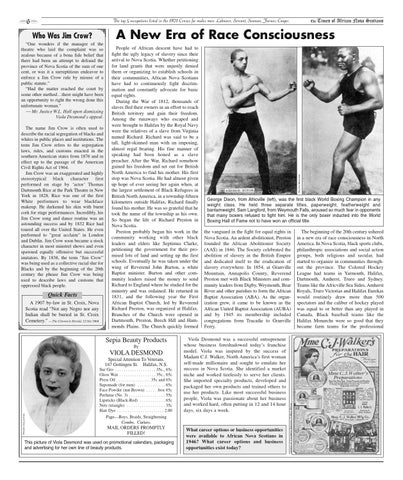
George Dixon, from Africville (left), was the first black World Boxing Champion in any weight class. He held three separate titles, paperweight, featherweight and bantamweight. Sam Langford, from Weymouth Falls, aroused so much fear in opponents that many boxers refused to fight him. He is the only boxer inducted into the World Boxing Hall of Fame not to have won an official title.
the vanguard in the fight for equal rights in Nova Scotia. An ardent abolitionist, Preston founded the African Abolitionist Society (AAS) in 1846. The Society celebrated the abolition of slavery in the British Empire and dedicated itself to the eradication of slavery everywhere. In 1854, at Granville Mountain, Annapolis County, Reverend Preston met with Black Ministers and community leaders from Digby, Weymouth, Bear River and other parishes to form the African Baptist Association (ABA). As the organization grew, it came to be known as the African United Baptist Association (AUBA) and by 1945 its membership included congregations from Tracadie to Granville Ferry.
Viola Desmond was a successful entrepreneur whose business foreshadowed today’s franchise model. Viola was inspired by the success of Madam C.J. Walker, North America’s first woman self-made millionaire and sought to emulate her success in Nova Scotia. She identified a market niche and worked tirelessly to serve her clients. She imported specialty products, developed and packaged her own products and trained others to use her products. Like most successful business people, Viola was passionate about her business and worked hard, often putting in 12 and 14 hour days, six days a week.
What career options or business opportunities were available to African Nova Scotians in 1946? What career options and business opportunities exist today?
LIBRARY OF CONGRESS ARCHIVES © MARY BELLIS
Who Was Jim Crow?
PRIVATE COLLECTION
The Times
The top 5 occupations listed in the 1871 Census for males were Labourer, Servant, Seaman, Farmer, Cooper.
6
The beginning of the 20th century ushered in a new era of race consciousness in North America. In Nova Scotia, black sports clubs, philanthropic associations and social action groups, both religious and secular, had started to organize in communities throughout the province. The Colored Hockey League had teams in Yarmouth, Halifax, Dartmouth, Amherst, Truro and Sydney. Teams like the Africville Sea Sides, Amherst Royals, Truro Victorias and Halifax Eurekas would routinely draw more than 500 spectators and the caliber of hockey played was equal to or better than any played in Canada. Black baseball teams like the Halifax Monarchs were so good that they became farm teams for the professional
of African Nova Scotians
Teacher/Community Activist
7
Jerry Jones “Is This Thing Any Good?”
PRIVATE COLLECTION
Negro Leagues in the US. Legendary boxers like George Dixon and Sam Langford began to establish a legacy of excellence in the sport that carries on to this day. A new generation of African Nova Scotian leaders emphasized education as the means to fight for social justice and against discrimination. Among this generation were James Robinson Johnston and James A.R. Kinney. Johnston started school in 1882 at the Maynard Street School for Negro Boys. When the School was amalgamated with the Lockman Street School for Negro Girls and moved to the North End Mission, Johnston came to the attention of the new principal, Jane Bruce. Bruce recognized Johnston’s special abilities and arranged for him to attend the racially-integrated and betterequipped Halifax Academy. In 1892, Johnston entered Dalhousie University and in 1896 earned his BA in Literature. Two years later, when he graduated from Dalhousie Law School, James Robinson Johnston became the province’s first indigenous African Nova Scotian lawyer. James A.R. Kinney was born in Yarmouth and in 1897 was the first black graduate of the Maritime Business College. After College, Kinney went to work for William, Stairs, Son and Morrow, a large manufacturing company located at the corner of Lower Water and Sackville Streets in Halifax and eventually became its advertising manager. Johnston and Kinney both volunteered with the AUBA and both worked tirelessly for better access to higher education for African Nova Scotians. Tragically, Johnston’s work was cut short by his untimely death in 1915. Kinney went on to serve on the executive of the AUBA and was a founder of the Nova Scotia Home for Colored Children. In 1921, J.A.R. Kinney became the Home’s first superintendent and worked there until his death in 1940. Wellington Ney States was born in Wolfville. Orphaned at an early age, States first lived with his white maternal grandparents but later went to live with his paternal grandparents in nearby Mount Denson. They encouraged him to enrol at Horton Academy where he studied theology.
The 1871 Census lists 160 Blacks living in Colchester County.
NOVA SCOTIA PUBLIC ARCHIVES
The Times
The Colored League All Stars, 1931. Back row, far left (with patch over his eye) is Jack Desmond. Back row middle is Elmer Jones (son of Jerry Jones and father of Rocky Jones). Next to Elmer is his brother Vic. Back row, far right is Beresford Husbands, Jr.
Halifax Diamond Championship Baseball Team, 1921. The professional Negro Baseball Leagues in the United States often scouted for players in Nova Scotia.
In 1899 Reverend Wellington States was ordained at Inglewood Church and began his missionary work for the AUBA. A gifted carpenter, States built churches in New Glasgow, Hammonds Plains, Granville Ferry and Delaps Cove. He also remodeled
Scholar/Educator
or repaired the churches at Acaciaville, Tracadie, Sunnyville, Kentville, Beechville, Africville, Cherrybrook and Dartmouth. William Andrew White was born in Virginia in 1874. Encouraged by Baptist missionaries, White came to Nova Scotia in
Here is a letter we have just received from a Truro Officer in Witley Camp, England about some Truro heroes. (Witley Camp, Surrey, July 25, 1917) “Word comes from those heroes, who are daily arriving in English hospitals, of numerous acts of bravery on the part of our boys from home, many of which should be rewarded with V.C.’s, but will never reach beyond the eyes of those who are now past recording such events. One of the humble citizens of Truro, always an honest, hard-working man was reported wounded several weeks ago. I last saw him in Bramshott in January before he had gone to France, had a few words with him, next heard he had been wounded and only today, from one of the lads in the hospital, who was with him at the time did I hear the complete story of how “JERRY JONES” had captured a German machine gun, forced the crew to carry it back to our lines, and depositing it at the feet of the C.O. said: “Is this thing any good? (“Isn’t that just like our big, honest, witty Jerry?” – Ed. News.) The report is that he has been recommended for a D.C.M. I hope it is true. All honor to this man, who is ready for the front again. May he live to return to Truro and receive the welcome he deserves.” We are glad for those encouraging lines for our boys from a Military Camp in England and the thoughtful writer need never fear but what if “Jerry Jones” returns to Truro with a D.C.M. he’ll be the lion of the hour. We can see the great big colored man, on the battlefield, without a word of German in his Ford Street vernacular order those cowardly Huns to pack up their machine gun and march to the British lines! Well done, Jerry. — The Truro Daily News - August 17, 1917
Educator/Mayor/Artist
Poet/Educator/Playwright
Edith Hope Cromwell, O.N.S.
Daurene Lewis, C.M.
George Elliott Clarke, O.C.,O.N.S.
1916 - 2009 Inglewood
1944 - 2013 Annapolis Royal
Life-long community activist and one of the earliest African Nova Scotian graduates of the Nova Scotia Teachers College.
Leslie H. Oliver Wolfville Professor Emeritus, Jodrey School of Computer Sciences, Acadia.
First elected African Nova Scotian Mayor and first black woman Mayor in Canada. Direct descendant of Black Loyalist, Rose Fortune.
Windsor Plains University professor. Winner of the Governor-General’s Award for Poetry, the Portia White Prize for Artistic Achievement, the Dr. Martin Luther King Jr. Award and numerous other awards. Canada’s hardest working poet.
The N.S.A.A.C.P. is the Ladder to Advancement. STEP ON IT! JOIN TODAY!
Did You Know? That Adult education in rural communities is being sponsored by the N.S.A.A.C.P. That the Educational Department of the Province of Nova Scotia is supporting the movement. That a class has already started in Hammonds Plains and is progressing favourably. That the C.G.I.T. [Canadian Girls In Training] group of Cornwallis Street Baptist Church, Halifax, raised the sum of $35.00 at their Christmas Sale. Mrs. Oliver is the leader and all girls are under 16 years. That the money will be used for the work of the Summer Camp at Fall River. That Mr. Horborn, of Fall River, gave the use of an island near the Cornwallis Street Church camp site for the promotion of the Young People’s work of that Church. That two Colored girls are enrolled as student nurses in two Halifax hospitals. They are Miss Gwendolyn Barton of Halifax and Miss Ruth Bailley of Toronto. That J. Calbert Best of King’s College, Halifax, will write for the Afro-American, one of the largest weekly Negro newspapers in the U.S.A. Mr. Best has been asked to prepare a 700-word article on Canada. The weekly circulation of the Afro is 200,000.
1899 and enrolled at Acadia University. Four years later he graduated with a Bachelor of Arts and was ordained that same year. Reverend William White’s first assignment was to organize the 2nd Baptist Church in New Glasgow. In 1905, he was assigned as pastor to Truro Zion Baptist Church and served there until 1917. At the outbreak of World War I, Reverend White, like many African Nova Scotians, answered the call to serve his country. Hundreds of African Nova Scotians were turned away when they tried to enlist, but the need for reinforcements in Europe, combined with pressure from Ottawa, forced the creation of the only segregated Black battalion in Canadian military history, the No.2 Construction Battalion. The Battalion was based out of Pictou and was comprised of 603 men, many of whom were from Nova Scotia. Of the 19 officers, only Reverend White, who was commissioned as a Major, was black. The Battalion served with distinction in France and was disbanded in 1919. The conduct of the Battalion and of individual soldiers in other Nova Scotia Regiments belies the myth that African Nova Scotians did not serve on the front lines during WWI. Sydney Jones served with the 106th Royal Canadian Regiment and was
PRIVATE COLLECTION
The 1871 Census lists J.T. Brown as a school teacher in Halifax City Ward 5.
8
wounded at the Battle of Passchendale, Belgium. He went on to serve as deacon at Cornwallis Street Baptist Church for 42 years. Roy Fells, from Yarmouth, was awarded the Military Medal for Bravery while serving with the 25th Battalion. Jeremiah Jones from Truro also served with the 106th Royal Canadian Regiment. During action at Vimy Ridge, Jones captured a German machine gun nest and forced the German gun crew to carry the machine gun
The N.S.A.A.C.P.
MARITIME COMMAND MUSEUM
of African Nova Scotians
Loyal Wilberforce Lodge, No. 7336, I.O.O.F., Halifax, 1917. Back row without a hat is Reverend Wellington States.
–––––N–––––
The Nova Scotia Association for the Advancement of Colored People (NSAACP) was organized in 1945: To improve and further the interest of the Colored people of the Province. To provide an organization to encourage and promote a spirit of fraternity among its members. To co-operate with Governmental and private agencies for the promotion of the interest and welfare of the Province or any community therein, wherein Colored People are resident, and particularly in reference to said colored people. To improve the educational opportunities of Colored youth and to raise the standard of the Colored people of the Province or any community therein.
The Times
The No.2 Construction Battalion Band.
Pastor/Social Activist
Sailor/Civil War Hero
Reverend William Andrew White, BA
Ben Jackson
1874 - 1936 Truro
1833 - 1915 West Brooklyn, Kings County
The first African Nova Scotian to be granted an Honourary Doctorate from Acadia University. The only commissioned African Nova Scotian officer in WWI.
Participated in the naval assault on Mobile Bay. One of at least 75 African Nova Scotian sailors known to have served for the North during the American Civil War.
back to his commanding officer. Remarkably, Jeremiah Jones was 49 years old at the time! Despite a recommendation from his commanding officer, Jones was denied the Distinguished Conduct Medal. Twenty years later, African Nova Scotians would again be among the first to enlist for WWII. Hundreds saw action in all theatres of the War and many fell in battle. Among the dead would be Private Cecil Dixon of Africville, Lance Corporal Primrose Hamilton of Halifax, Sapper Jack Tynes from Dartmouth, Privates Robert Lawrence, Lyle Izzard and Norman Skinner of Guysborough and Gunner Charles Fairfax of Windsor Plains. After both wars, returning veterans assumed the mantle of leadership in communities all across Nova Scotia. When Reverend William White returned to Nova Scotia after WWI, he was assigned to Cornwallis Street Baptist Church in Halifax and to the executive of the AUBA. A lesser known fact about Reverend White is that he was an accomplished singer. While at Cornwallis Street Baptist Church, he pioneered the broadcasting of Gospel music at the fledgling CHNS radio station. He and the White Family Singers reached a wide radio audience throughout Atlantic Canada and the northeastern United States. Reverend White obviously
War Hero
The following people comprise the charter members of the Association: Arnold P. Smith, Richard Symonds, William Carter, Bernice A. Williams, Carl W. Oliver, Walter Johnston, Pearleen Oliver, William P. Oliver and Ernest Grosse. –––––N––––– Join the N.S.A.A.C.P. Write Bernice A. Williams, Sec’y 166 Maynard Street, Halifax, N.S —The Clarion Vol.1, No.1. December 31, 1946
William Hall, V.C. 1827 - 1904 Horton Bluff First black person, first African-Canadian and the first Nova Scotian to be awarded the Victoria Cross.
of African Nova Scotians
H. Donald Thomas.
Do a presentation for your class that demonstrates an aspect of popular culture that has been shaped or influenced by black people in North America. Create, perform, illustrate or use examples of art, music, dance, fashion, spoken word, etc., for your presentation.
Pte. Vernal Braithwaite
Pte. Eric E. Langford
MARITIME COMMAND MUSEUM
9
Brothers Wilford, Curtiss and George Borden, Airforce and Cpl. Marlene (Tynes) Clyke, Army.
crusader” for equal rights in Nova Scotia. Like White, Kinney, States and others before them, Reverend and Pearleen Oliver continued to encourage participation in Church programs and action committees. With groups that included Ladies’ Auxiliaries, Laymen’s Councils, the Baptist Young Peoples Union (B.Y.P.U.) and Canadian Girls in Training (C.G.I.T.), the AUBA membership claimed to include nearly half of all African Nova Scotians. The beginning of the 20th century coincided with the largest influx of black immigrants to Nova Scotia since 1815. These new African Nova Scotians arrived from the Caribbean and settled primarily in Cape Breton and Halifax. Their arrival lent impetus to the new social consciousness. In 1915, a group of these new African Nova Scotians including Wilfred DeCosta, Dr Clement Ligoure, Ethelbert Cross, William Thomas, Fitzgerald Jemmott and others started The Atlantic Advocate, Nova Scotia’s first black periodical. The aim of The Advocate was “to show our people the need for unity, the desire to stand always for the right and to keep before them the dignity of true and honest toil.” The demands of WWI saw the demise of The Advocate. DeCosta, Cross and Thomas enlisted and served with the No.2 Construction Battalion. Jemmott, the first editor, went on to teach school at Africville for nearly 30 years. The Universal Negro Improvement As-
sociation (UNIA) opened a chapter in Glace Bay in 1918. Started by Marcus Garvey, a Jamaican national hero, the UNIA was founded “to promote social, political and economic freedom for Blacks.” The chapter opened a hostel and community center for immigrants from the West Indies who had come to work in the coal mine at the top of Jessome Street. Money to reimburse the coal company for the cost of their fare to Cape Breton was taken directly from their pay, and often these new arrivals would have to wait years in order to save enough
BLACK CULTURAL CENTRE
passed his passion for music on to his children. His son Lorne and his daughter Yvonne toured widely and were chosen to perform at the opening of the 1988 Winter Olympics in Calgary. His daughter Portia taught school at Africville, Lucasville and at the Home for Colored Children in Westphal before studying music. In 1943, she received the inaugural Nova Scotia Talent Trust Award and went on to become an
internationally renowned contralto. The Portia White Memorial Award for Excellence in the Arts is presented annually in her honour. Another daughter, Helena, was also a well-known singer. Helena gave up touring professionally after she married Clifford Oliver of Wolfville. Their son Donald would become the first African Nova Scotian Senator. Reverend White’s son, William White Jr., was the first African Canadian to run for federal office. He was invested into the Order of Canada in 1970. After his death in 1936, Reverend White was succeeded as pastor of Cornwallis Street Baptist Church by Reverend William Pearly Oliver. William Oliver was born and raised in Wolfville, Nova Scotia. His father, Clifford Havelock Oliver, and his grandfather, William Oliver Sr. had both worked as custodians at Acadia University. After finishing high school, he enrolled at Acadia and earned his BA in 1934 and his Divinity Degree in 1936. That same year, Reverend Oliver was assigned as pastor to the 2nd Baptist Church in New Glasgow. While there, he met and married Althea Pearleen Borden. Pearleen Borden was the first black graduate of New Glasgow High School. After finishing high school, Pearleen applied to nursing school but, because of racial discrimination, was denied admission. No doubt this experience fueled her relentless work for social justice and gained her a reputation as a “militant
MARITIME COMMAND MUSEUM
Reverend William Andrew White.
The 1871 Census lists Mary Bauld as a school teacher in Hammonds Plains.
MARITIME COMMAND MUSEUM
The Times
The Halifax Coloured Citizens’ Improvement League picnic at Point Pleasant Park, Halifax.
People of African descent have helped define popular culture in North America. Their influence has shaped modern music, dance, fashion, art and language. Evidence of that influence is all around us. For example, the language of African American jazz players, known as jive talk, has passed into the language of everyday use. The New Cab Calloway’s Hepsters Dictionary: Language of Jive was published in 1944 and was “the first glossary of words, expressions, and general patois employed by musicians and entertainers in New York’s teeming Harlem”. Many of those words and expressions are still used in today’s popular slang. Yeah, Man: an exclamation of assent Too much: term of highest praise Stache: to hide away, to secrete Square: an unhip person Solid: great, swell Sharp: neat, smart Riff: musical phrase Pad: bed Out of this world: perfect Mellow: all right, fine Latch on: take hold, get wise to
Joint is jumping: the place is lively Jam: improvised swing music In the groove: perfect, no deviation Hype: persuasive talk, build up for a loan Hip: wise, sophisticated Have a ball: to enjoy yourself Groovy: fine Chick: girl Cat: musician in a swing band Beat up: sad, tired Beat: exhausted
Cab Calloway
The Times
The 1871 Census lists Mary Ball as a school teacher in Chester.
PRIVATE COLLECTION
10
On stage at the Ballroom of the Lord Nelson Hotel in Halifax, circa 1930, are (left to right) Charles Adams, father of legendary Nova Scotian jazz musician Bucky Adams; Clyde Jemmott, principal of Africville School; Frank Adams, father of Wayne Adams, the first African Nova Scotian MLA; Maurice Earle, father of Gordon Earle, the first African Nova Scotian MP; Helena White, sister of Portia White and mother of Donald Oliver, the first African Nova Scotian appointed to the Senate.
money to bring their loved ones to Nova Scotia. The community center is now home to the UNIA Community Cultural Museum. Fredrick Hamilton was an active member of the UNIA. Hamilton had immigrated to Sydney from Tobago. He went to Halifax to attend Dalhousie University where he earned his Bachelor of Arts and Law Degree. He returned to Sydney to practice law in 1923. A few years later, Hamilton started a monthly newspaper in Sydney called The Nova Scotia Gleaner. Like The Advocate, The Gleaner was published to “unify the colored people of Nova Scotia”. The first issue appeared in August, 1929. The Gleaner only lasted a few issues and was likely the victim of the stock market crash that triggered the Great Depression. In 1950, Hamilton became the first African Canadian awarded the title King’s Council (KC). Many new immigrants, like Isaac Phills from the island of St. Vincent, would serve
in the war and later find work in the steel mills of Sydney. Phills became a community activist and raised a large family, many of whom attended university. Isaac Phills was the first African Nova Scotian invested into the Order of Canada. In 1921, Bishop George Alexander McGuire, an immigrant from Antigua, organized St. Philip’s African Orthodox Church in Whitney Pier. St. Philip’s was the only African Orthodox parish in Canada and became the focal point for the black community in the Sydney area. In 1940, the Venerable Archpriest George A. Francis began his distinguished forty-one year service to St. Philip’s and the surrounding community. Reverend Francis was born in Cuba and had studied theology in New York City before moving to Nova Scotia. His daughter, The Honourable Mayann Francis, would become the CEO of the Nova Scotia Human Rights Commission and the first black Lieutenant-Governor of Nova Scotia.
Educator/Community Activist
Theologian/Scholar/Educator
Dr. Geraldine Browning
Rev Dr. Peter J. Paris
East Preston/Gibson Woods
New Glasgow
Life-long community activist, teacher and nurse. Founding Member and past-President of the Black Cultural Society. Instrumental in re-opening Gibson Woods United Baptist Church. Recipient of numerous awards and honours including a Doctor of Humanities from Acadia University.
Professor Emeritus at Princeton Theological Seminary and a Visiting Professor at Boston University School of Theology. Named Alumnus of the Year, University of Chicago Divinity School, 1995 and Distinguished Alumnus of the Year, Acadia University, Wolfville, 2012.
The Halifax Colored Citizens Improvement League was a social action group started in 1932 by Beresford Augustus Husbands. Husbands was born in Barbados in 1883 and immigrated to Halifax in 1900. He attended Joseph Howe School and later married Iris Lucas of Lucasville, Nova Scotia. Husbands was a successful businessman who had started the Citizens Improvement League to help remove the barriers to education and employment for African Nova Scotians. Around the same time, a small group of about twenty African Nova Scotians in Halifax, led by Dr. F.B. Holder, a black doctor born in British Guyana, started to meet regularly at the Gerrish Street Hall to discuss interests of mutual concern. The group formed the Colored Education Centre and often invited the leaders of industry, education, politics and religion to speak to their group. It was the members of the Colored Education Center and the Halifax Colored
Politician/Senator
of African Nova Scotians
Citizens Improvement League who took the initiative in forming the Nova Scotia Association for the Advancement of Colored People (NSAACP). When the AUBA, lead by Reverend W.P. Oliver and the formidable Mrs. Pearleen Oliver gave their endorsement to the NSAACP, the Association instantly gained a provincewide network for membership. The Viola Desmond Appeal would be the newlyformed Association’s first major challenge. Despite the similar sounding names, the NSAACP was not affiliated with the National Association for the Advancement of Colored People (NAACP) in the United States. The NAACP was formed in the aftermath of the race riots and lynching which occurred in Illinois in 1908. In 1909, a group of activists, lead by Mary White Ovington, met in New York City to organize a “large and powerful body of citizens” to fight for equal rights. Almost from the beginning, the National Association used the courts to fight for social justice. Though initially a multi-race organization, by mid-century, the NAACP was almost exclusively African-American. By 1940, the Association had hired a young lawyer named Thurgood Marshall who systematically set out to reverse the Jim Crow laws and the ‘separate but equal’ doctrine that was entrenched in many State laws. Marshall and the NAACP went on to win many landmark victories in the U.S. Supreme Court and their efforts culminated with the passing of the American Civil Rights Act in 1964. Thurgood Marshall would become the first African-American to serve on the Supreme Court of the United States. Though the Nova Scotia Association worked to fight against discrimination and for social justice, education was the cornerstone of the organization. Unlike the United States, there were few laws that enforced segregation in Nova Scotia. Segregation was by custom rather than by law. Legal challenges were expensive to mount and depended on the availability and willingness of white lawyers. It would be 1951 before the third African Nova Scotian lawyer, George Davis from Halifax, graduated from Dalhousie Law School. Athlete/Commissioned Officer
Ted Upshaw Don Oliver, Q.C.
Windsor Plains
Wolfville
First African Nova Scotian Commissioned Officer and first Inspector in the Royal Canadian Mounted Police (RCMP). Named to Acadia University’s Sports Hall of Fame in 2012.
First African Nova Scotian appointed to the Senate.