Eye on Acadia
Prime example of Acadia’s community-based, non-profit research efforts By Laura Churchill Duke (’98)
C
overing a total area of more than 1.5 million hectares, the Southwest Nova Biosphere Reserve (SNBR) spans Annapolis, Digby, Yarmouth, Shelburne and Queens counties and is one of only 16 biosphere reserves in Canada. It includes rolling, river and glacial plains, hills, drumlins and coastal cliffs. It is home to many plant and animal species-at-risk. The SNBR also encompasses two special protected areas: Kejimkujik National Park and the Tobeatic Wilderness Area. Right in the heart of the SNBR, in Kempt, Queens County, sits the Mersey Tobeatic Research Institute (MTRI), a communitybased, non-profit research, monitoring and educational centre with strong ties to Acadia. “My first interaction with this site,” says Dr. Tom Herman, Acadia’s VicePresident Academic and Professor of Biology, “goes back more than a decade.” The facility was used initially to house student researchers working on species-at-risk in and around Kejimkujik National Park, but Herman says, “we quickly realized there was potential and we
needed to do much more with the site.” Thus, Acadia University was one of the founding partners in the development of MTRI. It was incorporated in 2004 and began renting the existing building, which had previously housed Acadia students. Acadia purchased the building in 2006 and substantially renovated it in 2011. The Institute’s mission is to advance collaborative research and to monitor and manage the sustainable use of resources and biodiversity conservation in the SNBR. “MTRI provides facilities for researchers, is a community partner on funding proposals, and helps coordinate field studies on the ground,” says Institute Executive Director Amanda Lavers (’04). MTRI’s activities therefore encompass a wide range of projects. From species at risk research to aquatic connectivity, old-growth forestry research, our human dimensions and youth outreach, they conduct a variety of short term projects and ongoing programs. The work is conducted by visiting researchers from universities, colleges,
government, and community groups, as well as by MTRI staff. Volunteers, students and staff collaborate to conduct applied science research, grounded in and based upon community and management requirements. Acadia currently has both graduate and undergraduate students from the Department of Biology conducting research and doing field work at the Institute. The educational and research impact of the MTRI reaches well beyond location and facility. “It allows students working in the field to be part of a community of researchers and to experience projects and perspectives that they would not experience if they were on their own,” says Dr. Steve Mockford, (’96), an Acadia Biology professor and Chair of the MTRI’s Board of Directors. “As an example, during the active research season we meet with others involved in the conservation of a variety of species and coordinate activities and resources. This maximizes the experience for students as well as ensuring the optimal use of increasingly scarce research resources.” Not only has the MTRI continued to expand its influence with the research community, it acts also as a trendsetter and a showcase for green technologies appropriate for local communities and industries. Recently, the building was expanded and the renovation incorporated several green technologies including geothermal heating, solar water heating, solar space heating, and wind energy. Jesse Saroli (’09) was project coordinator for this green technology project. “Besides from the Board of Directors, we also got advice about the renovation project by being a case study for a course at the NSCC campus in Middleton,” Lavers says. “The footprint of the Institute is one of influence,
Eye on Acadia
The Mersey Tobeatic Research Institute
not consumption,” Herman adds. The MTRI is a key driver for the economic future of the area. The renovated Community Room now serves as a space where people in the region can come together. In the long term, the lab space and updated equipment will increase MTRI’s capacity for collaboration with local landowners and businesses on research initiatives. The additional space will enhance MTRI’s capacity for hosting training workshops, university and school groups, and other public events, bringing people and dollars into the community. The MTRI is a shining example of Acadia’s community partnership philosophy and illustrates the University’s strong commitment to communitycentered research. That commitment is evidenced by the many students who have worked at and projects that have been supported by the Institute; by the two members of the Acadia community (Herman and Mockford) who serve on the Board; alumnus and former Board Chair Tom Sheppard (’66); by the Executive Directorship being held by an Acadia Alumna (Lavers); and by several other Acadia graduates who are serving or have served as staff members, including Saroli (’09) and Brennan Caverhill (‘03). “The future for MTRI is bright, particularly because of the people involved,” Sheppard says. “It seems to have touched a nerve in terms of its ability to carry out research projects for Kejimkujik, government, universities and colleges and private industry. Because of the quality of its work and its flexibility, I think it will continue to grow as a research institute.” For more information about the Mersey Tobeatic Research Institute, visit www.merseytobeatic.ca.
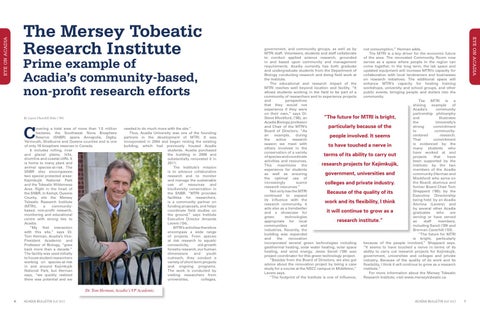
Dr. Tom Herman, Acadia’s VP Academic. 6
ACADIA BULLETIN Fall 2012
ACADIA BULLETIN Fall 2012
7