Building & Refurbishment
ideas between the supply chain. Architects strive for the aesthetic; facilities managers must comply with health and safety regulations but also meet budgets; installers and contractors look for products that are retrofit, or quick and easy to install, and choice of hardware becomes based on those factors. As a result, while compliance standards can be met, these competing forces mean the solution or hardware that is chosen may not be best for the users. Fire doors are another area that require debate and thought. Heavy in nature, but a necessity to fire safety, they can become dangerous when the hardware used with them does not facilitate easy passage or use. Primary school children may not have the strength to push open doors, while www.twitter.com/BFM_Magazine
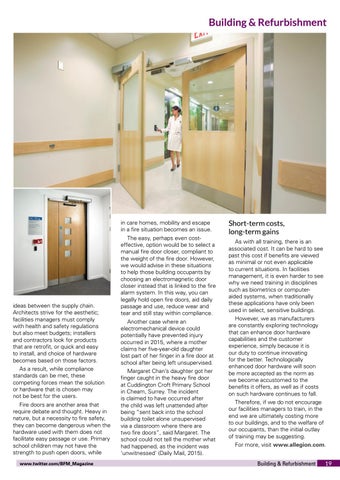
in care homes, mobility and escape in a fire situation becomes an issue. The easy, perhaps even costeffective, option would be to select a manual fire door closer, compliant to the weight of the fire door. However, we would advise in these situations to help those building occupants by choosing an electromagnetic door closer instead that is linked to the fire alarm system. In this way, you can legally hold open fire doors, aid daily passage and use, reduce wear and tear and still stay within compliance. Another case where an electromechanical device could potentially have prevented injury occurred in 2015, where a mother claims her five-year-old daughter lost part of her finger in a fire door at school after being left unsupervised. Margaret Chan’s daughter got her finger caught in the heavy fire door at Cuddington Croft Primary School in Cheam, Surrey. The incident is claimed to have occurred after the child was left unattended after being “sent back into the school building toilet alone unsupervised via a classroom where there are two fire doors”, said Margaret. The school could not tell the mother what had happened, as the incident was ‘unwitnessed’ (Daily Mail, 2015).
Short-term costs, long-term gains As with all training, there is an associated cost. It can be hard to see past this cost if benefits are viewed as minimal or not even applicable to current situations. In facilities management, it is even harder to see why we need training in disciplines such as biometrics or computeraided systems, when traditionally these applications have only been used in select, sensitive buildings. However, we as manufacturers are constantly exploring technology that can enhance door hardware capabilities and the customer experience, simply because it is our duty to continue innovating for the better. Technologically enhanced door hardware will soon be more accepted as the norm as we become accustomed to the benefits it offers, as well as if costs on such hardware continues to fall. Therefore, if we do not encourage our facilities managers to train, in the end we are ultimately costing more to our buildings, and to the welfare of our occupants, than the initial outlay of training may be suggesting. For more, visit www.allegion.com. Building & Refurbishment
19