Profile
Linda Barcklay
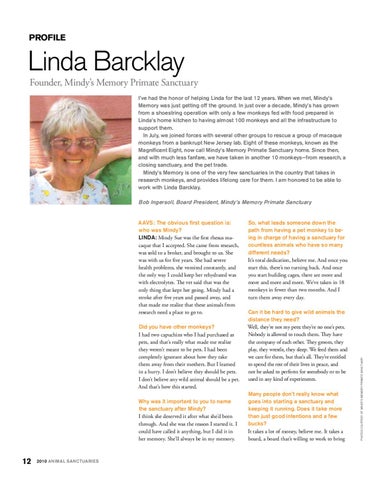
Founder, Mindy’s Memory Primate Sanctuary I’ve had the honor of helping Linda for the last 12 years. When we met, Mindy’s Memory was just getting off the ground. In just over a decade, Mindy’s has grown from a shoestring operation with only a few monkeys fed with food prepared in Linda’s home kitchen to having almost 100 monkeys and all the infrastructure to support them. In July, we joined forces with several other groups to rescue a group of macaque monkeys from a bankrupt New Jersey lab. Eight of these monkeys, known as the Magnificent Eight, now call Mindy’s Memory Primate Sanctuary home. Since then, and with much less fanfare, we have taken in another 10 monkeys—from research, a closing sanctuary, and the pet trade. Mindy’s Memory is one of the very few sanctuaries in the country that takes in research monkeys, and provides lifelong care for them. I am honored to be able to work with Linda Barcklay.
Bob Ingersoll, Board President, Mindy’s Memory Primate Sanctuary
Did you have other monkeys? I had two capuchins who I had purchased as pets, and that’s really what made me realize they weren’t meant to be pets. I had been completely ignorant about how they take them away from their mothers. But I learned in a hurry. I don’t believe they should be pets. I don’t believe any wild animal should be a pet. And that’s how this started. Why was it important to you to name the sanctuary after Mindy? I think she deserved it after what she’d been through. And she was the reason I started it. I could have called it anything, but I did it in her memory. She’ll always be in my memory.
12 2010 Animal Sanctuaries
So, what leads someone down the path from having a pet monkey to being in charge of having a sanctuary for countless animals who have so many different needs? It’s total dedication, believe me. And once you start this, there’s no turning back. And once you start building cages, there are more and more and more and more. We’ve taken in 18 monkeys in fewer than two months. And I turn them away every day. Can it be hard to give wild animals the distance they need? Well, they’re not my pets; they’re no one’s pets. Nobody is allowed to touch them. They have the company of each other. They groom, they play, they wrestle, they sleep. We feed them and we care for them, but that’s all. They’re entitled to spend the rest of their lives in peace, and not be asked to perform for somebody or to be used in any kind of experiments. Many people don’t really know what goes into starting a sanctuary and keeping it running. Does it take more than just good intentions and a few bucks? It takes a lot of money, believe me. It takes a board, a board that’s willing to work to bring
PHOTOS Courtesy of Mindy’s Memory primate sanctuary
AAVS: The obvious first question is: who was Mindy? Linda: Mindy Sue was the first rhesus macaque that I accepted. She came from research, was sold to a broker, and brought to us. She was with us for five years. She had severe health problems, she vomited constantly, and the only way I could keep her rehydrated was with electrolytes. The vet said that was the only thing that kept her going. Mindy had a stroke after five years and passed away, and that made me realize that these animals from research need a place to go to.