ARDF Makes the Connection
S
ince 1996, the American Anti-Vivisection Society and the Alternatives Research & Development Foundation (ARDF) have participated in every World Congress on Alternatives. In particular, ARDF, which has a mission very much aligned with the World Congress, has been a sponsor, and helped plan programs. ARDF’s leadership and visibility are appreciated and important because our priority on fully replacing animals in research and testing serves as a reminder that the animals are the main reason that these meetings came into being. The World Congresses have provided the ideal platform for some of ARDF’s most important advancements. In 1999, at the 3rd World Congress in Bologna, Italy,
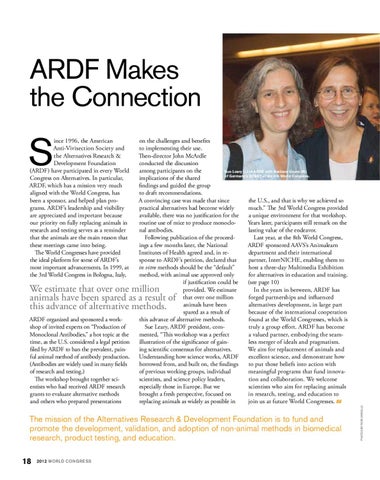
on the challenges and benefits to implementing their use. Then-director John McArdle conducted the discussion among participants on the Sue Leary (L) of ARDF with Barbara Grune (R) of Germany’s ZEBET at the 5th World Congress. implications of the shared findings and guided the group to draft recommendations. A convincing case was made that since the U.S., and that is why we achieved so practical alternatives had become widely much.” The 3rd World Congress provided available, there was no justification for the a unique environment for that workshop. routine use of mice to produce monocloYears later, participants still remark on the nal antibodies. lasting value of the endeavor. Following publication of the proceedLast year, at the 8th World Congress, ings a few months later, the National ARDF sponsored AAVS’s Animalearn Institutes of Health agreed and, in redepartment and their international sponse to ARDF’s petition, declared that partner, InterNICHE, enabling them to in vitro methods should be the “default” host a three-day Multimedia Exhibition method, with animal use approved only for alternatives in education and training. if justification could be (see page 10) provided. We estimate In the years in between, ARDF has that over one million forged partnerships and influenced animals have been alternatives development, in large part spared as a result of because of the international cooperation this advance of alternative methods. found at the World Congresses, which is Sue Leary, ARDF president, comtruly a group effort. ARDF has become mented, “This workshop was a perfect a valued partner, embodying the seamillustration of the significance of gainless merger of ideals and pragmatism. ing scientific consensus for alternatives. We aim for replacement of animals and Understanding how science works, ARDF excellent science, and demonstrate how borrowed from, and built on, the findings to put those beliefs into action with of previous working groups, individual meaningful programs that fund innovascientists, and science policy leaders, tion and collaboration. We welcome especially those in Europe. But we scientists who aim for replacing animals brought a fresh perspective, focused on in research, testing, and education to replacing animals as widely as possible in join us at future World Congresses. AV
ARDF organized and sponsored a workshop of invited experts on “Production of Monoclonal Antibodies,” a hot topic at the time, as the U.S. considered a legal petition filed by ARDF to ban the prevalent, painful animal method of antibody production. (Antibodies are widely used in many fields of research and testing.) The workshop brought together scientists who had received ARDF research grants to evaluate alternative methods and others who prepared presentations
The mission of the Alternatives Research & Development Foundation is to fund and promote the development, validation, and adoption of non-animal methods in biomedical research, product testing, and education. 18 2012 World Congress
PHOTOs By Rob Cardillo
We estimate that over one million animals have been spared as a result of this advance of alternative methods.