•
70 SECTION 2
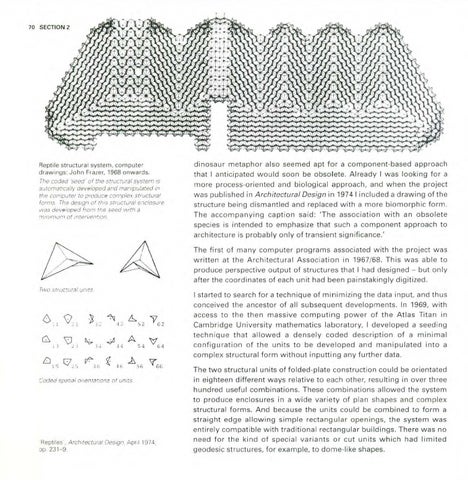
Reptile structura l system , compute r drawi ngs : Jo hn Frazer. 1968 onwards. The coded 'seed' o f ale s tructura l s vsrem.'s auromaucaliV de veloped and rna!1lpulat ed ,,'1 th e computer to produce comp lex Str ucturai forms The deSign of th.s structurai e.1ciosure "",as developed ' rom the seed W.' !,Il a i l .'n.'lflunl of .-nlerven r.'on
dinosaur metaphor also seemed apt for a component-based approach that I anticipated would soon be obsolete. Already I was looking for a more process-oriented and biological approach, and when the project was published in Architectural Design in 1974 1included a drawing of the structure being dismantled and replaced with a more biomorphic form. The accompanying caption said: 'The association with an obsolete species is intended to emphasize that such a component approach to architecture is probably only of transient significance.' The first of many computer programs associated with the project was written at the Architectural Association in 1967/68. This was able to produce perspective output of structures that I had designed - but only after the coordinates of each unit had been painstakingly digitized.
Two
6 6 Ll
s t ruc ~ u .'a /
_1
° '1
11 V 15
"
unw:;.
) L" t.;.
J .1
~
..;l
17 ., If'"36 ~ '"
"
A- 52 Yo, A
44
46
.L,
S4
~64
56
\/66
':oded spaTia,' ooen rar:o .'1 S o f Units
Reptiles' , Architectural Des.gn, Aprd 1974. JP¡231 - 9.
I started to search for a technique of minimizing the data input, and thus conceived the ancestor of all subsequent developments. In 1969, with access to the then massive computing power of the Atlas Titan in Cambridge University mathematics laboratory, I developed a seeding technique that allowed a densely coded description of a minimal configuration of the units to be developed and manipulated into a complex structural form without inputting any further data. The two st ructural units of folded -plate construction could be orientated in eighteen different ways relative to each other, resulting in over three hundred useful combinations. These combinations allowed the system to produce enclosures in a wide variety of plan shapes and complex structural forms. And because the units could be combined to form a straight edge allowing simple rectangular openings, the sys tem was entirely compatible with traditional rectangular buildings. There was no need for the kind of special variants or cut uni ts which had limited geodesic structures, for example, to dome-like shapes.