LANDSCAPE URBANISM Sprawl, post-industrialisation, rapid urbanisation and ‘natural’ disasters pose significant challenges to normative design practice, requiring an approach beyond the quick fix. Landscape Urbanism has emerged as a new discipline which responds to the demands of these conditions. Here, ‘landscape’ is a model of connective, scalar and temporal operations through which the urban is conceived and engages a complex ecology. Landscape Urbanism integrates techniques from environmental engineering, urban strategy and landscape ecology and employs the science of emergence, the tools of digital design and the thought of political ecology. Prototypical Urbanities 03: The Yangtze River Delta China’s economic boom, combined with migration from the countryside, produces new cities instantly and transforms the faces of older towns. This directional urbanisation has brought the phenomenon of globalisation, its foreign capital and generic architecture, to the smallest villages. Expanding on research established over the past two years, LU maintained its focus on China’s ambitions to build 400 new cities by the year 2020 – with 12 million people expected to move from rural to urban locations – as the basis for its brief. Far from resisting this development, we engaged opportunistically with ‘proto-strategies’ for new large-scale agglomerations as a means to critically address mass-produced urban sprawl. Our testbed was the Yangtze River Delta, including Shanghai, Nanjing, Hangzhou, Suzhou, Ningbo. Students explored three issues: Metabolic rurbanism: Explore modes of urbanisation emergent from the ‘desakota’ fabric in which urban and rural processes of land use are combined. Tactical resistance: Locate fault lines in the clash between top-down masterplanning and developed urban cores, where informed and territorially specific urbanism might be produced. Material identities: Explore infrastructure as a material alternative to prevailing urban settlements with an instant ‘identity’, based on either vernacular or western styles of building, in the context of ‘post-traditional’ urbanisation. Staff Eva Castro Alfredo Ramírez Eduardo Rico Tom Smith Douglas Spencer Visiting Staff Alex Wall Steve Graham Erik Swyngedouw Simon Marvin Mike Hodson Chris Reed Alberto Clementi
Students Fiona Kirkwood Ana Bachina Carlos Umaña Karishma Desai Golara Jalapor Athanasios Kourniotis Mak Mun Pheng Tzu-Hui (Teri) Kao Jian-Jie Zhou (Tommy) Diana Helena Araya Muñoz Leonardo Robleto Swepta Gupta Manuel Navarro Chen Chen Zhuo Li Nicola Saladino
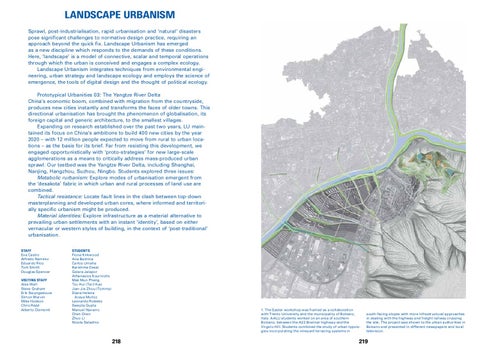
1. The Easter workshop was framed as a collaboration with Trento University and the municipality of Bolzano, Italy. AALU students worked on an area of southern Bolzano, between the A22 Brenner highway and the Virgolo Hill. Students combined the study of urban typologies incorporating the vineyard terracing systems in
218
south-facing slopes with more infrastructural approaches in dealing with the highway and freight railway crossing the site. The project was shown to the urban authorities in Bolzano and presented in different newspapers and local television.
219