56
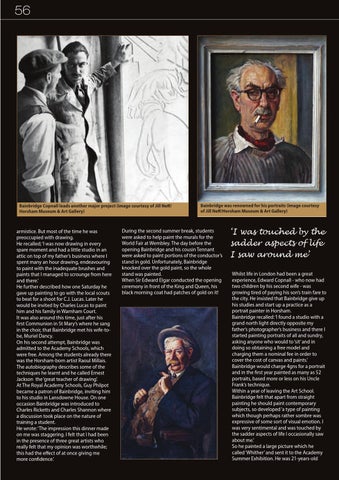
Bainbridge Copnall leads another major project (image courtesy of Jill Neff/ Horsham Museum & Art Gallery)
armistice. But most of the time he was preoccupied with drawing. He recalled; ‘I was now drawing in every spare moment and had a little studio in an attic on top of my father’s business where I spent many an hour drawing, endeavouring to paint with the inadequate brushes and paints that I managed to scrounge from here and there.’ He further described how one Saturday he gave up painting to go with the local scouts to beat for a shoot for C.J. Lucas. Later he would be invited by Charles Lucas to paint him and his family in Warnham Court. It was also around this time, just after his first Communion in St Mary’s where he sang in the choir, that Bainbridge met his wife-tobe, Muriel Dancy. On his second attempt, Bainbridge was admitted to the Academy Schools, which were free. Among the students already there was the Horsham-born artist Raoul Millais. The autobiography describes some of the techniques he learnt and he called Ernest Jackson the ‘great teacher of drawing’. At The Royal Academy Schools, Guy Philpot became a patron of Bainbridge, inviting him to his studio in Lansdowne House. On one occasion Bainbridge was introduced to Charles Ricketts and Charles Shannon where a discussion took place on the nature of training a student. He wrote: ‘The impression this dinner made on me was staggering. I felt that I had been in the presence of three great artists who really felt that my opinion was worthwhile; this had the effect of at once giving me more confidence.’
Bainbridge was renowned for his portraits (image courtesy of Jill Neff/Horsham Museum & Art Gallery)
During the second summer break, students were asked to help paint the murals for the World Fair at Wembley. The day before the opening Bainbridge and his cousin Tennant were asked to paint portions of the conductor’s stand in gold. Unfortunately, Bainbridge knocked over the gold paint, so the whole stand was painted. When Sir Edward Elgar conducted the opening ceremony in front of the King and Queen, his black morning coat had patches of gold on it!
Whilst life in London had been a great experience, Edward Copnall - who now had two children by his second wife - was growing tired of paying his son’s train fare to the city. He insisted that Bainbridge give up his studies and start up a practice as a portrait painter in Horsham. Bainbridge recalled: ‘I found a studio with a grand north light directly opposite my father’s photographer’s business and there I started painting portraits of all and sundry, asking anyone who would to ‘sit’ and in doing so obtaining a free model and charging them a nominal fee in order to cover the cost of canvas and paints.’ Bainbridge would charge 4gns for a portrait and in the first year painted as many as 52 portraits, based more or less on his Uncle Frank’s technique. Within a year of leaving the Art School. Bainbridge felt that apart from straight painting he should paint contemporary subjects, so developed ‘a type of painting which though perhaps rather sombre was expressive of some sort of visual emotion. I was very sentimental and was touched by the sadder aspects of life I occasionally saw about me.’ So he painted a large picture which he called ‘Whither’ and sent it to the Academy Summer Exhibition. He was 21-years-old