AAPM Newsletter | May/June 2025 Vo l u m e 5 0 , N o . 3
Defining the Medical Physics Practice Guideline MPPG UPDATE
W
hat is an MPPG? Why do they exist? Are they just a rebranding of Task Group (TG) reports? Even the most dedicated AAPM member is likely to throw up their arms in frustration trying to find answers to these questions. While this article may not alleviate all of your MPPG-related woes it should shed some light on why they exist and their intended role in the overall landscape of AAPM.
The MPPG was born out of a need to create practical guidance on clinical topics. The first MPPG (appropriately designated MPPG 1) was published in 2012 and outlined the management and review of CT protocols. While the details of CT dose metrics and dosimetry had been developed and discussed in various TG reports (Reports 111, 204, 220, and 293) accreditation bodies had started requiring medical physicists be involved in reviewing CT protocols, creating a need for practical guidance in how this review ought to be carried out. Similarly, in the therapy world, accrediting bodies and regulators were requiring strict adherence to TG-142 in its entirety, which was never the intent (and even stated in the document itself!). Using TG-142 as a starting point, MPPGs 2 and 8 provided much-needed clarification of the actual minimum testing required to ensure quality care. Over the past decade, MPPGs have provided similar guidance in other areas of medical physics. (A full list of MPPGs can be found here.)
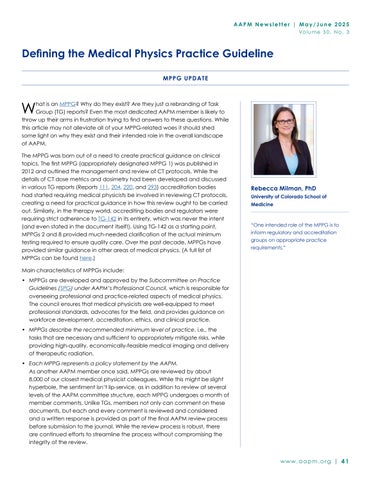
Rebecca Milman, PhD University of Colorado School of Medicine
“One intended role of the MPPG is to inform regulatory and accreditation groups on appropriate practice requirements.”
Main characteristics of MPPGs include: • MPPGs are developed and approved by the Subcommittee on Practice Guidelines (SPG) under AAPM’s Professional Council, which is responsible for overseeing professional and practice-related aspects of medical physics. The council ensures that medical physicists are well-equipped to meet professional standards, advocates for the field, and provides guidance on workforce development, accreditation, ethics, and clinical practice. • MPPGs describe the recommended minimum level of practice, i.e., the tasks that are necessary and sufficient to appropriately mitigate risks, while providing high-quality, economically-feasible medical imaging and delivery of therapeutic radiation. • Each MPPG represents a policy statement by the AAPM. As another AAPM member once said, MPPGs are reviewed by about 8,000 of our closest medical physicist colleagues. While this might be slight hyperbole, the sentiment isn’t lip-service, as in addition to review at several levels of the AAPM committee structure, each MPPG undergoes a month of member comments. Unlike TGs, members not only can comment on these documents, but each and every comment is reviewed and considered and a written response is provided as part of the final AAPM review process before submission to the journal. While the review process is robust, there are continued efforts to streamline the process without compromising the integrity of the review. www.aapm.org | 41