29
Real changemakers do things differently
CONTENTS
29
Onto unfamiliar 12 paths 18 From space
researcher to veterinarian-astronaut? Making a new 22 kind of forest fertiliser
5 Openings – Riitta Silvennoinen and changing working life. 6 Now – Small news items, big issues. 10 Oops! – Riikka Mäkikoskela and the tension of a creative workshop.
THEME: The art of change
Akseli Valmunen
12 Theme – Researcher and two entrepreneurs head for unfamiliar paths. 18 Who – Sini Merikallio has the makings of an astronaut. 22 On the go – Putretti is an outlaw fertiliser. 30 Theme – Professor around whom ideas fly. 34 In-house – Aalto arcades unwrapped after renovation.
These pine saplings planted in freezer storage containers help researchers evaluate the effectiveness of a new, climate-friendly fertiliser. It is simple to make: just mix compost and ash in the right proportion and add a smidgeon of boron.
36 On science – Juudit Ottelin and Matti Kuittinen consider the climate impact of construction. 38 On science – News in brief. 40 On science – Autonomous car A!ex hits the streets of Otaniemi. 43 Wow! – Kalle Järvenpää is developing a better election compass. 44 Partnership – The long partnership of ABB and Aalto students. 46 Theses – Marjo Keiramo and cruise ship concept design; Ted Nuorivaara’s toxin-free frother for the mining industry; Yijie Li and investor behaviour on the equity markets. 48 Everyday choices – Laura Sivula and lifewide learning.
The story behind the Putretti fertiliser starts on page 22.
AALTO UNIVERSITY MAGAZINE 29 \ 3
Rainer Paananen
Rainer Paananen
ON THE JOB
SATU KETTUNEN
RAINER PAANANEN
As an illustrator, I move in a world of ideas, serving as a messenger and reinterpreter. Transformation is a central aspect of this. I interpret and shape things from words to pictures – or perhaps translate music, values, ideas or numeral facts to images. At its best, illustration is a method of showing something that doesn’t yet exist or that could not, as it is, be seen in reality. Anything is possible in illustration.
The point of departure in my work as a photographer and professional artist is often the simplification of visual observations. I transform a moment, act or feeling into a visual reinterpretation. I employ mostly analogue materials, such as film, in my photography. They contain surprises, peacefulness and slowness while at the same time enhancing my concentration and supporting the creative work process.
PUBLISHER Aalto University, Communications EDITOR-IN-CHIEF Communications Director Jaakko Salavuo EDITORS Paula Haikarainen, Riikka Haikarainen, Tiiu Pohjolainen LAYOUT/PHOTO EDITOR Dog Design COVER Satu Kettunen TRANSLATION Ned Kelly Coogan CONTRIBUTORS IN THIS ISSUE Matthew Allinson, Tiina Aulanko-Jokirinne, Juho Haavisto, Terhi Hautamäki, Minna Hölttä,
Jaakko Kahilaniemi, Kalle Kataila, Anne Kinnunen, Veera Krouglov, Paavo Lehtonen, Ville Mehtonen, Aleksi Niemelä, Niina Norjamäki, Rainer Paananen, Aleksi Poutanen, Marjukka Puolakka, Mikko Raskinen, Joanna Sinclair, Eeva Sivula, Tiina Toivola, Annamari Tolonen, Sara Urbanski, Akseli Valmunen, Nita Vera ADDRESS PO Box 18 000, FI-00076 Aalto TELEPHONE +358 9 470 01 ONLINE aalto.fi/magazine EMAIL magazine@aalto.fi CHANGE OF ADDRESS alumni@aalto.fi PRINTING COMISSIONED BY Unigrafia Oy, 2021 PRINTING Grano Oy, 2021 PAPER Maxioffset 190 g/m2 (covers) & 100 g/m2 (pages) PRINT RUN 4 000 (English edition) & 30 000 (Finnish edition) SOURCE OF ADDRESSES Aalto University CRM Partnership and alumni data management PRIVACY NOTICES aalto.fi/services/privacy-notices ISSN 2489-6772 print ISSN 2489-6780 online
4 / AALTO UNIVERSITY MAGAZINE 29
OPENINGS
Can students provide a model for the new normal?
Riitta Silvennoinen Chief Human Resources Officer, Aalto University
The new generation expects a strong sense of workplace community.
Kalle Kataila
In my earlier job at an international telecoms corporation, team members had tasks spanning the globe. Place of residence was inconsequential, we lived in several different countries and would meet face to face a couple of times each year. These meetings were important, helping to maintain mutual trust, team spirit and shared goals. Virtual working functioned well, it was not necessary to be at the office to perform tasks. The team members based in Finland would, nevertheless, pop round the office several times a week. It felt important to maintain a community of present colleagues who you could share experiences with in addition to the virtual team. This kind of close community is what many of us who have been working remotely because of corona are now missing. Digitisation has accelerated the transformation of working life, altered the ways in which we work. At the same time, colleagues representing generation Z have joined our ranks. Gen Z was born into a digital world and uses technology habitually, its expectations regarding work are not the same as the ideas of earlier generations. We had to adopt new tools and ways of working when corona forced us to dump our old familiar practices abruptly. At the same time, the new reality taught us to be more independent and inventive. Now, we look for the most appropriate work practice instead of relying on old habits. What role will the workplace play in the new normal? We shouldn’t trek back to campus just to work in solitude unless that is what we specifically want to do. Work requiring focus, routine tasks and regular reports can easily be done in the home office or some other peaceful space. This also creates savings in commuting. The workplace itself, its physical space, can instead serve as a meeting
place where we come for fresh thinking. A place for bouncing ideas off one another, deep diving into strategic plans and meeting people as planned or extemporaneously. The planning of work in the new normal calls for bold thinking, however. Might we learn something here from the students? They have, after all, traditionally followed a hybrid work model consisting of contact teaching and group meetings, but also a lot of independent activity. When a workplace changes shape into an inspiring venue for renewal, it also becomes future-proof. It nourishes a sense of community, something the new generations rightly expect their place of employment to have.
AALTO UNIVERSITY MAGAZINE 29 \ 5
NOW Aalto University launched its new academic year virtually for the second time in a row. The opening ceremony was broadcast online, in close cooperation with the students.
President Ilkka Niemelä’s speech looked to the post-pandemic future: ‘When times tempt us to turn inwards, I think we need to do just the opposite. We need to open up even more. With students from more than 100 countries, and over 40 percent of our teaching and research staff from abroad, diversity and internationality is a great asset for Aalto, with huge untapped potential.’ The speech by Student Union Chair Milja Leinonen also emphasised that Aalto is a venue for encounters: ‘We cannot afford to be divided into small, individual groups; instead, we must always reach out to others and also reach for new ideas.’ European Commissioner Jutta Urpilainen relayed an official greeting to the Aalto community from Brussels. The President appointed Risto Ilmo niemi an Aalto Professor as recognition for his scientific achievements in researching magnetic stimulation of the brain. Distinguished experts and enablers were also lauded based on votes by the Aalto community. A series of lectures on philosophy and systems analysis by Professor Esa Saarinen received the Aalto Act of the Year award. The opening ceremony was hosted by students Olga Morozova and Elmeri Pälikkö.
Mikko Raskinen
New academic year commences
Aalto University has digitized almost 60 000 theses from the University of Technology and Helsinki School of Economics from 1960s onwards. The scope of this project is unique in the Finnish context and it provides insights into the national heritage of economics and technology. If your work is digitized, you can access it on the Aalto University platform Aaltodoc through identification and examine the digital
6 / AALTO UNIVERSITY MAGAZINE 29
quality of your thesis and then give permission to publish it openly online. Instructions can be found at aalto.fi/en/arkisto/digitointi Over 2 000 alumni have already given publishing rights.
Veera Krouglov
Your thesis might be digitized!
The online exhibition series Designs for a Cooler Planet showcases radical ideas and creative prototypes under the theme of resource wisdom. The physical exhibitions at Otaniemi campus were part of the Helsinki Design Week official programme in September. Resource wisdom means using raw materials, energy, products, time and facilities with care. Wise design respects our common future. It advances wellbeing and carefully considers the impacts of our choices on future generations, society and biodiversity.
Anne Kinnunen
See the exhibitions online at aalto.fi/acoolerplanet
The new organic WoodFoam material could be used in packaging, for example.
Kalle Kaitala
Showcasing paths to resource wisdom
Major international funding for the development of AI methods Samuel Kaski, Aalto University professor and director of the Finnish Center for Artificial Intelligence FCAI, has received the Turing AI World-Leading Researcher Fellowship. The funding is to be used to establish a new center of excellence in the field of AI research. Kaski divides his time between Aalto University and the University of Manchester. He received the Turing funding from UK Research and Innovation (UKRI) for his role at the latter. The funding will cover the work of a research group for five years in a new project involving multiple partners including Aalto, the coordinating institution of the FCAI. Medical research breakthroughs are expected to benefit from this work. The Turing Fellowships were awarded for the first time, with five researchers receiving funding. Kaski’s UKRI funding amounts to a good €5m, in addition to which the University of Manchester and partners will be providing over €10m.
The renewed Museum of Student Life opened The museum of the Aalto University Student Union AYY in the heart of the Otaniemi campus has been renovated, reopened, and brought up to date. It has expanded its activities and is from now on known as the Museum of Student Life. The renewed museum showcases the history and present of Aalto’s student cultures. The exhibition collection, which previously focused on engineering student cultures has been supplemented with the traditions, history and present of the associations KY from Economics and TOKYO from Arts and Design. The visual identity of the museum was updated by Hilla Mäkelä, a master student in visual communication design.
ayy.fi/en
AALTO UNIVERSITY MAGAZINE 29 \ 7
NOW
Sara Urbanski
THE LOST GRADUATION SHOW
exhibition was part of September’s international Salone del Mobile furniture fair in Milan. On display were 170 student projects from 48 schools from around the world. Finland was represented by seven Aalto University students. The exhibition was curated by Anniina Koivu, herself an Aalto alumna. Chair Asento – Lepo (Attention – At ease) by Jenni Inciarte Villaverde.
Helsinki School has grown into a prestigious photographic art collective.
THE HELSINKI SCHOOL is one of the internationally best known phenomena in Finnish contemporary art. It got started at the beginning of the 1990s with an experiment at the University of Art and Design Helsinki (now the School of Arts, Design and Architecture) and grew into a highly-regarded photographic art collective that emphasises a fresh approach to studying photographic art and finding employment in the field. The Kunsthalle Helsinki exhibition New Perspectives Through Photography – 25 years of the Helsinki School showcases 30 artists and is on display until 31 October. Untitled (Forest 17) by Sandra Kantanen.
Sandra Kantanen
8 / AALTO UNIVERSITY MAGAZINE 29
THE INTIMACY exhibition explores the relationship between clothes and the body, demonstrating how profoundly fashion and clothing are intertwined with definitions of humanity, while also updating our perceptions of clothing and accessory design. It showcases products and works by 40 clothing designers, artists or brands with connections to Finland and is curated by Professor Annamari Vänskä, doctoral researcher Natalia Särmäkari and postdoctoral researcher Jenni Hokka. The exhibition runs until 13 March 2022 at the Design Museum in Helsinki. Everybody Lives Here from a collection by Daniel Palillo.
FINNISH DESIGN was on dashing display at the Venice Glass Week in September. Eight Finnish glass artists, four of whom are Aalto alumni, took part. In addition to the exhibition, their skills were showcased in glass blowing demonstrations staged at the famed glass studios on the island of Murano. The Venice Glass Week is Europe’s biggest contemporary glass design event.
Juho Haavisto
Paavo Lehtonen
Etiäinen by Sini Majuri. Majuri is the founder of the FRESH – Contemporary Glass From Finland project that introduced itself at Venice.
AALTO UNIVERSITY MAGAZINE 29 \ 9
OOPS!
Ejecting personal biases Head of Radical Creativity Riikka Mäkikoskela witnessed the power of creativity while attending a workshop.
‘After a Sunday-evening football practice, a teammate wanted to talk about work. At the time, she was heading a research project at the School of Chemical Engineering, while I was a researcher at the School of Arts, Design and Architecture. My friend’s research had become stuck and she was looking for a fresh perspective. Following our chat, she asked, to my surprise, for me to join the project. In what way could an artist and visual arts teacher like me collaborate with engineers? The research focused on promoting the circular economy in the construction industry. A wall panel made of steel and mineral wool was being examined with the aim of lengthening its life cycle and discovering new use applications. These panels were used as material to build, for example, warehouses, but turned into pure waste once it was time to dismantle the structure. Workshops with participants representing many different fields were arranged to tackle the issue. At the first two meetings, we immersed ourselves in the subject and brainstormed ideas. The goal of the third meeting was to, at my lead, develop the product through the means of art, to alter its form and use concretely. I prepared for the workshop much more than usual when teaching, yet I still went there with doubts on my mind. Maybe it would not work out. Some fifteen people were taking part, including a flight mechanic, nurse and an engine driver, in addition to the students, engineers and artists. I wondered what this meeting would result in. I suspected I’d have to motivate and cajole the participants to sink their hands in the dirt, to get involved in a creative effort, which was perhaps unfamiliar to them. But the workshop was abuzz with activity in no time! The gang were busy sketching, painting and drawing. The wall panels didn’t know what hit them, getting worked on by hand and machine. Their creations included a green wall, a fireplace module and a birdhouse. An exhibition was arranged to showcase the workshop’s output. I suddenly realised that, although we used different concepts to talk about things, we were all enthusiastic about innovation, experimentation and development when given the opportunity to engage. The ways in which artists, engine drivers and engineers think and work are surprisingly similar. I continue to play football with my friend, who is now a senior expert on sustainability solutions at Sitra, the Finnish Innovation Fund, while I have returned to Aalto to work in a new, strategic position. Multi- and cross-disciplinary collaboration is surprisingly fruitful. It could be that Nani Pajunen and I got a peek of the headwaters of radical creativity back then.’ Text Paula Haikarainen Portrait Nita Vera Illustration Eeva Sivula
THEME
In a world of increasingly rapid upheavals, some people go on to shine. For them, change provides a research subject or a business idea.
Satu Kettunen
The art of change
12 18 22 30 34
Theme – Onto unfamiliar paths. Who – Sini Merikallio turns her gaze back to the stars. On the go – Putretti is a new type of fertiliser. Theme – Materials scientists draw inspiration from nature. In-house – Aalto arcades undergo renovation.
AALTO UNIVERSITY MAGAZINE 29 \ 11
12 / AALTO UNIVERSITY MAGAZINE 29
THEME The art of change
Many entrepreneurs and researchers set their goals based on a realisation that something needs to be done differently. The change they envision might be a new product or material, or it can be a new way to do things.
Onto unfamiliar paths Text Terhi Hautamäki Photos Rainer Paananen Illustration Satu Kettunen
Michael Hummel Work: Professor at Aalto University Department of Bioproducts and Biosystems since 2019. Director of the Bioinnovation Centre since 2021. Education: completed a doctorate in inorganic chemistry at the University of Innsbruck in 2009. Career: postdoctoral researcher and head of research group at Aalto in 2009–19. What are you learning right now? ‘I’m learning to promote multidisciplinary work within the Bioinnovation Centre. Earlier, I participated in an EU project where I learned that it can take a long time to even understand one another when you come from different fields. But multidisciplinary work is very rewarding.’ What issue have you tackled at work today? ‘Today is an exciting day as we’re starting the recruitment of a new professor for the Bioinnovation Centre.’
P
rofessor Michael Hummel is working towards a more sustainable textile industry. Annu Nieminen is CEO of Upright, a firm that measures the net impact of corporations, and she aims for a world where companies use their resources for good instead of doing unnecessary and harmful things. Helppy founder Richard Nordström wants to arrange services for senior citizens in a way that eases the burden on their families. A clear objective, support from colleagues and an ability to focus on actions, away from the self, are factors that alleviate uncertainty in the everyday lives of these changemakers. The textile industry needs new materials. Professor Michael Hummel’s field, biopolymer chemistry, likely sounds unfamiliar to the layperson. Part of the work, that Hummel has been involved in, has, however, been showcased quite publicly, for example at the biggest event in the Finnish social calendar, the Independence Day Ball in 2018, when First Lady Jenni Haukio wore a gown made out of a fabric that was produced from birch wood. Hummel is involved in the development bio-based textile fibres and now leads the new Bioinnovation Centre, which Aalto University established supported by more than €10m in grants from the Jane and Aatos Erkko Foundation. The Centre promotes bioinnovation development, focusing on textile fibres as well as packaging materials, whose development Aalto University has lots of expertise in. Hailing from Innsbruck, Austria, Hummel has
14 / AALTO UNIVERSITY MAGAZINE 29
THEME The art of change immersed himself in chemistry since high school. ‘I had a great chemistry teacher who really understood how to inspire pupils.’ He came to Finland 12 years ago to fill a postdoctoral research vacancy, thinking that he’d spend one year here. But then an interesting project altered his plans. At the time, corporations and universities were collaborating to explore the bioeconomy for potential new directions for Finland’s waning forest industry. One such project was working to develop a textile fibre out of cellulose. Led by Professor Herbert Sixta, the project resulted in the creation of an ecological and sustainable fibre latterly known as Ioncell®. ‘Four years and lots of tears,’ is how Hummel describes their work. Development of the research equipment alone took two years, while the other two was spent looking for a breakthrough. ‘It was really important that I got to work in a motivated team and that Professor Sixta had a clear vision and goal as well as lots of patience and trust. Members of our little team inspired one another by fostering a positive atmosphere.’ Hummel wants to contribute to the evolution towards a sustainable textile industry. Reasonably priced environment-friendly materials need to be developed, but consumption must also decrease. ‘Very little textile manufacturing remains in Finland, but there’s lots of research activity and new companies are steering development. This is why it’s so exciting to work in Finland.’ Hummel thinks it is especially important that different fields are cooperating in the effort to achieve change. For a chemist, working with clothing designers is fascinating. ‘Laboratory work produces charts and numbers, but we’ve gotten to make actual products with the textile designers. It feels very different when your work creates something you can wear and tell a story about.’
Annu Nieminen Work: Founder and CEO of Upright since 2017. Education: M.Sc. (Engineering) specialising in information networks, graduated from Aalto in 2009. Career: consultant with McKinsey in 2010–13, CEO of Kasvuryhmä in 2015–16 and since then a member of Kasvuryhmä’s board of directors. What are you learning right now? ‘I’m exploring patience: finding the courage to look a few years ahead, not just a few weeks. I’m also learning to lead with questions and trust, without knowing everything about everything myself.’ What issue have you tackled at work today? ‘I’ve thought about future uses for Upright’s data and ways in which employees might take advantage of our information on companies’ net impacts when choosing a workplace.’
Unnecessary resource use needs to end
A
nnu Nieminen had two passions as a young girl. One was classical music, playing the oboe and composing. The other was mathematics, especially exploring how ‘hard’ numbers could be used to solve ‘soft’ issues, i.e. major human problems. The latter is what Upright, the firm she founded, is focusing on. Upright compiles big data that reveals whether companies are doing more good than bad. The idea began to germinate during her student years in Otaniemi. Later, while working a day job, she felt a powerful urge to further develop her concept: a model for computing a company’s net impact, i.e. the plusses and minuses all operations as a whole have on the environment, human health and society. In the beginning, Nieminen felt certain that somebody somewhere would already be working on the same idea. But when she couldn’t find anything similar even in Silicon Valley, she made the decision to launch her business. The artificial intelligence developed by the Upright team searches an enormous database of scientific articles and mines hundreds of millions of information sources for data on, for example, the impacts a product’s manufacture and lifecycle have. ‘Apple, for example, is assigned a small share of the global aluminium industry’s emissions because it is one of the users of aluminium at the end of the value chain.’ Paying customers like banks, asset managers and other organisations utilise the database, which covers some 40 000 companies, when making investment and funding decisions. ‘We felt a need to start challenging the major flows of capital. Enough guilt has already been directed at ordinary people,’ Nieminen says. Ways to measure the responsibility of companies already exist, but they are susceptible to describing a firm’s PR efforts instead of its core business activities. A fossil energy company can have outstanding administration, a good workplace culture and give
THEME The art of change money to admirable charities, but that doesn’t alter the fact that its main product is destroying the climate. Nieminen would like to remove all unnecessary resource utilisation from our world. She provokes people to change: what can you do better with your time and passion? Sometimes, the message hits a company’s sensitive spot. ‘But the people in these firms are smart. Everybody would much rather add value than destroy it.’ Nieminen finds that her work has benefited most from her classical music studies and from learning to overcome the tremors and pressure felt when a concert performance or skill demonstration is about to begin. ‘I’ve learned to think that I just channel the music, this piece wants to be played through me. As an entrepreneur, I’ve sometimes felt dread about what we’re doing, too. In such moments, I bring to mind that we have a message that must be heard, let’s see where it takes us.’
Family carers of seniors need a partner
R
ichard Nordström worked in the finance sector for a decade, but when his mother’s health took an unexpected turn for the worse, Nordström found himself taking up a new role as carer for his parent. It was difficult. Both the local authority and private service providers almost always sent a different carer, and the flow of information to the family was weak. Nordström’s own life was hectic, he’d often rush over to take care of his mother’s everyday issues with morning coffee in hand and sometimes finish the day googling for information in the small hours. ‘I immediately recognised that there was a clear need for change. I felt that a specific party should act as the family carer’s partner from start to finish and provide guidance in a situation that almost 16 / AALTO UNIVERSITY MAGAZINE 29
Richard Nordström Work: Founder and CEO of Helppy. Education: two Master’s degrees from Aalto, industrial engineering and management in 2008, business and economics in 2009. Career: financial industry positions with Goldman Sachs 2009–13, McKinsey 2013, Boston Consulting Group 2014–18. What are you learning right now? ‘Among other things, I’ve been learning about recruitment. Team building is one of the most challenging tasks. You need to find people with the courage to create change and who can live with some uncertainty.’ What issue have you tackled at work today? ‘Working with our CTO, I’ve been planning a portal for family carers that enables them to take care of all of their responsibilities handily and with maximum efficiency.’
everybody is experiencing for the very first time,’ Nordström says. He’s always wanted to build something meaningful, and his lived experience provided the impulse for leaving the world of finance behind. ‘I think that if I hadn’t taken the plunge to become an entrepreneur then, I mightn’t have had the courage later either.’ At the end of 2018, he founded senior service firm Helppy, which is a platform that provides all at-home services from a single-point of contact and guidance to the family members arranging the care. Helppy’s hourly employees, helppers, are personal assistants or health care professionals who perform tasks they are qualified to handle. ‘Two-thirds of this assistance is helping with everyday chores at home and running errands:
basic stuff that seniors can find difficult after their functional capacity begins to deteriorate.’ Home care services usually operate based on optimised route planning, which often means that elderly care recipients are visited by different carers each time. Helppy strives to match carers with seniors living in the same area. A large share of its helppers work on a part-time basis serving two or three familiar clients. The company’s digital app enables the client and their next of kin to keep track of the services performed. They now have some 300 clients in different municipalities, but Nordström’s vision is big. Helppy is being financed by the Icebreaker Fund and two angel investors, and it intends to further develop its technology platform. There’s a big need for senior services, but the fact that different countries have
arranged their care services in disparate ways makes the situation more challenging. Throwing himself into practical work has helped Nordström in his effort to enact change and tolerate uncertainty. After establishing the company, he spent almost a thousand hours assisting three seniors alongside his mother, doing household chores, accompanying them on visits and keeping them company. ‘It showed me what the actual daily grind of this work is like.’
AALTO UNIVERSITY MAGAZINE 29 \ 17
18 / AALTO UNIVERSITY MAGAZINE 29
WHO The art of change
The makings of an astronaut Veterinarian and former space researcher turns her gaze back to the stars. Text Annamari Tolonen Photos Aleksi Poutanen and Nasa Sini Merikallio happily says yes to my interview request, but asks for a later date. ‘Right now, I’m in a terrible hurry to finish my application to become an astronaut,’ her email explains. Among other things, the application will require Merikallio to update her LinkedIn profile. Come 2022, she may be able to add the title of astronaut to her space researcher, veterinarian and TV panellist work accomplishments, as the European Space Agency (ESA) is recruiting for the first time in more than a decade. The previous round attracted over 10 000 applications, and Merikallio was included in the final 200. She expects to receive her licentiate in veterinary medicine before the end of the year, after the thesis examiners have completed their assessment. ‘I’m often asked about my career change, to which I say that I’m not changing careers, just expanding my existing one. It’s not like your background just disappears.’ As her LinkedIn introduction says: Once a planetary scientist, always a planetary scientist. Tassel-capped animal lover Sini Merikallio has always been fond of animals. She shared the yard of her childhood home with chickens, horses, a cat and summer piggies. The daughter of a sculptor dad and a painter mum dreamed of being a vet until a passion for physics emerged in her early teens. She devoured popular science books about black holes and the origins of the universe. Merikallio thought hard between choosing physics or technology. The idea of delving into pure theoretical physics was intriguing, but, on the other hand, Helsinki University of Technology (HUT) students got to don the prestigious tassel cap and, for a keen motorist, perhaps learning how to install nifty extra break lights on her car was also worth considering. This tipped the scales in favour of electrical engineering and space technology studies.
‘Although I never got around to those break lights,’ Merikallio admits. In addition to academic studies, HUT was a good place for discovering many hobby clubs and societies. Merikallio’s interests were wide-ranging: she participated in the activities of, e.g. the auto racing, aviation, hunting and rugby clubs. She also took out a student loan, which she used to buy a trotting horse together with two other students. Their horse visited the Otaniemi campus often as part of various events. ‘We trained the horse and I even drove it in a couple of harness races,’ Merikallio says. Journey to Mars Her path to becoming one of Finland’s best-known space researchers opened up by chance. During her second year at the university, Merikallio attended a space technology research seminar where a scientist from the Finnish Meteorological Institute (FMI) gave a lecture on Mars research. ‘I remember thinking, wow, here’s something I’d like to do in the future. Right after the lecture finished, I asked the lecturer how I should go about getting a summer job at the Institute.’ Eventually, she forged a career at the FMI lasting more than a decade. Merikallio has often appeared in the media to comment on space-related topics in addition to participating as a panellist on YLE’s science programmes. Mars has been a key research subject throughout Merikallio’s career. While finalising her master’s thesis on the behaviour of dust particles in the Martian atmosphere she got as close to her research subject as is possible while still on Earth, becoming the first Finn ever selected to crew the Mars simulator. The simulator, located in the Utah desert in the USA, is used to conduct two-week field experiments whose participants are required to live like a research team working on the red planet. ‘We exited the research station through an airlock,
AALTO UNIVERSITY MAGAZINE 29 \ 19
WHO The art of change where you had to wait eight minutes for the “pressure to even out”. While outside, we’d wear space suits and backpacks loaded with rocks to simulate how arduous movement would be. We’d explore the desert on quad bikes – when occasionally coming across some bush or fossil, you’d really imagine that you’d discovered life on Mars!’ What’s so fascinating about the red planet? ‘Mars is relatively nearby. I believe that humans will eventually go there, and this could happen during my lifetime. We’re already sending robots and getting very sharp images from there. It’s exciting to be involved in research that’s constantly yielding fresh knowledge.’ On canine terms When Merikallio completed her technology doctorate at Aalto University in 2016, she chose a picture of the planet Mars and her dog Eevi for the cover of her thesis. Labrador retrievers Eevi and Emmi were the reason why she decided to pursue veterinarian studies at the University of Helsinki in 2013. ‘I realised that my dogs would require veterinary assistance within a few years. I could best help them if I myself was the vet.’ This idea had been germinating for some time. Her childhood dream was on her mind right after she completed her master’s thesis, but other interesting job opportunities presented themselves. ‘I remember thinking that I’m too old to alter course, but then I realised that every year I’ll get older, making now the right time. People are at their most efficient when doing something they are truly passionate about.’ She’ll be a fully qualified veterinarian once her licentiate thesis is approved. Its subject is ocular melanoma – a topic once again determined by her dogs, as both of them were afflicted by the disease. Merikallio conducted genetic research to explore the possible hereditary nature of the illness. Her sample size was small, but the study pointed to possible genetic mutations that could be worth further research. Merikallio received a provisional licence to practice after her fifth year of studies, enabling her to personally perform surgery on her dogs’ eyes and assist her ageing pets to the very end. ‘My perception of what medicine can do and what should be done has changed quite a bit. I believe it gave me at least one year more of shared quality time with my dogs, and, in the end, allowed me to personally perform that final service in our own home.’ From hamsters to bulls Today, instead of dust particle modelling, Merikallio’s working days are filled with C-sections, tumour removals, dental work and vaccinating puppies. Working as a veterinarian has taken her to more than 20 municipalities all over Finland, helping patients ranging from tiny hamsters to bulls weighing nearly a tonne.
20 / AALTO UNIVERSITY MAGAZINE 29
‘The best aspect of veterinary work is its diversity. I do general practice like vaccines and microchipping, but occasionally I’m needed for bigger, demanding operations as well.’ The difference between research work is stark. Whereas researchers can focus on a single topic and work according to their own schedule, vets must live in synch with their clients. They run into unforeseen circumstances and emergencies, a difficult surgery can stretch on and on. ‘The coffee breaks are what I miss most about research work. Gathering around the same table with your colleagues once a day to discuss whatever springs to mind.’ Merikallio can see herself combining the two strands of her career. ‘A lot of tasks require both engineering and medical skills. I could see myself developing medical technology for some company.’ Or perhaps these paths will merge if she becomes an astronaut? Astronaut spice We’ll still have to wait a while before we find out whether or not she becomes the first Finnish astronaut, as ESA’s six-stage application process is scheduled to finish in October 2022. The candidates whose applications make it to the next stage can look forward to a year of in-depth interviews as well as detailed medical and psychological examinations. In the end, four to six actual astronauts will be chosen in addition to a reserve of twenty or so project astronauts. Finland is not participating in ESA’s programme of manned flights, which means that a Finn has a better chance of being chosen as a project astronaut than getting on the actual flight team. Reservists receive the same basic training and can be invited to specific missions when needed. ‘That would suit me just fine. A little astronaut spice would give my life a great spin!’ Merikallio awaits follow-up news with quiet confidence. ‘I reckon my chances of moving forward are decent.’ The ESA is seeking to recruit people with, for example, degrees in science and medicine. Any astronaut would also benefit from the hobbies Merikallio participated in as a tech student: she was an auto racing enthusiast and learned gliding. ‘The enchantment of flying is quite something, everyone at the airfield gives off an aura of happiness.’
Moments shared reading with her little niece on the weekends bring serenity to offset her hectic working life and actionpacked hobbies.
Sini Merikallio
Also…
Worked at the Finnish Meteorological Institute researching space and climate change in 1998–2017. Involved in the development of electric solar wind sails, a potential propulsion method for the space craft of the future.
A rugby fan: ‘I was the founding chair of the Polytechnic Rugby Club, although we never officially registered the club. Some of the people I played with have gone on to represent Finland. I’ve also used a rugby ball for illustration when presenting my doctoral research, as it employed ovoid dust particle models.’
Veterinarian at Pups ’n Pets Helsinki and Hospital veterinarian at the University of Helsinki. Also provides locum vet services around Finland. Panellist on YLE breakfast show’s science-themed segment. M.Sc. (Engineering) from Helsinki University of Technology majoring in electrophysics, Doctor of Technology from Aalto University and Bachelor of Veterinary Medicine from the University of Helsinki.
Glider pilot: ‘The silence of a glider is mesmerizing. I once flew through an air vortex alongside two birds of prey – that was a fantastic experience.’ Six Finnish championships in FIA auto slalom: ‘A fast-paced, high-tempo precision discipline that involves driving a street-legal car between gates. My favourite racing rocket was a 1977 Opel Kadett C Coupé. The racing stripe on its side consisted of a sine wave and, instead of the regular GT/E marking, it was marked S/Ni.’
ON THE GO The art of change
An outla fertiliser Text Minna Hölttä Photos Akseli Valmunen
Finnish forests are typically nourished with fertilisers containing energy-intensive nitrogen and phosphorous mined in Morocco. Researchers have now developed an ecological alternative with ingredients sourced from a waste processing plant. It is good for forests and the environment – but legislation has to be changed first.
22 / AALTO UNIVERSITY MAGAZINE 29
T
his is what a forest-owner’s most valuable holding, a 25-metre sawlog, looks like when just a baby. Packed into a ziplock bag, the ten-centimetre-long pine seedlings appear pale, but this is no cause for concern, says Aalto University researcher Hanna Vanhanen. It’s June, and the incipient conifers are fresh out of the sapling nursery’s freezer. Soon, they’ll be placed in planting jars filled with humus and provided with ample light and water, spurring a reaction: chlorophyll will form in the needles and growing crown buds will stretch their delicate stems. To grow, trees also require 16 different nutrients. Oxygen, carbon and nitrogen is taken from the air and the rest come with water from the soil. The sturdier a tree grows, the more the forest-owner is paid. This is why few people leave nutrient issues to nature. Forest fertilisers contain a suitable mix of, among other things, nitrogen, phosphorus and potassium. Trees use nitrogen as a cell-building material, phosphorus to enhance metabolism and strengthen their roots, while potassium is associated with the movement of water and nutrients.
aw r
The effects of traditional fertilisers last for 6–10 years. At the end of this period, a fertilised forest will contain some ten percent more wood than an unfertilised forest, and every euro invested in fertiliser will have yielded the forest-owner three euros. The artificial fertilisers applied in Finnish forests are, however, problematic: they are made with phosphorus, the majority of which is mined in Morocco, and fertiliser nitrogen that is very energy-intensive to manufacture. An ecologically superior and – what’s best – domestic fertiliser alternative could be developed from existing nutrient flows, i.e. sourced from industrial and household wastes. A simple recipe Garbage trucks unload their contents in the treatment hall and a distinct smell wafts up to the control room. Dozens of seagulls hover above the refuse pile on the lookout for a tasty treat. ‘They’ve learned to sneak in through our automated lifting doors,’ says Niko Wassholm, Managing Director of biogas and composting firm Labio Oy. Lahti-based Labio processes about 74 000 tonnes of household biowaste, food industry side streams and sludge from water treatment plants per year. Some is composted directly, while a part is first fed 24 / AALTO UNIVERSITY MAGAZINE 29
into a biogas facility, creating digestate that is then composted alongside other waste. Some 20 000 tonnes of compost is created annually. It has been used to fertilise fields and as a raw material for growing medium, but efforts have been made to identify new markets for it. In 2018, Aalto researchers, in cooperation with Labio and other partners, began developing the compost into a forest fertiliser called Putretti®. In addition to compost, the fertiliser is made with potassium-rich wood ash sourced from Lahti Energia’s power plant. The manufacturing process is simple: compost and ash is mixed in nutritionallybeneficial proportion and some boron is added to prevent sapling splits. ‘Impactful research doesn’t always have to be complex,’ Vanhanen says. Preliminary calculations indicate that the climate impact of Putretti is 88% lower than that of artificial fertiliser, and the first growth trials conducted with spruce seedlings have been promising. Many challenges need to be resolved before Putretti is spread in nearby forests, however. Removing impurities Nutrient cycling was employed to ease the waste problems of Finnish towns and cities as far back as the 19th century.
ON THE GO The art of change
‘Impactful research doesn’t always have to be complex.’
Labio Managing Director Niko Wassholm and Aalto University Research Assistant Camilla Inkeroinen examining Putretti raw material samples.
ON THE GO The art of change
Researcher Hanna Vanhanen monitors the pine saplings in the greenhouse. The sapling pots are divided into six groups based on which fertiliser has been applied – if any.
The idea behind Putretti is quite old. What’s new is the scale and attention to safety.
Waste was mixed with ash to create a fertiliser called pudretti, which farmers would cart directly to their own fields. As you can see, the idea behind Putretti is quite old, as is its name. What’s new is the scale, attention to safety and applicable legislation. The fresh compost used to make Putretti first needs to mature for 6–10 months on Labio’s fields, turning it into an evenly brown and porous mix with a pleasantly earthy smell. It still contains a small amount of impurities undesirable in a fertiliser product, however. The compost thus needs to be screened to remove these impurities. Research Assistant Camilla Inkeroinen is working to identify the most suitable screening density at Aalto University’s Otaniemi labs. The device that vibrates the screen is noisy enough to necessitate hearing protection and so old that it isn’t even marked with a manufacturer’s label. ‘It’s most likely at least a century old, possibly donated to us at some point,’ Inkeroinen says. A long-slitted screen removes larger pieces of wood and plastics that can be burned to generate energy. A screen with tighter holes then catches long, stick-like tree and plant parts that are composted again. If a screen is too dense, it will become blocked and raw material is also wasted. Screens with gaps of about 6 millimetres are most suited for Putretti. Each batch of compost is also tested for salmonella and E. Coli bacteria. Heavy metal and micronutrient content is measured at intervals of about 4 000 cubic metres. Next, the researchers aim to find ways of dealing with plastics residue possibly contained in compost. Microplastics from, for example, the water used to wash synthetic fabrics as well as from industry can wind up in composted sewage sludge, while urine can contain pharmaceutical residues. Plastics can be disposed of by burning, but this would also release the nitrogen needed by plants into the atmosphere. ‘That would, of course, make no environmental sense at all,’ Hanna Vanhanen notes. ‘Finding the golden mean is our goal.’ Using Putretti in forests also requires legislative changes, as it is currently not legal to fertilise Finnish forests with recycled organic fertiliser. Both ash and compost may, however, be utilised as is. Vanhanen says that the Ministry of Agriculture and Forestry and the Finnish Food Authority have been engaged in active discussions. ‘We are influencing legislation slowly and surely. Research findings, naturally, provide support as well.’ Climate change brake The pine saplings have almost doubled in height by the end of July – and no longer look pale. Hanna Vanhanen’s small greenhouse contains about 90 seedlings, which were separated into six
26 / AALTO UNIVERSITY MAGAZINE 29
ON THE GO The art of change groups during the midsummer week. Each group was treated differently: either with nitrogen-spiked ash fertiliser, garden fertiliser, chemical forest fertiliser, simple compost or the Putretti fertiliser. Five sapling pots will serve as an unfertilised control group. Fertiliser application is calculated by kilos of nitrogen per hectare. Vanhanen proportioned the dosage to match the area of the small plastic pots. Normally, tree saplings are not fertilised. But in order for Putretti to gain approval as a fertiliser product, its growth impact must be researched in both pot and field experiments. Pot experiments also help ensure that any pharmaceutical residues contained in the fertiliser are at a level safe to both humans and the environment. The experiment is only beginning, but the saplings already show differences. ‘Those fertilised with Putretti and compost have grown the best and look most vibrant,’ she reveals. In Putretti, nitrogen is bound in organic matter. This is why it doesn’t dissolve into water, and instead releases gradually to feed the trees as the organic matter decomposes. This makes it possible to apply Putretti to fertilise forests in conjunction with their first thinning, with a single application being sufficient to cover the entire lifecycle of the forest. One euro spent on fertiliser could thus yield forest-owners even more than a threefold return. Forests cover 73% of Finland’s land area. Two hectares of this is bogland set aside by the Natural Resources Institute Finland for Putretti experiments in Padasjoki. Research Engineer Markku Rantala paces the wet terrain expertly, stopping to examine some marked pines. They are about 60 years old and he is seeing how they are growing with the aid of Putretti in comparison to trees that have been given chemical forest fertilisers. In South Finland, pine trees grow to sawlog dimensions in about 80 years, while in the north this can take 120 years. Gathering experimental results on large trees also takes patience. ‘It takes five years before enough growth has occurred to make comparisons viable,’ Rantala says. Spurring the growth rate of forests is sensible not only from an economic perspective, but also environmentally. Over its lifecycle, a fertilised forest will bind up to 10 000 tonnes more carbon dioxide per hectare than an unfertilised forest. This amount equals the annual carbon footprint of the average Finn. The researchers hope that larger-scale production of Putretti can commence in two years, and that it could be spread in the forests of South Finland in five years. There’s plenty of Labio compost to supply the nearby area, but the model of an organic local fertiliser can be copied elsewhere. In a land of 22.8 million forest hectares, there’s no shortage of fertilisation need.
Spurring the growth rate of forests is also environmentally sensible.
The initial development of Putretti benefited from the European Regional Development Fund’s support (RAKIKY A74183), and further development is being funded by the Ministry of the Environment.
See the story online
AALTO UNIVERSITY MAGAZINE 29 \ 29
THEME The art of change
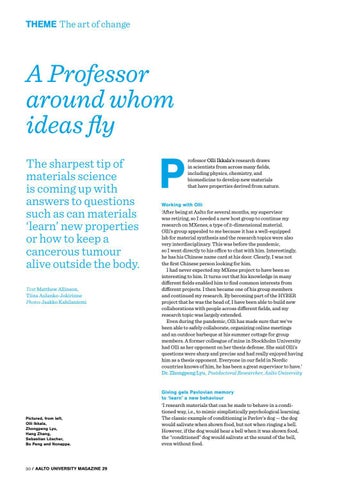
A Professor around whom ideas fly The sharpest tip of materials science is coming up with answers to questions such as can materials ‘learn’ new properties or how to keep a cancerous tumour alive outside the body. Text Matthew Allinson, Tiina Aulanko-Jokirinne Photos Jaakko Kahilaniemi
Pictured, from left, Olli Ikkala, Zhongpeng Lyu, Hang Zhang, Sebastian Löscher, Bo Peng and Nonappa.
30 / AALTO UNIVERSITY MAGAZINE 29
P
rofessor Olli Ikkala’s research draws in scientists from across many fields, including physics, chemistry, and biomedicine to develop new materials that have properties derived from nature.
Working with Olli ‘After being at Aalto for several months, my supervisor was retiring, so I needed a new host group to continue my research on MXenes, a type of 2-dimensional material. Olli’s group appealed to me because it has a well-equipped lab for material synthesis and the research topics were also very interdisciplinary. This was before the pandemic, so I went directly to his office to chat with him. Interestingly, he has his Chinese name card at his door. Clearly, I was not the first Chinese person looking for him. I had never expected my MXene project to have been so interesting to him. It turns out that his knowledge in many different fields enabled him to find common interests from different projects. I then became one of his group members and continued my research. By becoming part of the HYBER project that he was the head of, I have been able to build new collaborations with people across different fields, and my research topic was largely extended. Even during the pandemic, Olli has made sure that we’ve been able to safely collaborate, organizing online meetings and an outdoor barbeque at his summer cottage for group members. A former colleague of mine in Stockholm University had Olli as her opponent on her thesis defense. She said Olli’s questions were sharp and precise and had really enjoyed having him as a thesis opponent. Everyone in our field in Nordic countries knows of him, he has been a great supervisor to have.’ Dr. Zhongpeng Lyu, Postdoctoral Researcher, Aalto University
Giving gels Pavlovian memory to ‘learn’ a new behaviour ‘I research materials that can be made to behave in a conditioned way, i.e., to mimic simplistically psychological learning. The classic example of conditioning is Pavlov’s dog — the dog would salivate when shown food, but not when ringing a bell. However, if the dog would hear a bell when it was shown food, the “conditioned” dog would salivate at the sound of the bell, even without food.
THEME The art of change
We wanted to make materials that mimic this learning behaviour, and set about trying to recreate conditioning in a soft polymer. We succeeded, by making a gel that consists of water and polymers. Initially the gel melts when heated but not upon shining light. It can be conditioned to melt when light is shone upon it. The gel has nanosized particles of gold mixed in, and when the light is shone on it normally, nothing happens. But if it is heated to its melting point whilst this light is shining on it, the gel becomes conditioned. This means that the next time the light is shone on it, it spontaneously melts, even if it’s not being heated from the outside. The mechanism behind the conditioning in the material is that, when both heating and light are applied, the gold nanoparticles rearrange into chains that start to absorb the light in a new specific wavelength range. Once light shines again on the gel, the assembled nanoparticles themselves heat it up, melting it from the inside. People have been able to make electronic systems behave like Pavlov’s dog, but this is the first time for a soft material to do this “trick”. Importantly, the gel behaviour follows the same logic diagram as the Pavlov dog experiment. We are generalising the conditioning concept for other properties to make progressively “life-like materials”, perhaps even as a new simplistic form of artificial intelligence.’ Dr. Hang Zhang, Postdoctoral Researcher, Aalto University Personalized breast cancer models using nanotechnology ‘Breast cancer is the most frequently diagnosed cancer type, and is one of the leading causes of cancer-related deaths in women. In Finland, it represents nearly 30% of all cancer with more than 5 000 new annual cases. Despite tremendous progress in cancer-related research, the existing one-size-fits-all treatment has the least success rate when it comes to breast cancer. To address this challenge, the research group of Professor Juha Klefström, a top cancer biologist from the University of Helsinki, joined their forces with Olli’s group to develop personalized breast cancer therapy. The goal was to develop materials that mimic the cellular environment of breast cancer tissues. The aim is to keep the surgically removed patient-derived tumor tissues alive for weeks under laboratory conditions, without losing their biological and physicochemical properties. Validated using more than 2 000 patient samples, our technology is one of the significant breakthroughs in cancer biology in general and breast cancer in particular. Our research has resulted in two Business Finland-funded commercialisation projects aiming at precision cancer treatment. We created cost-effective nanoscaffolds with tunable mechanical and functional properties. Our scaffolds allow predictive and long-term storage of patient tissues offering a unique platform for identifying drug response of each patient and can be individually modeled.’ Nonappa, Associate Professor at the Tampere University, Adjunct Professor at Aalto University
32 / AALTO UNIVERSITY MAGAZINE 29
Delivering drugs to the right part of the body ‘Advanced therapy medicines — such as mRNA and protein treatments are becoming popular at the moment — not least because the use of mRNA in some of the covid-19 vaccines. As part of the GeneCellNano flagship project, that Olli is a member of, I am researching using polymers to make targeted drug delivery for conditions in the eye. With treatments like vaccines, it doesn’t exactly matter where in the body the chemical you inject ends up, because the immune system will find them and respond to them. But for targeted treatments it does. For example, if you’re treating a condition of the eye, it’s not useful if the drug you inject ends up in the feet. Our research is developing materials that can transport the drug safely within the target area, like the eye, and then release it only where it is needed. As a chemist, once you start working with medical research you receive a long list of requirements of what your material must and must not do, and it can sometimes feel overwhelming to achieve all the parameters. This is why I am fortunate to work in the MolMat Lab, since Olli always has supportive ideas for every kind of problem. In fact, he is one of the most creative minds I have met so far. You can have a ten-minute talk with him and you have three new ideas at the end to go and try.’ Dr. Sebastian Löscher, Postdoctoral Researcher, Aalto University
Making magnetic sensation for future robots ‘Biologists know that animals like birds and turtles that navigate across huge distances can do this by sensing earth’s magnetic fields, but don’t know sufficiently how animals sense magnetism. We wanted to see if we could create bioinspired magnetic sensing using our materials and whether we could achieve material behaviours that resemble simple learning processes, i.e., sensitisation and habituation. To make a material that can sense magnetic fields, we partially fill a gap between two electrodes with magnetic nanoparticles. In its normal state, electricity cannot flow through, so there’s almost no conductivity between the electrodes. When the device is exposed to a magnetic field, the particles form into chains, bridging the gap between the electrodes, creating a current we can measure. This increase in conductivity is how we know the device has detected a magnetic field. We are only looking into the fundamental principles of materials that can sense, but future applications are possible to imagine, specifically in fields like soft robotics. The ideal materials for soft robotics can sense their surroundings — like if something is magnetic — and can then react to what they sense.’ Dr. Bo Peng, Academy Research Fellow, Aalto University As of 1 September 2021, Olli Ikkala is Aalto Distinguished Professor emeritus, but continues his research work as before.
Olli Ikkala Started his career at the Low Temperature Laboratory of the former Helsinki University of Technology. He completed his Master’s in 1977 and defended his doctoral thesis in 1982. Also made a career in the private sector, mainly at the Neste research centre, researching polymer physics and batteries for storing solar energy in the mid-1980s. He accidentally came across polymeric nanotechnology at the turn of the 1980s and 90s as part of an effort to commercialise electrically conducting polymers.
Two-time recipient of prestigious Advanced Grant funding from the European Research Council, each worth €2.5 million. Appointed by the Academy of Finland, he served as an Academy Professor for two periods and has also led a national centre of excellence for five years. He has published 326 peerreviewed scientific articles during his career that have been referred to nearly 22 000 times and has been a thesis advisor for 35 doctoral dissertations. Received the prestigious Humboldt Research Award recently. Well networked. Sometimes new research directions get started when receiving phone calls in unexpected places. Since the early 1990s, he has been receiving co-operation offers in relation to biotechnology, nanocellulose, cancer research, and programmable materials. The latest such call Ikkala responded to at his summer cottage in 2020, when Professors Seppo Ylä-Herttuala and Arto Urtti reached out asking him to join a flagship project on biological medicine. Organist. Ikkala played the organ at Sibelius Academy’s youth department during his school years and later privately completed the professional organist course at Sibelius Academy. When younger, he was an active organist at several Helsinki churches. However, when his academic career took off, there was less time for commuting to churches for practise. Today, new technology has enabled virtual organs with an accurate keyboard feel and completely authentic sound. He now plays a virtual instrument at home, which mimics the Saint-Maximin-la-SainteBaume organ in Provence, France, built in 1772.
IN–HOUSE The art of change
An arcade in Aalto style
34 / AALTO UNIVERSITY MAGAZINE 29
A Blanc
Text Tiiu Pohjolainen Photos Sara Urbanski
Address: Otakaari 27, Espoo Developer: Otaniemen Liikekeskus Oy Main contractor: Pakrak Oy Architectural design: Arkkitehdit Q4 Oy The listed building is managed and let out by Aalto University Campus & Real Estate.
The wavy, fan-like copper roof of the just-renovated A Blanc shopping centre covers an arcade passage connecting the interior with the street. Designed by Alvar Aalto, the Otaniemi shopping centre was completed in two stages in 1961 and 1969, respectively. Throughout its existence, the shiny white centre has been an aberration from the redbrick general appearance of the campus area. It is also an exceptional
Alvar Aalto work – the building is one of the very few retail premises designed by the great architect. The space connecting the interior and the exterior of the building has been and is an important feature of the shopping centre’s architecture and functional idea. The pedestrian arcade is illuminated by light from shop windows. The renovated A Blanc currently houses restaurants, a laundry and a clothing rental shop, among other businesses.
Teksti Riikka Hopiavaara Kuva Lauri Veerde
An arcade is a series of arches supported by pillars or a passage walled in by a colonnade. Arcades are often built in countries where walkers are exposed to challenging weather – the arches can provide shelter from scorching sun or falling snow.
AALTO UNIVERSITY MAGAZINE 29 \ 35
ON SCIENCE
Achieving more with less The biggest environmental act would be not building at all. But a circular economy can also mitigate the environmental impact of construction. Text Joanna Sinclair Photo Jaakko Kahilaniemi
Construction material prices are uncommonly high. Material shortages are affecting the construction industry, which uses up to 50% of the world’s raw materials. The pressure to move to a circular economy is substantial. Aalto University Postdoctoral Researcher Juu dit Ottelin and Ministry of the Environment Senior Advisor, Aalto University Adjunct Professor Matti Kuittinen explain how a circular economy can become reality, and not just an empty phrase, in construction. ‘You hear people saying that if concrete were a country, it would be the world’s biggest polluter right after China and the United States. The most important thing in this situation is to strive for solutions, not guilt-tripping. Very few sectors can contribute to climate change mitigation as much as the construction industry,’ says Kuittinen.
Post-doctoral researcher Juudit Ottelin studies carbon and material footprints in the built environment in Aalto University’s real estate economics research group. Ottelin has studied, for example, how adding wood construction in both new builds and renovations would increase the carbon stocks of cities. In her research, Ottelin focuses mainly on consumer perspectives and always takes a global outlook on emissions in the lifecycle modelling of carbon and material footprints. 36 / AALTO UNIVERSITY MAGAZINE 29
Ottelin points out that when speaking of the environmental impacts of construction, often times doing something is compared to doing nothing. This creates an unfair set-up. ‘Building with wood should not be compared to leaving forests untouched – wood construction should be compared with, for example, concrete construction,’ Ottelin remarks. Material efficiency Finland aspires to be carbon neutral by 2035 and carbon negative soon after. ‘Construction has a heavy material footprint. Reaching Finland’s ambitious climate goals requires big changes in the way that we produce the built environment. A circular economy creates immense opportunities for the construction industry to mitigate climate change,’ Ottelin highlights. From a circular economy viewpoint, the existing building stock is seen as a resource that can be converted, developed, and improved. New buildings can be made versatile and adaptable, easily maintainable, and repairable – and they can be designed so that building parts and materials can be reused or recycled at the end of the building’s life cycle. Ideally, recycled materials will also be utilized as much as possible during the construction phase. There are many inspiring examples of circular economy solutions in construction from around the world. Architecture studio Lendager Group has built a three-storey townhouse in Copenhagen utilizing recycled waste concrete, disused floorboards, and reused double windows. In Amsterdam, ABN AMRO built a negotiating center, Circl, from recycled materials. Even the roof insulation of the building is made of old jeans donated by the bank’s employees. ‘A circular economy is first and foremost material efficiency: it is about achieving more with less. Upcycling materials to create higher quality or value is also an important part of a circular economy,’ Ottelin says. Kuittinen and Ottelin emphasize that no construction phase is
carbon-neutral, regardless of what material is used, be it wood, steel, concrete, or recycled material. The biggest environmental act would be not building at all. If this is not an option, renovating existing spaces is the next-best choice. Only after these alternatives have been explored is it worth considering new construction. Kuittinen and Ottelin also underline that the circular economy is not a new idea. It has merely been replaced by the current linear economic model, in which products are manufactured, consumed, and thrown away. ‘For me, the circular economy means returning to old building methods that were used before the linear model – a good example from Finland is recycling old usable logs into new log buildings. A circular economy means smart thriftiness in resource use,’ Kuittinen says. Legislation is fast-tracking a circular economy During upcoming years, significant changes are taking place in construction legislation. A climate study that maps the carbon footprint and handprint of a building will be a prerequisite for obtaining a building permit. By 2025, legislation will require all new construction to be low carbon. In spring 2021, an open, free-of-charge construction emissions database (https://co2data.fi) was published in Finland, providing objective data on the carbon footprint and handprint, material efficiency, and recyclability of construction products used in Finland.
‘The database will enable architects not only to decrease the negative environmental impacts of buildings, but also to leave a positive material reserve from the building as a legacy for future generations,’ Kuittinen envisions. Put together, the legislative reform and the emissions database significantly advance a circular economy. In addition, new solutions are needed for circular economy logistics, for example. ‘If I as an architect want to utilize materials from demolished buildings, how will the digital information appear on my laptop telling me that there are bricks available in Pieksämäki, and doors in Vaasa? And if I get the information, who will keep the bricks and doors stored for me until my client builds the house two years from now?’ Kuittinen ponders. Do we pride ourselves on consumption or eco-friendliness? The transition to a circular economy is a significant opportunity for the construction sector as a whole. There is great demand for expertise in the field both in Finland and abroad. ‘Just 10 years ago, when I was lecturing on resource-efficient construction, the subject was considered almost a curiosity. Now circular economy is taught at several universities, polytechnics, and vocational postgraduate courses. This is very positive,’ Kuittinen affirms. ‘In legislation, Finnish expertise in promoting a circular economy in construction is already an export product. Enthusiastic inquiries keep pouring in from abroad about the emissions database for construction and the reform of the Land Use and Building Act,’ he continues. Can Finland achieve a circular economy in construction with these measures? Not quite. As a final point, Kuittinen and Ottelin raise an essential issue: consumer attitudes and behavior. ‘What we as consumers feel proud of has a significant impact on the progress of a circular economy in construction. Do we take pride in building a new house and buying a new car – or for using public transportation and choosing to renovate instead of building?’ Kuittinen describes. ‘Total consumption is key. Thriftiness in construction is not an environmental act if you use all the money you saved on air travel. Environmentally conscious consumers are very well aware of the consequences of their consumption decisions. It will be interesting to see what average consumers do in upcoming years. Hopefully, ecological choices will soon become a matter of honor in construction,’ Ottelin says.
Architect Matti Kuittinen works as a Senior Advisor at the Ministry of the Environment. His main line of work is developing a method for calculating the carbon footprint of construction for Finland. Kuittinen is also an Adjunct Professor at Aalto University’s Department of Architecture, where he specializes in resource-efficient construction. Kuittinen designed a model house for the low-carbon circular economy, Pyörre, for the Lohja Housing Fair 2021. AALTO UNIVERSITY MAGAZINE 29 \ 37
ON SCIENCE BRIEFLY
Heat pumps cut carbon footprints
A study from Aalto University assesses the impact of heat pumps on energy consumption as well as how heat pumps should be subsidised. These devices run on electricity to warm spaces by efficiently transferring heat from one area to another, cutting buildings’ carbon footprints significantly. ‘My research shows that a heat pump can reduce carbon dioxide emissions from heating by more than 80 percent. Electrifying heating means we can warm our homes and buildings cleanly. Heat pumps are also truly energy-efficient: they can produce up to four units of heat for every unit of electricity,’ says Jussi Vimpari, a post-doctoral researcher at Aalto. ‘Eventually all heating has to become non-fossil fuel based. Currently, the electrification of heating with heat pumps looks like the most efficient way to do this, as we have the means to produce emission-free electricity and heat pumps can convert that electricity to heat with very high efficiencies.’
Alexander Henn
Bio-based, non-toxic coating for wood
38 / AALTO UNIVERSITY MAGAZINE 29
Researchers at Aalto University have used lignin, a natural polymer abundant in wood and other plant sources, to create a safe, low-cost and high-performing coating for use in construction. ‘Our new coating has great potential to protect wood. Since it’s hydrophobic, the coating is also quite resistant to stains, while lignin’s inherent structure resists colour changes from sunlight’, says Alexander Henn, doctoral candidate at Aalto. Lignin is often regarded as a waste product of pulping and biorefinery processes, but it has excellent anti-corrosion, anti-bacterial, anti-icing, and UV-shielding properties.
Eeva Sivula
Compiled by Tiiu Pohjolainen
Anyone can get super-hearing
Ville Pulkki
Researchers at Aalto University have developed a new audio technique that enables people to hear ultrasonic sources that generate sound at frequencies above 20 000 Hz with simultaneous perception of their direction. ‘In our study, we used bats in their natural habitat as sources of ultrasonic sound. With our new technique, we can now hear the directions-of-arrival of bat sounds, which means we can track bats in flight and hear where they are – we’re essentially giving ourselves super hearing,’ says Professor Ville Pulkki. The technique has tangible real-world applications. ‘Finding sources of ultrasonic sound is useful in many practical situations, such as finding leaks in pressurised gas pipes. Minor pipe leaks often produce strong ultrasound emissions not detected by normal hearing. The device allows us to spot the sound source quickly,’ Pulkki explains. ‘Sometimes, damaged electrical equipment also emit ultrasound, and the device could be used for locating faulty equipment faster in places such as data centres.’
Warm ice behaved in an unexpected way
Iman El Gharamti
Researchers have found strong evidence that warm ice – that is, ice very close in temperature to zero degrees Celsius – may fracture differently than the kinds of ice typically studied in laboratories or nature. The phenomenon was studied at the world’s largest indoor ice tank on Aalto’s campus. With a hydraulic loading device, the team applied multiple rounds of loading and unloading on the ice. Current understanding in the field suggests that ice will show viscoelastic recovery between loads, at least until the device is told to exert enough force to completely split the ice. Under the conditions provided, however, the ice behaved in an unexpected way: it showed some elastic recovery but no significant viscoelastic recovery at all. ‘What we typically see between mechanical loads is that the ice recovers – it springs back to normal formation until we intentionally apply so much force that it permanently cracks. In our research, the ice was increasingly deformed after each load and we detected no significant delayed elastic recovery,’ says Iman El Gharamti, doctoral candidate at Aalto. The main contributing factor seems to be the temperature of the ice. This research is the first to show that warm ice may behave in a fundamentally different way than the cold ice.
AALTO UNIVERSITY MAGAZINE 29 \ 39
ON SCIENCE
Otaniemi, meet A!ex This white car may look like a regular SUV, but a closer examination reveals a laser scanner on its roof. Inside, it’s missing a gear stick, as A!ex shifts gears with the aid of an algorithm.
Text Niina Norjamäki Photos Kalle Kataila
Purchased towards the end of spring 2021, the Lexus RX, which came with driver assist technologies as a standard feature, now shines in Otaniemi, surrounded by the many construction sites of the campus area. ‘We ordered a basic system enabling autonomous driving from a US supplier, and can now program and develop it ourselves,’ says Professor Kari Tammi. ‘The car can drive autonomously, but, for now, the presence of a human driver is always required.’ Otaniemi has a long tradition of research and teaching associated with vehicle technology.
40 / AALTO UNIVERSITY MAGAZINE 29
The research effort focused on this white Lexus, named A!ex, is only just beginning. Doctoral candidate Risto Ojala and Laboratory Engineer Jesse Pirhonen are responsible for keeping tabs on the additional equipment and software installed in the vehicle. The car is an excellent subject for further studies. ‘Various research groups want to test different things on it. My task is to make sure the basic system remains operational and that their experiments don’t cross each other’s wires,’ Pirhonen says.
Bringing different research fields together The Aalto Centre for Autonomous Systems (ACAS) was established in 2019 with funding from the Academy of Finland. The self-driving SUV – a vehicle with autonomous capabilities – is one of the Centre’s spearhead projects. ‘This vehicle enables us to combine many research subjects,’ says Professor of Robotics Ville Kyrki happily. A!ex is used to research 5G telecommunications and how the car communicates with other
The 3D laser scanning LIDAR on A!ex’s roof recognises oncoming cars and other objects in the environment. Pictured are, from left, doctoral candidate Risto Ojala, grad student Julius Pesonen, Professor Kari Tammi, Laboratory Engineer Jesse Pirhonen, and Professor Ville Kyrki.
AALTO UNIVERSITY MAGAZINE 29 \ 41
ON SCIENCE
‘Autonomy is no problem in limited situations. AI is clever, but not yet sensible.’
The rooftop LIDAR is augmented by several cameras. Together, they form a 3D view on the screen.
vehicles and transport infrastructure. Various research groups are interested in the processing of sensor data and driver assist systems, such as smart cruise control mechanisms. There is a lot of interest in remote traffic control and semi-autonomous transport systems in Finland. Demand is especially pronounced in the marine shipping and mass transport sectors. Development has reached an interesting stage also from the perspective of artificial intelligence. At present, autonomous cars still require human intervention in unusual circumstances. The driver can assume control of A!ex through the steering wheel or pedals, in addition to which the car has an emergency off switch. As a human is still required to sit behind the wheel, researchers are particularly keen to develop remote steering. In future, the distance between drivers and the vehicles they control, for example a set of earthmoving machines, may be measured in kilometres. A combination of autonomy and remote control could enable distance operators to assign tasks to vehicles. Finnish weather a benefit for once Autonomous cars are already moving about under the California sun, but exceptional situations and various weather conditions continue to cause problems. ‘Here in Finland and Otaniemi in particular, we’re focusing on how autonomous systems behave in different weather and lighting conditions as well as on various types of road,’ Kari Tammi says. ‘Sensor technology is easily confused by horizontal sunlight and reflections.’ Ville Kyrki says that we should not think of fully autonomous and semi-autonomous systems as opposites.
42 / AALTO UNIVERSITY MAGAZINE 29
‘Autonomy is no problem in limited situations. Also here in Otaniemi we have seen A!ex move around quite straightforwardly in good conditions. Its AI is clever, but not yet sensible.’ Changes in the weather and seasons require software development that enables the car to, for example, identify a tree as being the same when it is fully covered by verdant leaves and when under a coating of snow. Researchers are interested in how sensor data can be interpreted irrespective of the weather. What if the network is down? A key research question in remote control is the reliability and data security of telecommunications as well as the division of responsibility between the remote controller and the system. What to do if the connection drops just as the remote controller hits the accelerator on the other side of the globe? ‘The car has to be safe also when networks are down or being interfered with,’ stresses Communication Engineering Professor Riku Jäntti, who heads the ACAS research unit. Jäntti says ultra-fast 5G networks are a prerequisite to autonomous transports. Effective connections enable improved security and more fluid traffic. ‘The research being carried out with A!ex will serve more than just cars and traffic infrastructure. The same technologies are used in, among other things, forest machines,’ Professor Kari Tammi points out. ‘Finnish industry is familiar with autonomous solutions. They have been developed for port cargo handling equipment, mining vehicles and forklifts. We want to collaborate with industry as well.’
WOW!
More sophisticated election compasses can promote democracy
Designer Kalle Järvenpää returned to the school bench at Aalto last year to complete his interrupted studies. The theme of the semester at the Department of Media was democracy. Quite unexpectedly, a course headed by Professor Rupesh Vyas took Järvenpää deep into a project that continues to progress and expand. During the course, Järvenpää started thinking about better ways to design election compasses. Online election compasses play a significant role in informing Finnish voters. Various media outlets alone operated 15 election compasses during the previous general election, but the way in which they are realised tends to be quite uniform. No less than 12 of the compasses available during last summer’s local elections were the handiwork of two Finnish companies. Järvenpää thinks it is peculiar that services, which are so essential for a democracy, are provided by private businesses and not based on open data and source code. ‘I think it’s clear as day that the source code has to be open. The option to verify that election compasses are unbiased and free of programming errors, which could affect the result, must be provided.’ Results displayed as graphic chart The digital design specialist started to develop a new kind of open-source election compass called Ehdokaskartta (Candidate chart) in the run-up to last summer’s local elections. It is a prototype that utilises data from Finnish public broadcasting company Yle’s election compass and thus contains the same questions and answers. ‘My prototype only tackles some of the problematic issues: the way in which results are presented and questions answered,’ Järvenpää says.
Ehdokaskartta presents results in the form of a chart. Respondents are shown a graphic chart of where their answers place them on the political map. The outcome is not a list of names like in more typical compasses, instead users get to see which candidates are close to them and who is more distant. Highlighting issues important to voters The development project has continued in a more comprehensive form following the local elections. Järvenpää’s aim is to assemble a team of cooperation partners consisting of open data and source code experts as well as election compass researchers to build a platform that can be used to develop election compasses for Finland and other democracies. Existing election compasses are designed to inform citizens and help them choose. Järvenpää is keen to consider their job more broadly. Perhaps election compasses could work in the opposite direction and let the candidates know what issues voters consider important. Järvenpää believes that better election compasses could promote democracy. ‘User replies can generate an enormous amount of data even if the election compass stores answers on just the statistical level. It would be interesting to examine if, following an election, user opinions contained clusters to which there is no counterpart on the candidate side.’ While waiting for the posters for the upcoming county elections to go up, Kalle Järvenpää would like to examine the questions asked by election compasses in cooperation with researchers. There is no single right way to formulate questions, but it is important to consider their context carefully.
Text Terhi Hautamäki Photo Kalle Kataila
PARTNERSHIP
L
ike other forms of transport, maritime shipping is moving towards autonomous solutions. At present, many key functions, such as bridge work, are entirely dependent on humans and their observations, risk management and decision-making. ‘Like lane assist systems in road traffic, autonomous technologies can help improve the safety of maritime traffic,’ says Kalevi Tervo. He is in charge of global research, development and commercialisation of smart and autonomous ship systems at ABB. ‘Ship movements change quite slowly relative to human perceptual ability. Autonomous technologies help users recognise risky situations well in advance.’ Autonomy also enhances the efficiency of ship operations, thus conserving energy and cutting emissions. Propeller ideation and prototypes Developed in Finland, ABB’s Azipod® propulsion system has been revolutionising maritime traffic for over 30 years. The system is utilised in over 20 different types of ships around the world, ranging from luxury cruise liners to wind turbine installation vessels, and has been installed in some 300 ships already. The thrust-generating propulsion system is based on an electric motor that can be fed renewable electricity from, for example, fuel cells. The International Maritime Organisation has set a goal to halve ships’ greenhouse gas emissions by 2050 and to eventually eradicate them completely. ‘The Azipod system improves the hydrodynamic efficiency of ships and reduces fuel consumption. It enables shipping companies to optimise their operations and respond to global environmental requirements,’ says Mirva Nevalainen, Head of Project Management at ABB Marine. The development of Azipod products has benefited from Aalto University’s Design Factory product development facility. ‘Design Factory gives us the opportunity to break away from the daily grind and engage in ideation of prototypes for new products. For example, we have built small sub-assemblies out of plywood there to see how much space would be needed for maintenance 44 / AALTO UNIVERSITY MAGAZINE 29
Collaborating at the crest of marine technology Students get opportunities to assist in product development as global technology giant ABB develops electric and autonomous systems for maritime transport. Text Marjukka Puolakka Photo ABB
work, if the tools fit in the space and how assembly and disassembly can be done safely,’ Nevalainen says. New size classes have been developed for the Azipod product family over the last decade. Fresh solutions for, for example, bearing and electrical engine technologies have also been explored at the Design Factory. ‘The efficiency and performance of products is improved continuously, one step at a time.’ How good does technology need to be? The collaboration between ABB and Aalto University encompasses research projects, professorships, visiting lectures, guild cooperation as well as student and doctoral training. ‘Long-term university cooperation is vital to the continuous development of our competence,’ Kalevi Tervo says. His business unit, Marine & Ports, focuses its research on the digitalization of marine traffic, autonomous and AI-based solutions as well as electrical propulsion systems and fuel cells for shipping. ‘We develop technologies that respond
to the challenges of climate change. Here, students can, even before they graduate, contribute to projects that have a concrete impact on the future,’ Tervo notes. ‘The university has the latest knowledge of new technologies and trends that can provide the industry with real opportunities. On its side, ABB has an understanding of the value added such technologies bring when employed in industry. By collaborating we can discover the most effective solutions.’ In the future, technology itself might not be the bottleneck for development. Standards for how well a technology needs to perform in various circumstances, situations and tasks need to be determined in order for it to equal or outperform humans. From summer jobs to product development and management duties
ABB is a global technology corporation with operations in more than 100 countries. Its portfolio connects software to electrification, robotics, automation and motion. ABB has
First seen on the Finnish icegoing vessel Seili in 1991, Azipod® electric propulsion has set numerous records in the shipping industry, from powering the largest cruise vessels to enabling the first crossings of the Northern Sea Route for tankers without icebreaker assistance.
substantial research and development assets in Finland. University collaboration is an excellent recruitment channel for ABB. Students working summer jobs get their first taste of professional life and the opportunity to learn about ABB’s technologies and products. Mirva Nevalainen is a good example of what ABB can offer to an Aalto student: ‘I started as a summer intern at the Marine & Ports unit doing product development for the Azipod propulsion range. I continued to work part-time alongside my studies and also wrote my Master’s thesis for ABB. I worked in product development after graduating and have since progressed within ABB to various management positions.’
ABB is involved with the Design Factory’s Product Development Project course, in which companies present real-life product development challenges to multidisciplinary student teams. ‘The students come to these projects with a clean slate and see matters from an entirely fresh angle, as they are not yet familiar with the established practices of our business,’ Kalevi Tervo says. Aalto students visit ABB several times a year, and the corporation is an active participant in the University’s career and recruitment events. The fruits of this cooperation include numerous Master’s and doctoral theses. ‘Students engaged in doctoral research get to apply scientific theories to practice in an industrial setting. ABB provides doctoral candidates with use of, for example, its equipment and data on ships. One doctoral thesis dealing with fuel cells is presently being worked on at the Marine & Ports unit,’ says Tervo, who is himself a Doctor of Technology from Aalto.
In the footsteps of Gottfrid Strömberg Technology corporation ABB spurs change within society and industry with the goal of achieving a more productive and sustainable future. ABB’s workforce consists of some 105 000 professionals, with 5 000 employees in Finland. The foundation for the collaboration between Aalto University and ABB was created in 1889, when Polytechnic Institute (later Helsinki University of Technology) alumnus Gottfrid Strömberg established an electrical workshop in Helsinki (later Oy Strömberg Ab and ABB Oy). Gottfrid Strömberg was Finland’s first teacher of electrical technology and pioneered education in the field. The multidisciplinary collaboration of Aalto and ABB involves all six Schools of Aalto University. Each year, our students complete about five doctoral degrees and some 40 Master’s theses working for ABB, which also employs hundreds of Aalto alumni.
AALTO UNIVERSITY MAGAZINE 29 \ 45
THESES
The world’s first doctoral thesis on cruise ship concept design Enthusiasm, competence and teamwork are key factors in the initial stages of cruise ship design. Marjo Keiramo’s groundbreaking doctoral research is a fresh addition to Finland’s shipbuilding excellence.
Keiramo’s research explored ways to improve concept design and identified factors that are critical to its success. ‘Design involves endless technical, architectural and project management-related multidisciplinary challenges. In addition to shipping company and shipyard representatives, global design teams also include a large number of experts from different fields. They work under intense time and cost pressure.’
Much is at stake in cruise ship design, as the final price tag of the finished product can be close to a billion euro. Concept design is the first, and the most creative, phase of the design process. At its core are the experiences of future passengers. ‘Successful initial stages are crucially important, in order for the shipyard to eventually deliver a vessel that remains functional and attractive even 30–40 years later,’ says Marjo Keiramo, author of the world’s first doctoral thesis on cruise ship concept design.
Creativity and trust Keiramo developed a three-stage model for cruise ship concept design and verified its practical effectiveness with a real cruise ship prototype design. She emphasises that successful concept design requires a lot more than models and flow process charts. ‘The composition of the design team must be carefully thought out. In addition to top expertise and good cooperation abilities, design calls for creativity, commitment, vision, perseverance, responsibility and trust. Enthusiasm and true passion for the work will make things move forward.’ Team leadership and the management of design work involve their own demanding skill sets.
Part of the continuum of shipbuilding Writing the thesis represented an interesting journey for Keiramo, one that she took alongside her professional duties at the Royal Caribbean
Group cruise shipping company. Keiramo’s professional career commenced some twenty years ago at shipbuilder Kvaerner Masa Yards. Later, as CEO of Baltic Yards, she was involved in the building of the world’s largest carbon fibre sailboat. Keiramo transferred to Royal Caribbean Group from Meyer Turku last spring to take up an expert position in its product development programme. Her lengthy experience of the industry is evident in the thesis, which presents a wealth of general knowledge about cruise ships and shipbuilding on top of its research findings. Finland has a long tradition of shipbuilding and the industry has always been a significant source of employment. Modern cruise ships have been designed here for about 60 years, but it all got started in Turku in 1737. ‘Ship designers have always learned from earlier generations. Things need to be developed constantly to ensure that orders and jobs are there in future as well. I interviewed 18 experts in cruise ship concept design for my research, together they have some 600 years of experience in the industry.’ Keiramo’s doctoral research is part of a long continuum in the development of shipbuilding. It will make a fine textbook for Aalto University marine technology students. Marjo Keiramo 9.4.2021: Pathways of the creative journey – Significance of a cruise ship concept design Text Marjukka Puolakka Photo Nita Vera
46 / AALTO UNIVERSITY MAGAZINE 29
ALL DOCTORAL THESES ONLINE: aaltodoc.aalto.fi / shop.aalto.fi
Ted Nuorivaara using a bubble size column to study the size of bubbles and other characteristics of frothing agents.
Towards a more environment-friendly mining industry The world’s most common method for enriching metallic minerals is froth flotation, which has been used for more than a century. Froth flotation utilises chemicals that are often environmentally hazardous. Now, both citizens and decision-makers are calling for improvements to the mining industry’s environmental impact, which is driving the sector towards a more sustainable and efficient era. In his doctoral thesis on materials processing, M.Sc. (Engineering) Ted Nuorivaara presents an entirely novel frother compound, in which the typical frothing agents have been partially replaced by a nontoxic and biodegradable cellulose derivative. This is the world’s first research project to evaluate the use of cellulose-based chemicals as frothers. Experiments conducted during the study show that the new chemical improved both the recovery of the metallic minerals and the process kinetics, i.e. the recovery time of the valuable minerals. It was also observed that, using cellulose derivatives, it was possible to reduce use of other, more hazardous chemicals in froth flotation without significantly affecting process performance. While transforming this technology from the laboratory to an industrial scale is not trivial, the method proposed by Nuorivaara could ideally be taken into use without major investment costs. This would increase production at enrichment facilities and reduce the environmental impact of the mining industry. Ted Nuorivaara 7.5.2021: Improving sulphide-mineral flotation with sustainable cellulose-based frother formulations
The doctoral thesis of M.Sc. (Econ.) Yijie Li studies the behaviour of investors and brokers on equity markets. Li set out to investigate how investors and brokers affect certain aspects of the market (e.g., equity return, market liquidity and other participants) and, further, how they are affected by the behaviour and choices of other participants. Using data from the US, Li studied the impact of unemployment and its growth on expected stock market returns both theoretically and empirically. It was found that the expected equity returns increase as unemployment grows. Furthermore, the impacts of unemployment and its growth on expected equity returns reinforce each other. Nasdaq Helsinki has launched a voluntary post-trade anonymity model. The empirical results of the thesis show that brokers who traded anonymously experienced lower trading costs. Broker anonymity also had a negative impact on private investor liquidity. A broker’s trading practices can explain their anonymity choices. Local Helsinki brokers and brokers who offer retail investors discounts on online trading fees were more reluctant to select anonymity. The thesis indicates that a broker’s trading behaviour impacts both themselves and other market participants. Yijie Li 2.3.2021: Essays on investor and broker behavior in equity markets
Aleksi Niemelä
Nita Vera
Investor and broker behaviour on equity markets
AALTO UNIVERSITY MAGAZINE 29 \ 47
EVERYDAY CHOICES
What skill did you learn most recently, Laura Sivula? Text Tiiu Pohjolainen Photo Nita Vera
The Head of Aalto’s Summer School thinks nobody is ever completely done – not even when it comes to cooking. School of Business researchers just published the Future of Work course in MOOC format. What on earth is MOOC?
The acronym stands for Massive Open Online Course, in other words we’re talking about courses that are open to everybody and aimed at the masses. Anyone, from toddler to granddad, from anywhere in the world, can take part in a MOOC course. I’d say that that sets a pretty low threshold for accessing university-level education. Who is Future of Work aimed at? The course is for all lifewide learners. Perhaps most typically for people already in working life or returning to work. An interesting part of the course is Finland Works, a module aimed specifically at international students. It covers the special features of Finnish working life and culture, providing some concrete tips as well. Many find surprising how autonomous Finnish working life is, especially knowledge work. In some countries, it is unwise to go home before the boss leaves, but Finnish employers are rarely looking for a person prepared to work 80 hours a week.
48 / AALTO UNIVERSITY MAGAZINE 29
What does lifewide learning mean? Work and the ways of working have changed, and not only because of digitisation or corona. Lifewide learning is about recognising the significant impact the ongoing changes will have on individuals as well as on societal structures and organisations. There’s not much the individual can really do about the nature of work changing on the societal level. But changes will follow also at the workplace and these anyone can, depending on their status, actually influence. First and foremost, they can influence how their personal competence stays current. Lifewide learning is only possible when learning can happen at work and during working hours. You should be allowed to learn and develop at work, and time must be set aside for it. Everyone can personally influence what inspires them, how they envision their careers and what direction they’ll steer it towards.
Which skill did you yourself last learn? I’m constantly trying to learn new things, I guess I practice what I preach. I’m passionate about cooking, I practise different techniques and try to master new regional food cultures.
I recently acquired a sous vide circulator, a device for preparing food with the aid of vacuum packing and very carefully controlled heat. I’m learning to create fine dining experiences in my own kitchen. I think it’s important to be able to move naturally between working life and free time, drawing from both reciprocally. When, for example, I went to Japan to teach, I also got familiar with the local food culture. Might lifewide learning become and obligation to learn forever? I am, of course, familiar with such objections: some feel that it remains the responsibility of the employer to assign specific courses, the completion of which will enable you to succeed in your job. In simple terms, lifewide learning is about acknowledging the fact that none of us is ever complete. It makes sense to seek out objects of interest that you want to grasp, to deepen your competence in. Employees can shape the ways in which they work quite a lot by acquiring fresh knowledge and skills. As the world becomes more and more digital and automated, it will actually leave the more fun jobs, tasks requiring creativity and analytic decision-making, for us humans to do.
Give for the future
Donate today to help build a strong and internationally successful Finland If one wants to make a donation to help Finland succeed, the question is how to get the maximum value for money. A donation always has leverage, and a donation to a university has the most extensive possible leverage. Competence creates future success. A donation to Aalto also supports the reform of university activities. The government’s matching funding will further extend the leverage. Risto Siilasmaa F-Secure founder and Chairman of the Board
Now is an excellent time to donate
The Finnish government is running a matching funding campaign where it will provide capital to Aalto University to match donations received by the university. The matching funding campaign began in 2020 and will continue until 30 June 2022. The initiative will increase the impact of a donation with a multiplier
for each euro donated during the campaign. The government funding will be added to the university’s foundation capital. Further information about the matching funding campaign: aalto.fi/en/give-forthe-future, donor-engagement@aalto.fi or Sinikka Heikkala, Donor Engagement, tel. 0400 908899
Hello 2016 master’s and 2018 doctoral graduates of Aalto University! Remember to answer the national career monitoring survey you’ll receive shortly by email, mail or SMS. We really appreciate your participation in the survey — many thanks!
THIS ISSUE IS ABOUT • the art of change • making new materials • an ecological forest fertiliser
aalto.fi