ON SCIENCE
Online shops predict what customers want to buy Knowledge management in e-commerce gives benefits to consumers – at least as long as the algorithms that collect the data are used for good. Text Helena Raunio Photos Jaakko Kahilaniemi
E-commerce platforms have brought a veritable Aladdin’s cave of products right into our homes. As a consumer, you no longer need to go to a shop, instead, the shop will come to you. Digital platforms such as these amass a vast amount of data from their customers, which they analyse to enhance the customer experience. Once customers are happy with an online shop, they begin to trust the seller and will likely frequent the shop again. The world’s largest online marketplaces, for example, Amazon or Alibaba, have revolutionised competition and the rules of traditional trade. Information management and artificial intelligence make shopping more and more addictive, but an astute customer can also reap the benefits of online shopping. From multichannel to omnichannel Back in the 1990s, shops managed each of their sales channels separately. The brick-and-mortar shop operated as one entity, with an online shop as another separate entity and telesales as a third. At that time, shops obtained consumer information mainly from receipt data. With the advent of loyalty cards, more detailed customer information began to be gathered. ‘This multichannel approach was followed in the 2010s by an omnichannel one, where the customer decides where they do business. From the consumer’s point of view, the shop forms one entity, in which they may first visit a bricks-and-mortar shop to physically see the product, which they then order online. Transactions are independent of time and place,’ 32 / AALTO UNIVERSITY MAGAZINE 28
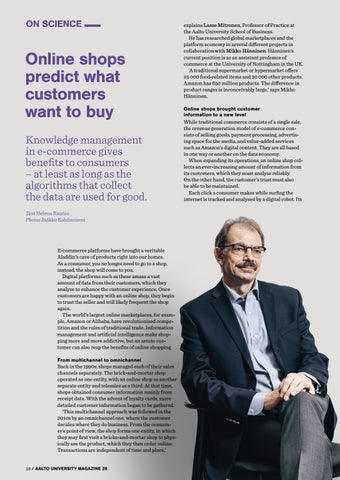
explains Lasse Mitronen, Professor of Practice at the Aalto University School of Business. He has researched global marketplaces and the platform economy in several different projects in collaboration with Mikko Hänninen. Hänninen’s current position is as an assistant professor of commerce at the University of Nottingham in the UK. ‘A traditional supermarket or hypermarket offers 25 000 food-related items and 30 000 other products. Amazon has 650 million products. The difference in product ranges is inconceivably large,’ says Mikko Hänninen. Online shops brought customer information to a new level While traditional commerce consists of a single sale, the revenue generation model of e-commerce consists of selling goods, payment processing, advertising space for the media, and value-added services such as Amazon’s digital content. They are all based in one way or another on the data economy. When expanding its operations, an online shop collects an ever-increasing amount of information from its customers, which they must analyse reliably. On the other hand, the customer’s trust must also be able to be maintained. Each click a consumer makes while surfing the internet is tracked and analysed by a digital robot. Its