A ALTO UNIVERSIT Y MAGA ZINE 24
24
APRIL 2019
A lifelong curriculum p. 12
You own your competence p. 30
The change in working life
Slow cycle
Curiosity will keep you on track
Our illustrator Parvati Pillai shares her feelings, memories and recollections from the time she came from India to study at Aalto University in Finland.
Contents Theme 12 A lifelong curriculum 28 Today’s learning can happen in a virtual world 30 You own your competence
Kalle Kataila
“The joy of learning is a force we deserve to benefit from all our lives.” 5 Openings—Petri Suomala and the joy of learning. 6 Now—Minor news, major issues. 10 Now—Mikko Kosonen is the new Chair of the Aalto University Board. 11 Oops—Kristiina Kruus encountered challenges when looking for work. 12 A lifelong curriculum—universities assigned a new task. 18 Maria Clavert is Professor of Practice in Technology Education. 20 Who—Karla Nieminen is a self-taught expert in relationships.
38 In-house—the School of Business is now in Otaniemi. 40 Aalto University Junior —fourth-graders at game workshop. 42 Learning from others —alumni and students spur one another. 43 Visiting—The imagination is a powerful tool, says Matthew C. Wilson. 44 The curious will not fall behind, Professors Pedro Vilaça, Rupesh Vyas and Alexander Frey believe.
28 Today’s learning can happen in a virtual world.
46 Doctoral theses—Emma Nordbäck and leadership in remote teams; Henriikka Huunan-Seppälä and grotesque imagery; Mihai Iulian Florea and super-efficient algorithms.
30 You own your competence—supplementary education as part of the study path.
48 Everyday choices —Marja Rastas trains art educators.
34 The change in working life provides loads to research say Eero Vaara and Hertta Vuorenmaa.
50 Ville Pulkki knows what maths sounds like as music.
24 Cooperation—the New Children’s Hospital offers consolation.
36 Slow cycle—a departure from fast fashion. AALTO UNIVERSITY MAGAZINE 24 \ 3
Veera Konsti
On the job
“I FULFILLED a long-term dream
to get myself a VR device, which ignited a desire to create virtual worlds. I started studying software that could realise my ideas. Thanks to my graphic design expertise certain concepts, like 3D and user interfaces, quickly opened up to me. Less than a week after acquiring the device, I had already released my first simple VR game, which received positive feedback. My dream guided me to learn new things with enthusiasm.” Wille Valkeisenmäki
“WORKING ON science communications,
you constantly learn about things you’re otherwise unlikely to come across. Electric transport, light pollution and artificial intelligence are examples of topics that I have been writing and simultaneously learning about recently. The research I write about almost invariably somehow deals with sustainable development, new energy forms and reducing emissions. Worrying news about climate change makes me anxious, but, at the same time, I’m aware that scientists are constantly working to save the world.” Riikka Hopiavaara
“I HAVE RECENTLY understood
the importance of user-centric design and so-called legal design. I now appreciate and try to create designs that are as user-friendly as possible especially when it comes to designing websites or documents that explain a person’s rights. It is fascinating how simple design choices can make a big difference to the end user.” Parvati Pillai
PUBLISHER Aalto University, Communications EDITOR-IN-CHIEF Jaakko Salavuo MANAGING EDITOR Paula Haikarainen AD/PHOTO EDITOR Liisa Seppo, Otavamedia OMA Oy GRAPHIC DESIGN IN THIS ISSUE Wille Valkeisenmäki
4 / AALTO UNIVERSITY MAGAZINE 24
STÖMER ÄRI KK MP
I
Riikka Heinonen, Venla Helenius, Riikka Hopiavaara, Minna Hölttä, Antti Ilvessuo, Iiro Immonen, Jaakko Kahilaniemi, Kalle Kataila, Olli Kiikkilä, Anne Kinnunen, Krista Kinnunen, Veera Konsti, Eeva Lehtinen, Anna Muchenikova, Markku Pihlaja, Parvati Pillai, Tiiu Pohjolainen, Marjukka Puolakka, Mikko Raskinen, Anu Salmi-Savilampi, Sourya Sen, Joanna Sinclair, Heli Sorjonen, Noora Stapleton, Anne Tapanainen, Tiina Toivola, Annamari Tolonen, Sergei Tretyakov, Annamari Typpö, Adolfo Vera, Maija Vikman TRANSLATION Ned Kelly Coogan ADDRESS PO Box 18 000, FI-00076 Aalto TELEPHONE +358 9 470 01 ONLINE aalto.fi, aalto.fi/magazine EMAIL magazine@aalto.fi CHANGE OF ADDRESS alumni@aalto.fi PRINTING COMISSIONED BY Unigrafia Oy PREPRESS Aste Helsinki Oy PRINTING Grano Oy, 2019 PAPER Maxioffset 250 g/m2 (kansi) & 120 g/m2 (sisäsivut) PRINT RUN 4 000 (English edition), 33 000 (Finnish edition) SOURCE OF ADDRESSES Aalto University CRM Partnership and alumni data management PRIVACY NOTICES aalto.fi/services/privacy-notices ISSN 2489-6772 print ISSN 2489-6780 online
Y
COVER Kalle Kataila CONTRIBUTORS IN THIS ISSUE Tiina Aulanko-Jokirinne, Anna Berg, Glen Forde, Anni Hanén, Terhi Hautamäki,
MI
LJÖ M Ä RKT 4041 0955 Painotuote
Openings
The university is with you at every turn of your lifelong study path thank goodness for that. Learning enables readjusting to changed circumstances or performing better when circumstances stay the same. Reform of national legislation and the rapid evolution of working life have now brought continuous learning into the spotlight. The strict division between working life and studying is history. Life contains phases during which the balance between accruing new competencies and exploiting your established abilities varies, although both aspects are constantly present. From the university’s perspective, both degree-oriented training and continuous learning are necessary. They complement one another. Our degrees are well-designed competence and education packages, which are strong assets when communicating your own potential to the employment market. On the other hand, refining or upkeeping your potential necessitates an attitude that sees graduating only as graduating to go further. Continuous learning is a partially untapped opportunity for universities. A report on trends in European higher education (EUA 2018) indicates what kinds of services are provided to support continuous learning. Recognition of prior studies as contributing to a new degree is the most common measure and is provided by 59% of European higher education institutions. Flexible study programmes and learning paths (58%) as well as courses provided in collaboration (53%) were the next most common measures. Less than half of the higher education institutions offer guidance and counselling services for adult learners, and only about a quarter offer online degree programmes that are independent of time and location. Aalto University is at the vanguard of progress when measured against these figures, as we already provide all of the abovementioned measures. Yet there remains room for improvement. We could open contents to new target groups, i.e. offer courses and degree components also to non-degree students. We can improve opportunities to complete entire degrees flexibly in different life situations. We can provide contents and modes of learning of an entirely new
kind. Alongside teaching, we could focus more generally on supporting and highlighting learning as well as quality control. But the wealth of choices on offer is not the crux of the matter. Most important is to recognise demand and identify the right target groups. Some learners are working full-time jobs and wish to update their knowhow. Others are looking for a fresh direction for their work. Some are entirely side-lined from working life and in need of a greater transition to rebuild their competence entirely in order to find success in the labour market. We want to offer solutions to these needs. We are developing ways with which to turn the lifelong development of personal ability into a systematic pursuit. High-quality supply, approachability and flexible studies are coming together because the university has a desire to serve learners. We also collaborate actively with other universities and institutions of higher education. The cooperative technology university FITech and its openings, most recently in the ICT sector, are excellent examples of this. What can we look forward to if all this is successful? A view of a personal, lifelong learning path that is easy to update when changes occur will emerge for indi-
Jaakko Kahilaniemi
HUMANS LEARN continuously—and
viduals. New types of high-quality learning will be created when learners from different backgrounds encounter each other. In addition, we will be able to respond rapidly to changes in the needs of society and business life. There are plenty of challenges, too. For example, in matching supply and demand. Hard work and pedagogicallywise utilisation of new technology is required to scale teaching and support for learning. Funding and incentives must likewise be considered. These issues are solvable. The joy of learning is a force we deserve to benefit throughout our lives.
Petri Suomala Vice President for Education AALTO UNIVERSITY MAGAZINE 24 \ 5
Now
Background noise strongly impairs children’s ability to concentrate
Parvati Pillai
NEUROSCIENTISTS FROM Aalto University in Finland and Erasme
Hospital in Belgium compared adults’ and children’s brain activities during the so-called ‘cocktail party effect’, i.e. their ability to pay attention to a single speaker in a noisy environment. Compared with adults, the children’s brain activity followed the speaker’s voice less reliably, especially when the background noise was high. “Children’s ability to concentrate on their teacher is disrupted in a noisy environment, such as an unruly class room, and this may affect their learning,” says Senior Researcher Veikko Jousmäki. The study compared adults with children 6–9 years of age. The researchers used magnetoencephalography (MEG) to observe brain activity while the subjects were asked to focus on one speaker’s voice among the background noise. Without any background noise, the brain accurately tracked the speech stream in both adults and children. When the level of background noise was increased, adults’ brains were still able to follow the intended speaker, but children lost this focus rather quickly. The results imply that the ability to concentrate in a noisy environment develops with age. The brain recordings agree with previous findings, which show that children have difficulties in understanding speech in noisy surroundings. “Our next goal is to find out how children could be helped deal with their often-noisy growth and learning environments,” says Jousmäki.
Engineered metasurfaces reflect waves in unusual directions IN OUR DAY lives, we can find many
Sergei Tretyakov
examples of the manipulation of reflected waves, such as mirrors used to see our reflections or the sound-reflecting surfaces that improve auditorium acoustics. When a wave impinges on a reflective surface with a certain angle of incidence and the energy is sent back, the angle of
6 / AALTO UNIVERSITY MAGAZINE 24
reflection is equal to the angle of incidence. This classical reflection law is valid for any homogenous surface. Researchers at Aalto University have developed new metasurfaces for the arbitrary manipulation of reflected waves, essentially breaking the law to engineer the reflection of a surface at will.
Metasurfaces are artificial structures composed of periodic meta-atom arrangements at subwavelength scale. Meta-atoms are made of traditional materials but, when they are arranged in a periodic manner, the surface can show many unusual effects that cannot be realized by naturally occurring materials. The researchers use powerflow conformal metasurfaces to engineer the direction of reflected waves. “Existing solutions for controlling the reflection of waves have low efficiency or difficult implementation,” says Postdoctoral Researcher Ana Díaz-Rubio. “We solved both of those problems. Not only did we figure out a way to design highly efficient metasurfaces, we can also adapt the design for different functionalities. These metasurfaces are a versatile platform for the arbitrary control of reflection.” New metasurfaces can reflect light or sound waves in any desired direction.
More recycling and billions in business to the battery sector BATCircle (Finland-based Circular Ecosystem of Battery Metals) consortium approximately €10m in funding. Led by Aalto University, the consortium aims at improving the manufacturing processes of the mining industry, metals industry and battery chemicals production, and to increase the recycling of lithium-ion batteries. Its goal is to strengthen the cooperation between companies and research organizations, and to find new business opportunities. According to the EU, the battery market’s value could reach €250b by 2025. The objective of the BATCircle consortium is to create a market worth at least five billion euro in Finland. A particularly large amount of unused potential can be found in the recycling of batteries. Lithium-ion batteries are used particularly in consumer electronics and their use is growing strongly as the number of electric cars increases. At the moment, only around 5% of lithium-ion batteries are recycled. According to the Director of BATCircle, Assistant Professor Mari Lundström,
Glen Forde
BUSINESS FINLAND has granted the
Battery waste and chemicals used in the recovery of rare earth chemicals.
it is important to find solutions to the problems of battery recycling in the near future. Aalto University researchers have a great deal of competence in the mechanical, pyrometallurgical and hydrometallurgical processes of battery metals. Pyrometallurgy refers to high-temperature melting processes, and hydrometallurgy means dissolving metals in, for example, acids, and recovering the residue metals. In addition, researchers study the structures of lithium-ion battery metals and assess electrochemical performance. “A multidisciplinary approach is our
strength: in addition to technical research, we can simultaneously focus on the ecosystems of batteries,” Lundström states. The battery industry is currently dominated by Asian companies. Consequently, Europe risks losing new business opportunities and becoming more dependent on imports. BATCircle is part of the EU’s European Strategic Energy Technology Plan. In all, 22 companies, four universities, two research institutes and two cities are involved in the national consortium. The total budget of this two-year project is over €20m.
7th
We’re best in the world in the field of arts and design QS World University Rankings 2019
Celebrating graduation and ceremonial conferments
Heli Sorjonen
AALTO UNIVERSITY’S schools will hold
their master’s and bachelor’s graduation ceremonies on 12 June 2019 after which all graduates, their families and alumni are welcome to celebrate at the Graduation Party (in Alvarinaukio Square, Espoo). The School of Arts, Design and Architecture’s ceremonial conferment of master’s degrees and doctorates takes place on 13 June in the Väre building (Otaniementie 17, Espoo) and the Undergraduate Centre (Otakaari 1, Espoo). The Ceremony Week concludes with the ceremonial conferment of doctoral degrees in technology on 14 June in Dipoli (Otakaari 24, Espoo). It is hosted by the School of Electrical Engineering. • aalto.fi/ceremony-week
AALTO UNIVERSITY MAGAZINE 24 \ 7
VIDEO: Fragile Water exhibition https://bit.ly/2C5SmOj
design students joined forces for the Fragile Water exhibition, which showcases the effects of water consumption. The fragile glass objects symbolise the vulnerability of water resources. The exhibition will be on display at Helsinki airport’s arrival hall 2B until the end of the year. Its cooperation partner is the Finnish airport operator Finavia.
Anne Kinnunen
FIVE WATER researchers and 17
Nina Hyry: Seasick Sea
Anne Kinnunen
8 / AALTO UNIVERSITY MAGAZINE 24
Now
Markku Pihlaja / Kirkon kuvapankki
Mikko Raskinen
The art concept of the new School of Business building depicts interaction between people. The material used in Stage, artwork made from white porcelain clay by artist Kirsi Kivivirta, is a reference to the façade relief of the School’s former main building.
THE NEW BISHOP of Espoo
Kaisamari Hintikka received the symbols of her office, a pectoral cross, crozier, mitre and vestments, during her consecration as a bishop. The vestments and mitre were designed by Emilia Kuurila, a master’s student in fashion design. The materials used for this outfit were linen, wool and silk.
AALTO UNIVERSITY MAGAZINE 24 \ 9
Now
There is a bit of a researcher inside Mikko Kosonen The Chair of the Aalto University Board is an expert of strategic management. Text: Eeva Lehtinen Photo: Jaakko Kahilaniemi MIKKO KOSONEN, President of Sitra,
the Finnish Innovation Fund, has a master’s degree (1982) and a doctorate (1991), both from the Helsinki School of Economics. In 2016, he returned to his alma mater for a new role as a member of the Aalto University Board and from the beginning of the year 2019 he has served as its Chair. His experience includes over 20 hectic years working at Nokia, where he was responsible for strategy and business infrastructure during the company’s years of strong growth. After Nokia, he studied and wrote about strategy, and since 2008 he has served as the President of Sitra. Mikko Kosonen completed his doctoral thesis alongside his work at Nokia. His international business dissertation was the first in its field in Finland, dealing with the internationalisation of industrial system suppliers. “While working on my doctoral thesis, I could immediately test my research results at Nokia. Doctoral studies provided me with knowledge and self-confidence, and through themI discovered that there was a bit of a researcher in me. Between Nokia and Sitra I worked as a researcher for a few years, and together with Professor Yves Doz we wrote a book and several publications on strategic agility,” says Kosonen.
A good strategy is a simple strategy Strategic management has been at the heart of Mikko Kosonen’s work and research career. “A good strategy process engages all key players in a joint ‘discovery phase’ and activities. A good strategy summarises the organisation’s value proposition and provides all key players with an inspiring and credible path to follow. It also evolves with the times and updates as the world changes.” Aalto University is now preparing its new strategy. The university commu10 / AALTO UNIVERSITY MAGAZINE 24
nity has been able to participate and raise questions that the new strategy should respond to. The board chair is satisfied with the work’s progress. “We want to involve the community and get different thoughts, ideas and views. Then, through the process, those ideas and views crystallise into the factors that make Aalto University so special.” The world changes at an ever more intense pace. According to Kosonen, the university must think strategically and be smart. “International competition for expertise is tough and, for example, Asian universities have more money and people than we could ever have. No one fares well alone any more, and we need to find the best partners in the world that share our values. It is important to network to ensure our relevance in society.” “We must also find new solutions to the challenges in lifelong learning, and in order to stay competitive, utilise new
technology-enabled learning paths. The challenge of sustainable development must also be seriously addressed. Aalto University has much to offer in this field as well.”
Otaniemi is a unique centre of expertise Mikko Kosonen was a member of the Aalto University Board in 2016 when it decided to place all the university’s core functions in Otaniemi. That decision has now materialised, with both the School of Arts, Design and Architecture and the School of Business operating in Otaniemi, Espoo. “This magnificent and unique campus is definitely our strength. Placing all our schools in the same location creates true multidisciplinarity. Otaniemi’s ecosystem includes basic research, applied research, art and businesses. It is a concentration of experts who together create solutions to the world’s toughest problems.” •
Oops!
What times, what customs! The just-appointed Dean of the School of Chemical Engineering Kristiina Kruus doesn’t miss the job interview customs of the previous millennium. Text: Paula Haikarainen Photo: Kalle Kataila Illustration: Parvati Pillai “I LIVED in the United States with
my family for more than four years at the start of the 1990s. Then we wanted to return to Europe. I was employed by Genencor, a Finnish-American biotech company that produces industrial enzymes. The firm had a research centre in the Dutch city of Delft, where I started as a researcher. It was interesting and challenging work, and I was enthusiastic about it. We planned to live in the Netherlands for at least five years. Less than a year later, these plans were quashed. Genencor decided to shut down its research facility in Europe and relocate everything to the US. The situation looked promising when we moved to Holland, but, in business, everything can change overnight. Our family was offered the opportunity to move to California, but we didn’t want that. International moves are hard. It was also necessary to consider what was best from the perspective of our kids’ schooling. We decided to return to Finland, and I started looking for work. I’m a biotechnology expert, and the sector was trending up. Among other things, bio-cities were being established in Finland. I figured I’d land a research job in industry, but reality presented a bleak picture. There were very few industrial jobs, and even when I managed to land an interview, I was told that I’m too old. It was 1997 and I was under 40 at the time. It was astonishing, I didn’t feel the least bit old. But it was still OK to say that in a job interview during the previous millennium! A friend urged me to apply for a returning researcher’s grant from the Academy of Finland. It would enable me to do research at VTT Technical Research Centre of Finland, who were unable to hire me directly because of a lack of vacancies. I drafted a funding application and the Academy liked it a lot. Unfortunately, that year’s funds had already been spent —in May. They told me to apply again next year.
But I was in too much of a hurry to wait. Also, I’d already started working at VTT, as the Academy funding had looked like a pretty sure thing. It was my good fortune to meet with Research Professor Liisa Viikari. She got busy and managed, with very little notice, to arrange a year’s funding for my research.
That’s how my, at first unpaid, career at VTT got started. I continued working there for 21 happy years. Beginnings like mine are not entirely exceptional in the field of research, I suppose, but I wouldn’t wish a similar situation on anyone.”•
12 / AALTO UNIVERSITY MAGAZINE 24
A lifelong curriculum A legislative reform made continuous learning the fourth mission for universities in Finland. Who will draft the lifelong curriculum and what will it lead to? Text: Terhi Hautamäki Illustration: Kalle Kataila
AALTO UNIVERSITY MAGAZINE 24 \ 13
S
oftware industry professionals are acquiring the latest knowledge on machine learning as their career progresses. More in-depth knowledge inspires them to develop new types of digital services, which make it easier to handle business and boost the efficiency of organisations staggeringly. At the same time, a large group of people has lost the plot when it comes to digital affairs. Fancy new apps only bring them consternation—and not so much increased efficiency. Services don’t free employees to focus on more productive work and time is spent helping users and customers who have run into trouble. Lesson of example: educating individuals benefits not only them, but also the people and society around them. At the same time, however, some fall by the wayside, hurting not only themselves, but others as well. This is one of the big questions of continuous learning. A lifelong study path has now been envisioned for us all, and the goal is to get everybody on it.
Faster and smarter
Re-education in the future won’t force us to switch fields entirely in the middle of our professional career. Instead, we will be required to add enhancements to the degree earned in our youth: to change course, maybe seek out a new field of specialisation. Aalto University’s Head of Learning Services Eija Zitting has grappled with the new task issued to universities. She says the demand for continuous learning means that, at the very least, the university should offer a more diverse selection of short modular studies or degree components. These are more concise than degrees, more specialised than open university courses—and more attainable also for the unemployed or the self-employed than market-priced supplemental training options. “A person could have a lifelong partnership with the university: they’ll train, serve in some role in the outside world and intermittently return to update their expertise. It would be great if taking study leave became a national habit,” Zitting envisions. The lifelong learner sounds like quite the active Fourth mission for universities character. It’s true that people must keep their eyes Up to now, universities have had three missions: open and observe changes in their own field. But, education, research and societal interaction. A new according to Zitting, the lifelong curriculum is not one, continuous learning, was added in the beginning the sole responsibility of the individual. of 2019—no doubt to ensure that universities don’t run “You can’t abandon people to think about what will out of things to do. happen to them in the next five or ten years all alone. This mission was enshrined in fresh university Support is available from, for example, our effective legislation and the Ministry of Education and Culture alumni network. It is an important asset for Aalto when has allocated €30 million in one-off funding towards its we’re communicating about the options on offer here.” implementation. Universities were given a task without Teaching can be realised in a tailored manner with detailed instructions on how to perform it, and they are digital tools. The university could also deploy at corponow busy considering a response. rate facilities. Zitting thinks continuous learning also Lifelong learners are the people who this year once means that young students and seasoned professionals again will sign up for basic studies at open university. will be more likely to attend the same courses. They are the people who complete management courses “This provides a tremendous learning opportunity for in between meetings and dedicate their doctoral theses both parties.” to their endlessly patient families. All this of course costs money. The one-off funding Finns are ardent students who are prepared to spend provided will help things get started, but Zitting says their own money on further education. The share of universities will themselves have to come up with self-funded participants has grown in, for example, implementation models. Resources are being sought Aalto EE’s supplementary education, with half of the from corporate cooperation and ever-closer collaboraMBA students paying the €35 800 tuition from their tion with other institutes of higher learning. own pockets. “Shared efforts will yield more extensive results than But there are also many people for whom the idea of what could be achieved by everyone fighting their own returning to school feels impossible. They can’t afford corner alone.” to take time off work and their boss refuses to foot the bill for supplementary education. Many are their own Filling the talent shortage bosses, but their energy is spent on earning a livelihood There is a massive shortage of competent coders. Last as a microentrepreneur. year, the Finnish Business and Policy Forum EVA estiFinnish politicians go on and on about the need to mated that Finnish software companies could immediretrain a million Finns within ten years. So how can ately hire 7 000–9 000 new employees. The shortfall is this be done? expected to grow up to 25 000–40 000 by 2025.
14 / AALTO UNIVERSITY MAGAZINE 24
Teema
AALTO UNIVERSITY MAGAZINE 24 \ 15
One response to this challenge is the FITech project, which is filling the shortage in talent faster than would be possible with degree-oriented studies alone. Aalto is educating ICT experts together with other technology universities as part of a network, which just received €10m in funding from the Ministry of Education and Culture. “People with qualifications for other sectors are transferring to ICT. We want to open bachelor’s level basic studies, which consist of basic programming skills and program production, to all willing participants. On the other hand, the skills of industry professionals eventually become outdated, and many want to deepen their competence in, for example, machine learning and the Internet of Things,” says Aalto University Professor Petri Vuorimaa, who heads the ICT project. The FITech network was created some time ago to help meet a shortage in talent in the Turku region. Discussions with businesses help tailor studies. Vuorimaa reckons there are possibilities in collaboration with regard to the contents of education, where the university would provide the general segment, while corporate representatives arrange group work, workshops or on-site training days. 16 / AALTO UNIVERSITY MAGAZINE 24
He has a vision for the future in which artificial intelligence makes recommendations to alumni based on their earlier studies and then monitors the progress of supplemental studies. Corporate training packages and online teaching could be combined with studies arranged by the university. The goal sounds ambitious: “In future, we won’t be producing just degrees, but a lifelong career,” says Vuorimaa.
Difficult to measure learning at work
The price tag for lifelong learning was €18.9b last year, of which State and municipal authorities accounted for €15.5b with the rest coming from businesses. These figures were contained in a report by Sitra, the Finnish Innovation Fund. The difficulty of measuring learning was revealed in the same paper. A lot happens outside course-based training. Then higher the learning demands of a job, the more the work itself will resemble learning and problem solving. “When you work and learn at the same time, it is difficult to separate what part was working and what was learning, or to assign euro amounts to them,” says
To be able to offer the best possible education, universities must be allowed to conduct research. Sinimaaria Ranki, a Leading Specialist at Sitra, who has studied the cash flows of training. In its Lifelong learning focus area, Sitra has gathered together representatives of ministries, higher education institutions and labour market organisations. The objective is to generate ideas that future governments can consider when deciding policy. This work is only beginning, but the main message is that training is an investment we can’t afford to skimp on. “Spending money on developing competence in the right way reduces the amount of people excluded from working life. This leads to less resources being needed on the rectifying side,” says Senior Adviser Tapio Huttula of Sitra. Continuous learning is more than just tailored training for corporate needs. “Getting educated is always a good thing from the individual’s perspective. It’s a positive factor when seeking employment, but also adds other good things like self-confidence and societal awareness to your life,” Ranki says. Intermittent work, entrepreneurial work and breaks in your professional career are part of the flow of life, and lots of people develop their competence independently without employer support. An important question is thus whether society encourages self-development. The unemployed, for example, should be able to study without fear of losing their financial support.
Flexibility to extend to degree studies
Tapio Hautamäki, the Chair of Aalto University’s Student Union Board, is at the master’s degree phase of his engineering studies. In his field, it takes students an average of seven years to graduate, with that time including some two years of relevant work experience on average. Such people are ideal for employers: young, educated and already experienced. But, from the perspective of the university’s funding, they are “weak” students who take too long to complete their studies. Universities receive funding based on degrees completed, with the new calculation methods particularly favouring rapid completion. “We’ve tried to underline the social futility of having study paths produce graduates with no work experience. Experience gained while studying can help direct your studies and boost confidence in your actions, which is likely to be much better for employers and society,” Hautamäki says. Hautamäki thinks the idea of continuous learning should be taken onboard already in the degree phase. If we really want to produce those versatile and innova-
tive learners, we need to allow time for multidisciplinarity and experiments with interesting minor subjects. Hautamäki argues that, over the long term, universal basic income would provide the best support for lifelong learning. It would enable people to both work and flexibly study without changing their status, and paid work would always be worthwhile. Furthermore, the duties of universities can’t be increased without additional funding, if quality is to be maintained. Hautamäki says funding will encourage the development of continuous learning if it is determined according to completed study credits instead of degrees. In such a scenario, it would not matter whether studies were being carried out by degree students, students from other institutions or learners popping over from working life.
Foundation still key
Lifelong learners don’t always return to the halls of a university. They might complete foreign online courses, attend Supercell’s coding school or, if they’re extremely ambitious, apply for the Nasa- and Googlefunded Singularity University’s intensive courses to tackle humanity’s most pressing problems. In future, advanced studies will be provided by an increasing number of parties. Alternative study paths don’t, however, mean that we should cut corners on the long education journey of our youth. The degree earned when young provides a foundation that creates an ability to study throughout our lives. It is also not advisable to turn universities into mere providers of tailored courses—for them to be able to offer the best possible education, they must be allowed to conduct research from which the most profound and fresh knowledge stems. “The challenge is to remain patient. Over the long run, we must permit some to delve into fundamental theories and, at some stage, perhaps emerge with fresh ideas. Faster-paced dialogue with companies is needed alongside this,” says Sitra’s Sinimaaria Ranki. Many have asked if external conditions are dictating too many of the demands and funding pressures directed at continuous learning. And what if we start training people on demand for narrow tasks that then, in the worst case, vanish when the multinational giant that ordered the training ups sticks from Finland? Aalto University’s Zitting says we must ensure that the range of training on offer is sufficiently diverse and that the university maintains communications channels with an appropriate variety of actors. “We support continuous learning, but we also have our own educational mission. And, in the background, basic research is generating fresh knowledge to serve as a foundation for education.” • AALTO UNIVERSITY MAGAZINE 24 \ 17
Let teacher enthusiasm for technology spread! Professor of Practice in Technology Education Maria Clavert encourages young people to study technology and develops co-teaching practices that break the boundaries between disciplines. Text: Marjukka Puolakka Photo: Veera Konsti TECHNOLOGY COMPETENCE is a com-
petitive advantage for Finland. More and more top talent in this field will be needed in the future. The problem, however, is that interest in maths and science subjects has been declining among young people for quite some time. And even though PISA scores, which measure learning, indicate that Finnish girls are very clever in maths, only about one in five of the students going for a Master’s in engineering are female. “We should weed out false impressions. Tech is not studied for the sake of tech alone, as the sector requires diverse competence in things like human behaviour. Comprehensive and secondary school teachers play a big role in determining how natural science subjects are presented: what mathematics is needed for and the extent to which phys-
18 / AALTO UNIVERSITY MAGAZINE 24
ics can be applied,” says Maria Clavert, who started work as the first Professor of Practice in Technology Education in June 2018. She holds a doctorate in education and wants to influence young people’s study paths from comprehensive school to university as well as develop teacher training in technology.
Change makers of the future
The three traditional tasks of universities are teaching, research and social influencing. “A Professor of Practice position usually places the most focus on social influencing,” Maria Clavert says. “This is true in my case as well—is want to provide support for choices made on all levels of education and develop teacher training across all subjects.”
Technology education is a new field of research in Finland. It aims to improve student understanding of the application targets of technology. The field wants to support students’ ability to perform with technologies as they play an increasingly important role across all sectors. “The intention is to prevent graduates of various university degree programmes from feeling paralyzed when they encounter technology. Everyone would do well to understand the connections between technology and their own field.” Technology education trains the change makers of the future, as the solving of more and more global challenges will depend on technology expertise and an understanding of the opportunities tech brings.
Across disciplinary boundaries
Multidisciplinary technology education requires cooperation in the planning, implementation and evaluation of teaching. Not many teachers are experts in business, art and technology at the same time.
Co-teaching can improve learning results and the quality of teaching.
Dialogue and the breaking of boundaries Maria Clavert cooperates with Assistant Professor, Technology Education, Kaiju Kangas from the University of Helsinki. Kangas assumed her professorship, which was established by the Faculty of Educational Sciences, in August 2018. She is responsible for the technology education minor subject for students aiming to become craft studies teachers. The goal is to make the minor available to all students irrespective of which subject they are specialising to teach. Technology education is its own research field, but Clavert thinks it shouldn’t be separated into its own subject. “Teachers should showcase the possibilities of technology in all basic teaching. The same applies to universities. At Aalto, for example, every subject has its own technology contents, whether the subject is textile design or quantum physics.” Clavert hopes she’ll be able to influence policy on the provision of technology education training to teachers already in employment. “Supplementary training is needed for teachers throughout the study path from comprehensive school to higher educa-
Technology education inspires young people to learn about tech, and teacher enthusiasm is particularly infectious!
tion. Aalto, together with the University of Helsinki, is playing a strong role in bringing this about.” In her work, Clavert focuses also on the development of teaching, especially with regard to undergraduate-level basic studies. She wants to increase cooperation between teachers of different subjects. Instead of narrowly defined courses, co-teaching offers broader totalities where the students get to apply knowledge and solve practical problems. “Multidisciplinary technology education requires cooperation and dialogue between the different subjects. Aalto has many good multidisciplinary models for technology education that supplementary training can introduce to other teachers as well.”
Aaltonaut encourages curiosity
As Aalto University’s development expert, Clavert was involved in establishing the Design Factory’s multidisciplinary Aaltonaut minor subject programme. Aaltonaut, which commenced in autumn 2013 and is open to all undergraduate Aalto students, is a minor in product development that focuses on teamwork, communications skills and entrepreneurship. Bringing together students of business,
Maria Clavert received her MA (Education) from the University of Helsinki in 2010 and completed a PhD in 2018. In 2010, she also started working as a development expert at Aalto University’s Design Factory, a multidisciplinary research and learning environment for product development. A specialist in developing the teaching of engineering, Clavert was involved in the creation of the multidisciplinary Aaltonaut minor. She was appointed Professor of Practice in Technology Education in June 2018. The Jane and Aatos Erkko Foundation granted €300 000 for the establishment of this five-year professorship.
engineering and design fosters cooperation skills that provide an advantage in the employment market. Each course includes teachers from several fields who are tasked with encouraging the students to be curious and take initiative. “These courses are themselves good examples of interdisciplinary technology education. The co-teaching model developed at Aaltonaut demonstrates what multidisciplinary cooperation can, at its best, offer.” Aaltonaut functions as a teaching development platform which enables teachers to easily experiment with new teaching methods. Clavert hopes that more teachers will get involved in this activity. “One of the best parts of co-teaching is that novices and experienced teachers alike can share their experiences, be encouraged and learn from one another. This inspires teachers to try out new methods of teaching and primes interest in developing teaching. Teacher enthusiasm affects students, too.” Aalto is Finland’s biggest tech university, and its teachers have a unique opportunity to pioneer technology education. Clavert hopes that Aalto’s teaching development efforts don’t go unnoticed nationally and internationally. • AALTO UNIVERSITY MAGAZINE 24 \ 19
Who
20 / AALTO UNIVERSITY MAGAZINE 24
Self-taught relationship virtuoso Karla Nieminen gives courses on relationship skills and networking. She tests her theses in practice, too, because she used to be “so bad” at being social. Text: Maija Vikman Photos: Veera Konsti
K
arla Nieminen was a frustrated secondary school student. She felt unable to get to know people and hold a discussion as well as she would like. Nieminen was the type of person to say what she had to say, but any kind of unnecessary chatter felt alien to her. She did hear some relationship advice in school, for example to approach people in a friendly manner. “This kind of general rule is OK, but not enough by itself,” says Nieminen. “I wanted more concrete advice.” An avid reader, she started to devour American relationship guidebooks, and began to discover practical tips on how to get to know people. Nieminen practised starting conversations and asking people how they were doing. “It is important to practise in order to develop your relationship skills, and you need to get used to making mistakes as well. It’s not even possible to master
everything so well that you never make a mistake. A better idea is to think of mistakes as part of the learning process.”
Significant relationships start at university Karla Nieminen is inspired by challenges and overcoming them. She taught courses in advanced maths and physics at upper secondary school and decided to study engineering at the then Helsinki University of Technology. She chose electronics as her major but switched to industrial engineering and management after a few years, when Nieminen realised she was also interested in issues related to business life. Nieminen participated in all sorts of student activities, from the Guild of Electrical Engineering to the student horse riding association. “Participating in student activities benefitted me also later in working life. I built networks and got a lot of new friends at the same time. I became famil-
iar with engaging in cooperation. I also learned a lot about boardroom work on the boards of associations.” There was no shortage of parties, so it was possible to meet new people constantly if you so desired. “Otaniemi is a fun place for a student in the sense that parties, home and school are all close by. You don’t spend time on travel, so Otaniemi people can easily party and network with one another.” Nieminen was also a member of Prodeko, the Guild of Industrial Engineering & Management, when studying at Aalto. Nowadays, she’s on the board of Prodeko’s alumni organisation and will serve as its chair in 2019. “Thanks to all the self-help guides I had read, I understood early that it made sense to get to know the alumni. At parties, I’d never hesitate to go sit with alumni who were unfamiliar to me. Back then, most students preferred to spend time with each other.” AALTO UNIVERSITY MAGAZINE 24 \ 21
Students these days hear more about the benefits of networking, says Nieminen. “Concrete benefits include summer jobs gotten through alumni and, more generally, mutual learning. Cooperation is valuable in many ways for the alumni as well.” Noticing how enthusiastically today’s students participate in the organising of shared activities pleases her. “The Department of Industrial Engineering and Management has also facilitated our alumni cooperation. For example, we’ve been given the use of facilities and resources.” The alumni-student cooperation consists of excursions, peer learning and various happenings.
Sales skills are relationship skills While still a student, Karla Nieminen founded a company called Jäänmurtajat Oy (Icebreakers Ltd) through which she started providing instruction in relationship skills. She has a lot to say about entrepreneurship. “An aspiring entrepreneur gets a lot of help from the university, such as theoretical knowledge and instruction in analytic thinking, cooperation skills and even a bit of networking. Sales-related instruction was, however, woefully absent when I got started. After all, a company does not succeed because it has a good product, it’s succeeds because it manages to sell it!” The incipient entrepreneur often fails to understand the significance of sales – or what sales is really all about. “You need to grasp the nature of sales correctly: it’s about helping.” Sales and relationship skills are, according to Nieminen, interconnected in many ways. Someone with good relationship skills can see things through the eyes of others and has a desire to help. Similarly, a good seller will actively attempt to provide assistance. “The way university people talk about the world of business can, at times, resemble a comedy sketch. Some people’s views are quite removed from reality. In real life, nobody gets stuck thinking about which product’s code functions
22 / AALTO UNIVERSITY MAGAZINE 24
most perfectly. Quality is of course important, but the significance of marketing and sales is enormous in practice.” “Things often have to be decided rapidly in business. You make your choices quickly and move on. There is rarely time for analysis as thorough as would be made in an academic setting.”
Lunching with strangers of interest These days Karla Nieminen works as a procurement analytics consultant at Sievo Oy. Both the programming skills acquired during her electronics studies and her familiarity with industrial engineering and management are important in this work. The company was founded by Department of Industrial Engineering and Management alumni, and Nieminen first heard about the job through an alumnus friend. The well-networked Nieminen can invite someone to lunch or a meeting even if the other person is unfamiliar to her. She often hears the question “how do we know each other?” “People wonder how I thought to contact them and who had introduced us. But there doesn’t need to be a specific connecting factor. If you run across an interesting person online, you can reach out even if you don’t have a friend in common.” Nieminen also thinks that success in working life is not decided by smarts alone. The overall mix of traits and relationship skills is decisive. “Workmates who generate a good mood around them are in high demand.” •
• Karla Nieminen graduated with a master’s from Aalto University in 2013. She majored in corporate strategy, industrial engineering and management, and electronics. • Author of Olet hyvä tyyppi—opas sujuviin ihmissuhteisiin, (You’re a god guy—a guide to smooth relationships). Otava, 2017. • Works as a procurement analytics consultant at Sievo Oy. • Arranges popular relationship skill development events through her company Jäänmurtajat Oy. • Author of the Kehity sellaiseksi kuin haluat personal development blog. Creator of several podcasts for the Supla platform.
Who
AALTO UNIVERSITY MAGAZINE 24 \ 23
Cooperation
Listen to the hospital’s soundscape at newchildrenshospital.aalto.fi
Comforting hospital walls
Surprising art at Helsinki’s New Children’s Hospital turns thoughts away from illness and brings joy both to the children and their families. Text: Tiiu Pohjolainen Photos: Sourya Sen, Antti Ilvessuo
A
serious little girl draws at the corner table, while a considerably bigger boy appears to be doing the same on the other side of the café. Both are colouring in fish with great concentration. Turn your eyes from the kids in the café to the open ground floor space, and it is impossible not to notice the almost five-metre-high virtual aquarium in the centre of the lobby. Right now, fish named by at least visitors Noel, Esra and Nea are happily swimming around the screen surrounded by other animated individuals. The café with the green floor is in Helsinki, on the second floor of the New Children’s Hospital. We’re in the Jungle, “Our little one now always leaves with enthusiasm for a day at the hospital, despite a long and difficult history of illness. The environment is so stimulating and exciting that it makes a genuinely impressive experience for a small child.” Helsinki mum
as each floor of this building has a name and a corresponding visual theme and style that is complemented by a distinct audio environment. The Jungle is bursting with colours and surprises.
Sounds of Indonesia
After progressing along the Jungle’s grass-coloured corridors, I’m surprised to suddenly hear exotic whispers and bird song. One of the speakers supplying the hospital’s audio environment is softly playing the sounds of shuffling palm leaves and geckos. 24 / AALTO UNIVERSITY MAGAZINE 24
Sixty speakers have been placed around the hospital. Each floor has its own soundscape, which is the responsibility of an Aalto University team headed by Lecturer Antti Ikonen. You might hear, for example, authentic tropical forest sounds recorded by a student of the Sound in New Media master’s programme while on holiday in Indonesia. On the Sea floor, your ears can catch the calls of seabirds from Harakka Island, while the vicinity of the ground floor’s aquariums is surrounded by the soothing sounds of waves gently hitting a rocky shore. The sounds are audible on small areas of each floor, surprising the hearer. A sound engine coded by students uses an algorithm to mix the ingredients into an audio texture that is always a little bit unique. Just like in real life, the sounds are never replayed in exactly the same form, nor are the sounds of the Star, Space or Mountain floors replayed identically, they always reform as if popping through a kaleidoscope. That Helsinki’s New Children’s Hospital has its own, globally unique, soundscape, is not a case of using technology for the sake of technology. The hospital focuses on good, high-quality and safe treatment, in addition to providing a positive patient experience. Sounds are one way with which the minds of the children and their families can be
directed towards pleasant things, pushing the emotions caused by illness more to the back. A mother from Helsinki with long experience of vising the Children’s Hospital and the Children’s Castle describes the soundscape of the New Children’s Hospital as calming. “Some might think that sounds are a minor detail. But when I think of my visits to the earlier facilities, with their beeping equipment, children crying and overall negative sounds, the new hospital is really soothing to be in. After all, the parents’ emotions are often quite frayed at the hospital, too.”
“Heavy treatments no longer make my child as frightened as before. Now she knows that, after the treatments are done, she’ll get back to wonder at the corridors.”
Follow the bunny
Mum of two-year-old
“The walls of the hospital are covered with beautiful paintings and slogans that give comfort to me, too.” Mum of special-needs child
Another mother speaks of how much her child has taken to the lifts: “My visually impaired and learning-disabled kid has very much noticed the sounds in the lifts! Combined with a child’s burning passion for elevators in general, they have made these lifts the best place in the entire hospital.” The family has in fact downloaded a player that enables them to play the same sounds on their mobile devices at home. Arttu Raute, 16, has had dealings with all of the three children’s and youth hospitals belonging to the Hospital District of Helsinki and Uusimaa. The young man is a seasoned veteran, but his reply is still
Cooperation
surprising. He says the most noticeable improvement has occurred in parking. “The garage is really bright! My parents have managed to find a spot easily every time, and often close to the door as well. Things like this make visiting much easier. Earlier, you could spend ages looking for a free space.” Arttu Raute knows that hospital visits involve waiting. Sometimes you wait just five minutes to get treatment, an examination or go for an operation, but you might also be there for hours or overnight. He still remembers how, as a five-year-old, he sat in the lobby of the Children’s Hospital killing time staring at a clock. Every hour, the number on the clockface would turn, revealing a clown. “Before, I never realised how little things, like Moomins on the wall and watching virtual fish, can be just the ticket to turn a hospital into a special, wonderful place that is nice to come to. It makes the hospital less scary.”
John Lee, Laura Horton, Jukka Eerikäinen and Sourya Sen designed a virtual aquarium to which children can add fish they themselves have drawn.
Mum of siblings
Two-dimensional fish
The little customers of the New Children’s Hospital have been considered in many ways. Even quite a young child, for example, can manage the signing-in process. Customers are assisted by an on-screen bouncing bunny and can select a personal virtual character when signing in. This personal avatar is displayed on the screens, guiding customers to the next destination. “Yeah, those trucks and big-eyed animals are fun enough, but they’re no longer my cup of tea,” Arttu Raute says. He’s noticed that bunnies and other such thingies aren’t of much interest to teenage customers. “Over-12s just fiddle with their phones,” he chuckles. But this 16-yearold has taken his eyes off the phone long enough to notice the size and colours of the virtual aquarium in the lobby, which did impress him. The old clown clock has met its match. •
JUST UNDER a year ago, student Jukka Eerikäinen received an e-mail seeking a media wall design for a children’s hospital. Soon after, Eerikäinen together with study pals Sourya Sen, Laura Horton and John Lee were bouncing ideas for a virtual aquarium off each other. The quartet are students at Aalto Medialab – in the words of Eerikäinen: right from the thick of the audio-visual scene. From the very beginning, it was clear to the team that they weren’t going for photorealism, yet the fish coloured by the user would need to behave like an actual aquarium fish. They wanted to create a happy and fun-looking aquarium, and the webcam used to scan the drawing was also going to be visually pleasing. One year later, a thrilling scanner box, laser-cut from plywood, awaits children’s drawings in the hospital cafeteria. A drawing is placed at the bottom of the
26 / AALTO UNIVERSITY MAGAZINE 24
box, a child presses a large blue magic button and, moments later, a just-coloured fish joins the vibrant school already swimming around the huge wall of the lobby. The aquarium has become such a central and pleasant part of hospital visits that one Helsinki family now sets aside extra time for the colouring. “If our child doesn’t have time to finish a fish before an appointment, it’s certain that we won’t be leaving the building before the fish is in the aquarium.” What was, for Eerikäinen, Sen, Horton and Lee, an optional component of their master’s degree studies, is, for many customers of the New Children’s Hospital, the highlight of their visit. This is how the mum of two Helsinki boys describes it: “Our 7- and 8-year-old fellas were chuffed to see the fish they had coloured in the main lobby’s virtual aquarium. The brothers often ask to see photos of their own fish swimming at the hospital.” •
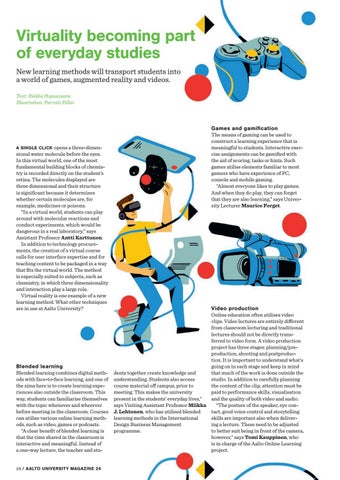
Virtuality becoming part of everyday studies New learning methods will transport students into a world of games, augmented reality and videos. Text: Riikka Hopiavaara Illustration: Parvati Pillai
Games and gamification A SINGLE CLICK opens a three-dimen-
sional water molecule before the eyes. In this virtual world, one of the most fundamental building blocks of chemistry is recorded directly on the student’s retina. The molecules displayed are three dimensional and their structure is significant because it determines whether certain molecules are, for example, medicines or poisons. “In a virtual world, students can play around with molecular reactions and conduct experiments, which would be dangerous in a real laboratory,” says Assistant Professor Antti Karttunen. In addition to technology procurements, the creation of a virtual course calls for user interface expertise and for teaching content to be packaged in a way that fits the virtual world. The method is especially suited to subjects, such as chemistry, in which three dimensionality and interaction play a large role. Virtual reality is one example of a new learning method. What other techniques are in use at Aalto University?
Blended learning
Blended learning combines digital methods with face-to-face learning, and one of the aims here is to create learning experiences also outside the classroom. This way, students can familiarise themselves with the topic whenever and wherever before meeting in the classroom. Courses can utilise various online learning methods, such as video, games or podcasts. “A clear benefit of blended learning is that the time shared in the classroom is interactive and meaningful. Instead of a one-way lecture, the teacher and stu28 / AALTO UNIVERSITY MAGAZINE 24
The means of gaming can be used to construct a learning experience that is meaningful to students. Interactive exercise assignments can be gamified with the aid of scoring, tasks or hints. Such games utilise elements familiar to most gamers who have experience of PC, console and mobile gaming. “Almost everyone likes to play games. And when they do play, they can forget that they are also learning,” says University Lecturer Maurice Forget.
Video production
Online education often utilises video clips. Video lectures are entirely different from classroom lecturing and traditional lectures should not be directly transferred to video form. A video production project has three stages: planning/preproduction, shooting and postproduction. It is important to understand what’s going on in each stage and keep in mind dents together create knowledge and that much of the work is done outside the understanding. Students also access studio. In addition to carefully planning course material off campus, prior to the content of the clip, attention must be meeting. This makes the university paid to performance skills, visualisation present in the students’ everyday lives,” and the quality of both video and audio. says Visiting Assistant Professor Miikka “The posture of the speaker, eye conJ. Lehtonen, who has utilised blended tact, good voice control and storytelling learning methods in the International skills are important also when deliverDesign Business Management ing a lecture. These need to be adjusted programme. to better suit being in front of the camera, however,” says Tomi Kauppinen, who is in charge of the Aalto Online Learning project.
Online resources
Online resources include interactive examples and exercises, which are checked automatically by the software. Students are immediately told the solution to the problem and are given feedback if the exercise was not completed flawlessly. Both the student and the teacher win: students can study and complete online courses at their own pace, irrespective of schedules or location. “From the teacher’s perspective, a course like this lightens the workload, especially in the case of mass lectures. Constructing and maintaining the online material requires expertise and a lot of work, so doing it for the smaller courses is not worthwhile,” says University Lecturer Pasi Sarolahti, who has used the method on a programming course.
Interacting online
The fishbowl conversation technique was developed to facilitate dialogue in larger groups. Originally meant for classroom situations, this interaction method can be transferred also to the online world. Clicking an empty box shown on the display informs the other debaters that someone in the audience wishes to take part in the debate. This prompts one of the four debaters to leave the debate and join the audience as an observer. The idea is to give everybody the opportunity to contribute to the debate, even when there are a lot of participants. When realised online, the method has the benefit of not requiring students to be present at one location. This enables students, who are unable to come to class, to also complete courses in which participation is mandatory. “The fishbowl technique is best suited to courses with a subject that is controversial enough to arouse debate. When arranged online, debates gain gamified aspects and excitement, as the identity of the person joining the debate is only revealed when his or her picture appears on screen. It is also easier to add outside experts to online discussions because participation does not require them to travel or prepare in advance,” says Associate Professor Teemu Leinonen.
Augmented reality
As the name implies, augmented reality refers to augmenting surrounding reality by adding elements—like sound, images and text—that are then displayed with the aid of a mobile device. “Students participating in a course that utilises augmented reality can learn about, for example, the campus’ energy solutions in their actual settings. Moving around outdoors and studying the course subject with the aid of augmented reality is entirely different from reading the same things from a textbook. Students can complete assignments without the teacher being present. The teacher monitors student progress with the aid of questions asked by the application,” says Maurice Forget, who has used the Augmented Reality for Interactive Storytelling (ARIS) app to construct several different ARIS games.
New learning methods developed for and with students Aalto Online Learning is a strategic project that has, over a period of three years, developed blended learning and online education methods and solutions for more than 150 different courses. A community of teachers that supports and helps in the development work has emerged at the same time. The project has grown into a network of more than 200 people who contribute to content production as well as the development of methods and learning platforms.
AALTO UNIVERSITY MAGAZINE 24 \ 29
You own your competence Career success calls for the constant updating of knowledge and skills. Responsibility for the development of competence rests with the individual. Text: Annamari Typpö Photos: Aalto EE and Aalto University archives
T
his article begins with a cliché. That is to say that the ancient Greeks already thought that a person’s mental development continues throughout their life. Since then, the theme has been raised by, among others, the Czech pedagogue J. A. Comenius and, in Finland, by J. V. Snellman, Santeri Alkio, J. A. Hollo and J. E. Salomaa. Actual lifelong learning became a topic of debate in the 1960s, when UNESCO brought it to international attention. In recent years, talk of lifelong learning has once again become more active in tandem with the transition of working life. As whole sectors, job descriptions and work contents are now locked in a permanent state of change, success will fall on individuals and organisations that have an ability to adjust and are constantly prepared to develop their competence. Group Managing Director of Aalto University Executive Education (Aalto EE), School of Business Professor of Practice Pekka Mattila notes that supplemental education and training were earlier viewed as sort of exceptional situations, even as rewards or breakaways from everyday work, but the situation has now been reversed. Mattila thinks organisations and individual employees should allocate part of their every workday or week to the development of competence. This would represent a significant advantage for businesses competing for the best talent. “Ambitious employees want to enhance their competence portfolio, and firms need to provide an appropriate framework for this,” Raija Kuokkanen, Head of Thought Leadership and Design at Aalto EE, underlines. 30 / AALTO UNIVERSITY MAGAZINE 24
Accordingly, attitudes towards supplemental education are changing. Alongside months-long courses, employees can develop their competence by, for example, reading books and watching videos. Employers can offer their personnel study programmes that combine different learning methods and paths from which each participant can compile a package that suits their individual needs.
Diversity changing who is in charge Responsibility for the development of personal competence is increasingly shifting to the individual. “Soon, everyone can think that a certain sum of money has been set aside for their personal development. It will be part of the overall compensation package offered by the employer,” says Pekka Mattila. But what if there’s no employer? Fragmenting professional careers and the increasing prevalence of self-employment are visible features of Aalto EE’s clientele as well. More and more participants in MBA and EMBA business management programmes, for example, are paying for their studies either personally or through their own company. “The self-employed need to price their services in a way that leaves money also for the updating of their personal competence,” Mattila says. Organisations, which employ free professionals, also need to update their management skills. When the HR department can’t order subcontractors to attend supplementary education, it is necessary to ensure that there are adequate incentives for self-development. In Mattila’s experience, people who have become entrepreneurs voluntarily
Various robes and hats are commonly worn at MBA degree conferrals around the world. The outfits of Aalto EE’s MBA and Executive MBA graduates were designed by Aalto University fashion design master’s students Eveliina Ronkainen and Ksenia Afanasjeva. The robes are, first and foremost, dignified, but user comfort was also an important design criterium.
are usually prepared for the necessity to constantly maintain and hone their competence. Those who have been forced into entrepreneurship may be in a more vulnerable position, similarly to actors in the creative industries. These groups include a lot of one-person firms that often have modest development budgets. “Some way to subsidise the maintenance of professional competence in the creative industries needs to be identified,” Mattila reckons. Help already exists for life’s turning points. For example, many organisations support the re-employment of employees they are going to sack. Good examples are
Nokia Bridge and Microsoft Polku, in which Aalto PRO has acted as a service provider. Aalto PRO has also, together with the Uusimaa Centre for Economic Development, Transport and the Environment, developed the Further Educated with Companies programme concept. Some 70% of its participants find employment with the company they train at.
Creativity and communications skills highly valued In addition to structures, the transition in working life affects the contents of training. The significance of metaskills,
learning to learn and the ability to discard working habits and practices that are no longer necessary, has long been the topic of discussion. Mattila thinks we should consider how deeply different matters should be understood. Often a capacity to ask the right questions, and find the experts with the answers, is enough. The nature of expertise is also changing. “Whereas in-depth experts of a specific topic used to be sought, the emphasis now is on creativity, interaction skills and a capacity for critical thinking. We identified the significance of interaction already in the 1990s, when it was AALTO UNIVERSITY MAGAZINE 24 \ 31
A brief journey across time to see how supplementary education and management training were marketed from the 1980s to the 2000s tells us that styles, equipment and clothing may change, but the value of learning and expertise remains constant.
included as a compulsory part of the degree programme,” says Raija Kuokkanen. Critical thinking and decision-making are developed at Aalto EE with, among others, the live case method, in which participants get to work on real challenges from the world of business. Exams are often taken at home and include applied problem solving.
Trendy themes survive for a few years Around a hundred diploma- or certi ficate-oriented or open degree programmes are offered each year in Finland under the Aalto EE and Aalto PRO brands. International activities have also expanded strongly. The selection of programmes and 32 / AALTO UNIVERSITY MAGAZINE 24
the contents of training are developed based on, for example, the research conducted at Aalto University and signals received from clients. Clear changes of direction have been the shift from Finnish to English-language training as well as increasingly targeted programmes. Digitalisation has been the greatest change. Now, Aalto EE has more than a dozen programmes, which deal with different aspects of digitalisation. In addition, the range of online education options is growing all the time. The first steps were taken as far back as the turn of the 1980s and 90s, when the Helsinki University of Technology’s training centre developed training that helped holders of a bachelor’s in engineering to complete an engineering master’s. Almost all the training was realised via
Developing competence is also business development.
and money is being budgeted for it than before, which has spurred growth in customer-specific solutions. The first tailored programmes were realised in 1991–92, when businesses started asking for programmes, which support their own corporate strategies. “This calls for us to be nimble, as the content of programmes is always unique. The goals are derived from business activities, and the aim is to support participants’ competence and personal growth, in addition to their organisation’s growth. The aim is to impact business quite directly,” says Kuokkanen.
Classics being renewed constantly Alongside their evolving programme selection, Aalto EE and Aalto PRO also offer several permanent fixtures. The longest-lived is the advanced course in municipal planning, which turned 50 in 2018. Now, the training is realised in cooperation between Aalto PRO and video conferencing, i.e. as what would the Department of Built Environment. nowadays be termed online studies. The management training programme Topical themes and trendy words AaltoJOKO® has reached almost as are moderately visible in Aalto EE’s pro- mature an age. The first programme gramme selection. Today, there is lots launched at the Helsinki School of Ecoof talk about, for example, the platform nomics in 1970, and the group next starteconomy, blockchains and lean thinking. ing studies will be the 98th. A persistent theme of the 2000s has been “AaltoJOKO® lives and thrives talent management. because it is being constantly renewed. “Fashionable terms usually have Two things have remained, however: a certain lifespan, three or four years, and the training programme supports growth then they are in turn replaced by somein personal leadership and is always thing else, but the theme itself remains. grounded in strategy,” says Kuokkanen. To be clear, we avoid offering the flavour Participants have lauded the training of the month,” Mattila mentions. programme also for its peer learning and Another substantial change is that broad perspective. What’s new for one the development of competence is no sector may be mundane in another, longer exclusively a HR activity, but and the other participants can offer valualso a feature of management and busiable viewpoints into one’s own work. ness development. That’s why more time The support provided by the network
Aalto University Executive Education group • Owned by Aalto University. • Offers executive training services (Aalto EE), supplementary education for experts (Aalto PRO), entrepreneurship development services (Aalto ENT) and financial sector training (Finva). • The Financial Times has ranked Aalto EE amongst the world’s top 50 executive training providers. • Internationalisation began in 1995 in South Korea, where we already have over 4 000 alumni. • Singapore subsidiary established in 2000. • Born in 2010 in the wake of the establishment of Aalto University, when HSE Executive Education Oy (earlier JOKO Executive Education Oy) and TKK Executive School of Business Oy merged. • Since 2011, the traditions of the Helsinki University of Technology’s Dipoli training centre, which was established in 1981, are being continued by Aalto University Professional Development, i.e. Aalto PRO, which is the result of a merger between Dipoli and the University of Art and Design Helsinki’s supplementary training unit as well as HUT’s training centre in Lahti. • Aalto PRO joined the Aalto EE group in 2014. In 2017 Financial and Insurance Institute Finva was affiliated to the group.
has been a key success factor also for a third evergreen, the 25-year-old Safety Management training programme. Social learning is at the heart of Aalto EE’s business. “We think that learning together is valuable,” says Raija Kuokkanen. • AALTO UNIVERSITY MAGAZINE 24 \ 33
Changing work presents a wealth of research topics Is there anything stable left in work life? At least constant change, say Future of Work researches, and advocate joining forces in work related research. Text: Joanna Sinclair Photo: Venla Helenius WORK LIFE is changing at a tremendous
pace. Many jobs no longer depend on time, place, or work contracts. Robotics and AI are altering or obsoleting old professions, while societal changes are creating entirely new ways of organising work. It is no wonder that Aalto University researchers are fascinated by the intensifying transformation of work and technology. The four-year Future of Work research project has ambitious goals. Funded by the Academy of Finland and Aalto University, this research project aims to bring together all Aalto University researchers interested in the transformation of work and create a worldclass hub for studying the future of work. “Future of Work helps work-life researchers find each other and work together,” says researcher Hertta Vuorenmaa. “We also bring together leaders, policy makers and think tanks. We are organising various kinds of events and lecture series to create a forum for discussions – and we have exciting research collaboration with both public and private sector organisations. Ilmarinen is a good example of an organisation that we have versatile research collaboration with,” Professor Eero Vaara adds. “Our aspiration is to have Aalto University and Future of Work be the first things that come to people’s minds when they ponder where to find the most relevant research on the transformation of work.”
Practical answers that benefit everyone Vaara and Vuorenmaa emphasise that the world is full of research that no one can find, or which has no practical ben34 / AALTO UNIVERSITY MAGAZINE 24
efits outside academia. Future of Work strives to change this. It challenges researchers to create answers about the changing nature of work that are relevant and useful for society, businesses and individuals. There is no shortage of things to study: leadership is transforming, as is strategy work, organising, business models—in continuously accelerating change, hardly anything about work remains intact. “Leaders and researchers alike have more questions than answers right now. This makes the entire Future of Work research programme so interesting and relevant: no answers are self-evident. An answer that is fitting for a certain area of industry in Finland, for example, may be completely irrelevant in India,” Vaara points out.
Empathy and sensitivity are increasingly important More questions than answers may prevail, but researchers can nonetheless describe many interesting Hertta Vuorenmaa and Eero Vaara list five central research areas: leadership, industries and business models, servitisation, organising and strategy work.
manifestations of changing times. For example, progressively versatile skills are now valued at work. In addition to digital dexterity, communication and other interaction skills are also highlighted —not to mention media literacy. “There is nothing new about constant change, but the pace of change is a new phenomenon. Above all, employees now need passion and aptitude for learning new things; as well as change resilience, which means the ability to adjust and
bounce back in surprising new situations,” Vuorenmaa emphasises. She also says that social skills are deemed imperative by a growing number of recruiters. White collar workers especially are expected to have more and more empathy and propensity for critical thinking. Leaders in turn may be surprised of the strength of emotions triggered by new technology related insecurity. “Although work and technology are changing, people stay more or less the same. Individuals might feel intense shame if they are incompetent with new tech, for example. Consequently, leaders need increasing sensitivity – the thoughtfulness and capacity to identify these situations,” says Vuorenmaa and reminds that for example empathy can be learned.
tough for HR Directors as they shop around to find employers that match Eero Vaara explains that organisations their values. Platform economy is dishave more and more colorful ways of rupting structures and inventing new working and organising work. ones. Unions are losing their significance “There are quite a lot of pioneers in in many industries. Finland. The City of Espoo is a great “And in the midst of all this, the strucexample. It conducted its entire strattures of society and legislation are lagegy work through storytelling. The Espoo ging way behind. Wherever I go to speak story is its strategy, steering the city’s about the changes in work life, the recepactions toward mutual goals,” Vaara says. tion is extremely enthusiastic. There Though fresh new takes on organising is no need to justify the need for this are mushrooming all around, many lead- research,” Hertta Vuorenmaa affirms. ers are striving to cope with a heavy burEero Vaara agrees with his colleague: den: scarce resources are making good “All spheres of society regard this area leadership an impossibility, irrespective of research as extremely important. It of their leadership skills. is quite an extraordinary situation for “The general level of awareness is an academic. We are pacesetters with growing all the time. The principles of the Future of Work research project.” good change management are underThere is no intention of reinventstood extremely well in many organisaing the wheel. All the research projects tions, yet managers may have no realisselected into Future of Work are existing tic possibilities of achieving them,” Vaara undertakings with solid track records. remarks. The project’s five central research areas “Many Finnish companies overlearned focus on leadership, industries and busicost-cutting during the financial crisis, ness models, servitisation, organising and this is holding back resources direly and strategy work. needed for good leadership.” The project’s goal is to reach more researchers and revitalise and boost A cornucopia of dialogue with the surrounding world research topics through communications and networking. Future of Work presents a myriad of “We are disrupting the status quo and highly interesting research themes. driving people to intermingle through Vaara and Vuorenmaa have a nearjoint events. We are planning a Future of endless list of attention-grabbing topWork event for alumni for autumn 2019, ics: young professionals are making life for example,” Vuorenmaa mentions. •
Courageous experiments and lacking resources
In the midst of all this, the structures of society and legislation are lagging way behind.
AALTO UNIVERSITY MAGAZINE 24 \ 35
Slow cycle In its present form, the clothing industry is a polluter of water systems and a climate baddy. Materials recycling is not a sufficient answer, the whole system must change instead, says an expert on the circular fashion economy. Text: Minna Hölttä Photos: Mikko Raskinen MY GRANDAD wore the same suit to weddings, birthday parties and funerals. My grandaunt’s wardrobe was so loosely filled that her winter dress, summer dress and party dress looked like valuable collector’s items hanging on display. It’s a different story today, in the era of ten-euro T-shirts method. Associate Professor, Fashion Research, Kirsi Niinimäki says a major change occurred at the turn of the millennium, when fast fashion took over the market. “The cycle has only intensified. There used to be four collections per year, but now Zara, for example, introduces a new collection at its stores every other week.” The volume of global clothes production has doubled in fifteen years. Some 6.4m tonnes are consumed annually in Europe alone. The service life has decreased by more than a third in the same period. An acquired item of clothing will be kept in the wardrobe for an average of three years and worn on 44 days. After this month-and-a-half of use, it is most likely destined for incineration or a landfill.
Valuable waste
The business model of the clothing industry is linear: you start with raw material and end up with waste. Only one percent of the materials used to make clothing is utilised as raw material for new clothes. Niinimäki notes that virgin raw materials are likely to increase in value. For example, the current world market price of cotton is low, but, as demand grows and the amount of available arable land shrinks, this is bound to change. The clothing industry generates about a tenth of global greenhouse emissions, more than shipping and international air traffic put together. Processing discarded clothes into raw material for new textile fibre would reduce emissions substantially and prevent the industry from losing €100b worth of raw materials. Many challenges remain on the path to a circular fashion economy. Some of these challenges are technical, such as how to separate different fibres from each other. Especially problematic is elastane, which is added to clothes to
“Everything affects everything in the circular fashion economy. This is why cooperation between different sectors is so important,” says Professor Kirsi Niinimäki.
make them more comfortable. Elastane cannot be separated from other fibres mechanically or chemically. In addition, it shortens the service life of clothing and releases colour more readily than other fibres.
Reddish-brown colourants can be extracted from willow bark. Natural pigments have been employed in textile dyeing for thousands of years.
36 / AALTO UNIVERSITY MAGAZINE 24
In future, we’ll design lifespans instead of products.
“This is why black stretch jeans, for example, fade really quickly,” Kirsi Niinimäki explains. “Our knowledge of which fibres can be recycled with each method – and which ones can’t be recycled at all – is constantly improving. This knowledge needs to get to the start of production, on top of which we should ask whether we should be making some fibres at all?”
Colours from forests and fields
The success of fibre recycling is important – but it is only the beginning. In the circular economy, chemicals need to rotate as well. One fifth of the water pollution caused by global industry is due to the dyeing of textiles and the chemicals used in the process. Some parts of China already have completely spoiled groundwater. “If we were to recycle also the dye contained in fibres, it wouldn’t be necessary to bleach and re-dye fibres again in the next phase,” Niinimäki explains. There are also non-toxic alternatives to dyes. Niinimäki has been researching the possibilities of vegetable dyes for a long time. Her favourite is dyer’s woad, which yields the colour blue. “It is very Finnish and special because only it and some lichen can provide a source of natural blue dye. In a sense, we are looking back at history, as we’ve lost a lot of knowledge along the way that can be adopted back into use, combined with new technology.” Cultivation of dye plants would provide a fresh boost to agriculture. Dyes can also be extracted from the side streams of the food and forest industries, and they can be grown with the aid of bacteria. In addition to research knowledge and technological solutions, what’s needed is open-mindedness on the part of all parties: designers, businesses and consumers. When the point of departure is not virgin fabric but recycled material,
the result can, instead of a uniform navy blue, be 20 different shades of indigo. “Why should it all be exactly the same shade of blue anyway?” Niinimäki asks. “We need to get away from thinking in terms of mass production. Small factories could exploit local materials and waste to manufacture more individual products—that’s the future.”
improving an individual product, it aims to change our entire way of producing and consuming. In future, we’ll design lifespans—and products that fit them— instead of designing products.” Slowing down the materials cycle is an essential part of the change. That’s why the amount of various customisation, repair and rental services is growing. Kirsi Niinimäki believes that Creativity and love the structures of mass production can When Kirsi Niinimäki graduated as also be challenged. a textile designer in the 80s, Finland “Fast fashion is, in fact, a really volatile was still a mass producer of textiles and business, which always involves excess clothes. Then the Soviet Union collapsed, production—that is then sold for a pitand globalisation arrived. tance or incinerated. What if everything “Now, I tell students how production was done according to the customer’s progresses all the way to a finished wishes and measurements, in a way that product on the other side of the planet.” eliminate all waste?” After industry, Niinimäki made Niinimäki would counsel consumers a career as an entrepreneur and then to invest in quality and think carefully as head lecturer and training programme about what they buy. director at Metropolia. At Aalto, she “We should see our wardrobes as conducts research and communicates investments and fall in love with clothes the latest knowledge to the students. over and over again.” • The clothing industry has upturned completely during Niinimäki’s career and will look entirely different again thirty years from now. That’s why training emphasises the ability to learn, broad-based thinking and creative thought. Students think about environmental loading constantly and, according to Niinimäki, almost all of them will undergo a crisis at some stage when they consider their own relationship with the industry. “I myself try and encourage them to think on the system level, i.e. tell them that the circular economy is not about
• Find out more about the circular fashion economy from the book Sustainable Fashion in a Circular Economy edited by Kirsi Niinimäki as well as the Ellen McArthur Foundation’s report A New Textiles Economy: Re-designing Fashion’s Future. VIDEO: Ioncell-F turns wood into garments and clothes https://bit.ly/2T6Mfiy
AALTO UNIVERSITY MAGAZINE 24 \ 37
In-house
38 / AALTO UNIVERSITY MAGAZINE 24
Welcome to the School of Business in Otaniemi BRASS, OAK, handmade details and other recollection of the Töölö campus can be found in the new building of the Aalto University School of Business in Otaniemi, Espoo. The activities in the new building began in February 2019. Master’s and Doctoral studies will be organised there and after almost fifty years, all School of Business’ departments are under one roof now. The Bachelor’s students of the School moved to Otaniemi in Autumn 2015. The Bachelor’s Degree Programme in International Business will continue to be organised in Mikkeli, Eastern Finland. “The relocation offers a lot of opportunities. Now, Master’s students can also complete multidisciplinary studies more easily, and our new environment creates good conditions for interdisciplinary research collaboration. The Otaniemi campus also offers excellent opportunities for our students, for example, to become entrepreneurs,” says Dean Ingmar Björkman. The name of the new four-storey building is the School of Business and the opening ceremony will be held in May 2019. The building provides facilities for a total of around 2 000 people. Restaurant Arvo, café Kylteri and most of the facilities are located on the street level. Other teaching facilities, student facilities, meeting and teamwork facilities are located on the upper floors. The new School of Business building is a part of a larger building block, and it’s two other parts are Väre, the School of Arts, Design and Architecture’s new building, and the shopping centre A Bloc. The block was designed by Verstas Architects. The former building in Töölö, Helsinki, will continue to be a meeting point for Aalto University and its partners. It will be renovated in stages, and the project is due to be completed by the end of 2020, when Aalto University Executive Education, which offers management training, will move there. •
Text: Noora Stapleton Photo: Mikko Raskinen
AALTO UNIVERSITY MAGAZINE 24 \ 39
Crafting digital birds into a boardgame Joy breaks out when a bird, catapulted by slingshot, hits a pig, dropping it onto the playing field. Class 4M of Päivänkehrä primary school has come to Aalto Junior to make a boardgame version of the familiar mobile game Angry Birds. Text: Riikka Hopiavaara Photos: Jaakko Kahilaniemi
FIRST, FOURTH-GRADERS Ella Kiuru,
Julia Kasslin and YiFei Guo agree on the division of labour: one will build the slingshot and another the board, while the third crafts the pigs and birds. Everyone has their own area of respon sibility, but everybody also helps the others. Before splitting into groups, the children were told how games are actually made. Whether dealing with traditional boardgames or digital games, the work is always done by a group con sisting of several different kinds of pro fessionals. A team will usually include a designer, graphic designer, program mer, level designer, sound technician and a tester.
The importance of communications is emphasised because of the multidis ciplinary nature of the game industry. Accordingly, a talk about different ways of communicating with others is held with the children. “In addition to strengthening commu nications skills, the workshop encour ages creativity in the solving of artistic and scientific problems. For example, the children built the slingshots them selves without receiving instruction,” says workshop leader Carolin Piotrowski. “Hey, what kind of nose should I make for this piggy?” “Don’t pigs have one with two holes in it?”
“We need more birds. What kinds were in that picture?” The game industry typically employs a test-based operating model in which a game idea is realised and then tested in the form of, for example, a boardgame. The game takes digital form only after testing has been completed. The operat ing model calls for lots of creative prob lem solving and for an ability to transform digital mechanics into something that suits the physical world. “Your playing field looks good! Give some more thought to how the pigs will stay on top of the structures. Use Blu-Tack, for example.” Focused work is sporadically inter 40 / AALTO UNIVERSITY MAGAZINE 24
Ella Kiuru, YiFei Guo and Julia Kasslin testing their boardgame.
rupted by bursts of laughter, when one of the kids comes up with something funny like red ears on a pig or a slingshot that hurls pig figurines instead of birds. The children have not crafted slingshots before this but experimenting with different designs finally results in a functioning projectile launcher. “Add another rubber band to that catapult.” Solutions to problems are arrived at together. These future game designers don’t need to be encouraged to have fun, it comes naturally to them. “That was great!” the kids exclaim and pack their self-made games in an Aalto Junior bag to take along. •
Aalto University Junior offers courses, clubs, themed events and educational visits to comprehensive school pupils and high schoolers. Schools can also ask researchers to come visit them. The activity supports the work of teachers in fields like biotech, electronics, robotics and programming, physics, chemistry, maths as well as art and design. • junior.aalto.fi
AALTO UNIVERSITY MAGAZINE 24 \ 41
Learning from others Text: Tiina Aulanko-Jokirinne Photo: Olli Kiikkilä/Prodeko
Alumni community of Prodeko and the Department of Industrial Engineering and Management are cooperating on trial methods for lifelong learning. The ideas are based on peer collaboration.
ALUMNI MEMBERS of the industrial engineering and management community Prodeko have, since autumn 2018, gathered to share their sometimes quite personal work experiences around common themes. Courses dealing with topics like leadership, personal growth and implementation of corporate acquisitions have been the setting for excellent encounters and insights. Prodeko’s lifelong learning courses resemble the process of training. The insights that emerge in continuous learning peer groups can be quite simple and easy to generalise. Heikki Koponen, who facilitated a mergers and acquisitions course, points to the introduction made by Assistant Professor Timo Vuori which compared the realisation of corporate acquisitions to a good relationship. “Two different cultures are combined in mergers and acquisitions. The recipe for success is surprisingly simple: you talk, discuss and listen. You try and understand the other party and don’t hang on every mistake.” A leadership course headed by Jari Ylitalo and Juha Äkräs has dived into, among other things, a model of comprehensive wellbeing that was created by sports physician Aki Hintsa. At the core of the model are the individual’s own identity and deep foundation of being. This is framed by other resource areas like sleep, nutrition, health issues and relationships. A stable everyday life is key. “Everyday life can be changed by implementing concrete changes, but most carry their ‘I should’ baggage with them day in, day out. They should bravely reach into this baggage and come up
42 / AALTO UNIVERSITY MAGAZINE 24
with, for example, a new morning routine, which can help them tackle a new day effectively,” says Jari Ylitalo.
Topic of doctoral studies drawn from professional career
And there are even more opportunities for lifelong learning. The Department Alumni and degree has experimented with part-time docstudents together toral studies in the spirit of continuous Some fifty new students join the Depart- learning. ment of Industrial Engineering and Ari Virtanen, who now works as Management each year. Alumni and a partner at IMS Talent, commenced students get to know each other well. his doctoral studies while employed It’s not unusual for students to encounby Kone in 2015. Virtanen’s doctoral ter role models like Risto Siilasmaa thesis analyses the success of the comand Ilkka Paananen, who are actively pany’s transition to become a provider of involved with Prodeko’s alumni activities. service solutions while simultaneously Head of Department, Associate trying to retain the efficiency of existing Professor Risto Rajala says that alumni operations. and students are brought together via, “Ari Virtanen has cooperated with among other things, speed mentoring and top researchers from the Department, the alumni mentor programme. Whereas enabling us to establish an exceptionally speed mentoring involves the sharing of effective cooperation between researchexperiences on specific themes, alumni ers and the subject company. Cooperatmentoring can provide support and fresh ing with Ari has also helped me personideas for a personal career path. ally as a researcher,” Risto Rajala notes. • “A speed mentoring event is a fantastic opportunity to meet with high-status executives. The discussions are in-depth and the encounters real. They also include frank talk about insecurities and failures,” says student Susanna Prodeko Tamminen. • 53-year-old guild for industrial In alumni mentoring, small student engineering and management groups meet with individual alumni students, the alumni community a few times during the spring semesforms part of it. ter. Susanna Tamminen values these • 2 500 members. encounters. • Finland’s most active alumni “You can learn about real work experiassociation measured in the amount ences as well as draw inspiration and find of shared activities between alumni, a direction for planning your own career students and university personnel. in alumni mentoring. You can easily get • Activities include corporate visits, a bit lost if you only hear about a couple encounters and traditions. of stereotypical career paths you’re • The annual Prodeko seminar takes unable to identify with.” place in April, this year on 5 April.
Visiting
A visual artist wielding more than a hammer Aalto University’s fifth Artist-in-Residence Matthew C. Wilson explores the entangled nature of ideas. Text: Tiina Toivola Photo: Mikko Raskinen SCIENCE AND CULTURE work together
to imagine the future, says Artist-inResidence Matthew C. Wilson. He refers to director Stanley Kubrick’s consultations with artificial intelligence pioneer Marvin Minsky, held in order to develop HAL 9000, the infamous AI character in the film 2001: A Space Odyssey. “Now we talk to Siri and Alexa, but we needed the film to prepare us for their arrival.” Wilson appreciates the fact that Aalto University places art alongside science and other forms of research, adding: “If we somehow detach our tools from their specific discipline, we can discover new uses for them.” According to Wilson, artistic research and practice are as significant as scientific work, but employ different methodologies. “If all you have is a hammer, everything looks like a nail. With more tools, you might approach and solve problems differently. Addressing complex problems— like those we face today—requires not one tool, but a toolkit.” Wilson’s current research includes “future imaginaries”—collective image pools, ideas, institutions, and ideologies that transform the world. “The future always springs from his-
tory. We live in a world that was once only imaginary. In the process of realising images of the future, there are always unintended consequences. Art and culture address those consequences, before and after they appear—bridging histories and futures. Science and culture are involved in the same processes of imagining and transforming.”
Do we underuse our ability to imagine? Science needs methods and structures, but there are moments when limitations and boundaries are reached. Wilson ponders the history of non-analytical techniques for engaging with these boundaries. “There is a long list of scientists and innovators whose ‘aha’ or ‘eureka’ moments do not come exclusively from analytical processes—these range from Friedrich Kekulé’s claim that a dream of a snake biting its own tail provided insight into the structure of benzene, to Alfred Russel Wallace who, independently of Darwin, conceived of evolution by natural selection during a malarial fever.” Wilson also describes how the inventor Thomas Edison “visualised the future” by holding steel balls in his hands that would drop if he fell asleep, awakening
him just in time to catch insights from hypnagogia—the state on the edge of sleep.
Experimental processes
Formerly both a computer engineering and literature student, and now turned artist Wilson has a longstanding engagement with discourses and methods outside art. “I’ve always been interested in anthropology and its method of participant observation—this idea that you can be in multiple positions or roles at a time, which need not negate each other even if those experiences are irreconcilable.” When starting a dialogue or collaboration with scientists or researches from different fields, Wilson wants to understand not only the materials and methods of their work, but also the motivation behind it. Asked about his own motivation, Wilson said, “It’s a common idea that art is supposed to make your life better, bring beauty or enjoyment. This can be true, but harmony is often found by first making ourselves uncomfortable and uncertain, by struggling to re-evaluate existing perceptions. I produce work that invites this process.” •
Matthew C. Wilson holds a Master of Fine Arts degree from Columbia University. He is a visual artist who makes videos and sculptures exploring natural, historical, economic, and perceptual processes. As Aalto University’s artist-in-residence, he will develop an artistic project in the schools of Chemical Engineering and Science and give lectures. • matthewcwilson.com Aalto University’s Artist-in-Residence Programme aims at producing artworks stemming from a dialogue between art and science. During this residence, the artist will pursue her or his own creative project while at the same time engaging with the Aalto community. The outcome of the residence period will be premiered in the Helsinki region. The programme, established in 2011, has welcomed altogether five artists to date.
AALTO UNIVERSITY MAGAZINE 24 \ 43
Curiosity will keep you on track We asked three professors what the University can do to support continuous learning.
Rupesh Vyas : Higher education plays a key role in adjusting to the needs of future working life. Promoting student commitment to continuous learning as well as providing opportunities for updating competence at different life stages are both important. Individual study paths should be made possible. Course-based studies are not a good fit for everyone, nor do they always lead to the best learning outcomes. Alumni-student cooperation projects, for example, are rewarding for both parties.
Text: Annamari Tolonen Photos: Adolfo Vera, Anni Hanén
How is the demand for continuous learning affecting your field? Pedro Vilaça Associate Professor, Engineering Materials: New materials and material properties are developed in a fast pace, and in close relation the mechanical design and manufacturing techniques are evolving. Rising sectors, like space technology and artic applications, pose fresh kinds of demands on competence. Finland is one of the most industrially successful countries in the world: we are home to just five and a half million people, but also have several world-class companies specialising in everything from raw materials production to sophisticated technologies. Competence really needs to be kept up to date in order to maintain our competitiveness.
Rupesh Vyas Professor of Practice, Visual Communications Design and Information Design: Creative work is going through a transition. In graphic design, for example, an AI can already take care of routine tasks like layout. It is important to maintain abilities and skills that remain in demand irrespective of technological developments: creative and inventive thinking as well as an individual style of expression. Trying and learning new things keeps your creativity honed.
Alexander Frey Associate Professor, Molecular Biotechnology: The rate at which fresh knowledge is being accumulated in the field of biotechnology is enormous, as is the development of methods and technology. Many of the gene editing technologies that have received attention in the news have been developed in the last few years, for example. It’s easy to lose track if you don’t update your expertise. 44 / AALTO UNIVERSITY MAGAZINE 24
What role do universities play in continuous learning?
Pedro Vilaça: In addition to teaching, universities can promote opportunities for continuous learning in other ways, too. Fresh knowledge, expertise and innovations are disseminated via, for example, companies with strong research-based activities. In an approach resembling the tradition of ‘Summer Jobs’, where students go from academia to industry to start and reinforce their professional experiences, Aalto could establish a ‘Winter Academy’ period, and brand, that would embed alumni and other professionals in ongoing courses and research. On the other hand, internal motivation and commitment are the most important factors in learning. Encouraging a senior professional, educated in a classic environment, who is nowadays a top expert in their field to learn new ways of doing things can be difficult. Therefore, we should promote a more easy environment for continuous learning in the future, by showing to our present students that continuous personal development brings you joy and improves the quality of your life. Alexander Frey: Universities can encourage you to maintain a curious attitude towards all new things as well as to develop an ability to adjust to changes and quickly assume fresh skills. Whether or not universities should play a stronger role in the upkeep of competence also after graduation remains an open question that needs to be discussed among the different stakeholders in Finland. It is also a political issue.
How can we support continuous learning? Pedro Vilaça: Multidisciplinarity is a strength for sure. Very specialised expertise is valued nowadays, but the making of wise decisions calls for a broad understanding of society and the world. Changes, which affect our work, don’t always take place within our own field. The Internet of Things and Artificial Intelligence, for example, are at the intersection of several fields of science. The university institution is rooted in philosophy and broad-reaching education—and we should cherish this tradition. It helps us see that there are countless opportunities to learn new things! Rupesh Vyas: We have excellent resources for encouraging people to step beyond their own field and try something entirely new. Our strengths are multidisciplinarity and internationality, a strong vision, high-quality teaching and research as well as state-of-the-art technology. We should be proactive and keep in mind that change is the new normal. Our strategy must also be constantly developed.
Aalto Alumni Aalto Alumni
Circle Circle
Alexander Frey: One of the best ways to feed lifelong curiosity is problembased learning. Instead of rote learning, it encourages the finding of creative solutions to problems, and at the same time builds up fresh skills and flexibility. In our field, teaching is extremely practical and relevant from the perspective of working life. However, we need to renew ourselves continuously in order to keep it that way. •
alumnicircle.aalto.fi
Internal motivation and commitment are the most important factors in learning.
Aalto alumni and students, join now and update your contact details!
AALTO UNIVERSITY MAGAZINE 24 \ 45
Shared leadership of remote teams Shared leadership is needed when the members of a virtual work team are scattered around the world. Emma Nordbäck’s doctoral thesis examined whether global corporations are ready for this. Text: Marjukka Puolakka Photos: Iiro Immonen EMMA NORDBÄCK, who enjoys working
as part of a team, had the perfect opportunity to examine her burning interest —people who engage in cooperation via technology—in her doctoral research. “I study the effectiveness of shared leadership in the global teams of multinational corporations. Shared leadership allows the expertise of team members to shine when they take turns to lead the team towards success,” Nordbäck says. This form of leadership is sorely needed in teams that are distributed far and wide. Time difference alone sets its own conditions: the head of a single-leader team might be asleep when the others need assistance. On the other hand, the competence of one person may well be insufficient to manage all of the team’s affairs in, for example, product development projects that require the participation of experts from several fields. Nordbäck’s research focused on six global IT companies, whose virtual
teams consisted primarily of local units in Europe and Asia, and Europe and the United States. Interviewing the members of 16 different teams formed the backbone of the study.
Leaving bossiness behind
The local cultures of different countries add complexity to shared leadership. Whereas Finns are used to a low-hierarchy working culture, Asians often consider a single-leader model more natural. “Multinationals should critically evaluate their leadership cultures. In Finland, for example, a team leader might not know whether the local heads of the other organisations give team members enough autonomy to make independent decisions. Autonomy must come from both the team’s named leaders as well as the local organisations.” A precondition for genuine teamwork and shared leadership is that the leadership of remote teams is not focused into
a single local unit. Teams should also be consciously built in a way that distributes their expertise as evenly as possible. “An atmosphere that encourages shared leadership is required for it to succeed.” Modern technology eases the coordination of shared leadership and the management of work processes. Digital project management tools help in the allocation of tasks and lower the threshold for participating in the team’s decisionmaking.
Runners on and off to the playground Nordbäck performed part of her research at the American University in Washington D.C. The year she spent there was both a thrilling experience and the most productive time of her research period. “I got to focus 100% on the drafting of my doctoral thesis. I analysed the interviews I had conducted and authored two articles, among other things. I also made a lot of friends, who I have visited annually since then.” At present, Nordbäck is busy with teaching and research work as part of Aalto University’s multidisciplinary International Design Business Management (IDBM) programme. “An academic career has been my long-time dream. I already taught secondary school maths and physics during the bachelor’s phase of my studies.” Nordbäck is responsible for the IDBMFITech minor subject totality. The FITech network, which was formed by Finnish technology universities, offers flexible online studies with the aid of new kinds of corporate-university cooperation models. Mother to three-year-old daughter Nelli, Nordbäck spends much of her free time at playgrounds and participating in family activities. Her jogging hobby also keeps her on the move, and she has already completed a few marathons.
Emma Nordbäck 5.10.2018: Shared Leadership in Global Virtual Teams: Building Conditions for its Emergence and Team Effectiveness. 46 / AALTO UNIVERSITY MAGAZINE 24
Doctoral theses ALL DOCTORAL THESES ONLINE: aaltodoc.aalto.fi, shop.aalto.fi
The grotesque makes strangeness desirable
TODAY’S MEDIA CULTURE is brimming
with grotesque imagery, which is dominated by monsters, vampires, non-ideal bodies and overflowing violence. Henriikka Huunan-Seppälä’s, MA, doctoral research explored the relationship between grotesque imagery and norms, ideologies and society’s power structures. The study approached the topic through seven classic films: Pink Flamingos, Antichrist, Alien: Resurrection, Fight Club, Kill Bill, Satyricon and The Cook, the Thief, His Wife & Her Lover. These movies focus on slimy monsters and human-animal hybrids, sick minds and bruised bodies, filth and obscenities as well as sadistic terror and masochistic pleasure. The grotesque materialises, brings to a head and upturns norms, taboos and ideals. Its imagery reflects valuations
Efficient tools for large-scale optimisation Depar tment of Signal Processing and Acoustics
Mihai Iulian Florea
Aalto-DD 197/2018
Constructing Accelerated Algorithms for Large-scale Optimization
C onstructing Accelerated A lgorithms for Large-scale Optimization Framework, Algorithms, and Applications
Mihai Iulian Florea
�� ��
��
��
��
��
�� �� BUSINESS + ECON OMY
SCIEN CE + TECHNOLOGY CROSSOVER D O C TO R A L DISSERTATIONS
Aalto Universit y
AR T + DESIGN + ARC HITECTURE
2018
D O C TO R A L DISSERTATIONS
associated with corporality and ideals of beauty, but also with gender and identity questions. The abundance of taboos targeting the female body indicates the patriarchal origin of taboos. For its part, the grotesque mockery of ideals tells of the pretentiousness and oppressiveness of the dominant ideals. The grotesque is an effective tool of visual communications that appeals strongly to the emotions and connects with unconscious paradigms.
Her opponent, Professor Noël Carroll from the City University of New York, considers the study to be of great significance to the field. Carroll is an internationally renowned art philosopher whose visit to Finland was a major event.
MIHAI FLOREA’S, M.Sc., doctoral thesis
In particular, ACGM can operate in a fully automatic mode where it can solve problems without requiring any parameters, but still benefits from user input if provided. The features of ACGM are very well suited for medical imaging, where it enables new applications such a high-accuracy ultrasound image reconstruction. Professor Nesterov himself valued the work highly and attended the defence as an opponent. The thesis was graded “Passed with Distinction” and received the 2018 Dissertation Award of the Aalto University School of Electrical Engineering.
in the field of signal processing focused on efficient algorithms used in solving optimisation problems with millions of variables. A property called “acceleration” related to optimisation algorithms refers to modifications, which dramatically increase their performance. The thesis provides a unified analysis of accelerated methods. Acceleration was invented by Dr Yurii Nesterov in 1983, when he proposed his highly recognised Fast Gradient Method (FGM). By introducing a simple but powerful mathematical construction, the thesis gives a new perspective on FGM and creates a more general algorithm, the Accelerated Composite Gradient Method (ACGM). This algorithm encompasses the most popular accelerated methods of its class and, by combining their strengths, surpasses all of them.
Henriikka Huunan-Seppälä 14.12.2018: Unfolding the Unexpressed: The Grotesque, Norms and Repressions.
Mihai Iulian Florea 23.10.2018: Constructing Accelerated Algorithms for Large-Scale Optimization: Framework, Algorithms and Applications. AALTO UNIVERSITY MAGAZINE 24 \ 47
Everyday choices
What are art teachers needed for, Marja Rastas? The world contains a void in art education, says Lecturer of Visual Arts Pedagogy. Text: Krista Kinnunen, Paula Haikarainen Photo: Jaakko Kahilaniemi
Aalto University trains art teachers, who go on to work in comprehensive and secondary schools as well as art schools. Is there enough work for them? About thirty students are accepted each year, and the aim is for the same amount to graduate annually. Changes in the standing of the visual arts subject in the comprehensive and secondary school curricula directly affect the number of jobs available in the teaching sector. Our graduates work quite diversely in art education positions or as experts and researchers. Some graduates are self-employed in various art and art education positions. They combine teaching, development, socio-cultural art projects and their own artistic work, which can result in interesting new practices. It looks like the world has a void that art education can fill: our graduates are in ever increasing demand in various sectors of society. A good example is the arrival of art educators at libraries and early childhood education. In other words, we are training art education professionals with lifelong and all-round learning in mind. Why should visual arts be taught in schools—aren’t they more of a hobby? And what if you just can’t draw at all? As a school subject, visual arts is much more than just drawing. It encompasses artistic thinking, exploring and critically examining phenomena in visual culture, challenging your own thoughts through art as well as learning different methods of communication, interaction and influencing. These are things that affect all of us, whoever you may be. And if you think that you can’t draw at all, it could be you’ve failed to notice how multi-faceted a tool drawing is. A skilled 48 / AALTO UNIVERSITY MAGAZINE 24
teacher can instruct you in a way that leads you to notice you can do something you thought was beyond you.
I haven’t worked as a school teacher, although I have performed other teaching duties related to the visual arts since I was a student in the mid-1980s. I started with children and young people, after In 2017, the Ministry of Education published a report on the role of the which I worked in adult education for creative industries in strengthening a long time. My own doctoral studies led me to become a teacher at my alma mater. the economy and employment in Finland. According to it, cultural Working on curriculum planning, the development of teaching, is my passion. sectors generate 3.6% of GDP, i.e. more than, for example, forestry. In my former job, I worked as the head Still, it feels like they aren’t taken teacher of a visual communications programme for almost 15 years. It was my seriously. What can be done about this? ‘pedagogic laboratory’. During that time, I started studying for a doctorate and As an educator of art teachers, I would say that we need to look after the arts adopted the attitude of a researching subjects by arguing for them persistently, teacher. This experience made it easy to loudly and with sophistication. Providing transfer to Aalto for work. a growing person with an in-depth founIn my present job, our fantastic studation in the arts early fosters a personal dents make sure that my thinking doesn’t relationship with art and, ideally, insight stagnate. into the broader significance of art and Who is your favourite artist? culture. I agree with philosopher Martha I can’t give you an individual name, but there are artists who have affected my Nussbaum, who calls for the teaching of art and the humanities to be made own thinking, even quite radically. One part of the curricula of all universities. such example is the composer John Cage. His concert, in which he used She says art develops the ability to put yourself in someone else’s shoes—it is rocks, conifer cones and other natural objects he had gathered as instruments, directly linked to the development of ethical thinking and eco-social justice. obliterated all divisions in how a young Here at Aalto, we have a unit that me perceived art. On the other hand, there are contemprovides art education to all students. University-Wide Art Studies (UWAS) is porary artists and artworks that open fresh perspectives on the world. An an excellent example of how this can be carried out in practice. example was Outi Pieski’s recent exhibition Čuolmmadit at the Espoo Museum of Modern Art EMMA. The exhibition What got you into the field? Visuality has been important to me since dealt with the cultural heritage of the Sámi people and their relationship with childhood. My home was encouraging and supportive of my interests. At first, nature in a sensually impressive way. I studied Finnish, literature, theatre At the same time, it made a powerful political declaration about the rights of studies and art history, but wound up, almost by chance, in the art education a minority culture. The artist succeeded in touching me—not through preaching, department at what was then the Uni versity of Art and Design Helsinki. but by asking questions. •
The sculpture hall used for Aalto University’s general art studies has a collection of old plaster models for drawing. “Visual art is a fascinating area of pedagogics also because it involves a constant dialogue between past, present and future,” says Marja Rastas. AALTO UNIVERSITY MAGAZINE 24 \ 49
How does mathematics sound like as music?
Associate Professor Ville Pulkki derives music from maths. Text: Riikka Hopiavaara Illustration: Parvati Pillai THE COMMODORE 64 personal compu-
ter opened a door to the world of binary number for teenage Ville Pulkki. A piano player since the age of eight, Pulkki one night started to fumble with the edge of his blanket as if he were playing binary numbers on a piano keyboard. He later did the same on a real piano. The ones and zeros of binary numbers transformed into music at his hands: zeros equated to silence, while the ones prompted him to press corresponding fingers down on the piano’s keys. For example, when Pulkki wants to express the decimal number two as music, he’ll play it with his index finger, and the number five is played by simultaneously hitting keys with his thumb and middle finger. In addition to the binary number work, his youthful interest in transforming mathematics into music has spawned other pieces as well. His fractal work was created as part of a University of Helsinki studio course. Fractals are familiar concepts to all students of mathematics. They refer to mathematical patterns that retain an identical appearance irrespective of the scale on which they are examined. However, Pulkki says the music that was demonstrated at the course by the teacher did not sound fractal by nature, i.e. it did not include, 50 / AALTO UNIVERSITY MAGAZINE 24
for example, a melody that manifests in different ways, such as slow and fast rhythms, or large or small patterns within melodies. This prompted him to consider if it would be possible to express fractality in music in a simple manner, and in a way that makes the work sound like Western, harmonic music. Pulkki allowed the question to stew in his mind until one evening when, just as he was about to fall asleep, a solution came to him. What if he opened the horn of the best-known fractal curve, the Koch snowflake, and transferred it into a musical melody with some minor adjustments?
A meld of science and art
Imagine the sound of an instrument as a continuous line that moves along the stave as time progresses. At a specific moment, the line ascends vertically and continues forward at a higher pitch. After progressing for a while, the line descends equally abruptly to the same pitch from which it originally started. This translates one horn of a fractal curve into melody. When described visually, Pulkki shaped the triangular horn of the Koch snowflake into a square shape in order to create a musically meaningful entity. At the beginning of Ville Pulkki’s frac-
tal work, one instrument plays the slowest movement alone. Gradually, other instruments join to play a fractally more complex intonation faster and at a higher pitch. “The fractal work merges science and art concretely. It makes me happy that I’ve been able to create something novel that can bring people enjoyment,” Ville Pulkki says about his works, which he makes as a hobby. •
• Professor Ville Pulkki researches communication acoustics at the Aalto University School of Electrical Engineering. • He was appointed as Assistant Professor at the Department of Signal Processing and Acoustics in 2012 and as tenured Associate Professor in 2015. • In 2014, Ville Pulkki received the Samuel L. Warner Memorial Medal for his contributions to the development of motion picture sound technology.
Listen to his music online: https://bit.ly/2TCdoyc
THIS ISSUE TELLS ABOUT • continuous learning • the change in working life • circular fashion economy
aalto.fi